When a self-employed borrower's income declines, FHA tells the lender exactly what to do. HUD Handbook 4000.1 requires gross self-employment income to be calculated as the lesser of the two-year average and the most recent one-year average, and if business income shows a greater than 20 percent decline over the analysis period, the loan must be downgraded from FHA's automated scorecard and underwritten manually, where the lender must document that the income is now stable. Fannie Mae's Selling Guide sets no percentage. It asks the lender to analyse the trend in the business and to count only income that is stable and likely to continue. So the same two years of returns can produce one figure under FHA and another under a conventional loan, and an FHA loan that would have gone through automated approval may need a manual underwrite. Botminds' Self-Employed Income Calculation, a set of agents for mortgage underwriters, applies the HUD Handbook method to FHA files and the lender's written policy to conventional ones, and drafts the analysis either way.
One business, three trends: what FHA and Fannie Mae each require
How does FHA treat declining self-employment income?
FHA lowers the figure and, past 20%, takes the loan out of automated approval. Its stability standard is one sentence: "Income obtained from businesses with annual earnings that are stable or increasing is acceptable" (HUD Handbook 4000.1, II.A.4.c.x). Everything else follows from the arithmetic. A decline makes the latest year lower than the two-year average, so the lesser-of rule picks the latest year automatically. A decline larger than a fifth changes the underwriting route as well.
Errors here are common enough that HUD names them. In its review of fiscal year 2022 loans, borrower income was the largest area of material findings at 22.17%, and HUD's listed examples include self-employment income not calculated on the average of the previous two years and borrowers self-employed for under two years without the required prior history (HUD, FHA Quality Assurance Update, January 2023).
What is the FHA 20 percent decline rule?
It is a downgrade trigger. The Handbook's TOTAL Mortgage Scorecard section says: "If the income from businesses shows a greater than 20 percent decline in Effective Income over the analysis period, the Mortgagee must downgrade and manually underwrite", and lists "business income shows a greater than 20 percent decline over the analysis period" among the conditions that force a downgrade. Once downgraded, "the Mortgagee must cease its use of the AUS and comply with all requirements for manual underwriting" (HUD Handbook 4000.1).
Read the measure carefully: it is effective income from the business, over the analysis period, not gross receipts. A business whose sales fell 5% but whose profit fell 25% has crossed the line. A business with falling sales and steady profit has not. The sample lender in Botminds' Self-Employed Income Calculation keeps the 20% trigger as a setting, so the agents flag an FHA file for manual underwriting the moment the worksheet shows it.
FHA's declining-income rules in three numbers
20%
decline in business income over the analysis period that forces a manual underwrite
12months
of stable or rising income, after an extenuating cause, before a reduced income can be called stable
1quarter
after the last tax year, beyond which a year-to-date P&L and balance sheet are required
Lesser of the one-year or two-year average: FHA's arithmetic
FHA's calculation rule is a minimum of two numbers. The lender "must calculate gross Self-Employment Income by using the lesser of" the average over the previous two years (or the shorter time the income has been earned, where that is allowed) and the average over the previous one year (HUD Handbook 4000.1). Rising income gets the two-year average, which is lower than the latest year; falling income gets the latest year, which is lower than the average. The borrower never benefits from the better year.
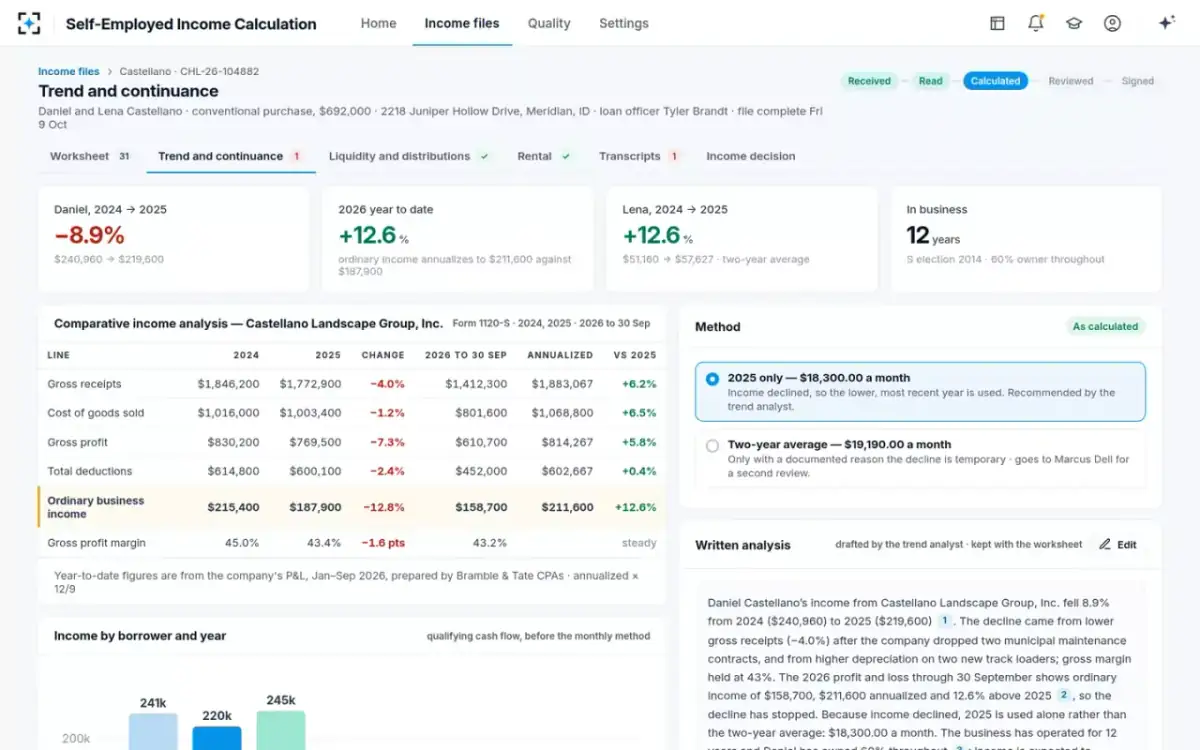
Take the sample file in the solution, on fictional borrowers. Daniel Castellano's income from his S corporation, his W-2 plus his 60% share of the business cash flow, was $240,960 in 2024 and $219,600 in 2025: down 8.9%. Under FHA's rule the answer is the lesser of $19,190.00 a month (the average) and $18,300.00 (2025 alone): $18,300.00. The decline is under 20%, so an FHA file would stay with the automated scorecard. The loan in the sample is conventional, and the sample lender's conventional policy reaches the same figure by a different route.
Daniel's two years, and the figure each method gives
Fannie Mae declining income guidelines: a trend, not a formula
Fannie's rule is a standard of judgement backed by a required analysis. For the business, the lender's written analysis must measure year-to-year trends in gross income, expenses and taxable income, and the share of gross income each takes, and "determine a trend for the business based on the change in these percentages over time" (B3-3.5-01). Form 1088 is Fannie's worksheet for exactly that comparison, and its instructions ask for the percentage change "covering at least a two-year period" (Form 1088). For the person, the Guide is blunt: "The lender should not include any income that does not appear to be stable or likely to continue" (B3-3.6-01).
For partnerships and S corporations Fannie goes further: the lender must confirm that business income is stable and consistent and that sales and earnings trends are positive, and "If the business does not meet these standards, business income cannot be used to qualify the borrower" (B3-3.7-01). Fannie's own Income Calculator turns this into a message: a declining trend on its comparative analysis tells the lender to make sure the file documents that the income has stabilized before using it (Income Calculator user guide).
What Fannie does not do is say which number to use once a decline is judged acceptable. Many lenders write FHA's lower-year arithmetic into their conventional credit policy; the sample lender in the solution does, with an option to average with a second reviewer's approval. That is a lender's choice, and it should be written down as one.
Declining self-employed income: the two rulebooks side by side
FHA (HUD Handbook 4000.1): The lesser of the two-year and one-year averages.
Fannie Mae (Selling Guide): Not specified; the lender’s written analysis decides, counting only stable income likely to continue.
FHA (HUD Handbook 4000.1): More than 20% decline over the analysis period.
Fannie Mae (Selling Guide): None; any decline needs analysis. S corporation and partnership income needs positive trends.
FHA (HUD Handbook 4000.1): Downgrade from the automated scorecard to manual underwriting.
Fannie Mae (Selling Guide): Documentation that the income has stabilized, or the income is excluded and the loan resubmitted.
FHA (HUD Handbook 4000.1): Required once more than a calendar quarter has passed since the last tax year.
Fannie Mae (Selling Guide): Optional; the lender may require one if the application is more than 120 days after the tax year ends.
FHA (HUD Handbook 4000.1): Stable after a 20% cut if caused by an extenuating circumstance, stable or rising for 12 months, and the borrower qualifies on the reduced income.
Fannie Mae (Selling Guide): A judgement in the written analysis, supported by the P&L and other documents.
Can I get an FHA loan if my business income dropped?
Yes, on the lower income, and with a manual underwrite if it fell more than 20%. The loan is sized on the lesser of the two averages, which after a drop is usually the latest year. If the drop was more than a fifth, a manual underwriter must find the business income stable now. HUD gives a specific path: "A Mortgagee may consider income as stable after a 20 percent reduction if the Mortgagee can document the reduction in income was the result of an extenuating circumstance, the Borrower can demonstrate the income has been stable or increasing for a minimum of 12 months, and the Borrower qualifies utilizing the reduced income" (HUD Handbook 4000.1, II.A.5).
Two conditions in that sentence do most of the work. The borrower qualifies on the reduced income, not the old one. And the 12 months of stability must be shown, usually by a year-to-date profit and loss statement and the returns. A temporary exception covered declines caused by the COVID-19 pandemic, with six months of stability and 80% recovery; it applies only to income lost to that event.
Manual underwriting for declining income: what the file must show
A manually underwritten FHA file with a decline must show three things: why income fell, that it has stopped falling, and that the borrower qualifies on what is left. On the manual side the Handbook says that when business income "shows a greater than 20 percent decline in Effective Income over the analysis period, the Mortgagee must document that the business income is now stable". The documents are the same ones the TOTAL path needs, plus the reasoning: two years of personal and business returns, a year-to-date profit and loss statement and balance sheet once more than a calendar quarter has passed, and an explanation of the cause.
What a declining-income file should hold, under either program
- The size of the decline
Effective income from the business, year on year, not gross receipts.
- The reason
Lost contracts, new equipment depreciation, an owner’s illness: say what and show it.
- The trend in the business
Receipts, expenses and taxable income by year, as on Form 1088.
- The year to date
A profit and loss statement, and a balance sheet unless the business is Schedule C only.
- The figure used, and why
Lesser of the averages for FHA; the lender’s written policy for conventional loans.
- That the borrower qualifies on it
DTI on the reduced income, not on the year that was better.
- Who decided
The underwriter’s signature, and a second review for any departure from policy.
What the year-to-date P&L can and cannot do
It can show that a decline has stopped; it cannot replace the returns. Fannie treats a profit and loss statement, audited or not, as support for "its determination of the stability or continuance of the borrower's income", optional for most businesses but available to the lender when the application is more than 120 days after the tax year (B3-3.7-04). FHA requires one once a calendar quarter has passed, and if the income used exceeds the two-year average of the returns, it must be an audited P&L or a signed quarterly tax return from the IRS (HUD Handbook 4000.1).
On the sample file, the company's profit and loss statement through 30 September 2026 annualizes to $211,600 of ordinary income, 12.6% above 2025, after a 12.8% fall in 2025 that the written analysis ties to two lost municipal contracts and depreciation on new equipment. That is evidence the decline has stopped. It is not a reason to use the higher 2024 figure, and the solution's trend analyst does not: it uses 2025 alone and drafts the analysis for the underwriter to edit. Choosing the average instead is an override that goes to a second reviewer.
The trend, the method and the drafted analysis on one screen
FHA self-employed income with less than 2 years
A short history is the other way FHA self-employed income gets cut. FHA counts self-employment of one to two years only if the borrower "was previously employed in the same line of work in which the Borrower is self-employed or in a related occupation for at least two years"; under one year it does not count (HUD Handbook 4000.1). Fannie Mae's version asks for a full 12 months on the latest returns and documented prior earnings at the same or a higher level in a similar field. Where both a short history and a decline appear, both rules apply, and the arithmetic of the worksheet is laid out in how to calculate self-employed income for a mortgage. Fannie's further rule on reduced pay also bites: if the lender learns the borrower is moving to a lower pay structure, it "must use the lower income amount in qualifying" (B3-3.1-01).
Questions people ask
Does FHA average two years of self-employment income?
Only when the average is the lower figure. FHA uses the lesser of the two-year average and the most recent year's average, so rising income is averaged and falling income is taken at the latest year.
Is the FHA 20 percent decline measured on gross receipts?
No. The Handbook measures the decline in effective income from the business over the analysis period. Sales can fall with profit steady, or profit can fall far more than sales; it is the income that counts.
Does Fannie Mae have a 20 percent rule?
No. Fannie Mae sets no percentage. It requires a written trend analysis, counts only stable income likely to continue, and for partnerships and S corporations requires positive sales and earnings trends before business income is used.
What if my income dropped and then recovered?
The returns still show the drop, so FHA's lesser-of rule still applies to them. A year-to-date profit and loss statement can show the recovery and support stability, but under FHA, income above the two-year average of the returns needs an audited P&L or a signed quarterly tax return from the IRS.
Can an underwriter use the two-year average on a conventional loan after a decline?
Fannie Mae's Guide does not forbid it, but the written analysis must show the income is stable and likely to continue. Many lenders' policies, including the sample lender's in Botminds' solution, require a second reviewer to approve that choice.