To calculate K-1 income for a mortgage, take the borrower's share of ordinary income and net rental income from the Schedule K-1 (Form 1065 for a partnership, Form 1120-S for an S corporation), adjust the business's cash flow for depreciation, one-time items and short-term debt at the borrower's ownership share, and then answer one question before counting any of it: could the borrower actually get the money? Under Fannie Mae's Selling Guide the answer is yes if the K-1 shows a steady history of cash distributions consistent with the income being used, or if the business has enough liquidity to pay it out, usually tested with a current ratio or quick ratio of one or greater. K-1 income is easy to overstate from a 1040 alone, because pass-through income is taxed whether or not it was paid. Botminds' Self-Employed Income Calculation runs the test as a separate agent, the liquidity and distributions checker. Below, the rules and one worked file.
The K-1 income test, step by step
Agent
Read the K-1Box 1 ordinary income, boxes 2 and 3 net rental income, guaranteed payments, and the distributions line, for each year and each business.
Agent
Compare with distributionsIf cash distributions show a stable history consistent with the income used, no liquidity test is needed.
Agent
Choose the ratioQuick ratio for a business that relies on inventory; current ratio otherwise.
Never: Never counts K-1 income that was neither distributed nor supported by liquidity.
Agent
Compute from Schedule LCurrent assets, inventory and current liabilities from the business return’s balance sheet, end-of-year column.
Agent
Separate short-term debtNotes payable within a year come off cash flow; renewing lines of credit are identified from the statements.
A person decides
UnderwriterAccepts the result, or documents an alternative liquidity rationale, and decides any credit line in doubt.
How is K-1 income calculated for a mortgage?
It is calculated from the business, then cut down to the borrower's share, then tested for access. Fannie Mae lets ordinary income, net rental real estate income and other net rental income from a K-1 into cash flow "provided the lender can confirm that the business has adequate liquidity to support the withdrawal of earnings", and adds guaranteed payments to a partner when there is a two-year history of receiving them (Selling Guide B3-3.6-07). The Guide begins the topic with a warning: the lender "must use caution when including income that the borrower draws from the borrower's partnership or S corporation as qualifying income".
The caution has history behind it. Research on the pre-2008 market found that income reported on mortgage applications stopped tracking IRS-reported income in the non-agency market between 2002 and 2005 (Mian and Sufi, NBER). Pass-through income is the easiest place for that gap to open, because the borrower pays tax on it in full whether or not the business ever paid it out.
When business returns are required, the business's own cash flow is adjusted first: depreciation, depletion, amortization and casualty losses added back; travel and meals exclusions, income that is not consistent and recurring, and obligations payable within a year subtracted. Only the borrower's proportionate share of the result counts (B3-3.7-02). The full set of rows is laid out in Form 1084, line by line.
Partnership, S corporation or LLC: which K-1, and which share?
The form follows the tax election, and the share follows the form. A partnership files Form 1065 and issues a Schedule K-1 (Form 1065); an S corporation files Form 1120-S and issues a K-1 (Form 1120-S); an LLC files either, depending on how it is taxed (B3-3.6-07). For a partnership the borrower's share is the "partnership percentage of Ending Capital" on the K-1 (B3-3.7-01); for an S corporation it is the percentage of stock ownership for the tax year (B3-3.7-02). A C corporation issues no K-1 at all, and its earnings can be used only if the borrower owns 100% of it (B3-3.7-03).
1065 against 1120-S: the K-1 income calculation side by side
| Partnership (Form 1065) | S corporation (Form 1120-S) | |
|---|---|---|
| Income on the K-1 | Box 1 ordinary income; boxes 2 and 3 net rental income | Box 1 ordinary income; boxes 2 and 3 net rental income |
| Extra lines | Guaranteed payments to the partner, with a two-year history | W-2 wages paid by the company, matched by employer number |
| Borrower’s share | Ending capital percentage on the K-1 | Stock ownership percentage for the year |
| Business add-backs | Depreciation (including Form 8825), depletion, amortization, casualty loss | The same |
| Business subtractions | Meals and travel exclusion; non-recurring income; notes payable within a year; income passed through from other partnerships unless documented | Meals and travel exclusion; non-recurring income; notes payable within a year |
| Access to the cash | Distributions consistent with the income, or liquidity | The same |
What if K-1 distributions are less than income?
Then the lender must prove the business could have paid it. Fannie's rule turns on one sentence: if the K-1 "reflects a documented, stable history of receiving cash distributions of income from the business consistent with the level of business income being used to qualify, then no further documentation of access to the income or adequate business liquidity is required. But if the Schedule K-1 does not reflect a documented, stable history, then the lender must confirm adequate business liquidity" (B3-3.6-07).
"Consistent with the level of business income being used" is the phrase to read slowly. A borrower who was allocated $112,740 and received $96,000 has a stable history of distributions, but not at the level of the income being used. The lender can qualify on the distributions alone, or test liquidity and use the full share. What it cannot do is use the full share without either.
Daniel's K-1 income against what was actually distributed
What is the business liquidity test? Fannie Mae's quick ratio and current ratio
It is a check that the business holds enough current assets to cover its current liabilities after the owner takes the income out. Fannie leaves the method to the lender, as long as it is "a generally accepted formula that measures business liquidity by deriving the proportion of current assets available to meet current liabilities", and names two. The quick ratio, or acid test, is meant for "businesses that rely heavily on inventory to generate income", because it leaves the inventory out; the current ratio, or working capital ratio, suits businesses that do not (B3-3.6-07).
The two liquidity ratios, and the line between pass and fail
Current ratio
current assets ÷ current liabilities
For a business that does not rely on inventory: services, construction, professional practices.
Schedule L, end of year
Quick ratio
(current assets − inventory) ÷ current liabilities
For a business that relies heavily on inventory: retail, distribution, manufacturing.
Schedule L, end of year
Generally sufficient
a result of 1.00 or greater
Below one, the lender may still support liquidity by another method with a documented rationale.
Fannie Mae B3-3.6-07
Short-term debt
− notes and mortgages payable within a year × ownership share
Taken off cash flow; not required for lines of credit or debts shown to roll over regularly.
Fannie Mae B3-3.7-02
The threshold sentence is permissive on purpose: "While a result of one or greater is generally sufficient to confirm adequate business liquidity to support the withdrawal of earnings, lenders may support adequate liquidity using alternative methods with a documented rationale" (B3-3.6-07). A business with a ratio of 0.9 and a large undrawn credit line, or a seasonal business tested at its low point, may still pass on a written argument. That argument is the underwriter's to make, not a formula's.
Quick ratio vs current ratio for a mortgage: which one applies?
The one that matches how the business makes money. Daniel's company, Castellano Landscape Group, sells landscaping services; inventory is a small part of its current assets, so the current ratio fits. From the 2025 Schedule L, end of year: $412,600 of current assets (cash $168,300, receivables $201,900, inventory $22,600, other $19,800) against $298,300 of current liabilities. Current ratio 1.38. Even on the quick ratio, which drops the $22,600 of inventory, it would be 1.31. Both clear 1.00, so his full 60% share of the K-1 income can count.
The choice matters more for a distributor or a retailer, where inventory can be half of current assets. A shop with $500,000 of current assets, $300,000 of it stock, and $350,000 of current liabilities has a current ratio of 1.43 and a quick ratio of 0.57. On the quick ratio, which suits it, it fails, and the lender needs distributions or another rationale.
Liquidity and distributions on the sample file
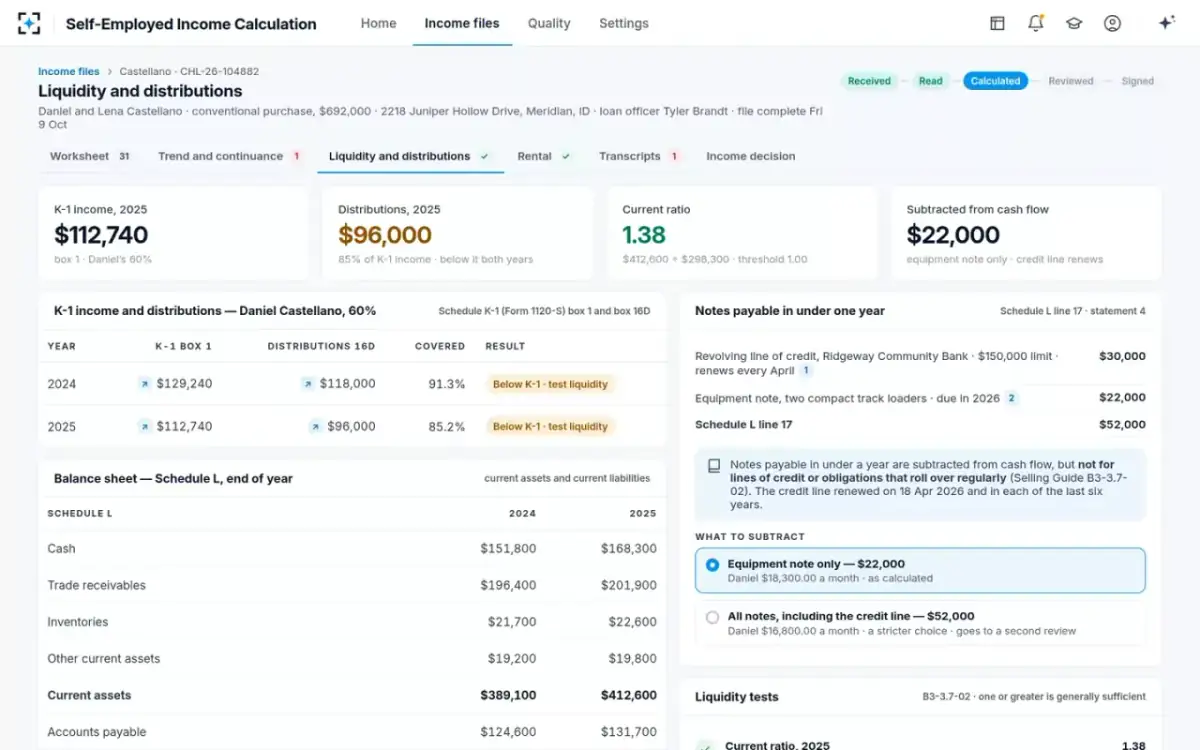
Notes payable in less than 1 year: what Fannie Mae takes off, and what it does not
Mortgages, notes and bonds payable within a year are subtracted from business cash flow, at the borrower's share, unless they are lines of credit or roll over. Fannie's S corporation and partnership sections list "the total amount of obligations on mortgages, notes, or bonds that are payable in less than one year" among the subtractions, then add: "These adjustments are not required for lines of credit or if there is evidence that these obligations roll over regularly and/or the business has sufficient liquid assets to cover them" (B3-3.7-02). Form 1084 points to Schedule L, end-of-year column, for the amount (Form 1084 instructions).
On the sample file, Schedule L line 17 shows $52,000. The company's statement 4 splits it: a $30,000 revolving line with Ridgeway Community Bank, on a $150,000 limit, renewed every April for six years; and $22,000 due this year on an equipment note for two compact track loaders. Only the $22,000 is subtracted: at 60% that is $1,100 a month off Daniel's income. Subtracting the credit line too would take another $1,500 a month, bringing him from $18,300.00 to $16,800.00. The sample lender's own stricter rule set for its Form 91 comparison subtracts credit lines unless the bank's renewal letter is in the file, so the solution shows both figures and offers to ask the processor for the letter.
K-1 income and short-term debt: Fannie Mae against FHA
Fannie Mae: Distributions consistent with the income used, or business liquidity; ratio of one or greater generally sufficient.
FHA: Not written as a distributions test; the Handbook warns that cash withdrawals may harm the business.
Fannie Mae: Subtracted at the borrower’s share, except lines of credit and debts that roll over regularly.
FHA: The borrower’s income “must be reduced proportionately” by obligations payable within a year; no credit-line exception is written.
Fannie Mae: Depreciation, depletion, amortization, casualty losses, other non-recurring losses.
FHA: Depreciation, depletion, amortization and non-recurring casualty losses, in proportion to ownership.
Fannie Mae: A trend judgement; S corporation and partnership income needs positive sales and earnings trends.
FHA: The lesser of the two-year and one-year averages.
The FHA text is short and strict: for an S corporation and a partnership alike, "The Borrower's income must be reduced proportionately by the total obligations payable by the corporation in less than one year" (HUD Handbook 4000.1, Appendix 2.0). A lender that applies Fannie's credit-line exception to an FHA file is applying a rule HUD did not write. How FHA's averaging differs is covered in FHA's decline rule against Fannie's trend test.
Do I need business tax returns with a K-1?
Usually yes, two years of them, unless the waiver applies. Fannie's documentation for K-1 income is one or two years of signed personal returns with the K-1s, plus "the most recent two years of business federal income tax returns (IRS Form 1065 or IRS Form 1120S), unless the requirements to waive business tax returns have been met", or one year in the cases the Guide allows (B3-3.6-07). The waiver needs personal funds for the down payment and reserves, five years in the same business and rising self-employment income on two years of personal returns (B3-3.5-01). Without the business return there is no Schedule L, and without Schedule L there is no liquidity ratio, so a borrower whose distributions fall short usually needs the business return anyway.
Business returns are also transcripted separately. Because only one tax form can be requested on each IRS Form 4506-C, a borrower who supplies personal and business returns signs one form for the 1040 and another for the 1065 or 1120-S (B3-3.1-02). What happens when those transcripts disagree with the returns is the subject of return against transcript.
Daniel's K-1, worked from the return to the month
Here is the whole calculation on the fictional sample file. The company's 2025 ordinary income on the 1120-S was $187,900. The business cash flow adds back $71,800 of depreciation and $4,200 of amortization, and takes off an $18,500 one-time gain on equipment, the $22,000 equipment note due within the year and $7,400 of travel and meals excluded on Schedule M-1: $216,000. Daniel's 60% is $129,600. His $90,000 W-2 from the company is added: $219,600 for 2025, against $240,960 for 2024.
Distributions of $96,000 did not cover his $112,740 K-1 income, so the ratio decides; at 1.38 it passes. Because his income declined 8.9%, the sample lender's policy uses 2025 alone: $18,300.00 a month. Every one of those figures links to its line on the 1120-S, the K-1 or Schedule L in Botminds' Self-Employed Income Calculation, and the underwriter signs it.
Questions people ask
Does a K-1 loss reduce my qualifying income?
Yes. Form 1084 records ordinary income or loss from the K-1 with its sign, so a loss from a partnership or S corporation lowers the cash flow, after the business's own add-backs are applied at the borrower's share.
What counts as a stable history of distributions?
Fannie Mae does not set a percentage; it asks for distributions consistent with the level of income being used. Two years of distributions at or near the K-1 income meet it plainly; distributions well below the income mean qualifying on the distributions or testing liquidity.
Where do I find current assets and current liabilities?
On Schedule L of the business return, end-of-year column, or on a current balance sheet. Form 1084's instructions also use Schedule L, end of year, for notes payable within a year.
What if the liquidity ratio is below one?
The K-1 income above the distributions is not supported by the ratio. Fannie Mae allows an alternative method with a documented rationale, such as recent business bank statements showing cash well above the withdrawals; otherwise the lender qualifies on the distributions actually received.
Are guaranteed payments to a partner counted?
Yes, when the borrower has a two-year history of receiving them. They are added to cash flow on the partnership rows of Form 1084 alongside the partner's share of ordinary income.