To calculate self-employed income for a mortgage, a lender starts from the net profit or ordinary income on the tax returns, not from gross receipts. It adds back expenses that did not use cash, such as depreciation; subtracts income that will not recur and, for a business, obligations falling due within a year; applies the borrower's ownership share; then averages two years of results, or uses the lower recent year when income is falling, and divides by 12. Each of those moves is set by the program: the Fannie Mae Selling Guide for conventional loans, HUD Handbook 4000.1 for FHA. It is slow by hand because each figure sits on a different schedule of a different return, and an error in one line changes the debt-to-income ratio. Botminds' Self-Employed Income Calculation, a set of agents for mortgage underwriters, does this arithmetic with every figure linked to its return line. Below, two dollars are followed from the return to the ratio.
Self-employed qualifying income, written as a sum
What the return reports
Schedule C net profit, or K-1 ordinary income and W-2 wages from the business
The starting point is the bottom line, not gross receipts.
From the return
Non-cash expenses back
+ depreciation, depletion, amortization, business use of home, casualty loss
Deducted for tax, but no cash left the business that year.
Listed by program
What will not recur
− one-time gains and other income; + one-time losses
An equipment sale or an insurance payout is not income the borrower can count on.
Lender’s judgement, in writing
Cash the business still owes
− meals exclusion; − notes payable within a year (business returns)
Lines of credit that roll over regularly are an exception under Fannie Mae.
Listed by program
How do lenders calculate self-employed income?
Lenders rebuild cash flow from the returns, business by business, then decide how much of it will continue. Fannie Mae describes the whole exercise in one sentence: the point of a self-employment cash flow analysis is "to determine the amount of income that can be relied on by the borrower in qualifying for their personal mortgage obligation" (Selling Guide B3-3.5-01). It warns that business income on a personal 1040, particularly from a partnership or S corporation, "may not necessarily represent income that has actually been distributed to the borrower".
The legal floor is the ability-to-repay rule. A lender must verify the income it relies on with reliable third-party records, and the rule names an IRS tax-return transcript as one (12 CFR 1026.43(c)(4)). For a business owner the main third-party record is the tax return, checked against the IRS's transcript of it. Everything else on this page is how the agencies say to read that return.
A large population, and the income line examiners flag most
30.4M
nonemployer businesses in the United States in 2023, with $1.8 trillion in receipts
U.S. Census Bureau
22.17%
of material findings in FHA’s FY2022 loan reviews were about borrower income, the largest area
HUD Quality Assurance Division
25%
ownership share at which Fannie Mae and FHA treat a borrower as self-employed
Who counts as self-employed for a mortgage, and how many years of tax returns do you need?
Anyone who owns 25% or more of a business is self-employed for a mortgage, and two years of returns is the norm. Fannie Mae "generally requires lenders to obtain a two-year history of the borrower's prior earnings". A shorter history can work if the latest signed returns show a full 12 months from the current business and the borrower previously earned as much in the same field (B3-3.5-01). FHA allows one to two years of self-employment only if the borrower worked at least two years before that in the same or a related line of work (HUD Handbook 4000.1).
Fewer returns are sometimes enough. Fannie accepts one year of personal and business returns when the business has existed for five years and the borrower has owned at least 25% of it for all five. It waives business returns when the borrower uses personal funds for the down payment and reserves, has been self-employed in the same business for five years, and shows rising self-employment income on two years of personal returns. FHA's waiver of business returns needs rising self-employment income, no closing funds from business accounts, and a loan that is not a cash-out refinance. The worksheet rows these returns feed are mapped in Form 1084 cash flow analysis, line by line.
Schedule C income calculation for a mortgage, worked
A sole proprietor's dollar is the simplest to follow. Take the sample file that ships with the solution, on fictional borrowers: Lena Castellano runs a photography business she started in 2019 and reports it on Schedule C. Her net profit on line 31 was $41,200 in 2024 and $46,800 in 2025. That figure has already lost every deduction the tax code allows, and some of those deductions were not cash.
Fannie's rule for Schedule C is short. Non-recurring income must be deducted, "including any exclusion for meals and entertainment expenses", and "depreciation, depletion, business use of a home, amortization, and casualty losses must be added back" (B3-3.6-03). Lena's 2025 return shows $6,100 of depreciation on her cameras and lenses (line 13), $4,100 for business use of her home (line 30) and 6,900 business miles on the standard mileage rate. Form 1084's instructions let the depreciation inside the mileage rate be added back by multiplying the miles by that year's depreciation factor; at the sample file's $0.33 a mile it is $2,277 (Form 1084 instructions, line 3d). Her deductible meals of $1,650 come off, because the same amount was excluded for tax and was still spent.
Lena Castellano's Schedule C, from net profit to monthly income
| Line | 2024 | 2025 | Rule |
|---|---|---|---|
| Net profit, line 31 | $41,200 | $46,800 | Starting point |
| + Depreciation, line 13 | $5,600 | $6,100 | Added back: no cash spent that year |
| + Business use of home, line 30 | $3,900 | $4,100 | Added back |
| + Mileage depreciation | $1,860 | $2,277 | Business miles × depreciation factor |
| − Meals exclusion | −$1,400 | −$1,650 | Spent, but excluded for tax |
| Cash flow for the year | $51,160 | $57,627 | Up 12.6% |
| Monthly, two-year average | $4,532.79 | ($51,160 + $57,627) ÷ 24 |
What one of Lena's 2025 cash-flow dollars is made of, before the meals exclusion
Lena, 2025
- Net profit · 79%
- Depreciation · 10%
- Home office and mileage · 11%
What can be added back to self-employed income for a mortgage? Is depreciation added back?
Yes, depreciation is added back under both Fannie Mae and FHA, along with depletion, amortization and casualty losses. The lists differ at the edges. Fannie adds back business use of home as a single line and subtracts the meals and entertainment exclusion; FHA lists the items within business use of home that may be added back (mortgage interest, mortgage insurance, real estate taxes, property insurance) and treats capital gains as one-time unless three years of returns show a steady pattern (HUD Handbook 4000.1, Appendix 2.0).
Common add-backs and subtractions, Fannie Mae against FHA
| Item | Fannie Mae | FHA |
|---|---|---|
| Depreciation, depletion | Added back | Added back |
| Amortization, casualty loss | Added back | Added back (non-recurring casualty) |
| Business use of home | Added back | Interest, mortgage insurance, taxes and insurance added back |
| Mileage depreciation | Added back: miles × depreciation factor | Not separately listed |
| Meals and entertainment exclusion | Subtracted | Not separately listed |
| One-time gains and other income | Subtracted unless recurring | Capital gains excluded unless a three-year pattern |
| Notes payable within a year | Subtracted, except lines of credit or debts that roll over | Subtracted proportionately |
| Corporate net operating loss | Added back (Form 1120) | Not separately listed |
Do lenders use gross or net self-employment income?
Net, then adjusted. The starting figure is the business's profit after expenses, never gross receipts. The confusion comes from FHA's wording: HUD tells lenders to calculate "gross Self-Employment Income", but it means the borrower's income from the business after the return has been analysed and the allowed items added back, not the business's sales (HUD Handbook 4000.1). Gross receipts matter in a different place, the trend analysis, where a lender compares sales, expenses and taxable income year on year to judge whether the business is viable.
What if my self-employed income went down?
Then the method depends on the program, and the answer usually gets smaller. FHA writes a formula: the lender must use the lesser of the two-year average and the most recent year, and a decline of more than 20% over the analysis period forces a manual underwrite. Fannie writes a standard rather than a formula: the lender "should focus on earnings trends and the actual sources of the income, not just on the total amount", and should not include income that does not appear stable or likely to continue (B3-3.6-01). For partnerships and S corporations it adds that business income cannot be used unless its sales and earnings trends are positive (B3-3.7-02).
In practice many lenders write the FHA arithmetic into their conventional policy as well. The sample lender's setting uses the most recent year alone when it is lower. Why the same two years produce two answers under the two programs, and what the year-to-date profit and loss statement can show, is set out in FHA self-employed income decline against Fannie's trend test.
S corporation and K-1 income: the extra tests
A business owner's second dollar takes two more steps: ownership share and access to the cash. Daniel Castellano owns 60% of Castellano Landscape Group, an S corporation. His income has two parts: the $90,000 W-2 the company paid him in 2025, and 60% of the company's adjusted cash flow. On the 2025 return, ordinary income of $187,900, less an $18,500 one-time gain on equipment, plus $71,800 of depreciation and $4,200 of amortization, less a $22,000 equipment note due within the year and $7,400 of travel and meals exclusion, gives $216,000 of business cash flow. Sixty percent is $129,600. With the W-2, $219,600 for the year.
The share is only countable if the cash could reach him. Fannie allows K-1 income only with documentation that it "was actually distributed to the borrower consistent with the level of business income", or that the business "has adequate liquidity to support the withdrawal of earnings" (B3-3.7-01). Daniel's distributions covered 85% of his 2025 K-1 income, so the solution ran the liquidity test. The test, the ratios and the treatment of credit lines are worked in how to calculate K-1 income for a mortgage.
The worksheet with every figure tied to its line
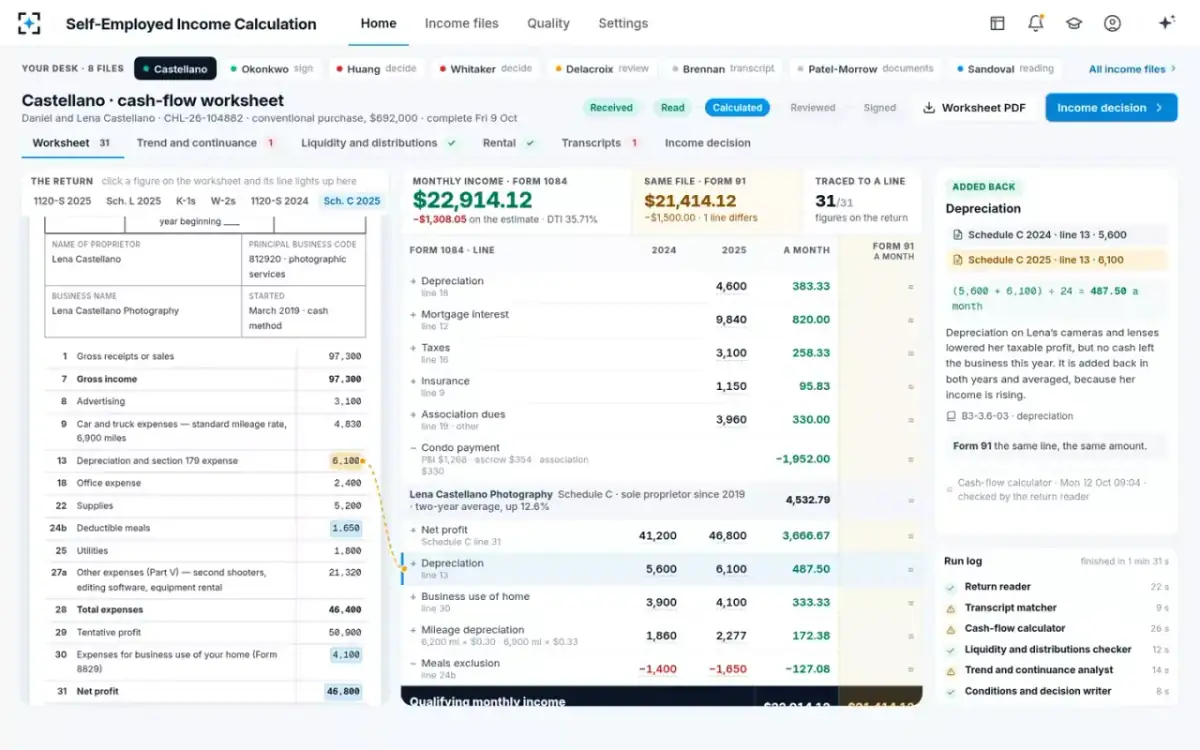
From a yearly figure to a monthly qualifying income and DTI
The last steps are division and a ratio, and they are where a small slip shows. Daniel's income fell 8.9% from 2024, so under the sample lender's policy 2025 is used alone: $219,600 ÷ 12 = $18,300.00 a month. Lena's rose, so her two years are averaged: $4,532.79. The condo's Schedule E adds $81.33 after its payment. The qualifying income is $22,914.12 a month.
The loan officer's quick estimate at application, a two-year average with no adjustments, was $24,222.17, so the worksheet comes in $1,308.05 lower, 5.4%. Debt-to-income moves from 33.78% to 35.71%. That is inside Fannie Mae's limit of 50% for loans underwritten through Desktop Underwriter (36%, or up to 45% with compensating credit score and reserves, when manually underwritten), but the loan must be resubmitted at the new income (B3-6-02). On a tighter file, the same 5.4% would decide it.
Where self-employed income calculations go wrong
They go wrong in the same few places, and the agency findings name them. HUD's quality assurance examples for FHA include self-employment income not averaged over the previous two years, borrowers with under two years of self-employment and no qualifying prior history, and self-employment losses that were never subtracted from qualifying income (HUD, 2023). The fictional sample lender's worksheets in Botminds' solution changed a figure most often for one-time income taken out, declining years and notes payable.
Eight checks before you sign a self-employed income figure
- Start from the bottom line
Net profit or ordinary income, never gross receipts or deposits.
- Add back only listed items
Depreciation, depletion, amortization, business use of home, casualty loss, mileage depreciation where allowed.
- Take out what will not recur
Gains on equipment or property sales, insurance proceeds, other income that has not repeated.
- Subtract losses
A self-employment loss on the returns reduces cash flow; HUD lists unsubtracted losses among its FHA findings.
- Apply the ownership share
K-1 percentage for an S corporation, ending capital for a partnership; corporate earnings only at 100%.
- Test access to K-1 income
Distributions consistent with the income, or a liquidity ratio of one or greater.
- Decide the trend in writing
Average, lower year or stabilized income: state which, and why, for each business.
- Match the transcripts
Every year used should agree with the IRS, or carry proof of filing and a condition.
Questions people ask
How many years of tax returns do I need for a mortgage if I'm self-employed?
Usually two years of personal and business returns. Fannie Mae accepts one year when the business has existed for five years and you have owned at least 25% of it for all five, and FHA can consider one to two years of self-employment if you worked two years before that in the same or a related line of work.
Is depreciation added back for a mortgage?
Yes. Fannie Mae and FHA both add back depreciation because it reduces taxable profit without using cash that year. For a partnership or S corporation only the borrower's ownership share of the business's depreciation is added.
Do lenders use my tax return income or my bank deposits?
For agency loans, the tax returns. Fannie Mae and FHA build qualifying income from the returns and verify it against IRS transcripts; bank statements and a year-to-date profit and loss statement support the trend but do not replace the returns.
How is a Schedule C loss treated?
As a negative figure. Form 1084 carries a Schedule C or K-1 loss into the cash flow with its sign, so it lowers the total. On FHA loans the point is sharper: HUD lists self-employment losses that were not subtracted from qualifying income among its common review findings.
Can a lender use my year-to-date profit and loss statement instead of last year's return?
Not instead of it. Fannie Mae uses a year-to-date P&L to support stability or continuance and may ask for one when the application is more than 120 days after the tax year ended. FHA requires a P&L once more than a calendar quarter has passed, and if income used exceeds the two-year average of returns, an audited P&L or signed quarterly tax return.
How long does the calculation take?
By hand, long enough that files queue for it. On the fictional sample file in Botminds' Self-Employed Income Calculation, six agents filled the 19-line worksheet from 42 pages in 91 seconds; the underwriter's reading and signature come after.