The SBA loan closing process turns on one seat: the closer, the person at an SBA lender who makes sure a 7(a) loan closes exactly as approved: the note, guaranties, liens, insurance, equity injection, settlement sheet and agent fee forms each match the approved SBA terms, and every condition is met before or at disbursement. The duties are unusual because SBA writes most of them. SOP 50 10 8.1 says the lender "must close the loan in accordance with the provisions of the SBA Terms and Conditions", and a closing gap that nobody catches can cost the lender its guaranty years later, when SBA reads the file after a default. The work is hard because one closing runs to dozens of signed documents prepared by other people. Botminds' SBA Loan Closing Review exists for that reading: six agents compare every approved term with the signed package and hold funding on anything that does not tie, so the closer spends the week resolving gaps instead of finding them.
The examples come from a fictional sample lender as it runs through the solution: Danielle Osei, an SBA closer, closing a $2,148,400 acquisition loan for Bell Comfort Holdings LLC. The rules and research figures come from SBA, its Inspector General and the Bureau of Labor Statistics, linked where they appear.
Most SBA lenders close a 7(a) loan only a few times a year
1,336
lenders made at least one 7(a) loan in fiscal 2025
711
of them made five or fewer, so the closer also processes, books and services
0
O*NET loan-officer task statements that mention SBA or small business
What does an SBA loan closer do?
An SBA loan closer assembles and checks the closing package of an SBA-guaranteed loan, then holds the money until every approved term is met. In practice that means reading the approved terms and the credit memo, ordering what the deal needs (lien searches, filings, insurance certificates, the standby agreement, the settlement statement), checking what comes back from closing counsel, chasing what is missing, and preparing the release instruction once the checklist is signed.
The federal statistics do not see the role. There is no SBA occupation code, and the O*NET task statements for loan officers are generic: "Review loan agreements to ensure that they are complete and accurate according to policy" is the closest line, and it says nothing about SBA. BLS describes loan interviewers and clerks as the people who "prepare the documents that go to the appraiser and are issued at the closing of a loan" (BLS, Financial Clerks). An SBA closer does that and something more: the closer is the last person who can stop a loan that does not match its approval.
The lender's size changes the seat. In fiscal 2025 the ten largest 7(a) lenders made half of all loans, by our count of SBA's own loan file (SBA 7(a) FOIA data), while most of the rest closed a handful. At a high-volume lender the closer is a specialist on a closing team. At most lenders the same person also processes, books and services, and closes an SBA loan a few times a year.
The duties SBA writes into the job
SBA does not publish a list of closing duties, but its closing chapter reads like one. Section B, Chapter 6 of SOP 50 10 8.1, in force since 1 October 2026, lists what a lender must do between approval and disbursement on every 7(a) loan, and the same requirements apply whether the loan was approved under delegated authority or by SBA: "SBA closing requirements are the same for loans guaranteed through delegated PLP processing as for non-delegated loans" (SOP 50 10 8.1).
The SBA loan closer's duties, as SOP 50 10 8.1 writes them
| Duty | What the SOP requires | When |
|---|---|---|
| Close to the approved terms | Close "in accordance with the provisions of the SBA Terms and Conditions, including any SBA-approved post-approval modifications." | At closing |
| Collateral and conditions | Obtain all required collateral and meet all other required terms "before or at the time of disbursement", with valid security interests and proof of the lien filings. | Before the first dollar |
| Equity injection | Verify the required injection before any proceeds are disbursed: the wire or check, the source account statement, and the deposit or settlement statement. | Before the first dollar |
| Tax verification | Obtain IRS transcripts and reconcile them with the financial data the loan was underwritten on. | Before the first dollar |
| Borrower certifications | Collect the certifications, including that there has been no adverse change since the application was signed. | Before the first dollar |
| Settlement sheet | Lender and borrower complete and sign SBA Form 1050 or an equivalent, with proof of each payee, date, amount and purpose. | At first disbursement |
| Agent fees | A Form 159, signed by applicant, agent and lender, for every paid agent; uploaded within two monthly 1502 reporting cycles. | After first disbursement |
| Changes | Report changes to the terms in place when the loan number was issued within 15 business days of final disbursement. | After final disbursement |
| Licences | Obtain evidence of every licence the business needs within 90 days of final disbursement. | After final disbursement |
Two things stand out in that list. First, almost every duty has a clock, and most of the clocks run out before the first dollar moves. Second, the closer seldom produces the evidence. The equity injection proof comes from the buyers' banks, the lien filing from closing counsel, the insurance from an agent, the transcripts from the IRS. The closer's job is to know what each piece must say and to notice when it says something else. The closing thresholds, from $2,500 to 48 months, sets out each number the closer has to hold in mind.
Who attends an SBA loan closing? The six seats
Six seats sit around the closer at an SBA closing, and each one owns part of what the closer must check: the loan officer who sold the deal, the credit officer who approved it, closing counsel, the title, lien-search and insurance agents, the borrower with its owners and guarantors, and, on an acquisition, the seller. Only some of them come to a signing table; all of them produce documents the closing depends on.
Six seats and the closer: who holds which part of an SBA closing
Today
Reads every approved term against a 40-document package by hand in the days before funding, and is the last person who can catch a mismatch.
With agents
Opens the package with each term already tied to its document or hanging loose, and spends the week resolving the loose ones.
Still theirs: Every resolution, every fix request, the submission of the checklist.
Today
Hears about a closing problem when the borrower calls to ask why funding moved.
With agents
Sees the open exceptions and who owns each one, so the call to the borrower comes before the borrower calls.
Still theirs: The relationship and the timing conversation.
Today
Learns that the owners or the structure changed after approval, often from the signed documents.
With agents
Gets each change to approved terms with both versions quoted, and decides before funding.
Still theirs: Every approval of a change to the credit.
Today
Drafts the note, guaranties and lien instruments, runs the signing, and gets fix requests in prose.
With agents
Gets the exact fix: the approved wording, the signed wording and the page.
Still theirs: Drafting, filing and recording.
Today
Send certificates and search results that someone reads for the right names and loss payees.
With agents
Their documents are read against the approved collateral and insurance terms on arrival.
Still theirs: The coverage and the searches themselves.
Today
Sign 30 or 40 documents in one sitting and supply the injection proof.
With agents
Receive a short list of exactly what is missing and why.
Still theirs: Their certifications and their money.
Today
Signs the purchase agreement and, often, a seller note on standby.
With agents
Is asked for a corrected note only if its terms differ from the approval.
Still theirs: The sale.
The seat that changes least is the one that decides. The credit officer still approves any change to the credit, closing counsel still drafts and files, and the closing manager still signs. What moves is the reading: in the sample closing, Priya Raman, the credit officer, learned that a third owner had appeared in the signed operating agreement on Monday morning, three days before funding, with the 60/40 split she approved and the 55/25/20 split that was signed shown side by side.
What does the closing attorney do on an SBA loan?
Closing counsel drafts and negotiates the loan documents, runs the signing, and files and records the liens; the closer checks that what counsel produced matches the approval. SBA leaves the choice of forms to the lender, the note and guaranty may be SBA Forms 147 and 148 or the lender's own, but it fixes some of the words. Every lien instrument, "including mortgages, deeds of trust, and security agreements", must carry SBA's federal-law paragraph, and a lender's own note must state that "When SBA is the holder, this Note will be interpreted and enforced under Federal law" (SOP 50 10 8.1).
Two other SOP lines bear on counsel. Legal fees charged to the borrower must be "charged on an hourly basis", and an attorney acting "in connection with the SBA Loan closing" is not an Agent for Form 159 purposes, so counsel's fee does not need the form that a packager's does. That is why, in the sample closing, the $3,850 legal fee on the settlement statement raised nothing, while a $12,500 "loan packaging fee" to an advisory firm with no Form 159 was one of six exceptions.
"The Lender must obtain all required collateral and must meet all other required terms and conditions as applicable before or at the time of disbursement."
SBA SOP 50 10 8.1, Section B, Chapter 6
Where the closer's hours go
Most of a closer's hours go to reading, not deciding. Our estimate for one SBA 7(a) acquisition closing puts about 21 hours of work on the closer's desk, and more than half of it is listing the approved terms and reading the signed package against them. The judgement, deciding what a difference means and who must fix it, takes a fraction of the time and cannot be delegated.
Where an SBA closer's hours go on one acquisition closing, by hand and with agents
By hand · about 21 hours
- Listing the approved terms · 3 h · 14%
- Reading the package against them · 8 h · 38%
- Tracing the injection · 3 h · 14%
- Proceeds · 2 h · 10%
- Fixes and re-checks · 4 h · 19%
- Sign-off · 1 h · 5%
With agents · about 4.5 hours
- Listing terms · 0.5 h · 11%
- Reading the package · 0.5 h · 11%
- Injection · 0.5 h · 11%
- Proceeds · 0.5 h · 11%
- Fixes and re-checks · 2 h · 45%
- Sign-off · 0.5 h · 11%
The bar that barely shrinks is the one that matters. Fix requests and re-checks still take two hours, because a corrected seller note or a new lien filing has to be requested, received and read again. The hours that disappear are the ones in which a closer is most likely to miss something: the eighth hour of reading one package against another.
What must be done before SBA loan disbursement?
Before an SBA 7(a) loan disburses, the lender must have every required lien, every condition in the approved terms, verified equity, reconciled tax transcripts and the borrower's certifications in hand. SBA puts the deadline for each at the first dollar, not at final disbursement, so a closing that funds in stages still has to clear these items before the first draw.
The pre-disbursement list every SBA closer works to
- Approved terms and post-approval changes in hand
The current SBA terms, with any change that needed SBA approval approved, not merely requested.
- Liens filed under the right name and in the right position
Proof of each filing in the loan file, and a search that finds it under the debtor's registered name.
- Equity injection verified from three documents
The wire or check, the source account statement covering at least 30 days, and the deposit or settlement statement.
- IRS transcripts received and reconciled
Against the returns and statements credit relied on; no disbursement if the IRS has no record and the exceptions do not apply.
- Standby agreement and the note it covers
Form 155 or an equivalent, with a copy of the note attached, and no payments of principal or interest during the loan.
- Hazard, flood and life insurance as approved
Loss payee or mortgagee clause in the lender's favour; any life policy assigned and acknowledged by the insurer's home office.
- Borrower certifications signed
Including no adverse change since the application, taxes current, and no change of ownership without the lender's consent.
- Settlement sheet and Form 159s ready
Every payee, amount and purpose; one Form 159 for each paid agent.
What changes when the agents read the package first
With SBA Loan Closing Review, the closer's Monday starts with the comparison already done. In the sample closing, all 38 signed documents came back from closing counsel on Friday evening. When Danielle pressed one button on Monday at 09:06, six agents listed the 214 approved terms, read the 38 documents page by page and drew a line from each term to the document that satisfies it. One minute and 27 seconds later, 208 terms were tied and six hung loose, and funding was held.
The closer's Monday: every approved term tied or hanging loose
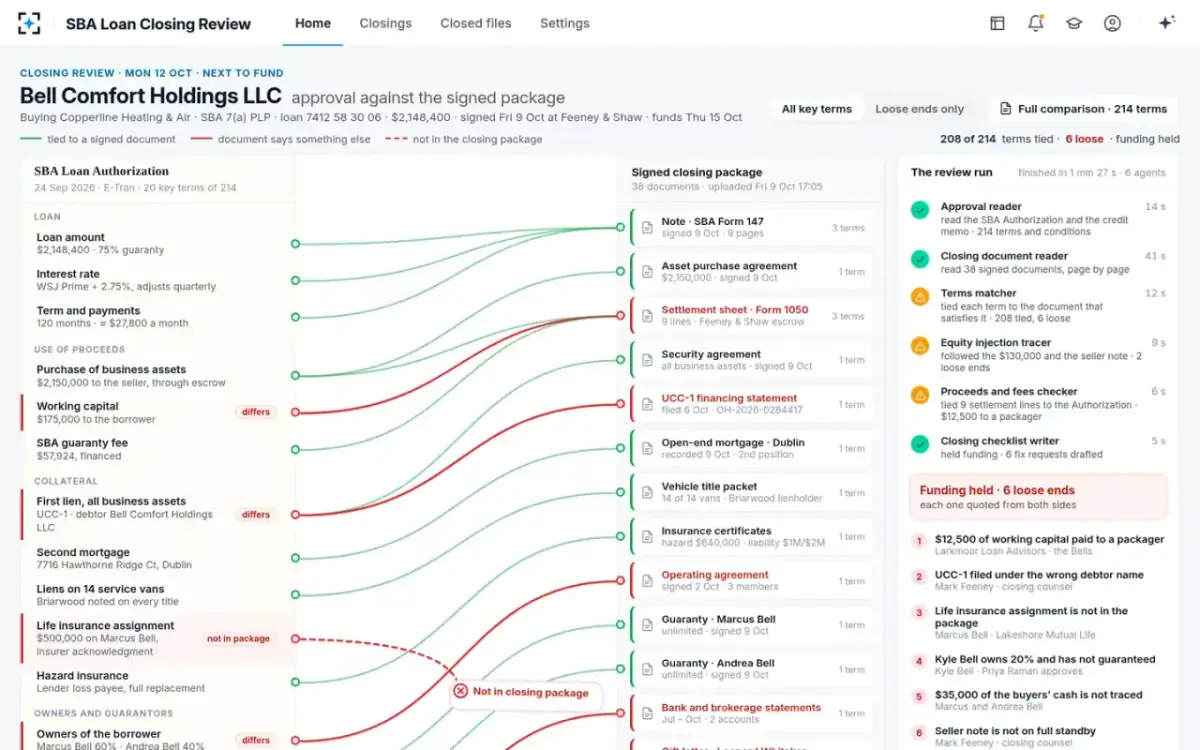
What the agents do not do is as much a part of the closing process as what they do. They never decide which version of a term is right, never waive a mismatch, never fill a blank or edit a signed document, never move money, and never sign. The six loose ends in the sample closing went to six different people: Marcus Bell and his insurer for a missing life insurance assignment, closing counsel for an amended seller note and a new lien filing, the buyers for proof of a gift, a third owner for his guaranty package, and an advisory firm for its Form 159. Danielle sent the six requests the same morning.
Six exceptions, six owners: the closer's work once the reading is done
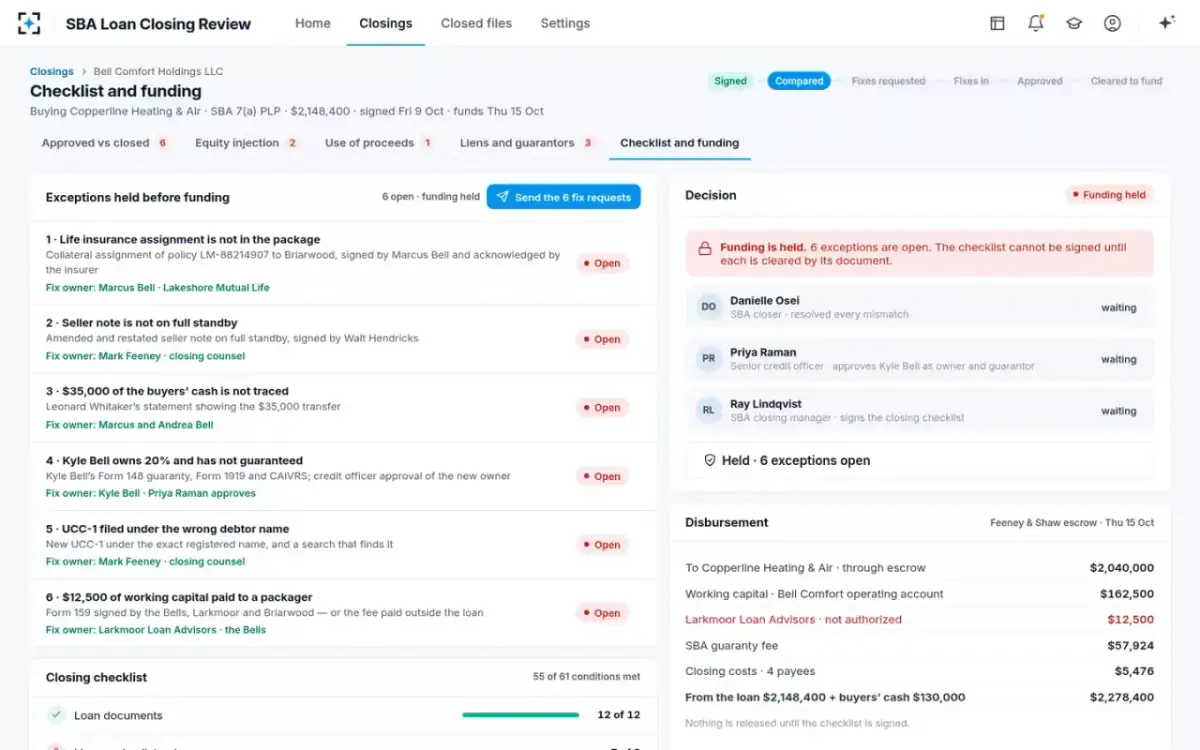
The closing manager's seat changes too. Ray Lindqvist, the sample lender's SBA closing and servicing manager, signs only when every term ties, and the signed comparison stays with the closed file for the day an SBA reviewer reads it. Why the person who built the package should not be its only checker takes up that division of labour.
Closer, closing manager, closing specialist: one seat, many titles
Lenders staff this work under at least five titles: SBA loan closer, closing specialist, closing officer, closing manager and loan documentation specialist. SBA's own vocabulary does not settle it. The SOP names the "Lender", the "Agent", the "Packager" and the "Lender Service Provider", an Agent who "carries out Lender functions in originating, disbursing, servicing, or liquidating" SBA loans for a fee, but no closing job title.
The outsourcing route matters for who carries the duty. A lender may hand closing to a Lender Service Provider under an SBA-reviewed agreement, and work done under that agreement is not reported on Form 159. The obligation does not move with the work: the regulation that lets SBA walk away from a guaranty names the lender's own failure to close prudently (13 CFR 120.524), whoever held the pen.
Why a closer's miss surfaces years later
A closing gap rarely shows at funding; it shows when the loan defaults and SBA reviews the file before honouring its guaranty. Under 13 CFR 120.524 SBA is released from liability, in whole or in part, if the lender materially breached a program requirement or did not use SBA's required forms, and it can claw back money already paid if it finds such an event later.
The pattern is visible in SBA's own reviews. Across 18 risk-based reviews of the two small business lending companies that made most of that sector's 7(a) loans, SBA's Office of Credit Risk Management found 26 repeated loan closing and disbursement deficiencies, such as liens not obtained in the required position, and 21 technical exceptions for incomplete or inaccurate Forms 1919, 1920, 1050 and 159 (SBA OIG Report 26-14, September 2026). Each one was, at some point, a closer's desk. What happens in the 15 business days after disbursement follows the closing into its last steps.
Questions people ask
How long does an SBA loan take to close?
SBA sets no deadline from signing to funding; it sets limits around it. Escrow may hold funds for no more than five business days, and the loan must be fully disbursed within 48 months of approval. In the fictional sample lender's closed files, the median from signing to funding fell from 9.5 days in March to 3.0 days in October once every package was read on arrival.
Who signs the SBA closing checklist?
SBA does not prescribe a closing checklist or its signers; the lender's own procedures do, and the SOP only requires that every condition be met before or at disbursement. At the fictional sample lender the closer submits the checklist with a password and the meaning of her signature, the credit officer approves any change to approved terms, and the SBA closing manager signs before anything is released.
Does an SBA loan closer need to be an attorney?
No. Closing counsel drafts, files and records, and SBA requires legal fees charged to the borrower to be hourly and for services by a licensed attorney or someone under one's direct supervision. The closer checks that counsel's documents match the approval; the two roles are often held by different firms.
What is the difference between an SBA loan closer and a loan processor?
A loan processor assembles the application before approval: the forms, statements and verifications credit needs. A closer works after approval, comparing the signed documents with the approved terms and holding funding until they match. At smaller lenders one person often does both, which is one reason a second reader matters at closing.
Can an SBA lender outsource loan closing?
Yes, to a Lender Service Provider under an agreement SBA reviews, and the provider's work for the lender is not reported on Form 159. The lender stays responsible for closing prudently and to SBA's requirements, and a closing defect found at purchase review is charged against the lender's guaranty, not the provider's fee.