IRS tax transcript verification, for an SBA 7(a) loan, is the lender's check that the applicant actually filed its business tax returns and that the financial statements the loan was underwritten on agree with what was filed. The lender requests transcripts directly from the IRS, through the Income Verification Express Service (IVES) on Form 4506-C or on Form 8821, and must obtain them and reconcile any discrepancies "prior to first disbursement of loan proceeds". If the IRS has not answered within 10 business days, the lender sends a second request; if the IRS has no record, no money moves unless the filing and payment can be proved another way. The deadline is tight and the stakes are high: on a loan that defaults within 18 months, missing evidence of the comparison justifies a full denial of SBA's guaranty, and IRS delays are no excuse. Botminds' SBA Loan Closing Review, a solution that checks a signed SBA closing package against the approval before funds move, checks the transcripts against the returns used in credit and keeps the condition open on the closing checklist until they match.
The rules below are quoted from SOP 50 10 8.1, in force since 1 October 2026, and SOP 50 57 4; the outcomes come from SBA's Inspector General. Sample figures come from a fictional lender in the solution.
Where SBA's unsupported purchase decisions sat: 13% was IRS tax verification
$11.5 million of potential improper payments, 16 loans
- Repayment ability · 42%
- Other eligibility · 24%
- Equity injection · 19%
- IRS tax verification · 13%
- Refinance · 2%
What is tax transcript verification for an SBA loan?
Tax transcript verification is SBA's test of two things: that the business filed, and that its numbers are real. SOP 50 10 8.1 states the purpose in one line each: to determine whether "The Applicant filed business tax returns" and whether "The Applicant's financial statements provided as part of the application agree with the business tax returns submitted to the IRS" (SOP 50 10 8.1). An applicant that has not filed required federal returns "is not eligible for SBA financial assistance".
The check exists because the statements are the easiest part of an application to invent. In a case SBA publicised in March 2026, a California man was sentenced to 66 months for a conspiracy that began with 7(a) applications; he "helped them generate fake documents, including false tax returns, to support the false applications" (SBA, 18 March 2026). A transcript comes from the IRS, not the applicant, which is the whole point.
Which transcripts, and for how many years?
The years depend on how the applicant's size was measured, and the entities depend on the deal. For a change of ownership, the seller's numbers are the ones that matter, and SBA requires the lender to verify them, including a selling sole proprietor's Schedule C.
Which IRS transcripts an SBA 7(a) loan needs
| Situation | Transcripts required | Note |
|---|---|---|
| Size measured by NAICS size standard | The applicant (or operating company) for the last 3 years | All years in operation if fewer than 3; start-ups excepted |
| Size measured by the alternative size standard | The last 2 years | All years in operation if fewer than 2 |
| Sole proprietorship | Verify the Schedule C | |
| Change of ownership | The seller's financial data, including a selling sole proprietor's Schedule C | A division purchase with no separable transcripts uses other third-party verification |
| Most recent fiscal year | Not required if the year ended within 6 months of SBA receiving the application | If an extension was filed: the extension and proof of estimated tax paid |
| Amended return | The amended return transcript | If unavailable: the signed amended return and evidence it was filed |
When must IRS transcripts be received for an SBA loan?
IRS transcripts must be received and reconciled before the first disbursement of a 7(a) loan, except under SBA Express and Export Express. The SOP's words: "SBA Lenders must obtain tax return transcripts and reconcile any discrepancies with the Applicant's financial data against the tax transcripts, for 7(a), prior to first disbursement of loan proceeds" (SOP 50 10 8.1). For a 504 loan, the deadline is before the request to fund the debenture.
In practice that makes transcripts a closing item, not an underwriting one, even though the request usually goes out with the application. A closer who finds the transcripts in the file has not finished the check; the reconciliation has to be there too, and any significant difference resolved "to the satisfaction of the SBA Lender" and, on a non-delegated loan, of SBA's processing center.
IVES or Form 8821: how lenders get the transcripts
SBA allows two routes, and both put the request in the lender's hands, not the borrower's. The lender may use the IRS's Income Verification Express Service, enrolling itself or contracting with an IVES participant, with the taxpayer's consent on Form 4506-C; or it may file Form 8821 with the lender, and any Lender Service Provider, named as designee. "SBA will not permit the borrower or its own tax preparer or enrolled agent to file IRS Form 8821 for an SBA loan."
The transcript path, from consent to reconciled file
A person decides
ConsentEach taxpayer signs a Form 4506-C (IVES) or the lender files Form 8821 as designee; one business form type per 4506-C.
A person decides
RequestThrough IVES by fax, application-to-application or web; the IRS charges $4 per transcript.
A person decides
Wait, then second requestFax returns in about 2–3 business days; no answer in 10 business days means a "Second Request".
Agent
CompareTranscripts read against the returns and statements credit used; every difference listed with both figures.
Never: accepts a borrower-supplied copy as a transcript.
A person decides
Resolve before the first dollarDifferences explained or escalated; the condition clears only with the reconciliation in the file.
The IRS's own rules cause most of the delay. "Only one form type can be requested per 4506-C (i.e., a 1065 and an 1120 cannot be requested on the same F4506-C)", so a borrower with an operating company and a holding company filing different returns needs separate forms; forms with missing signatures or missing client information "will be rejected"; and registering a new user for the IVES secure mailbox "takes about two weeks" (IRS, IVES FAQs). A rejected form restarts the clock.
The second request rule
If the IRS has not responded within 10 business days, the lender must follow up by resubmitting the Form 4506-C or Form 8821 "with the notation 'Second Request' in the top right-hand side" (SOP 50 10 8.1). The rule turns waiting into a documented step: a file that shows the first request, the date it went and the second request ten business days later shows a lender doing what SBA asked, even if the IRS was slow.
The second request does not move the deadline. Transcripts are still due before the first disbursement on a standard 7(a) loan, which is why a closing calendar should count back from funding: request at application, check at ten business days, and treat a missing transcript a week before closing as a funding problem rather than a paperwork one.
Can an SBA loan close before transcripts arrive?
A delegated lender may close and disburse without the transcripts, but it carries the risk. "For a 7(a) Lender processing a loan under its delegated authority, the Lender may proceed to close and disburse the loan; however, if the Lender disburses the loan and is unable to obtain the tax transcript and, when applicable, reconcile the tax transcript with the financial data provided by the Applicant, the guaranty may be subject to repair or denial" (SOP 50 10 8.1).
SBA Express and Export Express lenders may close and disburse "immediately if disbursement is requested by the Borrower", but must follow up, verify and document the file, with the same repair-or-denial risk if they cannot. Where an Express lender relies on a credit scoring model rather than business financials, it still needs transcripts to confirm the returns were filed and to measure size, but "reconciliation of the tax transcripts is not required." For a non-delegated loan, differences must be resolved to the processing center's satisfaction, which in practice means the transcripts come first.
What if the IRS has no record?
If the IRS says it has no record of the applicant, or of any required year, "no disbursements may be made on the loan and either the loan must be canceled, or the closing must be postponed until the issue is resolved", unless one of two documented exceptions applies (SOP 50 10 8.1).
When the IRS returns 'no record': the two ways to close anyway
- Prove the return was filed
An IRS e-file acknowledgement, or a paper return stamped as received by the IRS.
- Prove the tax was paid or refunded
Payment or refund that reconciles with the liability on the return; for pass-through entities, the guarantors' own transcripts may show the tax was paid.
- Or, for a missing middle year of three
If the other two years are verified and there is a record of a refund or payment for the missing year, the lender may reasonably assume it was filed.
- Document every step in the file
The SOP treats a documented middle-year case as a good-faith effort; an undocumented one is a missing transcript.
- Otherwise, hold
Cancel the loan or postpone the closing until the issue is resolved.
Does an IRS delay excuse the lender?
No. SBA's purchase reviewers apply the opposite rule, and they apply it hardest where losses come early. Under SOP 50 57 4, a full denial of liability "is justified if there was an Early Default on the Loan and the Lender failed to provide credible evidence that it verified the Borrower's financial information by comparing it to relevant IRS tax return transcripts".
"Delays in receiving transcripts from the IRS do not excuse a Lender from complying."
SBA SOP 50 57 4, Chapter 25
An early default, for this purpose, is one within 18 months of the initial disbursement, or of the final disbursement if that came more than six months later, unless the borrower cures and then performs for 12 months. A delegated lender that closed without transcripts, expecting them to arrive, has until then to get them and reconcile; after a default inside that window, the absence is enough. The same window turns an undocumented equity injection into a presumed cause of default, as what a missing wire costs sets out.
What SBA's reviews and auditors found
Tax verification shows up wherever SBA and its Inspector General look. In SBA's reviews of the two small business lending companies that made most of that sector's 7(a) loans, the most frequent repeated category, "Other core requirements", was illustrated by lenders that "did not request, receive, and reconcile IRS transcripts and did not obtain required insurance documentation" (SBA OIG Report 26-14). And when SBA overturned its own repair or denial recommendations, two of the four IRS tax verification cases OIG sampled lacked support.
Tax verification in SBA's own findings
31
repeated "other core requirements" deficiencies at two lenders, led by IRS transcripts not reconciled
2 of 4
overturned IRS tax verification decisions OIG sampled that lacked support
$1.53M
potential improper payments on those two loans
Reconciling, not just receiving
The word in the SOP is "reconcile", and it is where files fail. A transcript in the file proves the IRS answered; it does not prove anyone compared it with the financial statements credit used. What purchase reviewers ask for, under SOP 50 57 4, is "credible evidence" that the lender compared the two. A reconciliation that lists each year, the figures on each side, the differences and their explanation is that evidence; a transcript stapled to a credit memo is not.
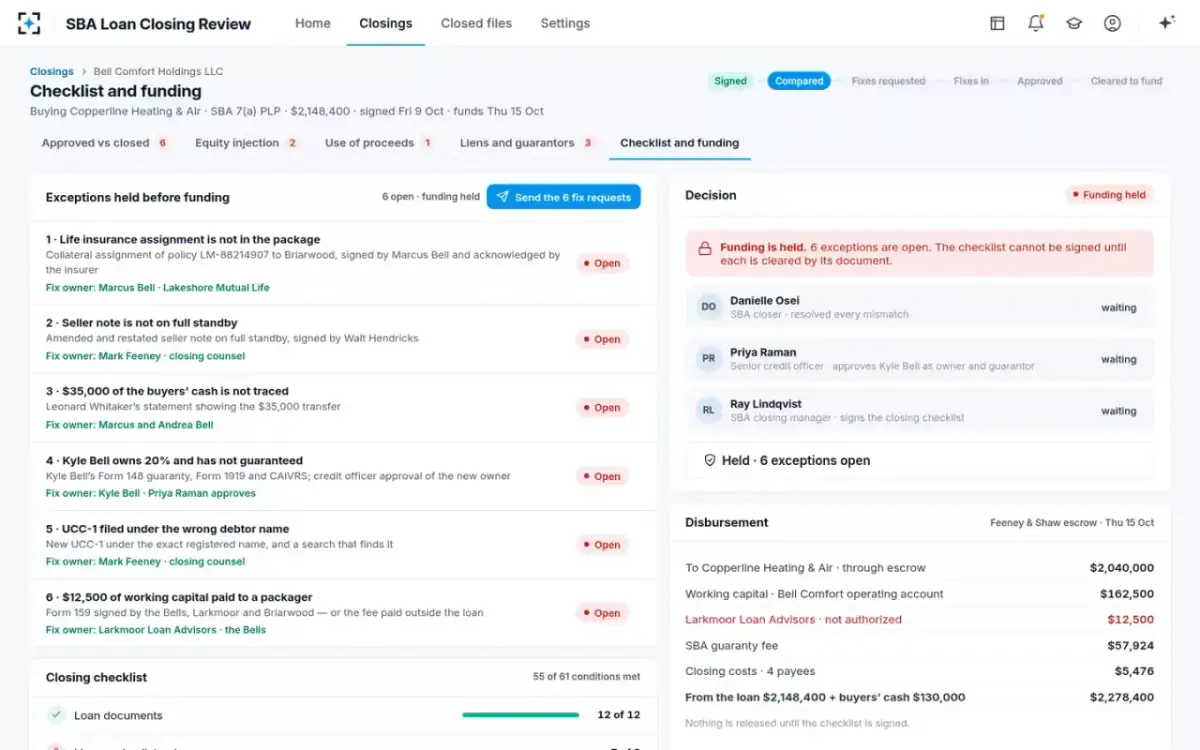
That comparison is mechanical, and that is where SBA Loan Closing Review helps. The solution reads the transcripts with the rest of the closing package and checks them against the returns used in credit, and the condition stays open on the closing checklist until the comparison is complete; nothing is released until the checklist is signed. The judgement of whether a difference matters, a book-to-tax adjustment or an unexplained gap in revenue, stays with the credit officer. How to measure an AI review of SBA closing documents explains why a missed transcript gap should carry the heaviest weight in any test.
Conditions held before funding, each cleared by its document
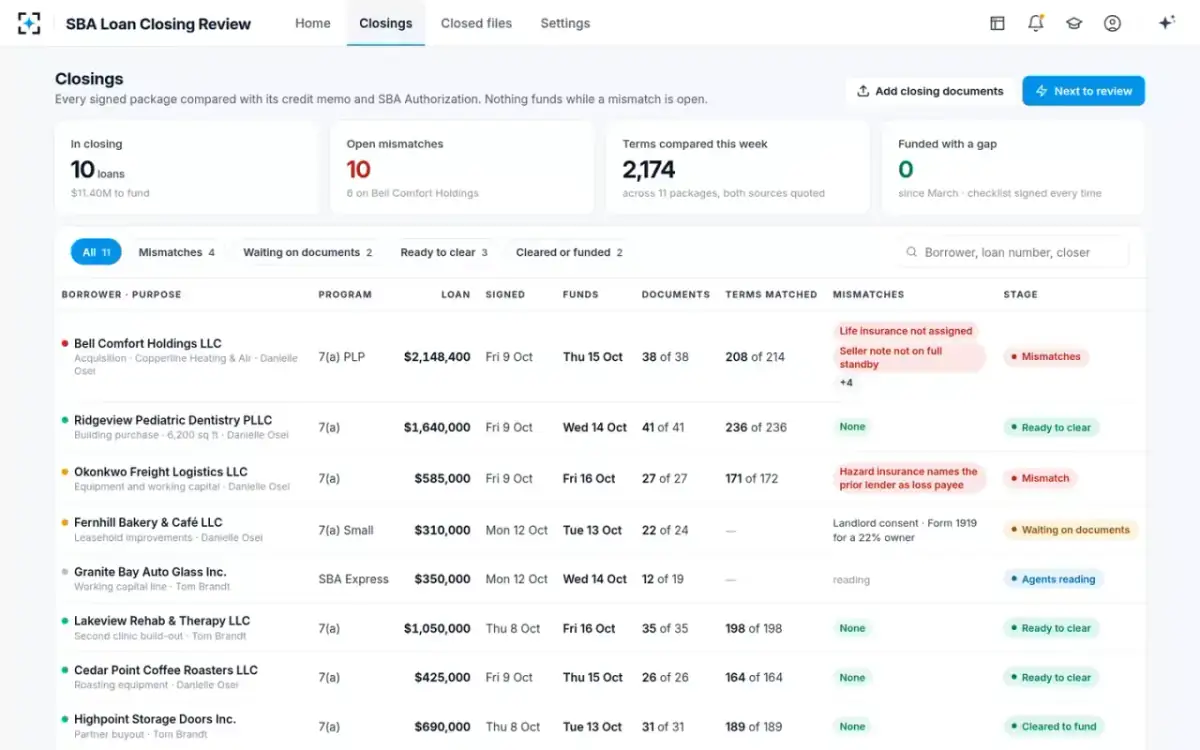
A pipeline where every closing waits on its documents, not on a reader
Questions people ask
What is IVES?
The IRS's Income Verification Express Service, which delivers tax transcripts to enrolled participants with the taxpayer's consent on Form 4506-C. SBA lenders may enrol themselves or use an IVES participant; the IRS charges $4 per transcript and returns faxed requests in about two to three business days.
How long do IRS transcripts take for an SBA loan?
Through IVES by fax, about two to three business days, with faster online options, according to the IRS. Rejections for missing signatures or mixed form types restart the clock, and SBA's rule calls for a second request if nothing arrives within 10 business days.
Can the borrower's accountant request the transcripts?
No. SBA does not permit the borrower, its tax preparer or its enrolled agent to file Form 8821 for an SBA loan; the lender, and any Lender Service Provider it uses, must be the designee. Copies of returns from the borrower do not replace transcripts from the IRS.
Do SBA Express loans need tax transcripts?
Yes, with differences. If the lender underwrites on business financials, the full verification applies, though Express lenders may disburse first and verify after. If it relies on a scoring model, it still needs transcripts to confirm filing and size, but reconciliation is not required.
Whose transcripts are needed when a business is being bought?
The seller's, because the loan is underwritten on the seller's history: SBA requires the lender to verify the seller's financial data, including a selling sole proprietor's Schedule C, and to check the figures behind the business valuation against the seller's transcripts.