SBA closing documents are the signed note, guaranties, lien instruments and filings, insurance certificates and assignments, the standby agreement and seller note, the purchase and operating agreements, the settlement sheet, the Form 159 fee disclosures, the equity injection proof and the IRS transcripts that together show a 7(a) loan closed as SBA approved it. Measuring an AI review of those documents is harder than it looks, because in a well-run closing nearly every term ties, so a reviewer that flags nothing can still look accurate. The useful measures are per term, not per file: how many planted mismatches the review finds, how many false alarms it raises, whether each finding cites the right page of the right document, and how much each miss would have cost when SBA reviews the file after a default. This guide sets out that framework and runs Botminds' SBA Loan Closing Review, six agents that compare every approved term with the signed package before funding, through it.
The examples use a fictional sample lender and its closing of a $2,148,400 acquisition loan for Bell Comfort Holdings LLC. Rules are quoted from SBA's SOPs and costs from SBA's Inspector General.
Why accuracy per term flatters a review that finds nothing
214
approved terms in one sample acquisition closing, across 38 signed documents
6
of them mismatched at closing: 2.8% of terms
97.2%
term accuracy of a review that marks every term as tied and finds none of the six
What documents are in an SBA loan closing?
An SBA 7(a) closing package holds the loan documents, the collateral documents, the deal documents and the evidence SBA requires before disbursement. Lenders may use SBA's own forms (Form 147 for the note, 148 and 148L for guaranties) or their own equivalents, but some SBA wording is mandatory in each, and some documents exist only because SBA requires them (SOP 50 10 8.1).
The SBA closing documents a review has to read, and the terms each sets
| Document | Usually prepared by | Terms a review checks in it |
|---|---|---|
| Note (Form 147 or lender form) | Closing counsel | Amount, rate and base rate, adjustment dates, maturity, payment, any interest-only period, SBA federal-law clause |
| Guaranties (Form 148 / 148L) | Closing counsel | One unlimited guaranty per 20%-plus owner; limited options as approved |
| Security agreement, mortgage or deed, UCC-1, title applications | Closing counsel, title agent | Collateral, lien position, debtor name, SBA lien paragraph, filing and recording |
| Insurance certificates and life policy assignment | Insurance agents, borrower | Coverage amount, loss payee or mortgagee clause, cancellation notice, assignment acknowledged by the insurer |
| Seller note and standby agreement (Form 155) | Counsel for buyer and seller | Amount, payments, full standby for the life of the loan, subordination |
| Purchase agreement and operating agreement | Deal counsel | Price, assets, seller role after closing, owners and percentages |
| Settlement sheet (Form 1050 or equivalent) | Closing counsel, lender | Each payee, amount, date and purpose against the approved uses |
| Fee disclosures (Form 159) | Lender, agents, applicant | One per paid agent, signed by all three; itemised above $2,500 |
| Wires, statements, gift letters | Buyers, their banks, donors | Equity injection amount, source, seasoning and receipt |
| IRS transcripts and reconciliation | Lender via IVES or Form 8821 | Returns filed; figures agree with the statements credit used |
| Borrower certifications | Borrower and operating company | No adverse change, taxes current, no change of ownership without consent |
Why a per-file accuracy score hides the misses that matter
A per-file score treats a closing as one answer, pass or fail, and that throws away the information a quality team needs. In the sample closing, a review that found five of the six mismatches would fail the file exactly as a review that found none, yet the first sends five fixes and the second sends the loan to funding with all six open. And a per-term accuracy score has the opposite problem: because 208 of 214 terms tie, "accuracy" is 97% before the review has done anything.
The way out is the one any test of a rare-event detector uses. Count the mismatches that exist, and ask how many the review found (recall). Count the mismatches the review raised, and ask how many were real (precision, or its complement, the false-alarm rate). Neither number moves when a review says "all clear" on a file that is in fact clean, which is what makes them honest.
How do you measure the accuracy of a closing document review?
Measure a closing document review on four numbers: recall of real mismatches, false alarms per closing, citation accuracy, and the weighted cost of what it missed. The first three tell a quality team whether the review can be trusted on an ordinary file; the fourth tells a chief credit officer whether its misses are the cheap kind or the expensive kind.
A scorecard for an AI review of SBA closing documents
Recall
mismatches found ÷ mismatches present
Measured on seeded and historical mismatches, by category; report the worst category, not only the average.
Quality control
False alarms
raised mismatches that were not real ÷ closings
Each one costs a fix request to counsel or the borrower; too many and closers stop reading them.
Closing manager
Citation accuracy
findings with the right document, page and rule ÷ findings sampled
A finding that cites the wrong page cannot be fixed or defended.
Quality control
Weighted miss cost
Σ misses × consequence weight at purchase review
Weights from the SOP: presumed full denial, denial of the guaranteed share, repair, technical exception.
Chief credit officer
Citation accuracy is the one most evaluations skip and the one an SBA reviewer will care about most. A mismatch is only useful if the closer can open the two pages and see it, and the file only defends the lender later if each resolved exception still points at the document that cleared it. In the solution every mismatch carries the approved wording, the signed wording, both page references and the SOP rule behind it; an evaluation should sample those references and check them by hand.
Weight each miss by what it costs at purchase
Not all misses are equal, and SBA's own rules say which are worst. On an early default, within 18 months of disbursement, SOP 50 57 4 treats two closing failures as grounds for a full denial of the guaranty: an undocumented equity injection, which SBA presumes caused the default unless the lender proves otherwise, and missing evidence that the lender compared the borrower's financial information with IRS transcripts (SOP 50 57 4). A lien not perfected in the required position costs "a full or partial denial of liability equal to the guaranteed share of the net loss" (SOP 50 10 8.1). Where SBA repairs rather than denies, the repair is generally the loss times the guaranty percentage.
Where SBA's own purchase decisions went unsupported, by category
Two of those five categories are closing checks, and they are the two SOP 50 57 4 singles out for full denial on an early default. That gives a defensible weighting: a missed equity-injection gap or transcript gap counts at the full guaranteed amount, a missed lien defect at the guaranteed share of the loss, and a missed form defect as a technical exception that matters mostly for lender oversight. What a missing wire costs works through the repair and denial arithmetic on the sample loan.
Consequence weights for missed closing defects, from SBA's own rules
| Missed defect | Consequence at purchase review | Where SBA says so |
|---|---|---|
| Equity injection not documented, early default | Rebuttable presumption the missing injection caused the default; supports full denial | SOP 50 57 4, Ch. 25 |
| No evidence of IRS transcript comparison, early default | Full denial justified; IRS delays are no excuse | SOP 50 57 4, Ch. 25 |
| Required lien not perfected or not in required position | Full or partial denial equal to the guaranteed share of the net loss | SOP 50 10 8.1, Sec. B Ch. 6 |
| Proceeds used outside the approved uses | Repair or denial; loss × guaranty percentage is the usual repair | SOP 50 57 4, Ch. 25; 13 CFR 120.524 |
| Required SBA form missing or not an exact copy | A release event in the regulation; SBA's lender reviews have logged incomplete forms as technical exceptions | 13 CFR 120.524(a)(9); OIG 26-14 |
How do you test a closing review tool?
Test a closing review tool on closed files where you already know the answer, with mismatches planted in every category that matters, and with decoys that should not fire. Historical closings give realistic documents; seeding gives a known denominator for recall, which real files rarely provide because nobody knows how many mismatches went unnoticed.
Seeding a test closing: what to plant, and what should stay quiet
- Change an owner's percentage in the operating agreement
And add an owner above 20% with no guaranty: the review must catch both the drift and the missing guarantor.
- Give the seller note payments
Interest-only from month 25, with a standby agreement that still says full standby.
- Move a slice of proceeds to an unnamed payee
A fee to an adviser out of working capital, with no Form 159.
- Misspell the debtor on the lien filing
One letter, so the filing exists but a search under the registered name does not find it.
- Remove a required assignment or loss payee
A life policy issued but never assigned; a hazard certificate naming the prior lender.
- Break the injection trail
A gift letter and a deposit, but no statement showing the money leave the donor.
- Plant decoys that are not mismatches
The same rate written two ways, a renumbered exhibit, a document signed a day early: each should tie, and any flag is a false alarm.
- Record what was planted before the run
Kept by someone other than the operator, so the scoring is blind.
False alarms, and the citation check
A false alarm is not free: each one becomes a fix request to closing counsel or the borrower, or a closer's half-hour proving that two clauses mean the same thing. A review that raises twenty findings on a clean closing will be ignored within a month, and the twenty-first finding will be ignored with it. That is why the solution's terms matcher compares meaning rather than words: "WSJ Prime + 2.75%" and "Prime Rate plus 2.75 percent" are the same term, and an operating agreement that gives a third owner 20% is a different one.
The citation check closes the loop. Pull a random sample of findings and resolved terms from the test run and confirm, by hand, that each cites the right document, page and clause on both sides and the right rule. A review whose citations hold up can be audited; one whose citations drift cannot, however good its recall looks.
What closing errors lead to SBA denial?
The closing errors SBA can turn into repairs and denials are the ones a purchase reviewer can test from the file: injection without proof, transcripts not compared, liens not perfected, proceeds outside the approval, missing guarantors and missing or wrong forms. The regulation behind all of them is 13 CFR 120.524, which releases SBA when the lender "failed to comply materially with any Loan Program Requirement", "failed to make, close, service, or liquidate a loan in a prudent manner" or "failed to use required SBA forms or exact electronic copies" (13 CFR 120.524).
Timing makes the weighting sharper. SBA's purchase reviewers apply the SOP 50 10 that was in force when the loan was approved, and on an early default the burden shifts toward the lender. A review that misses an injection gap on a loan that performs for three years costs nothing; the same miss on a loan that defaults at month 14 can cost the whole guaranteed portion.
Every closing in the pipeline, measured the same way
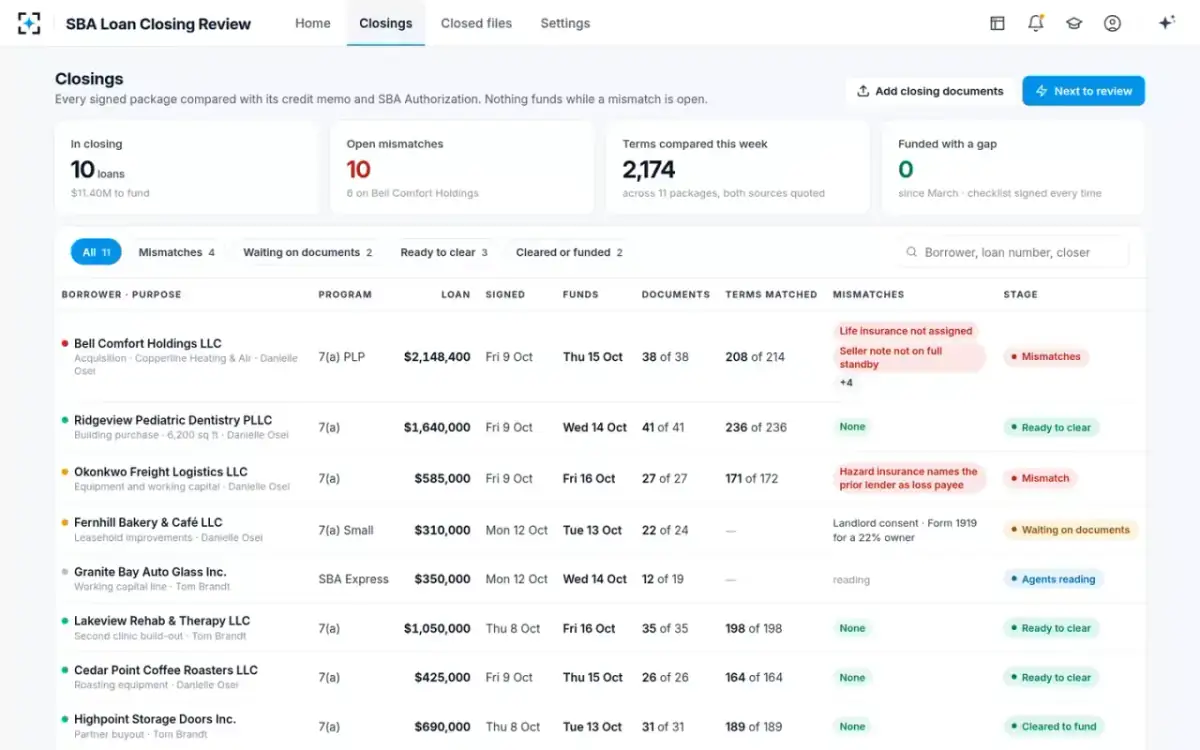
Reading the sample run through the framework
The sample closing is a demonstration, not a measurement, and should be read that way. On fictional data, the solution's agents listed 214 terms, read 38 documents and raised six mismatches in 1 minute 27 seconds; all six were real, and each was cleared by a corrected document and re-checked against the approval before the closing manager signed. Across the sample lender's 64 closings in 2026, the closed-files screen shows 156 exceptions caught before funding, 2.4 per closing, led by equity injection not traced (38) and owners or guarantors that differed from approval (27).
What the comparison caught before funding, closing after closing
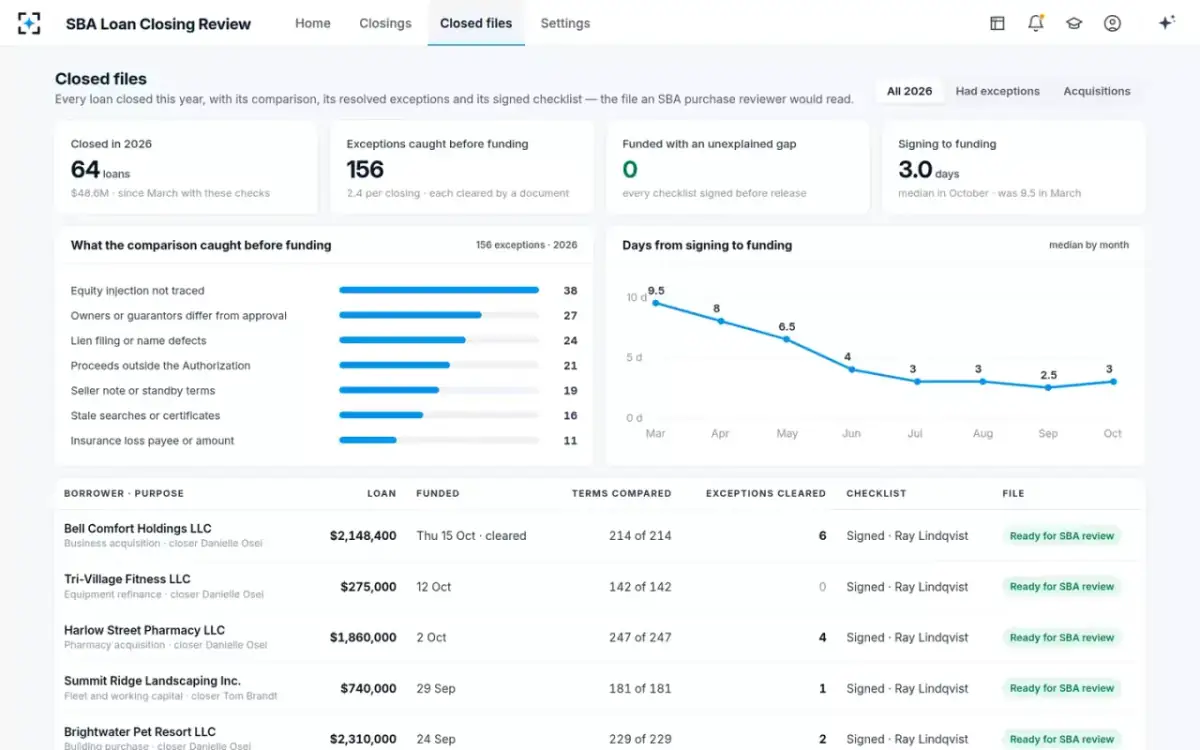
What a lender should take from the sample is the shape of the test, not its result. Nobody can know the solution's recall on your closings without running it on them, with known mismatches, and scoring it blind. A pilot on last quarter's closings sets out how to do that in four weeks, with the pass and fail lines written down first.
Questions people ask
Can AI review SBA closing documents?
AI can read the documents and compare their terms with the approval; it cannot carry the lender's responsibility for the closing. SBA has published no guidance on AI in lender closing review. Its Inspector General noted in September 2026 that OMB presumes AI affecting federal loan decisions at agencies is high impact (OIG Report 26-15); that rule binds agencies, not lenders, but a design that leaves every decision with named people fits its direction.
What is a good false alarm rate for a closing review?
There is no industry standard. A practical target is fewer false alarms per closing than real mismatches, so closers keep reading every finding; set the number before the test, and measure it on clean closings as well as seeded ones.
Should the test use real loans or synthetic ones?
Both. Real closed files give the review real handwriting, scans and drafting styles; seeded copies give a known count of mismatches. A test on synthetic documents alone tends to overstate accuracy, because real packages are messier than anything written for a test.
How many seeded mismatches does a fair test need?
Enough in each category to report recall by category, not just overall. As a rule of thumb, at least a handful per category across the test files, with clean files mixed in so that false alarms are measured too; one seeded mismatch per category tells you almost nothing.
Does SBA review the lender's closing documents before purchase?
Not routinely. SBA asks lenders not to send closing documents except through Form 1502 reporting, and it reads them in lender oversight reviews or at guaranty purchase. That is why the lender's own review is the only check before the money moves.