Pre-funding quality control is an independent review of a loan's data and documents before it closes or funds, done by people outside production so that defects are fixed while they still can be. The best-known checklist is the mortgage one: Fannie Mae's Selling Guide requires a written plan, a monthly sample of loans, and full-file reviews of the data entered for automated underwriting, Social Security numbers, income, employment, assets, the appraisal, mortgage insurance and occupancy. An SBA 7(a) loan fails in different places. What decides whether SBA honours its guaranty is whether the closing met the approved SBA terms and SBA's conditions before disbursement: the equity injection proved by three documents, IRS transcripts reconciled, standby agreements, liens perfected under the right name, insurance and assignments, guaranties from every 20% owner, a Form 159 for every paid agent, and proceeds only to approved payees. Those rows are missing from a mortgage checklist, and because SBA decides its guaranty one loan at a time, they are worth checking on every loan rather than a sample. Botminds' SBA Loan Closing Review does that check before funding: six agents compare each approved term with the signed package, and nothing is released until the closing manager signs.
Sample figures come from a fictional lender in the solution. Mortgage rules are quoted from the Fannie Mae Selling Guide and SBA rules from SBA's SOPs.
Mortgage pre-funding QC and an SBA closing review, row by row
Mortgage pre-funding QC (Fannie Mae): The lender from selling an ineligible loan to Fannie Mae.
SBA 7(a) closing review: SBA's guaranty, which can be repaired or denied at purchase if the loan did not close to SBA's terms.
Mortgage pre-funding QC (Fannie Mae): Selling Guide D1-2-01: a written plan, timing, loan selection, review types.
SBA 7(a) closing review: SOP 50 10 8.1, Section B, Chapter 6; SOP 50 57 4 at purchase; 13 CFR 120.524.
Mortgage pre-funding QC (Fannie Mae): Data in the automated underwriting system, Social Security numbers, income, employment, assets to close, appraisal, mortgage insurance, occupancy.
SBA 7(a) closing review: Every approved term against the signed package; injection evidence, transcripts reconciled, liens, insurance, guaranties, standby, proceeds and payees, Form 159.
Mortgage pre-funding QC (Fannie Mae): A monthly sample, risk-based, from every production channel.
SBA 7(a) closing review: Every loan, because the guaranty is decided loan by loan.
Mortgage pre-funding QC (Fannie Mae): Individuals with no involvement in origination, processing or underwriting of the loan.
SBA 7(a) closing review: SBA sets no rule; the same independence principle applies to whoever, or whatever, compares.
Mortgage pre-funding QC (Fannie Mae): Early enough to correct the loan before closing or acquisition.
SBA 7(a) closing review: Before the first disbursement, when SBA's conditions fall due.
What is pre-funding quality control?
Pre-funding quality control is a lender's own review of loans before closing or funding, independent of the people who made them, designed to catch defects while they can still be corrected. The mortgage definition is the most developed: Fannie Mae requires lenders to "maintain and implement a written prefunding QC plan that outlines requirements for reviewing a sample of its loans prior to closing", and says the review exists to "identify loans with defects (such as analysis or calculation errors, inaccurate data, or inadequate documentation) prior to closing or acquiring the loan" (Fannie Mae Selling Guide D1-2-01).
"At a minimum, prefunding QC must be conducted by individuals who have no involvement in the origination, processing or underwriting functions of the loan being reviewed."
Fannie Mae Selling Guide D1-2-01
SBA has no equivalent rule. Its SOP says what must be true before disbursement and leaves the lender to decide how to check it. But the logic carries over exactly: the people who assembled a closing are the people least likely to see its defects, and a defect found after funding is far more expensive than one found before. Why the checklist's maker should not be its only checker makes that argument for the SBA closing desk.
What is on a pre-funding QC checklist?
A mortgage pre-funding QC checklist covers the inputs of the underwriting decision: Fannie Mae's full-file review must assess "data entered into an automated underwriting system; borrower Social Security number(s); income calculations and supporting documentation; employment documentation, including verbal verification of employment; assets needed to close or meet reserve requirements; appraisal or other eligible collateral data", mortgage insurance and occupancy. Lenders may add component reviews that focus on one element, such as income or assets, where they see elevated risk.
Almost none of that maps onto an SBA closing. An SBA 7(a) loan is underwritten on business cash flow, closed on documents drafted by deal counsel, and guaranteed on terms that live in SBA's system. A pre-funding checklist that checks the borrower's identity and income and stops there will pass a closing with a seller note paying interest, a lien filed under the wrong name and a packaging fee paid out of working capital.
How is SBA closing review different from mortgage QC?
An SBA closing review checks the closing against a guarantor's conditions, term by term, on every loan; mortgage pre-funding QC checks an underwriting decision against an investor's eligibility rules, on a sample. The difference follows from who bears the risk. Mortgage pre-funding QC, in Fannie Mae's words, "prevents the lender from selling ineligible loans"; SBA can decline to pay, wholly or in part, when a lender materially breached a program requirement or did not make and close the loan prudently (13 CFR 120.524), and it decides that loan by loan, usually years after funding.
The SBA review is also more mechanical and more document-bound. Most of its questions have yes-or-no answers that a document either proves or does not: is there a wire with the source statement and the deposit, is the standby note on full standby, does the search find the filing under the registered name, is there a Form 159 for the adviser on the settlement statement. That makes it a good fit for reading by agents, with people deciding what each difference means.
The SBA rows a mortgage checklist does not have
These are the rows an SBA lender has to add to any pre-funding checklist it borrows. Each is a condition SOP 50 10 8.1 puts at or before the first disbursement, or a document SBA reads at purchase review.
Nine rows an SBA pre-funding checklist needs that a mortgage one lacks
- Every approved term tied to a signed document
Amount, rate, repayment, uses and payees, guarantors, collateral and lien priority, as they stand in the SBA Terms and Conditions with approved changes.
- Equity injection proved by three documents
Wire or check processed, source statement of at least 30 days, deposit or settlement statement; no gift letter or note on its own.
- IRS transcripts received and reconciled
Before the first dollar on standard 7(a) loans; a second request at 10 business days; no disbursement on "no record" without the exceptions.
- Standby debt on full standby
Form 155 or equivalent with the note attached, and the note itself free of principal and interest payments for the loan's life.
- Liens perfected, in position, under the right name
A filing that a search under the debtor's registered name finds; SBA's federal-law paragraph in every lien instrument.
- Guaranties from every owner of 20% or more
Against the signed operating agreement, not only the credit memo; spouses and trusts by SBA's rules.
- Insurance as approved
Hazard on collateral above $50,000, flood where required, life insurance assigned and acknowledged by the insurer's home office.
- Proceeds only to approved uses and payees
The settlement statement line by line; Form 1050 where required.
- A Form 159 for every paid agent
Signed by applicant, agent and lender; itemised above $2,500.
Should pre-funding QC sample or review every loan?
For SBA closings, every loan. Sampling is the right design when the purpose is to find patterns in a process, and Fannie Mae's monthly, risk-based sample does that well. But SBA does not sample its guaranty: it reviews the specific loan that defaulted, and an injection gap on an unsampled loan is just as costly as one on a sampled loan. A pattern found in the sample does not repair the loan that was not in it.
Sampling against every loan, for SBA pre-funding review
| Question | Sample (e.g. 10% of closings) | Every loan |
|---|---|---|
| Finds process patterns | Yes, over months | Yes, within weeks |
| Protects the guaranty on a given loan | Only on the loans sampled | On every loan |
| Exceptions seen at the sample lender in 2026 | About 15 of 156, from 6 or 7 of 64 closings | All 156, before funding |
| Reading cost | A fraction of the loans, read in full by hand | Every loan, read by agents; people resolve the exceptions |
| Fits SBA's purchase review | Partly: SBA reviews the loan that defaults, not the sample | Yes |
The objection to every-loan review has always been cost: by our estimate, a full by-hand review of one SBA acquisition package takes about 21 hours, which no QC team can repeat on every closing. That is the constraint agents remove. In the sample closing, the reading took 1 minute 27 seconds and the people's time went to six real exceptions.
Who does pre-funding QC at a bank?
At a mortgage lender, a QC team independent of production, by investor rule. At an SBA lender it varies with size, because SBA does not specify. A large SBA lender may have a closing manager who signs every checklist and a quality team that samples after funding. A small one may have one person doing the processing, the closing and the only check, and most SBA lenders are small.
Who is checking SBA closings, and how thinly
711
of 1,336 lenders that made a 7(a) loan in FY2025 made five or fewer
3,100+
lenders, CDCs and microloan intermediaries SBA's oversight office supervises
13,195
hours a year SBA estimates lenders spend responding to its reviews
For the small lender, the independence principle is the expensive part, because a second trained reader for a handful of SBA closings a year is hard to justify. A reader that did not prepare the package, and that does not tire on the eighth hour, is the cheapest way to get independence without a second closer. The closing manager then signs on the strength of a comparison someone else made.
What does post-closing QC check, and what can it still fix?
Post-closing QC reviews loans after funding, usually on a sample, to confirm the file is complete and the process worked. For an SBA loan it can still catch the post-closing deadlines; it cannot undo a condition that SBA required before the first dollar.
What post-closing QC can still fix on an SBA loan, and what it cannot
| Item | Due | Fixable after funding? |
|---|---|---|
| Form 159 uploaded with the 1502 | Within two reporting cycles of first disbursement | Yes, within the window |
| Changes reported to SBA | Within 15 business days of final disbursement | Yes, within the window |
| Licences in the file | Within 90 days of final disbursement | Yes, within the window |
| Equity injection verified | Before any disbursement | No: the SOP requires it before funds move |
| IRS transcripts reconciled | Before first disbursement (delegated lenders close at their own risk) | Partly: late reconciliation helps, but the risk was taken |
| Lien perfected in the required position | Before or at disbursement | Sometimes, if no intervening lien has attached |
| Proceeds to approved payees | At disbursement | No: the money has gone |
The table is the case for moving the check forward. The items post-closing QC can fix are the ones with deadlines after funding; the ones SBA weighs most heavily at purchase, the injection and the transcripts on an early default, have to be right before the money moves. Transcripts before the first SBA dollar shows how unforgiving that deadline is.
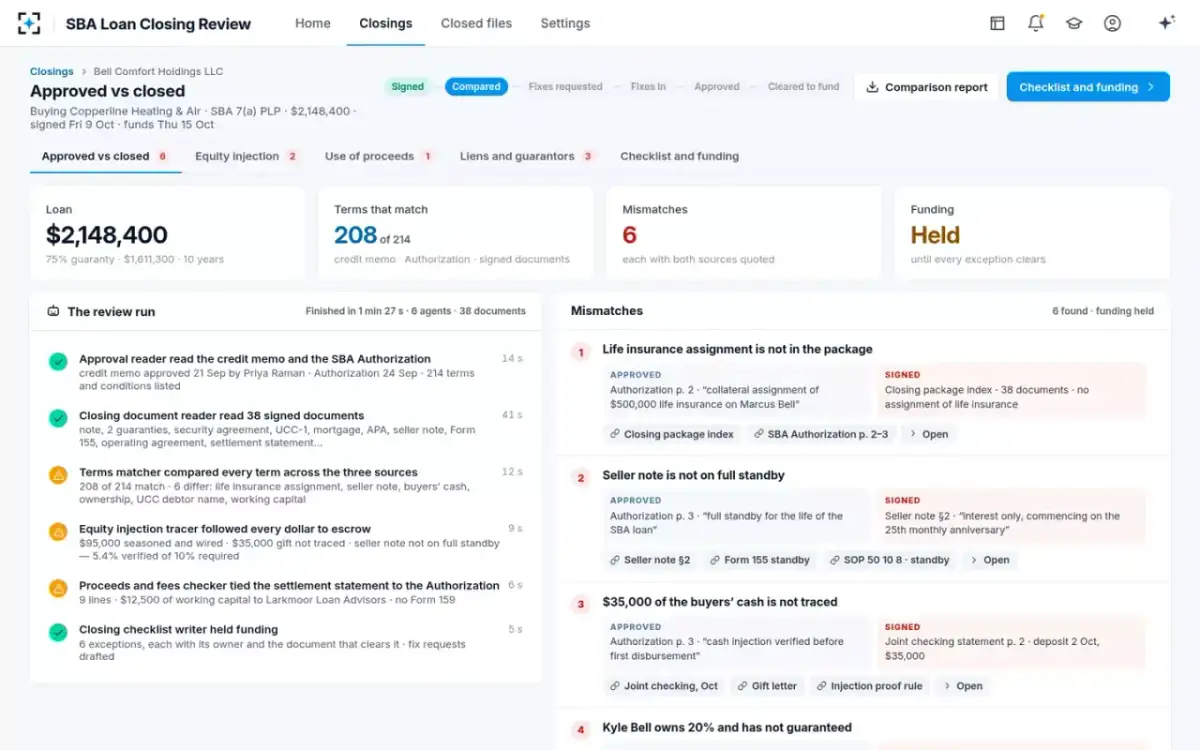
Approved against closed, before funding rather than after
Buying pre-funding QC software for SBA lending: what to look for
Look for software that reads SBA's terms and SBA's documents, checks every loan, and leaves every decision with your people. A checklist built for mortgage QC is organised around automated underwriting data, income, assets and the appraisal; none of those is where an SBA closing goes wrong. The questions that separate a fit from a misfit are specific: does it read the approved SBA terms with their changes, does it trace an injection through three documents, does it read the seller note behind the standby agreement, does it check the debtor name on a filing against a search, does it check a Form 159 for every payee that needs one, does it apply the SOP in force when each loan was approved, and does it hold funding while anything is open.
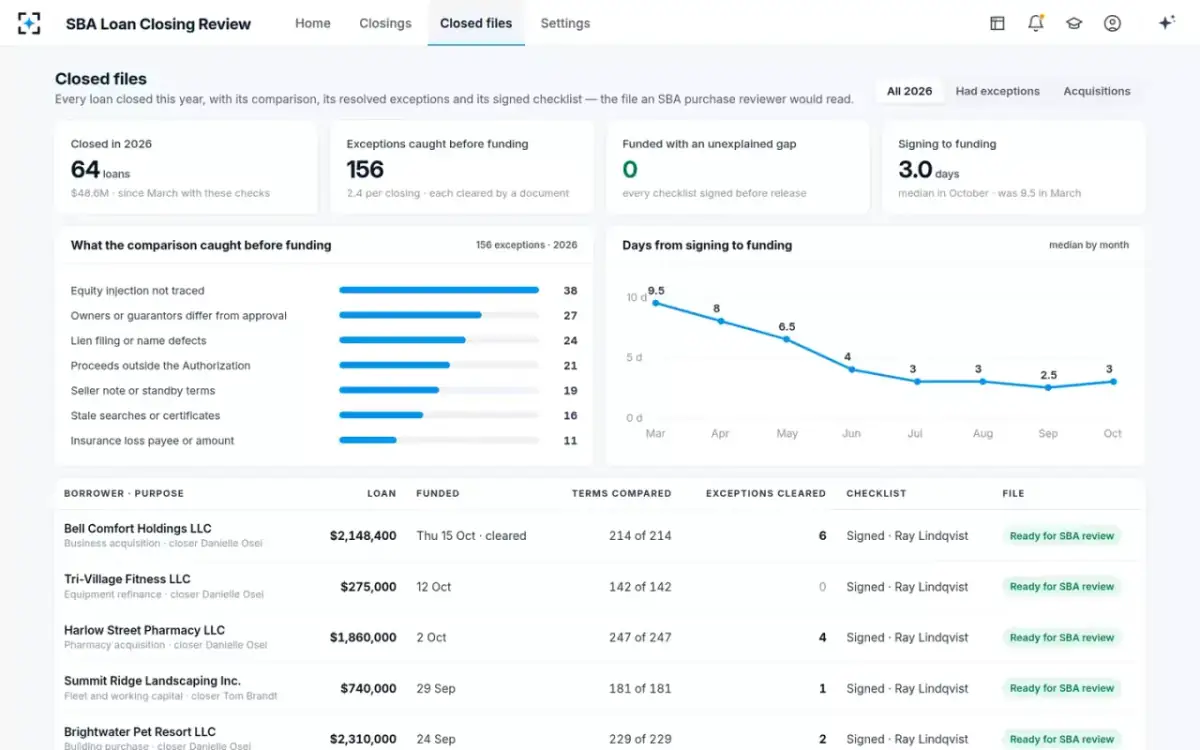
Be equally clear about what SBA Loan Closing Review is not. It is not a mortgage QC tool, not a credit re-underwriting (repayment ability stays the credit officer's call), and not a post-closing sampling program; it reads the signed package of every SBA closing before funding and builds the checklist your closer resolves and your manager signs. Across the fictional sample lender's 64 closings in 2026, it held 156 exceptions before funding, and its design target is no disbursement with an unexplained gap between approval and closing. To test that on your own files, pilot it on last quarter's closings.
A year of closings with the comparison kept for the SBA reviewer
Questions people ask
Is pre-funding quality control required for SBA loans?
SBA has no pre-funding QC rule comparable to Fannie Mae's. It requires that collateral, conditions, equity verification, tax transcripts and certifications be in place before or at disbursement, and it leaves the lender to decide how to check that, which is why the check is usually lender policy.
Can the closer do the pre-funding review?
The closer can prepare it, but should not be its only reader. Fannie Mae requires pre-funding QC to be done by people with no involvement in origination, processing or underwriting; SBA has no such rule, but the reason, that people do not see the defects in their own work, applies just as much to an SBA closing.
What is a component review in pre-funding QC?
A review of one element of a loan rather than the whole file. Fannie Mae lets lenders add component reviews, for example of income or assets, where they see elevated risk or want to test a new control; an SBA lender might run one on equity injections or lien filings across all closings.
How many loans should mortgage pre-funding QC review?
Fannie Mae sets no fixed number; the lender must document a monthly selection process based on its own risk assessment, including loans from every production channel, and Fannie Mae may require changes or minimum samples. For SBA closings, where the guaranty is decided loan by loan, there is a strong case for reviewing every loan.
Does SBA review the lender's pre-funding QC?
SBA's oversight office reviews lenders' SBA operations, and its review requests cover items such as credit scoring and risk rating methods and loans approved as exceptions to policy. Closing files are read in those reviews and again at guaranty purchase, so a lender's pre-funding check is ultimately judged by what those reviewers find.