SBA equity injection verification is the lender's proof, gathered before any loan proceeds are disbursed, that the borrower's required equity really came from a legitimate source and really reached the business or the closing escrow. SOP 50 10 8.1 names the three documents that prove a cash injection: a copy of the check or wire with evidence it was processed, a statement covering at least 30 days from the account the money left, and a statement or settlement sheet showing where it landed. A gift letter, a promissory note or a financial statement does not count on its own. The rule is easy to state and easy to get slightly wrong, and the cost of slightly wrong is large: on a loan that defaults within 18 months, an undocumented injection lets SBA presume the missing equity caused the default and deny the guaranty. Botminds' SBA Loan Closing Review has an agent that works out the required injection from total project cost and traces every dollar of it, through seasoned statements and the donor's account for gifts, to escrow, before the closer can clear the loan to fund.
The worked example is a fictional sample closing in the solution: Bell Comfort Holdings LLC buying Copperline Heating & Air for a total project cost of $2,388,400 with a $2,148,400 SBA 7(a) loan. The rules come from SBA's SOPs and the outcomes from SBA's Inspector General.
One missing wire, three outcomes: who bears a $900,000 loss on an SBA loan
Guaranty honoured
SBA bears
$675,000
Lender bears
$225,000
SBA bears 75% of the net loss, as the guaranty intends.
Repair of the whole loss
SBA bears
$0
Lender bears
$900,000
$900,000 loss × 75% = a $675,000 repair deducted from what SBA pays.
Full denial
SBA bears
$0
Lender bears
$900,000
SBA does not honour the guaranty; the lender keeps the loan and the loss.
How do you verify SBA equity injection?
To verify an SBA equity injection, collect three documents that together show the money's source, its movement and its arrival, and collect them before the first disbursement. The rule sits in Section B, Chapter 6 of SOP 50 10 8.1, which applies to every 7(a) loan except SBA Express and Export Express: "Lenders must verify the SBA-required equity injection prior to disbursing any loan proceeds and must maintain evidence of such verification in their loan files", and failure "may warrant a repair or partial/full denial" (SOP 50 10 8.1).
The three documents that verify a cash injection, and what each must show
- The check or wire, with evidence it was processed
Not the wire request: the confirmation that the funds moved into the borrower's account or the closing escrow.
- The source account's most recent statement, covering at least 30 days
Showing the funds were available in the account they came from, in the name of the person injecting them.
- The landing evidence
A statement from the borrower's account showing the deposit, or a settlement statement or HUD-1 showing how the cash was used.
- All of it in the loan file before disbursement
And sent again with any purchase request; SBA requires the documentation "with each purchase request" on a loan that needed an injection.
The documents follow the money, not the paperwork. A wire confirmation without the source statement proves the money moved but not whose it was; a statement without the wire proves it existed but not that it arrived. Each gap is a place where a borrowed or borrowed-back dollar can pass for equity.
What proof of equity injection does SBA accept, and from which sources?
SBA accepts cash that is not borrowed, from the business or from other sources including gifts, without limit, and a narrower set of sources, standby debt and seller debt among them, for no more than half of the required injection. For a business acquisition the required amount is set in Appendix 15 of SOP 50 10 8.1: 10% of total project cost for an initial acquisition, a figure that "cannot be reduced or eliminated" (SOP 50 10 8.1).
Where an SBA equity injection may come from, and how far each source counts
| Source | How far it counts | What proves it |
|---|---|---|
| Cash not borrowed (savings, business cash, gifts) | Without limit | The three documents above; for a gift, the donor's statement showing the funds leave |
| Personal loan to a guarantor | Without limit, if repayment comes from a source other than the business's cash flow | The loan terms and evidence of the other repayment source |
| Grants with no repayment or clawback during the loan | Without limit | The grant terms |
| Eligible prepaid expenses | Without limit; fees paid to an Agent do not count | Paid invoices, cancelled checks or bank statements |
| Debt on full standby (Form 155) | With seller debt, no more than half of the required injection | Standby agreement with the note attached; no principal or interest payments for the life of the loan |
| Seller debt on full standby | Part of the same half | Subordinated note on full standby |
Is a gift letter enough for SBA equity injection?
No. A gift letter is a statement of intent, not proof that money moved, and SOP 50 10 8.1 says so directly. A gift is an unlimited source of equity, but it has to be traced like any other cash: out of the donor's account, into the buyers' account or escrow, with the statements to show both.
"A promissory note, 'gift letter,' or financial statement is not sufficient evidence of cash injection without corroborating evidence."
SBA SOP 50 10 8.1, Section B, Chapter 6
The rule exists because the paper is easy to fake. A Maryland loan broker sentenced in 2019 ran a scheme whose fraudulent documents included "bank statements for borrowers that were altered to make it look like the borrowers had more cash to inject ... counterfeit cashiers' checks and fake gift letters" (U.S. Attorney, District of Maryland). Another broker, sentenced in 2015, submitted "false copies of the borrowers' monthly bank statements to reflect more money than was actually in the borrowers' bank accounts" to substantiate injections (FDIC Office of Inspector General). A third-party statement read against the wire is the check that defeats both.
In the sample closing the gift was genuine and the gap was ordinary. Leonard Whitaker, the buyer's father, gave $35,000. The file held his signed gift letter, the deposit into the buyers' joint account on 2 October and the wire to escrow on 8 October. Nothing showed the money leaving his account, so $35,000 of the injection was not traced. His statement arrived two days later and cleared it.
Does a seller note count as equity injection?
Only on full standby for the life of the loan, documented on Form 155 or an equivalent with the note attached, and only for up to half of the required injection together with any other limited source. "Full standby" means "no payments of principal or interest for the term of the 7(a) loan"; interest may accrue and be paid after the SBA loan is repaid (SOP 50 10 8.1).
The trap is the note itself. In the sample closing the standby agreement said full standby, as the approval required, but section 2 of the $110,000 seller note began "interest only, commencing on the 25th monthly anniversary", which is the 24-month standby SOP 50 10 7.1 allowed before SOP 50 10 8 required full standby for the life of the loan. A reviewer who read the standby agreement saw compliance; one who read the note saw a $110,000 hole in the injection.
Tracing the sample buyers' $240,000
On paper the sample closing met the requirement with $1,160 to spare: total project cost of $2,388,400 needed $238,840, and the closing claimed $240,000, made up of $130,000 of the buyers' cash and the $110,000 seller note. The equity injection tracer followed every dollar and found a different number.
The sample injection, as claimed and as traced, against the 10% required
Every dollar of the injection, traced to escrow
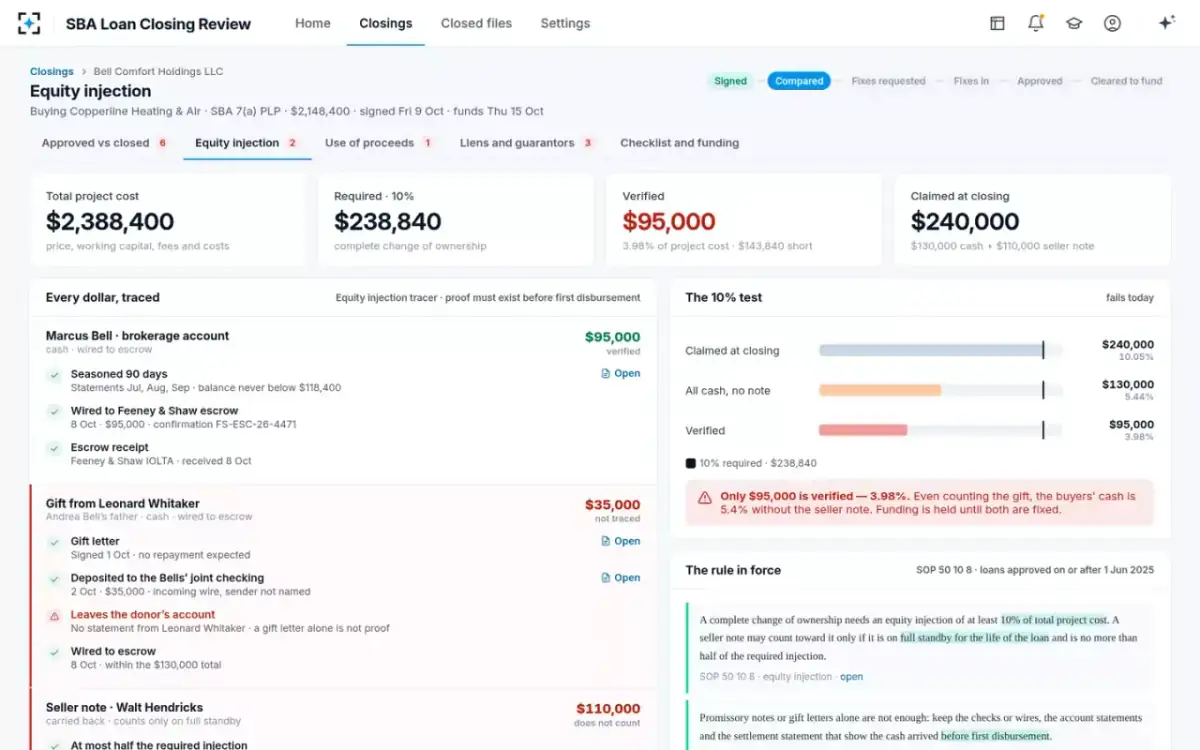
Funding was held until both gaps closed: the donor's statement for the gift, and an amended and restated seller note on full standby, signed by the seller on 14 October. With both, the injection was $240,000 and verified, and the closing could proceed. Without the tracer, the closing would have funded on Thursday at 3.98% verified against a 10% rule.
What happens if equity injection is not verified?
If the injection is not verified, SBA may repair or partly or fully deny the guaranty when the loan defaults and the lender asks SBA to buy it. A repair is a deduction from what SBA pays, "generally" the loss times the guaranty percentage; SBA's own example is "$50,000 loss x 75 percent guaranty = $37,500 Repair" (SOP 50 57 4). On the illustrative $900,000 loss in the figure above, a repair of the whole loss moves the lender's share from $225,000 to $900,000.
The guaranty also does not end at purchase. Under 13 CFR 120.524, SBA may recover money it has already paid if it later finds a release event, and lenders must submit the injection documentation with every purchase request. A file that cannot show the three documents is a file whose guaranty can be questioned for as long as SBA can act on it.
Why the early default presumption makes this the costliest gap
On an early default the burden shifts to the lender. SOP 50 57 4 defines an early default as one within 18 months of the initial disbursement, or of the final disbursement if that came more than six months later, unless the borrower cures and then pays for 12 months. For those loans, a missing injection is not just a defect; it is presumed to be the cause.
The SOP's words are these: a failure "to properly document a material portion of any injection of cash or non-cash equity ... raises a rebuttable presumption that the Early Default was caused by the absence of the required equity injection and justifies a full Denial of Liability". To rebut it, the lender needs "credible evidence that the primary cause of the Borrower's Default was something other than the lack of the required equity injection, e.g., the death of an irreplaceable Key Employee or an uninsured natural disaster" (SOP 50 57 4, Chapter 25). Few defaults come with evidence that clean. Missing tax verification carries the same early-default consequence, which is why IRS transcripts before the first SBA dollar belong on the same pre-funding list.
What did SBA's Inspector General find on equity injection?
SBA's Inspector General found SBA itself paying out on loans whose injection was never proved. In its August 2026 review of purchase decisions where SBA overturned its own repair or denial recommendation, three of the seven equity-injection cases it sampled lacked sufficient support, about $2.15 million in potential improper payments; in one, "the lender did not provide adequate evidence that demonstrated the cash injection was made from a legitimate source, as required" (SBA OIG Report 26-12).
Equity injection, where SBA's reviews and auditors keep finding it
3 of 7
overturned equity-injection decisions OIG sampled that lacked support (2026)
$2.15M
potential improper payments on those three loans
38
of 156 exceptions caught before funding at the sample lender: injection not traced
fictional sample data
SBA's own improper-payment testing points at the same place. For fiscal 2025 the 7(a) guaranty-purchase improper payment rate fell to 1.07%, from 5.34% the year before, and the root cause SBA named was "Statutory Requirements of Program Were Not Met when the source of equity injection funds was not provided" (SBA Agency Financial Report FY2025). And in a 2025 Maryland hotel case, the people convicted had misrepresented to lenders "the nature and amount of the equity injected by the borrowers" in a scheme to obtain more than $35 million of SBA loans (U.S. Attorney, District of Maryland).
What verification costs against what it saves
Tracing an injection by hand takes about three hours on an acquisition closing, by our estimate, and the solution brings it to about half an hour of review. Against the arithmetic above, the trade is not close: three hours of a closer's time against the difference between a 25% and a 100% share of a default loss on a loan that may be several million dollars.
The harder cost is the conversation. Holding funding three days before closing because a donor has not sent a statement is uncomfortable for the loan officer and the buyers. The rule makes that conversation easier: SBA, not the bank, requires the statement, and the closer can show the exact line. In the solution, the hold is automatic and the request names who must send what; a checklist whose maker is not its only checker explains why that matters most on the files the closer knows best.
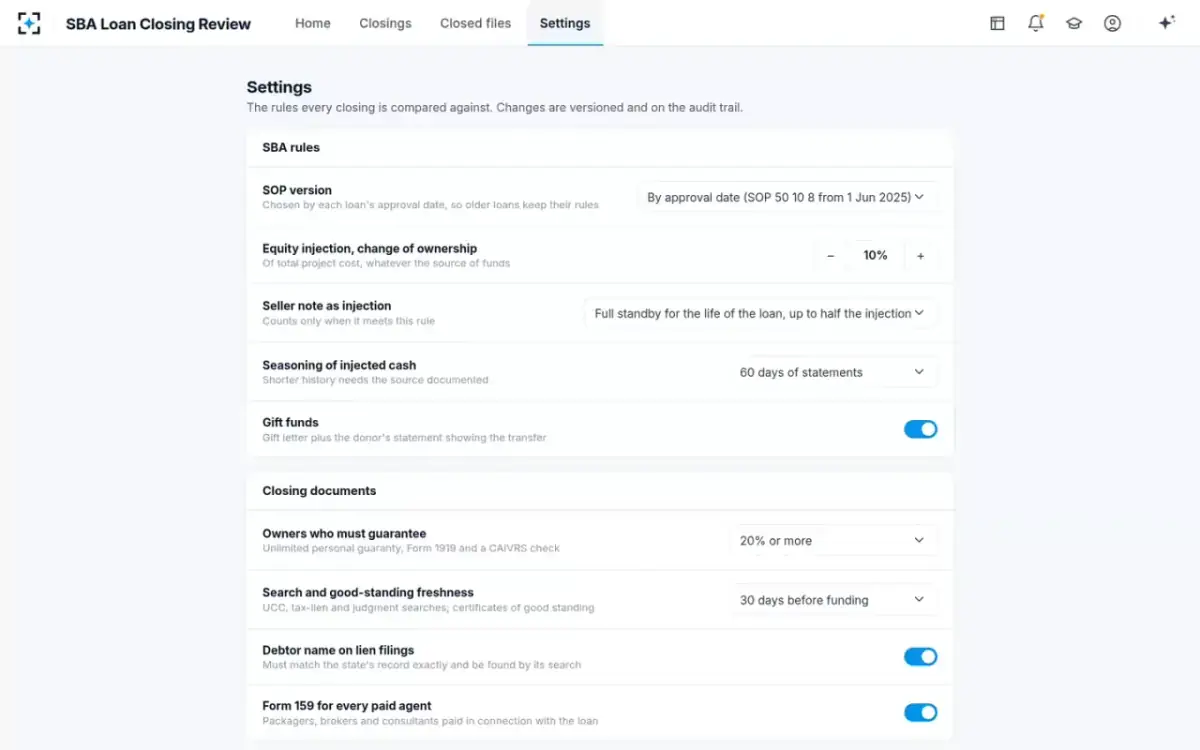
Your injection rules, set once and applied to every closing
Questions people ask
What is the minimum equity injection for an SBA acquisition loan?
Under SOP 50 10 8.1, an initial acquisition needs 10% of total project cost, and that cannot be reduced. Business expansions and owner buyouts also start at 10%, but the lender may reduce or waive it if the borrower has enough liquidity and working capital, subject to conditions such as no negative net worth at the last fiscal year-end.
How long must equity injection funds be seasoned for an SBA loan?
SBA's rule asks for the most recent statement or statements, covering at least 30 days, from the account the funds come from. A lender may ask for more as policy; the fictional sample lender asks for 60 days, and an unexplained large deposit inside the window needs a source of its own.
Can the equity injection come from a HELOC or a personal loan?
Borrowed money counts only in defined ways. A personal loan to a guarantor counts without limit if it will be repaid from something other than the business's cash flow, and when an injection comes from a HELOC or other borrowing, the lender must address its repayment and any standby or subordination terms.
Is equity injection verification required on SBA Express loans?
Not by SBA's verification rule, which exempts SBA Express and Export Express. But if the lender requires and verifies an injection on its similar non-SBA loans, it must do the same on its Express loans.
Do the equity injection documents go to SBA?
Not at closing. They stay in the loan file and go to SBA with any purchase request on a loan that required an injection, which is when a missing statement is most expensive to find.