SBA Form 159, the Fee Disclosure Form and Compensation Agreement, is required on a 7(a) loan for every Agent paid by the applicant or the lender (a packager, broker, consultant or other representative, but not a Lender Service Provider working under an SBA-reviewed agreement) and for any lender fee to the applicant above $2,500. It is signed by the applicant, the agent and the lender, one form per agent, and uploaded to SBA after the first disbursement with the lender's monthly Form 1502 report, within two reporting cycles. Form 159 is the closing requirement people search for most by name, but it is one of about ten numbers that decide whether an SBA closing is complete: $50,000 for hazard insurance, five business days in escrow, 15 business days to report changes, 90 days for licences, 48 months to disburse. Botminds' SBA Loan Closing Review is a solution that checks a signed SBA closing package against the approval before funds move; one of its six agents ties every line of the settlement statement to an approved use and payee and checks for a Form 159 from every paid agent.
The sample figures come from a fictional closing in the solution, a $2,148,400 acquisition loan for Bell Comfort Holdings LLC. The thresholds are quoted from SOP 50 10 8.1, in force since 1 October 2026.
Ten numbers that decide an SBA 7(a) closing
$2,500
Lender fee above which a Form 159 is needed; also the agent total above which the form needs an itemisation
At closing
2 cycles
Monthly Form 1502 reporting cycles after first disbursement to upload each Form 159
After first dollar
20%
Ownership, direct or indirect, at which an owner must give an unlimited guaranty
Before first dollar
$50,000
Loan size above which hazard insurance is required on all collateral
Before first dollar
30 days
Minimum span of the source-account statement behind each cash injection
Before first dollar
10 bus. days
Wait for an IRS transcript before a second request must go in
Before first dollar
5 bus. days
Longest an escrow account may hold loan funds at closing
At closing
15 bus. days
After final disbursement, to report changes to the terms in place when the loan number issued
After last dollar
90 days
After final disbursement, to have evidence of every licence the business needs
After last dollar
48 months
From approval to full disbursement, or SBA cancels the undisbursed balance
After last dollar
When is SBA Form 159 required?
SBA Form 159 is required whenever an Agent is paid by the applicant or the 7(a) lender in connection with the loan, and whenever the lender charges the applicant a fee above $2,500. SBA defines an Agent broadly: "an authorized representative, including an attorney, accountant, consultant, packager, lender service provider, or any other individual or entity representing an Applicant" (SOP 50 10 8.1). The obligation comes from Section 13 of the Small Business Act and 13 CFR 103.5, which require the applicant, lender and agent to sign a compensation agreement.
The form is per agent and per application. "Separate SBA Forms 159 are required for each Agent who provides services to the Applicant", and an agent working on two applications for the same borrower, say a term loan and a line, needs a separate form for each. An agent who provides two services, packaging and referral, reports both on the same form, ticking both boxes and itemising each amount.
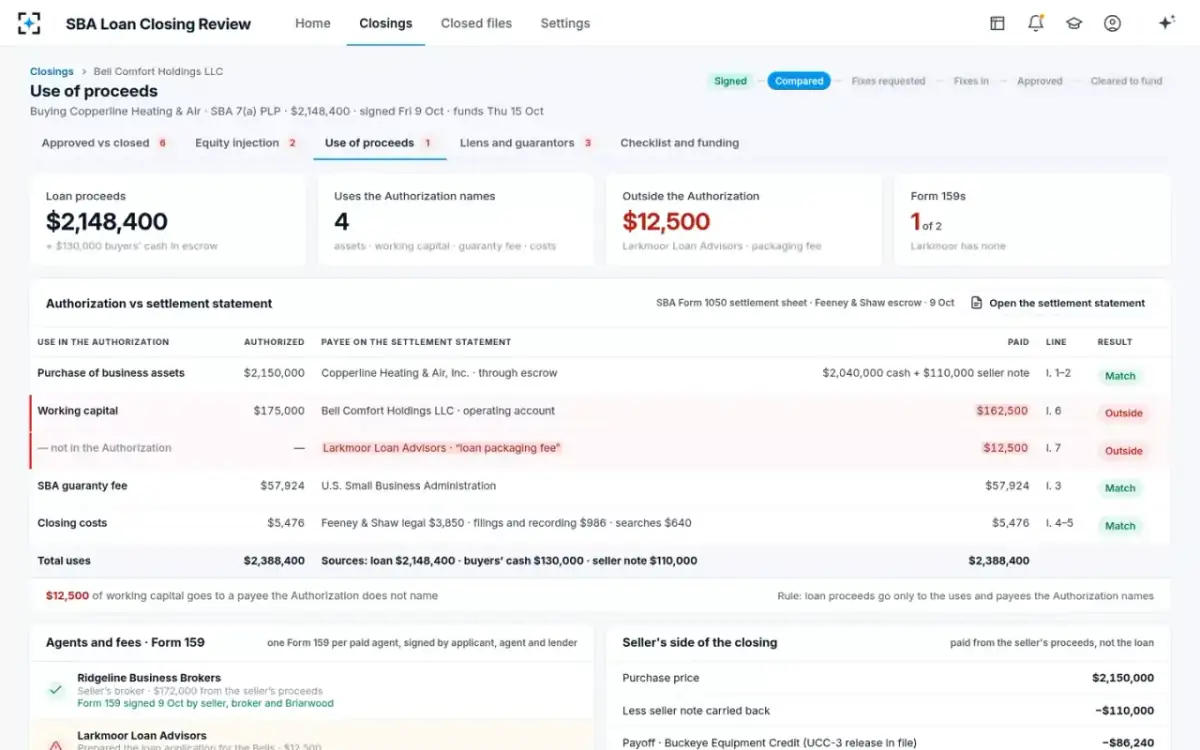
In the sample closing, two parties were paid in connection with the deal. Ridgeline Business Brokers, paid $172,000 out of the seller's proceeds, had a Form 159 signed on 9 October. Larkmoor Loan Advisors, which prepared the buyers' application, was paid $12,500 out of the loan's working capital as a "loan packaging fee", with no Form 159 and no breakdown of its work. That was one of six exceptions held before funding.
Is there a $2,500 threshold for Form 159?
There are two $2,500 lines in SBA's fee rules, and neither one excuses an agent from the form. For the lender's own packaging fee, SBA lets the lender charge "a flat fee of up to $2,500 per loan without documenting the service performed"; above $2,500, the lender must complete a Form 159. For agents, the form is needed at any amount, and the $2,500 line decides how much detail it carries: "If the aggregate compensation for all fees provided by the same Agent exceeds $2,500, an itemization of the compensation received and supporting documentation must be attached" (SOP 50 10 8.1).
The two $2,500 lines in SBA's fee rules, side by side
The lender's own fee: A flat fee may be charged without documenting the service; it is disclosed in the SBA Loan System.
An agent's fee: Form 159 still required, signed by applicant, agent and lender.
The lender's own fee: Form 159 required; percentage fees capped at the lesser of the lender's own practice or 5% (loans of $150,000 or less) or 3% (larger loans), with a $30,000 ceiling.
An agent's fee: Form 159 plus an itemisation of the compensation and supporting documentation.
The lender's own fee: Charging for the same service twice, or splitting a loan to charge two fees.
An agent's fee: Fees hidden from the lender; a false "no agent" answer.
Who signs SBA Form 159, and when is it uploaded?
The applicant, the agent and the 7(a) lender all sign each Form 159, and the lender uploads it after the first disbursement, alongside its monthly Form 1502 report. The deadline is counted in reporting cycles, not days: "Submission must be within two SBA Form 1502 reporting cycles from the date of initial disbursement." The lender keeps the original-signature version and the supporting documents in its file for compliance review.
The penalty falls first on the agent. "Failure of an Agent to fully complete and execute the required SBA Form 159 may result in suspension or revocation of the Agent's privilege to conduct business with SBA under 13 CFR Part 103." The lender is not untouched: failing to name an agent in the SBA Loan System "may result in a finding by OCRM", SBA's lender oversight office, and incomplete Forms 159 were among the technical exceptions SBA logged again and again at two small business lending companies in the period its Inspector General reviewed in 2026.
Who is not an Agent for Form 159?
SBA lists seven kinds of paid party that are not Agents for Form 159 purposes, and the closing attorney is one of them. The list matters at closing because the settlement statement is full of payees, and a closer needs to know which of them need a form.
Paid at closing but not an Agent: no Form 159 needed
| Party | Why no Form 159 |
|---|---|
| Any attorney in connection with the SBA loan closing | Excluded by name; legal fees must still be hourly and reasonable |
| A Lender Service Provider working for the lender | Only under an SBA-reviewed LSP agreement; its services to the lender are not reported on Form 159 |
| A state-certified or licensed appraiser employed by the lender | Collateral appraisal for the SBA loan |
| A qualified source employed by the lender for a business valuation | Independent valuation for the SBA loan |
| An environmental professional employed by the lender | Environmental assessment of the collateral |
| A real estate agent paid a sale commission | Commission on real estate sold in connection with the loan |
| The applicant's own accountant | Only for financial statements prepared in the normal course of business, not for the application |
Everyone else paid in connection with the application is presumptively an Agent. A consultant who "helped with the business plan", an adviser who introduced the buyers to the lender, a broker paid a success fee: each needs a signed form, and each form needs an itemisation once that agent's fees pass $2,500.
Why SBA cares who was paid
SBA collects about 16,210 Forms 159 and 159D a year, by its own estimate, to see "whether borrowers are paying unnecessary, unreasonable or prohibitive fees" and to "monitor the Agents, fees charged by Agents, and the relationship between Agents and lenders" (Federal Register 2025-07624). Its Inspector General is blunter about why.
"Our investigative work has revealed a pattern of fraud by loan packagers and other fee-based agents in the 7(a) loan guaranty program."
SBA OIG, Top Management and Performance Challenges, FY2026
The cases show what a missing form can hide. In a 2023 Massachusetts case, two brokers and a bank loan officer were sentenced after applications for SBA Express loans "falsely indicated that no broker had assisted in preparing or referring the loan applications, when they in fact charged borrowers excessive fees" (FDIC Office of Inspector General). A Form 159 does not prevent fraud, but a closer who checks every payee on the settlement statement against the forms in the file will see an unexplained fee before it is paid.
Every payee on the settlement statement, tied to an approved use or flagged
The other closing thresholds, from five days to 48 months
The rest of the numbers in the figure above fall into three groups: those due before the first dollar, the escrow limit at closing, and those that run after the last dollar. The first group is where funding should hold; the third is where files quietly go stale.
Before the first dollar: owners of 20% or more give unlimited guaranties, counting direct and indirect ownership and spouses whose combined interest reaches 20%; each cash injection is backed by a source statement covering at least 30 days; and if the IRS has not answered a transcript request within 10 business days, the lender resubmits the request marked as a second request. At closing, loan funds may sit in escrow for five business days at most, and the lender may not report the loan as disbursed or charge the guaranty fee until the funds leave escrow. After the last dollar: changes to the terms in place when the loan number was issued go to SBA within 15 business days, licences are in the file within 90 days, and the loan must be fully disbursed within 48 months of approval or SBA cancels the rest (SOP 50 10 8.1). The 15 business days after disbursement walks through the post-closing group in order.
When is SBA hazard and flood insurance required?
Hazard insurance is required on all collateral for 7(a) loans above $50,000, at full replacement cost, with a mortgagee or lender's loss payable clause in the lender's favour and at least 10 days' written notice of cancellation; "If hazard insurance is not available, the loan cannot be approved." Flood insurance follows the National Flood Insurance Program rules: a building in a special flood hazard area that secures the loan must be insured, and so must collateral equipment, fixtures or inventory inside it.
SBA insurance requirements at closing, by type
| Insurance | When required | What the closer checks |
|---|---|---|
| Hazard | All collateral, on 7(a) loans above $50,000; exceptions for loans of $500,000 or less where residential real estate is in junior position and cover cannot be had, or business assets are worth $50,000 or less | Full replacement cost; mortgagee or loss payable clause; 10 days' cancellation notice |
| Flood | Collateral buildings, and personal property collateral inside them, in a special flood hazard area | NFIP or equivalent private policy; at least the lesser of the principal or the maximum NFIP cover; 45 days' notice for private policies |
| Life | Standard 7(a): if the loan is not fully secured, for the principals of sole proprietorships, single-member LLCs or businesses dependent on one owner | Cover equal to the collateral shortfall; collateral assignment acknowledged by the insurer's home office |
| Life, 7(a) Small and SBA Express | Lender's own written policy for similar non-SBA loans | Whatever the approval requires |
When is life insurance required on an SBA loan?
On a standard 7(a) loan, life insurance is required when the loan is not fully secured and the business depends on one person: "life insurance is required in the amount of the collateral shortfall for the principals of sole proprietorships, single member LLCs, or for businesses otherwise dependent on one owner's active participation." Otherwise the lender may follow its own policy for similar non-SBA loans, and for 7(a) Small and SBA Express loans the lender's written policy governs throughout. SBA does not require credit life or whole life cover, and the lender may accept an existing policy.
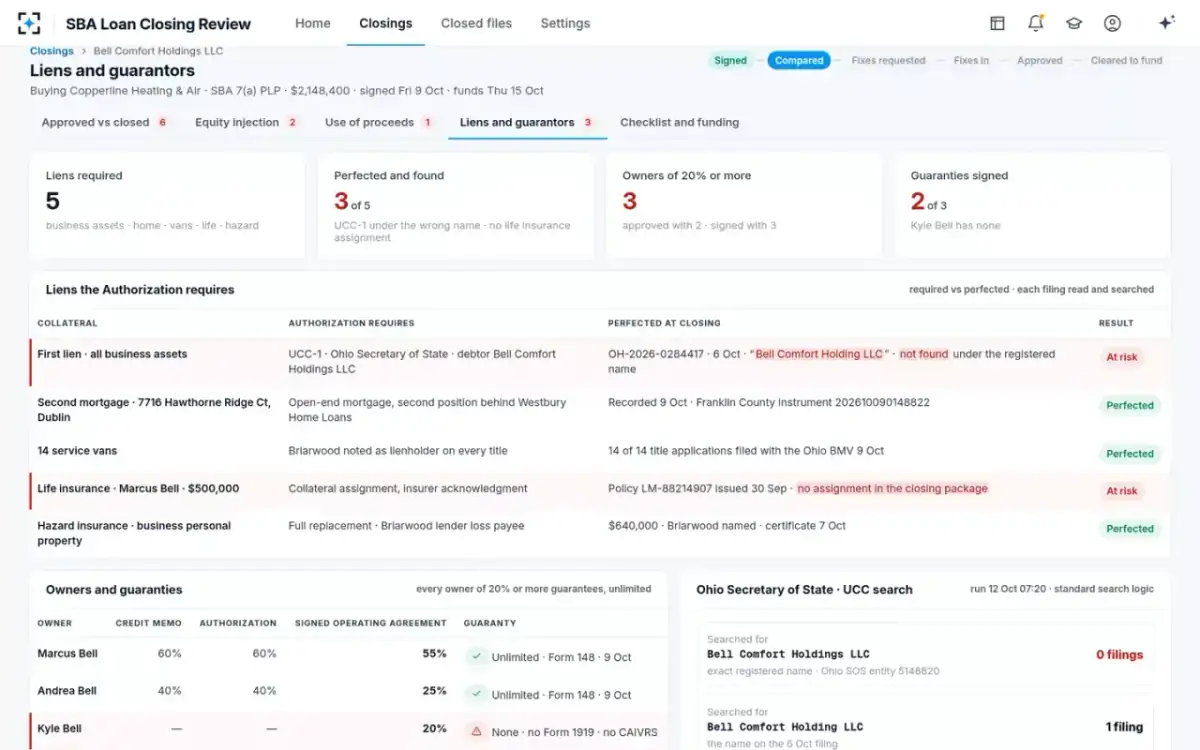
The detail that trips closings is the assignment, not the policy. Each required policy needs "a collateral assignment identifying the 7(a) Lender ... as assignee that is acknowledged by the Home Office of the Insurer", and the borrower pays the premiums. In the sample closing, the insurer had issued a $500,000 policy on Marcus Bell on 30 September, but no assignment had been signed and none of the 38 documents mentioned one. Funding held until the assignment was signed on 13 October and acknowledged by the insurer the next day.
Thresholds the sample closing turned on
$12,500
paid to an adviser with no Form 159, above the $2,500 itemisation line
20%
stake of a third owner who had signed no guaranty
$500,000
life policy issued but not assigned to the lender
Form 155: the standby line that has no number
SBA Form 155, the Standby Creditor's Agreement, is the one closing threshold expressed as a condition rather than a number: debt counts as equity only if it is on "full standby (no payments of principal or interest for the term of the 7(a) loan)", on Form 155 or the lender's equivalent, "and a copy of the note must be attached to the standby agreement" (SOP 50 10 8.1). Interest may accrue and be paid after the SBA loan is repaid; standby and seller debt together may make up no more than half the required injection.
The number hides in the note. A standby agreement can say full standby while the note it covers says interest-only from month 25, as the sample seller note did. Checking Form 155 without reading the attached note checks the label, not the terms. What a missing wire costs follows what that note did to the sample buyers' injection.
Owners and liens against the thresholds that govern them
Questions people ask
Is SBA Form 159 still required?
Yes. SOP 50 10 8.1, in force since 1 October 2026, keeps Form 159 for every paid Agent and for lender fees above $2,500, and SBA sought comment on renewing the form's information collection in May 2025. It applies to SBA Express and 7(a) Small loans too, which must meet SBA's required-forms list even though they close under the lender's own procedures.
Does a closing attorney need to sign a Form 159?
No. SOP 50 10 8.1 excludes "any attorney in connection with the SBA Loan closing" from the definition of Agent for Form 159. Legal fees charged to the borrower must still be hourly and for services by a licensed attorney or someone under one's direct supervision.
Does a business broker need a Form 159?
A broker paid by the applicant or the lender in connection with the loan is an Agent and needs one, with an itemisation above $2,500. Where the seller pays the broker out of sale proceeds, follow the form's instructions and counsel's view; the fictional sample lender collects a Form 159 from the seller's broker as a matter of policy.
What happens if a Form 159 is missing?
The agent risks suspension or revocation of its privilege to do business with SBA under 13 CFR Part 103, and the lender risks an oversight finding. At purchase review, an undisclosed fee paid from loan proceeds is also a use of proceeds outside the approval.
Can SBA loan proceeds pay a packaging fee?
Loan proceeds may go only to the uses and payees the approval names, so a fee paid from proceeds has to appear there, and an agent's fee needs a Form 159 wherever it is paid from. In the sample closing, a $12,500 packaging fee came out of approved working capital, so it failed twice: no Form 159, and a payee the approval did not name. The fix was a revised settlement statement with the full $175,000 to the borrower and the fee paid outside the loan, with a signed Form 159.