The SBA loan authorization is the statement of the terms and conditions under which SBA guarantees a loan: amount, fees, repayment terms, use of proceeds, guarantors, collateral and lien priority, and any special conditions. For 7(a) loans it is no longer a signed document. SBA's servicing SOP defines it as "SBA's written agreement", then adds that "For 7(a) Loans approved after August 1, 2023, Loan Authorization means the electronic record of the terms and conditions of the Loan in E-Tran". SOP 50 10 8 called that record the E-Tran Terms and Conditions; SOP 50 10 8.1, in force since 1 October 2026, calls it the SBA Terms and Conditions, held in the "SBA Loan System". The names changed; the rule did not. The lender must close the loan to those terms, and SBA's guaranty depends on it. That is why reading the approved terms against the signed documents is the core of a closing review, and it is what Botminds' SBA Loan Closing Review does: one agent lists every approved term with its page, another reads the signed package, and a third ties each term to the document that meets it.
The sample examples come from a fictional closing in the solution, a $2,148,400 acquisition loan for Bell Comfort Holdings LLC approved on 24 September 2026. The definitions are quoted from SBA's SOPs.
The SBA loan authorization, then and now
Loan Authorization (SBA's definition): "SBA's written agreement, including subsequent modifications thereto, which sets out the terms and conditions under which SBA will guarantee a Loan."
SBA Terms and Conditions (SOP 50 10 8.1): "The digital loan guaranty authorization request by the Lender to SBA" under the terms "submitted in the SBA Loan System".
Loan Authorization (SBA's definition): A written agreement.
SBA Terms and Conditions (SOP 50 10 8.1): "SBA does not require signatures on the terms and conditions."
Loan Authorization (SBA's definition): In the lender's loan file.
SBA Terms and Conditions (SOP 50 10 8.1): "Electronically stored in the SBA Loan System."
Loan Authorization (SBA's definition): SBA authorises the guaranty on the stated terms.
SBA Terms and Conditions (SOP 50 10 8.1): Delegated lenders submit the terms with the request and the loan number issues; non-delegated loans get a number if SBA approves.
Loan Authorization (SBA's definition): Close and service the loan to its terms.
SBA Terms and Conditions (SOP 50 10 8.1): "Close the loan in accordance with the provisions of the SBA Terms and Conditions, including any SBA-approved post-approval modifications."
What is an SBA loan authorization?
An SBA loan authorization is SBA's approval of a guaranty on stated terms: the loan amount and SBA's share of it, the fees, the repayment terms, what the proceeds may be used for, who must guarantee, what collateral secures the loan and in what lien position, and any conditions to be met before disbursement. It is the yardstick for everything that follows. The lender's credit memo explains why the loan makes sense; the authorization fixes what SBA agreed to guarantee.
The phrase survives in everyday use and in SBA's own servicing rules. SOP 50 57 4, the 7(a) servicing and liquidation SOP in force since 1 November 2025, lists the "Loan Authorization/E-Tran Terms and Conditions" first among the loan documents and still says "Loan Authorization" in its purchase-review chapters (SOP 50 57 4). A closer who searches an older file for "Authorization" will find one; a closer who searches a 2026 loan will find "Terms and Conditions".
What replaced the SBA Authorization?
An electronic record replaced it, for 7(a) loans approved after 1 August 2023. Instead of a written authorization, the lender submits the loan's terms and conditions digitally with its guaranty request, and SBA's approval issues against that record. SOP 50 10 8, effective 1 June 2025, called it the E-Tran Terms and Conditions, "the digital loan guaranty authorization request by the Lender to SBA" (SOP 50 10 8). SOP 50 10 8.1 kept the definition, changing only the names: E-Tran Terms and Conditions became SBA Terms and Conditions, and "E-Tran" became "SBA Loan System", which it defines to cover "All current and future SBA designated electronic loan systems" so the SOP need not be amended "if system names change" (SOP 50 10 8.1).
One document, three names: what each SBA rulebook calls the approval
| Rulebook | In force from | Name for the approved terms |
|---|---|---|
| SOP 50 57 4 (servicing and liquidation) | 1 November 2025 | "Loan Authorization/E-Tran Terms and Conditions"; for loans approved after 1 August 2023 the Loan Authorization is the electronic record in E-Tran |
| SOP 50 10 8 (origination) | 1 June 2025 | "E-Tran Terms and Conditions", stored in E-Tran |
| SOP 50 10 8.1 (origination) | 1 October 2026 | "SBA Terms and Conditions", stored in the SBA Loan System |
The renaming matters less than what came with it in 2023: an approval that exists as data in SBA's system rather than as a signed page in the file. A closer can no longer staple the authorization to the front of the package and read down it. The approved terms have to be pulled from the system, printed or exported, and compared with documents drafted by other people afterwards.
What are SBA Terms and Conditions?
The SBA Terms and Conditions are the approved terms of a 7(a) loan as submitted digitally in the SBA Loan System, and SBA's guaranty is conditional on them. SOP 50 10 8.1 lists what must be submitted: the upfront fee and the lender's annual service fee, the repayment terms, the use of proceeds, the guarantors, the collateral "including lien priority", and construction terms where they apply. Insurance requirements must appear in them too.
"SBA's guaranty is subject to the terms and conditions authorized by SBA in the SBA Loan System (including any changes) and the Lender's compliance with those terms and conditions and all other applicable SBA Loan Program Requirements."
SBA SOP 50 10 8.1, Section B, Chapter 6
Two other SOP lines show how far the terms reach into the closing documents. A lender using the SBA note must "insert the repayment terms from the SBA Terms and Conditions into the Note", and one using its own note must comply with SBA's repayment terms even if it does not copy the wording. And before disbursement the borrower and operating company certify that they "received a copy of the SBA Terms and Conditions or the Lender's equivalent". The terms are not signed by SBA, but the documents the borrower signs must carry them.
Is the SBA loan authorization signed?
Not for 7(a) loans approved under the electronic process. SOP 50 10 8.1 says it plainly: "SBA does not require signatures on the terms and conditions. The terms and conditions are electronically stored in the SBA Loan System." The same sentence appeared in SOP 50 10 7.1 and 8.
The absence of a signature changes the closing in one practical way: no one has a signed copy to point to when the deal changes. If an owner's percentage moves, a seller negotiates payments on a standby note, or a payee appears on the settlement statement, the only way to find it is to compare the system's terms with each signed document. In the sample closing, the operating agreement signed on 2 October gave a third owner 20%; the approved terms still listed two owners at 60% and 40%.
Which SOP applies to an older loan?
SBA judges a loan's making and closing by the SOP 50 10 that was in force when the loan was approved, whatever has changed since. "SBA will apply the requirements of SOP 50 10 in effect when the Loan was approved for loan making, loan closing, and loan modifications that took place on the date of or prior to full disbursement" (SOP 50 57 4, Chapter 24). A 2024 loan is read under SOP 50 10 7.1, and its approved terms under the E-Tran name.
For the move to SOP 50 10 8.1, SBA's notices did not word the trigger the same way. The superseding notice of 25 September 2026 says SOP 50 10 8.1 applies "to all applications received by SBA on or after" 1 October 2026 and that SOP 50 10 8 applies to applications "submitted through September 30, 2026" (SBA Information Notice 5000-882227); the August notice it replaced referred to the loan-number date. A closer should take the trigger from the notice that governs the loan and note it in the file. The sample loan, approved on 24 September 2026, closes under SOP 50 10 8 on either reading.
Can terms change between approval and closing?
Yes, but only through SBA's post-approval process, and some changes need SBA's approval before the lender acts. Before final disbursement, SOP 50 10 8.1 sends lenders to SBA's servicing matrix and SOP 50 57: changes that need SBA's prior approval go to the loan guaranty processing center with the reason, details, supporting documents and the lender's recommendation; changes that need only notification are made in E-Tran Servicing; and "Lenders must not unilaterally approve any actions that require prior SBA approval" (SOP 50 10 8.1).
Before you close on changed terms: the checks the SOP implies
- Is this a change to the approved terms at all?
Owners, guarantors, collateral, lien position, uses and payees, fees and repayment are all in the SBA Terms and Conditions.
- Does it need SBA's prior approval?
Check the servicing matrix and SOP 50 57; examples include releasing a guarantor and increasing or decreasing the loan amount.
- Has your own credit authority approved it?
A new owner or a different structure is a credit decision before it is an SBA one.
- Is it a loan increase?
More than 20% of the original amount or more than 18 months after approval needs SBA approval on non-delegated loans and documented analysis on delegated ones.
- Is it entered where SBA will see it?
Notification items in E-Tran Servicing; every change in place since the loan number issued reported within 15 business days of final disbursement.
- Do the signed documents now match the changed terms?
Guaranty, Form 1919 and searches for a new owner; an amended note or standby; a revised settlement statement.
Which changes need SBA approval?
SBA's prior written approval is needed for the changes listed in 13 CFR 120.536 and in Chapter 3 of SOP 50 57 4, and some of them are common at closing. The regulation's list includes any action that "Increases the principal amount of a loan above that authorized by SBA at loan origination" or "Confers a Preference on the Lender" (13 CFR 120.536). The SOP adds, among others, the "Release of a co-Borrower or Guarantor", an "Increase in SBA's guaranty percentage", and an "Increase or decrease in the Loan amount", which on delegated loans is approved "directly in E-Tran" (SOP 50 57 4).
Adding a guarantor is not on that list; releasing one is. In the sample closing, the new 20% owner had to be added, not released, so the decision was the lender's: Priya Raman, the senior credit officer, approved him as an owner and unlimited guarantor with coverage unchanged at 1.42 times, and the change to the guarantors would then go into the report to SBA after final disbursement. The 15 business days after disbursement covers that report.
One approval, read against one signed package
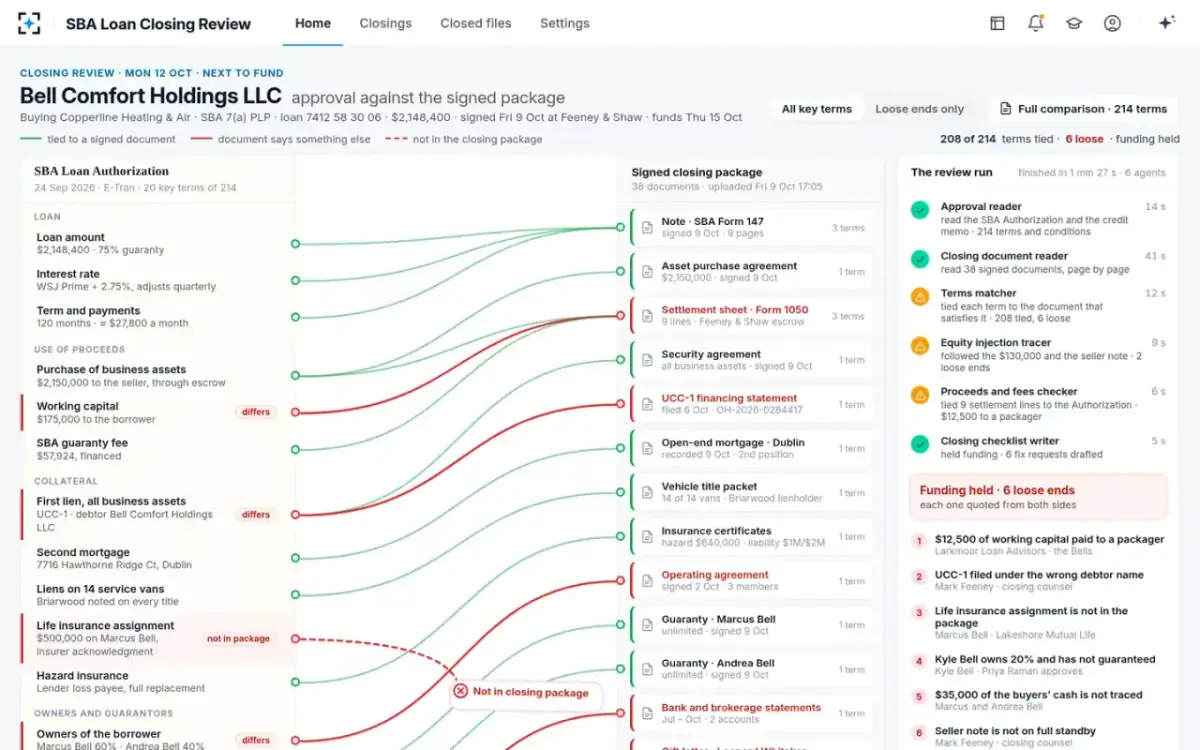
214
approved terms and conditions listed from the credit memo and the approved SBA terms
38
signed documents read against them, page by page
6
terms the signed package did not meet
How a closing review reads the approved terms
A closing review reads the approved terms as a list of claims and looks for the document that proves each one. In the solution, the approval reader lists every term from the credit memo and the approved SBA terms with its page, never deciding which version is right; the closing document reader extracts what each signed document sets, with clause and page; and the terms matcher compares meaning, not just words, raising any difference in an amount, party, percentage, payee, lien, name or payment schedule with both quotes.
One approved term with nothing in the package to meet it
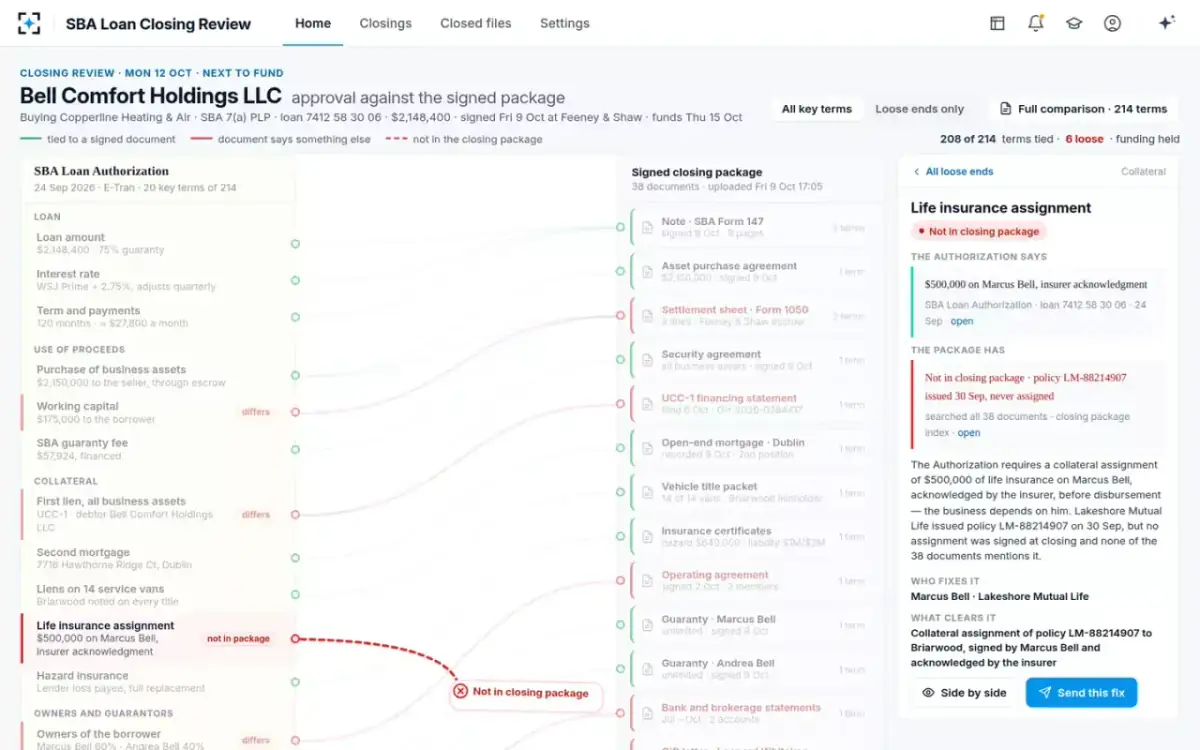
The design follows the shift the rules made. When the authorization was a signed page, the risk was that nobody read it carefully; now that it is a record in SBA's system, the risk is also that the version the closer reads is not the current one. The solution reads the approved terms the lender supplies, so the export it reads has to carry every post-approval change, and by default it applies the SOP in force on each loan's approval date, so a 2024 loan and a 2026 loan are each tested against their own rules. The SBA closer's job description shows where that reading sits in the closer's week.
Every approved term, tied or loose, before anyone signs
Questions people ask
Where do I find the SBA Terms and Conditions for a loan?
In the SBA Loan System, where SBA stores them electronically, and in the lender's own file as an export or print. SBA asks lenders not to send it closing documents, so the lender's copy of the approved terms, with every post-approval change, is the one the closing has to be checked against.
Is there an SBA loan authorization form to sign?
Not for 7(a) loans approved through the electronic process; SBA does not require signatures on the terms and conditions. The borrower signs the note, guaranties and lien documents that carry the terms, and certifies before disbursement that it received a copy of the SBA Terms and Conditions or the lender's equivalent.
Does the SBA Terms and Conditions replace the promissory note?
No. The note is still required, on SBA Form 147 or the lender's own form, and must carry the repayment terms from the SBA Terms and Conditions. A lender's own note must also include SBA's federal-law clause and be legally enforceable and assignable.
What is the SBA Loan System?
It is SOP 50 10 8.1's name for "All current and future SBA designated electronic loan systems", including E-Tran. SBA chose a general name so that its SOP would not need amending whenever a system is renamed.
Are 504 loans also on SBA Terms and Conditions?
Yes. In the 504 program the SBA Terms and Conditions are SBA's agreement with the CDC on the terms under which SBA will issue a debenture, and they must use the pre-approved conditions in SBA's Boilerplate. Who drafts them depends on whether the loan is processed under regular, ALP or PCLP authority.