A loan closing checklist template for an SBA 7(a) loan should list every term in the approved SBA terms and every condition SOP 50 10 8.1 puts before disbursement, each with the signed document that satisfies it and the person who confirms it: the note and repayment terms, guaranties from every owner of 20% or more, liens and their filings, insurance, the equity injection and its three proofs, standby agreements, use of proceeds and the settlement sheet, Form 159 for each paid agent, reconciled IRS transcripts and the borrower's certifications. Templates like that are easy to find and easy to fill in. The hard part is who fills them in: on most SBA closings the closer who requested, received and assembled the package is also the one who ticks it off, and a person checking their own work sees what they expect to see. Botminds' SBA Loan Closing Review gives the checklist an independent reader: six agents compare each approved term with the credit memo and the signed documents and hold funding on every mismatch, so the closer and the closing manager sign a checklist someone else has already tested.
The worked examples follow a fictional sample lender closing a $2,148,400 SBA 7(a) acquisition loan for Bell Comfort Holdings LLC. The requirements are quoted from SBA's SOPs and the findings from SBA's Inspector General, linked where they appear.
Maker and checker on an SBA closing: who prepares, who compares, who decides
A person decides
Closer requests and assemblesOrders searches, insurance and the standby agreement; receives the signed package from closing counsel.
Agent
Approval readerLists every term and condition in the credit memo and the approved SBA terms, with its page.
Never: decides which version of a term is right.
Agent
Closing document readerReads every signed document and extracts the terms each sets, with clause and page.
Never: fills a blank or edits a signed document.
Agent
Terms matcherCompares each term across the three sources and raises every difference with both quotes.
Never: waives a mismatch.
A person decides
Closer resolves, credit approvesThe closer sends each fix; the credit officer approves any change to approved terms.
A person decides
Closing manager signsSigns the checklist only when every term ties; nothing is released before.
What should an SBA loan closing checklist include?
An SBA loan closing checklist should follow the approved terms first and the SOP second, because SBA's guaranty depends on both. Under SOP 50 10 8.1 the guaranty is conditional on both: on the terms SBA authorized and on the lender's compliance with them and with every other program requirement. The template below has twelve sections; each row says what the section must establish and which document proves it.
An SBA 7(a) loan closing checklist template: twelve sections and their proof
| Section | What it must establish | The document that proves it |
|---|---|---|
| 1. Approved terms | The current approved SBA terms, and any post-approval change approved by SBA where approval is required. | The terms in the SBA Loan System; SBA approval of any prior-approval change |
| 2. Note | Amount, rate, base rate and adjustments, maturity, payments, any interest-only period as approved. | SBA Form 147 or the lender's note with SBA's federal-law language |
| 3. Guaranties | An unlimited guaranty from every owner of 20% or more, direct or indirect, and any other guarantor the approval names. | SBA Form 148 / 148L or the lender's equivalent, signed |
| 4. Collateral and liens | Every lien the approval requires, in the required position, filed under the debtor's exact name. | Filed and recorded instruments; a search that finds each filing |
| 5. Insurance | Hazard on collateral for loans over $50,000, flood where required, life insurance where approved. | Certificates with loss payee or mortgagee clause; life policy assignment acknowledged by the insurer |
| 6. Equity injection | The required amount, verified before any disbursement. | Wire or check with proof it cleared, source statement of at least 30 days, deposit or settlement statement |
| 7. Standby debt | Any debt counted as equity is on full standby for the life of the loan. | Form 155 or equivalent, with the note attached |
| 8. Use of proceeds | Every dollar goes to a use and payee the approval names. | Settlement sheet (Form 1050 or equivalent), invoices, joint payee checks or wires |
| 9. Agents and fees | Every paid agent is disclosed; lender fees above $2,500 documented. | One Form 159 per agent, signed by applicant, agent and lender |
| 10. Tax verification | Transcripts received and reconciled with the financial data credit used. | IRS transcripts via IVES (Form 4506-C) or Form 8821, and the reconciliation |
| 11. Borrower certifications | No adverse change since the application, taxes current, no change of ownership without consent. | Signed certifications |
| 12. After closing | Changes reported within 15 business days of final disbursement; licences within 90 days; Form 159 uploaded within two 1502 cycles. | SBA Loan System entries; licences in the file |
Two choices make this template better than the usual one. It is organised by what must be true, not by document name, so a missing assignment of life insurance shows as an unmet condition rather than a document nobody thought to list. And every row has a "proved by" column, so a tick means a named document was read, not that a folder exists.
Is there an official SBA 7(a) loan closing checklist?
No. SBA publishes no closing checklist form for 7(a) loans; it publishes the requirements, mostly in Section B, Chapter 6 of SOP 50 10 8.1, and leaves the checklist to the lender. SBA does not see the closing documents either: "the Lender should not send SBA any other loan closing documentation, including disbursement information, except through the required periodic loan status reports using SBA Form 1502" (SOP 50 10 8.1). The first time anyone at SBA reads the closing package is usually a lender review or a purchase review after default.
That is the difference between an SBA closing checklist and a commercial loan closing checklist. A commercial checklist is the bank's own control; its gaps cost the bank only what the collateral fails to cover. An SBA checklist is evidence for a guarantor who will read it later, and the regulation lets that guarantor walk away from a loan the lender did not close prudently (13 CFR 120.524). How SBA closing review differs from a mortgage pre-funding checklist works through the same contrast for quality control teams.
Why the closer who built the package should not be its only checker
The person who assembled a closing package is the worst-placed person to find what is wrong with it. The closer ordered the lien filing, so she reads the filing for the filing number, not the debtor name. She asked closing counsel for a seller note on standby, so a note that arrives with a standby agreement attached reads as done. She knows the buyers have the money, because she has seen their statements, so a gift letter with a deposit looks like proof.
Each of those is a real exception from the sample closing, and each was signed off on paper: the UCC-1 had been filed, the standby agreement had been signed, the gift letter and the deposit were in the file. What failed was the content. The filing named "Bell Comfort Holding LLC", and a search under the registered name, Bell Comfort Holdings LLC, returned nothing. The seller note itself started interest-only payments in month 25. Nothing showed the gift leaving the donor's account. A checker who did not build the package reads for what the documents say rather than for what was asked for.
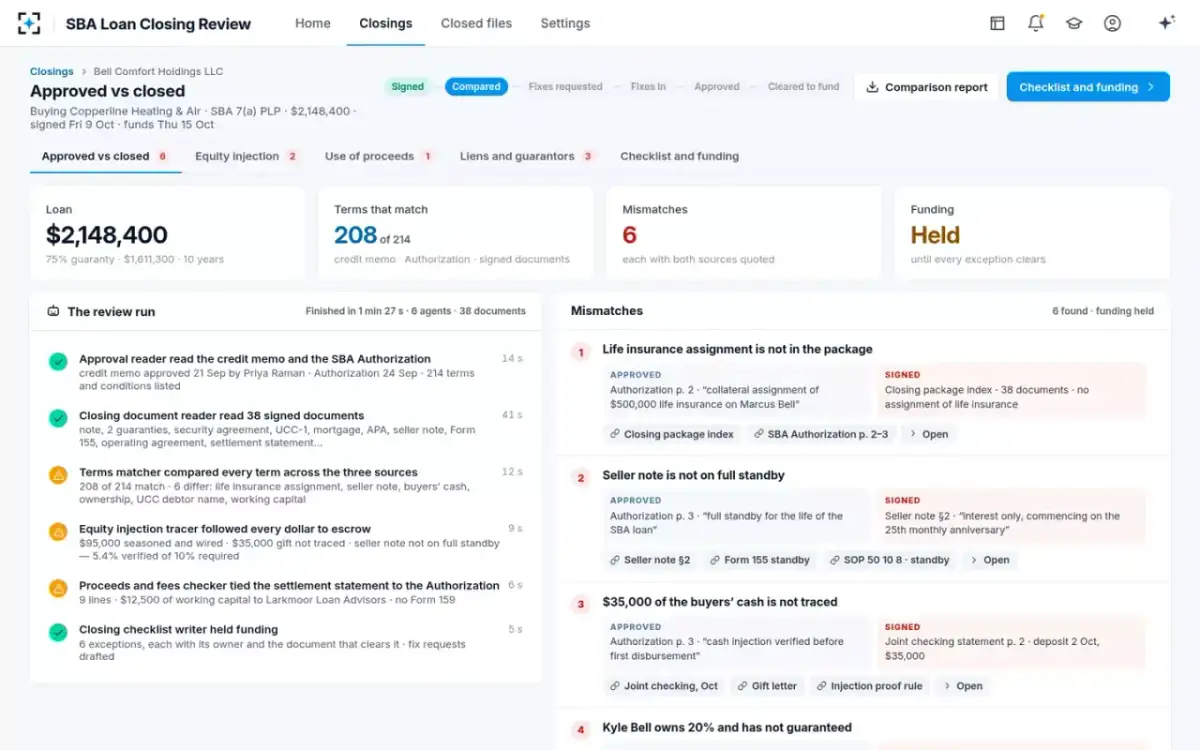
Approved against closed: each mismatch with both quotes and the page
Where do terms drift between approval and closing?
Terms drift wherever a document is drafted after approval by someone who did not write the approval: the operating agreement, the seller note, the settlement statement, the lien filings and the insurance. An SBA loan's terms are written three times, in the credit memo, in the approved SBA terms and in the signed documents, and the three are prepared by different people in different weeks.
One term, three sources: where the sample closing drifted
Approved (credit memo and SBA terms): Marcus Bell 60%, Andrea Bell 40%, both guaranteeing.
Signed at closing: Operating agreement of 2 October: Marcus 55%, Andrea 25%, Kyle Bell 20%, with no guaranty, Form 1919 or CAIVRS check for Kyle.
Approved (credit memo and SBA terms): $110,000 on full standby for the life of the SBA loan, counted toward the injection.
Signed at closing: Note §2: "interest only, commencing on the 25th monthly anniversary", while the standby agreement says full standby.
Approved (credit memo and SBA terms): $175,000 to the borrower.
Signed at closing: Settlement statement: $162,500 to the borrower and $12,500 to a loan advisory firm as a "loan packaging fee".
Approved (credit memo and SBA terms): UCC-1 against all business assets of Bell Comfort Holdings LLC.
Signed at closing: UCC-1 filed under "Bell Comfort Holding LLC"; a search under the registered name finds 0 filings.
Approved (credit memo and SBA terms): Collateral assignment of $500,000 on Marcus Bell, acknowledged by the insurer, before disbursement.
Signed at closing: Policy issued 30 September; no assignment among the 38 signed documents.
None of the five is exotic. Each is the kind of change that happens between approval and closing because the deal keeps moving: a family member joins the ownership, a seller negotiates some payments, an adviser sends an invoice, a paralegal drops a letter. A checklist that asks "operating agreement received?" passes all five.
Can the same person prepare and check the closing?
SBA's rules do not forbid it, but they leave the lender holding the risk if the check fails. Nothing in SOP 50 10 8.1 says who must review a closing; it says what must be true before disbursement, and SOP 50 57 4 lists what SBA will deny or repair at purchase. At a lender that closes a handful of SBA loans a year, a second trained closer is hard to justify, and most SBA lenders are that size: 711 of the 1,336 lenders that made a 7(a) loan in fiscal 2025 made five or fewer, by our count of SBA's loan data.
There are three ways to add the second reader. A second closer or the closing manager can re-read the package, which roughly doubles the reading hours; our estimate of a single by-hand review of an acquisition package is about 21 hours. Quality control can sample closed loans afterwards, which finds problems after the money has moved. Or a reader that did not prepare the package can compare every term before funding and leave the people with the decisions. Mortgage investors already require pre-funding reviewers to be independent of origination; SBA lenders can borrow the principle without waiting for SBA to require it.
What did OIG find at SBA closings?
SBA's Inspector General keeps finding the same closing failures. Its September 2026 report on small business lending companies tallied the deficiencies SBA's own reviewers had found, again and again, at the two companies that made most of that sector's 7(a) loans; closing and disbursement failures and incomplete forms were two of the largest groups.
Repeated deficiencies SBA found at two lenders, Oct 2021 to Mar 2025
The older evidence points the same way. In OIG's high-risk review of eight early-defaulted loans SBA had already purchased, "lender origination and closing deficiencies" justified denial on five, about $8.7 million, and "SBA staff completed purchase and quality control reviews on these eight loans but did not identify or fully address the material deficiencies" (SBA OIG Report 19-22). A second reader that reads the same way as the first adds little.
The extreme case is a certification signed by the people it was meant to check. In a 504 loan the Justice Department pursued in 2010, the bank and the borrowers "falsely certified that the Kims had experienced no adverse change in their financial circumstances, even though the bank and the Kims knew that the Kims were facing serious financial difficulties"; the $1.7 million loan never received a payment (U.S. Department of Justice).
What should loan closing checklist software do?
Loan closing checklist software for SBA lenders should test the checklist, not just store it. Most closing tools track whether a document has arrived; an SBA closing needs to know whether the document says what the approval says. These are the questions worth asking in an evaluation.
Eight questions to ask of any SBA closing checklist software
- Does it read the approved terms, or ask someone to key them?
A checklist built by retyping the approval inherits every typing error, and the person typing is the maker.
- Does it read the signed documents, or only log their arrival?
Receipt is not compliance: the seller note, the filing and the settlement statement have to be read.
- Does it compare per term, with both quotes and pages?
A mismatch nobody can see the evidence for gets waived; one with both quotes gets fixed.
- Does it hold funding while anything is open?
The control is the hold. A list of exceptions that can be signed over is a report.
- Does it apply the SOP in force for each loan?
SBA applies the SOP 50 10 in effect when the loan was approved; a tool fixed to the latest SOP misreads older closings.
- Can your own policy be set, not coded?
Seasoning, guarantor thresholds, search freshness and approvers differ by lender.
- Is every step on the audit trail?
The file an SBA reviewer reads years later should show what was compared, what was fixed and who signed.
- Does it stay out of the decisions?
It should never sign, waive, edit a signed document or move money.
Where SBA Loan Closing Review fits, and where it does not
SBA Loan Closing Review is the independent check on the checklist, not a replacement for the systems around it. It reads the credit memo, the approved SBA terms and the signed package, ties every term to the document that meets it, traces the equity injection, ties the settlement statement to the approved uses and payees, and builds the closing checklist with funding held on every open exception.
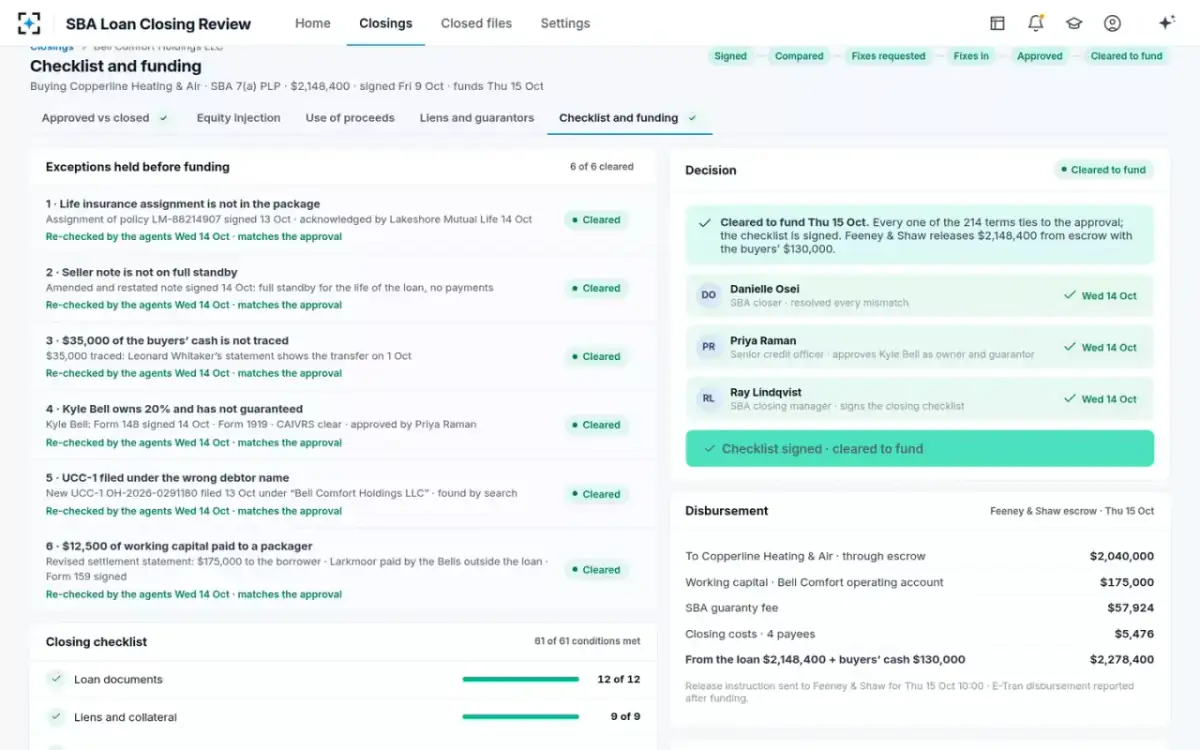
It does not draft documents, file liens, order searches or insurance, or replace closing counsel; it reads what they produce. It does not book the loan or report to SBA; the lender's own systems do that. It needs the signed package to work on, so it starts where document preparation ends. And it does not make the decisions a checklist exists to record: in the sample closing, Priya Raman approved the new 20% owner as a guarantor with coverage unchanged at 1.42 times, Danielle Osei submitted the checklist, and Ray Lindqvist signed it. How to pilot it on last quarter's closings sets out how to test that claim on your own files.
Cleared to fund: every exception closed by its document and re-checked
Questions people ask
Can a mortgage closing checklist be used for an SBA loan?
Only as a starting point. A mortgage checklist has no rows for an equity injection verified before disbursement, a standby agreement on seller debt, a Form 159 for each paid agent or guaranties from every 20% owner. Each of those is a requirement on which SBA can repair or deny the guaranty at purchase review.
Who reviews the SBA closing package at SBA?
Usually nobody at closing. SBA asks lenders not to send closing documentation except through the monthly Form 1502 reports, and it reads the file during lender oversight reviews or when the lender asks SBA to buy the guaranteed portion after a default.
Does an SBA Express loan need the same closing checklist?
Not the same one. SBA Express, Export Express and 7(a) Small loans close under the lender's own procedures for similar non-SBA loans plus SBA's required forms, and Form 1050 is not required. SBA Express loans also skip SBA's equity verification rule unless the lender verifies equity on its own comparable loans.
How many conditions does a typical SBA closing checklist hold?
It depends on the deal; an acquisition with real estate, vehicles, a seller note and life insurance carries far more than a working-capital line. The fictional sample acquisition in the solution carried 61 conditions across 214 approved terms and 38 signed documents.
When should the SBA closing checklist be signed?
Before the first disbursement, because SBA puts collateral, conditions, equity verification and tax transcripts at or before that point. Items that fall due later, such as licences within 90 days of final disbursement and the 15-business-day change report, belong on a post-closing list with their own dates.