Loan closing software, for an SBA lender, is any system that helps turn an approved 7(a) loan into a funded one: document preparation, closing checklists, e-signing, and the review that checks the signed package against the approved SBA terms before money moves. The last of those is the one an SBA lender should pilot hardest, because its failures do not show until SBA reviews a defaulted file years later. The way to pilot it is retrospective: take 20 to 30 SBA closings funded last quarter, which your closers and quality control have already checked, run them through the software, and compare what each found, against pass and fail lines set before anyone sees a result. Botminds' SBA Loan Closing Review is built to be tested this way: its six agents read the credit memo, the approved SBA terms and the signed documents of each closing, tie every term to the document that meets it, and list every mismatch with both quotes and their pages, so a quality team can check every finding by hand.
The examples come from a fictional sample lender's closings in the solution. The rules are SBA's, and the deficiency patterns come from SBA's Inspector General, linked where they appear.
Pass and fail lines to write down before a closing review pilot
- No miss in the costliest categories
Every seeded or known gap in equity injection, IRS transcript reconciliation and lien perfection is found. One miss here fails the pilot.
- Recall on all other categories at or above your line
Set the number first, for example nine in ten of known mismatches, and report the weakest category, not the average.
- False alarms below your line
For example, fewer than two per closing on files QC passed clean; above that, closers stop reading.
- Citations that hold up
In a hand-checked sample of findings, each cites the right document, page and SOP rule on both sides.
- Findings QC missed are real
Each new finding is confirmed by a reviewer who did not run the pilot before it counts in the tool's favour.
- The right SOP for each loan
Loans approved under SOP 50 10 7.1, 8 and 8.1 are each read against the version in force at approval.
- No decision taken by the software
It flags, quotes and drafts; it does not waive, sign or release anything.
What is loan closing software, for an SBA lender?
For an SBA lender, loan closing software falls into four kinds, and only one of them checks the closing. Document preparation systems draft the note, guaranties and lien instruments. Loan origination systems carry the closing checklist and the conditions. E-signing and e-closing platforms collect signatures and deliver the package. Review software reads what came back and tests it against what was approved. Most lenders already own the first three in some form.
Four kinds of loan closing software, and what each does for an SBA closing
| Kind | What it does | What it does not do for an SBA closing |
|---|---|---|
| Document preparation | Drafts the note, guaranties and lien instruments from a template, often with SBA's required clauses. | Read what the parties actually signed, or what other parties drafted: the seller note, the operating agreement, the settlement statement. |
| Loan origination system checklist | Tracks conditions and document arrivals; stores the approved terms as data. | Tell whether a received document says what the condition requires. |
| E-signing and e-closing | Collects signatures, timestamps and delivers the package. | Check content; a perfectly signed note can carry the wrong standby terms. |
| Closing review | Reads the approval and every signed document, compares term by term, and holds funding on mismatches. | Draft, file or record documents, or report to SBA; it reads what the others produce. |
The SBA-specific content is what separates review software that fits from review software that does not. A general commercial closing review checks the bank's own conditions. An SBA review has to know that an equity injection needs three documents before the first dollar, that a seller note counts only on full standby, that every agent needs a Form 159 and that the guaranty depends on closing to the approved SBA terms (SOP 50 10 8.1). A pilot is the cheapest way to find out whether a product actually knows.
How do you pilot a closing review tool?
Pilot a closing review tool on files you have already closed, so nothing in the pilot can affect a live loan, and score it against answers you already have. A retrospective pilot also removes the strongest bias in software evaluations: nobody can tune the run to the answer, because the answer was written down by your own people months ago.
A four-week retrospective pilot, drawn to scale
- Set lines, pick 25 files, seed copiesWeek 1
- Supply files and QC resultsWeek 2
- Blind scoring and adjudicationWeek 3
- Decide against the linesWeek 4
- Settings from your policyWeek 1
- Run all 25 closingsWeek 2
- Answer questions on findingsWeek 3
Two rules keep the pilot honest. The person who scores the findings should not be the person who ran the software, and the seeded copies should be prepared by someone who records what was planted and keeps it from both. And disagreements between the software and your quality control should go to a third reader, because sometimes the software is right and QC missed it, which is the most valuable thing a pilot can show.
How many loans should a pilot cover?
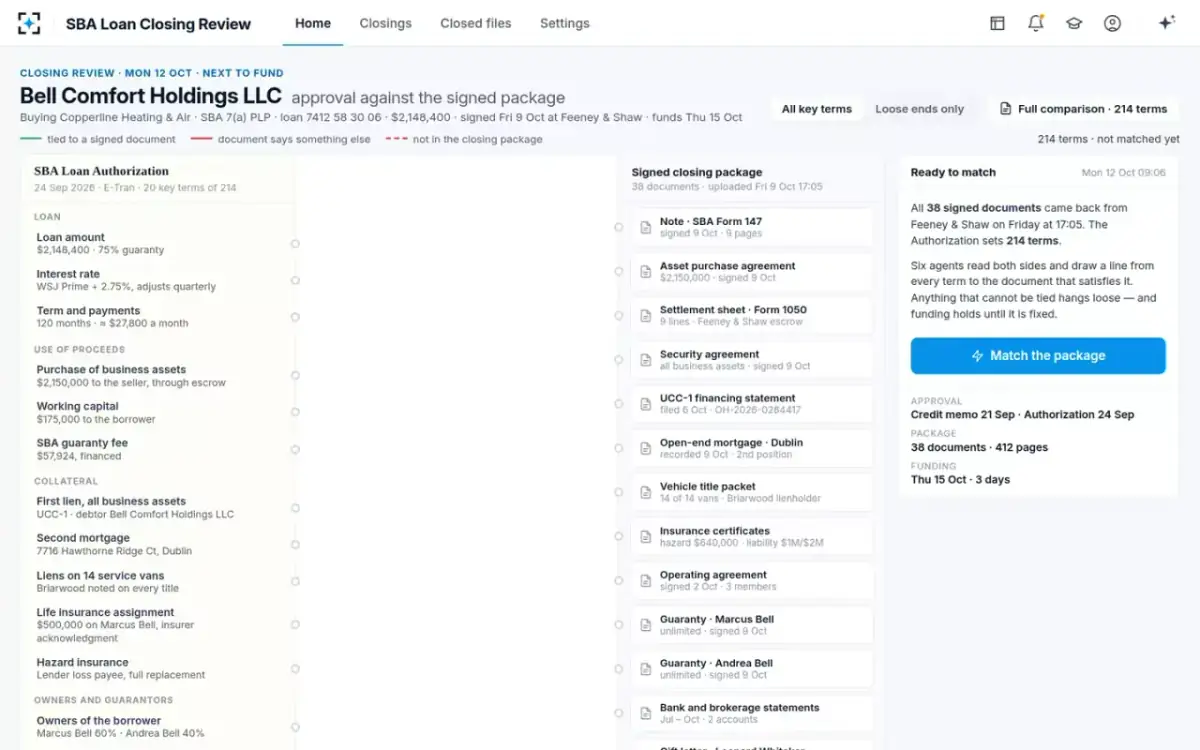
Twenty to thirty closings is enough for most SBA lenders, provided they are chosen for spread rather than convenience. The unit that matters is not the loan but the term: an acquisition closing in the sample carried 214 approved terms, so 25 closings of mixed size put a few thousand terms through the comparison, and enough real and seeded mismatches to report recall by category.
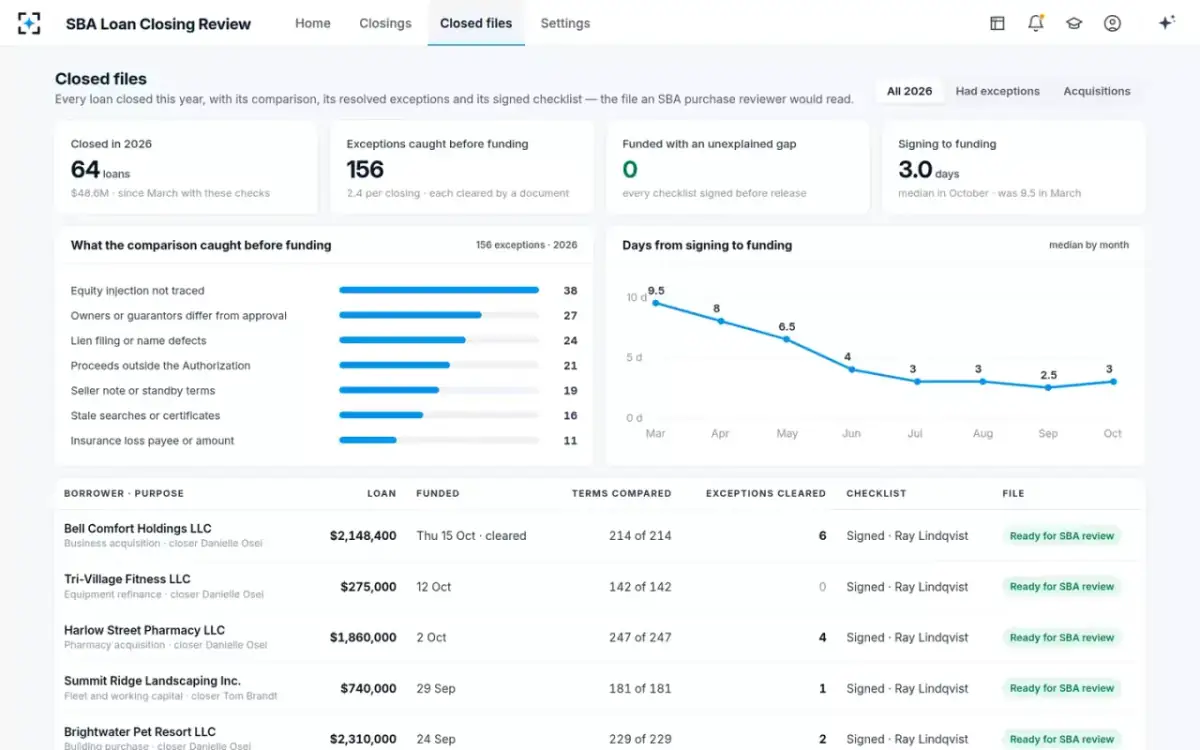
The arithmetic sets a floor. If your closings carry two or three exceptions each, as the fictional sample lender's do (156 caught across 64 closings, 2.4 per closing), 25 files hold roughly 60 real exceptions before any seeding. Seeding a handful of extra mismatches in each high-cost category on copies of the files lifts the count where the risk is. With fewer than 15 files, at least one category is likely to hold too few examples to judge.
Choosing the files
Choose files for the variety of what can go wrong, not for typicality. A pilot that runs 25 working-capital loans tells you nothing about acquisitions, and acquisitions are where seller notes, standby agreements, ownership changes and large injections live.
A good mix includes acquisitions with seller notes, loans with real estate and second mortgages, loans with vehicle or equipment titles, at least two SBA Express or 7(a) Small loans (which close under the lender's own procedures plus SBA forms, without Form 1050), any loans your QC flagged, and a few clean files to measure false alarms. Include a few older loans approved under SOP 50 10 7.1 alongside last quarter's SOP 50 10 8 loans, and run the parallel month on loans under SOP 50 10 8.1, which applies to applications received by SBA from 1 October 2026 while SOP 50 10 8 still governs those submitted through 30 September (SBA Information Notice 5000-882227). A review that applies one version to every loan will misread the older files.
A closed package, loaded and ready to compare
What should a closing pilot measure?
A closing pilot should measure what the software finds, what it gets wrong, whether its evidence holds up, and what it does to the closer's week. The first three decide whether it is safe to rely on; the fourth decides whether it is worth buying.
What to measure in a closing review pilot, and how
| Measure | How to take it | Why it matters |
|---|---|---|
| Recall by category | Known and seeded mismatches found ÷ present, per category | Shows where the review is weak; one weak category is a policy decision |
| New findings confirmed | Findings QC did not have, confirmed by a third reader | The value the software adds over the current process |
| False alarms per closing | Findings on clean terms ÷ closings, on files QC passed | Predicts whether closers will keep reading the output |
| Citation accuracy | Hand-check a sample of findings and tied terms | A finding nobody can locate cannot be fixed or defended |
| SOP version handling | Check the rule cited on loans approved under each SOP | SBA applies the SOP in force at approval |
| Reading time per closing | Closer hours to review the output vs the by-hand baseline | The cost case; our estimate of a by-hand acquisition review is about 21 hours |
The scoring behind those rows, including how to weight a miss by what it would cost at purchase review, is in measuring an AI review of SBA closing documents. The short version: report the weakest category and the false alarms, not an overall accuracy figure, because nearly every term in a closing ties and an accuracy figure will look high whatever the software does.
Comparing with post-closing QC
Compare the pilot with your post-closing quality control finding by finding, and sort every disagreement into one of three piles: the software found something QC missed, QC found something the software missed, or one of them is wrong. The second pile decides the pass or fail; the first decides the business case.
Map both sets of findings to the categories SBA itself uses, so the comparison speaks the regulator's language. SBA's reviews of two small business lending companies grouped their repeated deficiencies into categories such as loan closing and disbursement (26 deficiencies, for example required lien positions not obtained), technical exceptions in Forms 1919, 1920, 1050 and 159 (21), and other core requirements such as IRS transcripts and insurance documentation (31) (SBA OIG Report 26-14). A pilot that shows strength in exactly those categories is evidence an examiner will recognise.
What a year of closings looks like through the review: exceptions by type
What the pilot will not tell you
A retrospective pilot will not tell you how your loans would fare at purchase review, because most of them will never default and those that do will default years from now. It measures whether the review finds what SBA's rules make costly, not whether any particular loan would have been repaired.
It also cannot measure the live effects. On a funded file, the fixes already happened, or did not, so the pilot cannot show how fast closers clear exceptions or how counsel responds to a fix request quoting both versions. Those show in the first month of parallel running on new closings. And it will not measure integration effort with your origination and document systems, which belongs in a separate technical review.
The paperwork scale a closing review sits on
52,000
Form 1050 settlement sheets a year, by SBA's estimate
26,000
hours a year SBA estimates lenders and borrowers spend on them
16,210
Form 159 and 159D fee disclosures a year
After the pilot: from last quarter's files to this week's
If the pilot passes, run the software on live closings in parallel with the current process for a month before anyone relies on it, then make the hold real: no release until the checklist is signed, and no signing while an exception is open. The settings that matter are the ones the pilot exercised: SOP version by approval date, the injection and seller-note rules, seasoning, which owners must guarantee, how fresh searches must be, and who approves changes to the approved terms and who signs.
What the lender brings is the material the pilot already used: its SBA credit policy, its closing checklist, its approved-terms exports and the signed packages of a sample of closed files. In the sample lender's closed files, the median time from signing to funding fell from 9.5 days in March to 3.0 days in October; that is fictional data, and the number to watch in your own parallel month is your own. How SBA closing review differs from mortgage pre-funding QC covers where the review sits among your other controls.
Closed files that keep their comparison for the SBA reviewer
Questions people ask
How long should a loan closing software pilot run?
Four weeks is enough for a retrospective pilot of 20 to 30 closings: a week to choose files and set the pass and fail lines, a short run, a week of blind scoring and a week to decide. The software's run is minutes per closing; the time goes to the lender's own scoring.
Should a closing review pilot use live loans?
Not at first. Closed files carry no risk and come with your QC results as an answer key. Live loans belong in the month of parallel running after the pilot passes, when the software's findings are acted on but the current process still runs alongside.
Who should score a closing review pilot?
Someone who did not run the software and did not prepare the seeded files: usually a quality control analyst or an internal auditor. Disagreements between the software and QC go to a third reader, often the closing manager.
Can the pilot include loans approved under older SOPs?
It should. SBA reviews closing against the SOP 50 10 in effect when the loan was approved, so a pilot that includes loans under SOP 50 10 7.1, 8 and 8.1 tests whether the software applies the right rules to each.
What does an SBA lender need to provide for a pilot?
The signed closing packages and credit memos of the chosen loans, their approved SBA terms, the lender's closing checklist and credit policy, and the post-closing QC results for the same loans. Seeded copies are prepared by the lender's own reviewer.