Regulatory intelligence is the systematic work of collecting what health authorities publish, analysing what it changes, and getting that analysis to the people whose products, filings and labels are affected. The academic definition is almost the same sentence: a 2026 review in the PDA Journal of Pharmaceutical Science and Technology describes it as a function "defined by its focus on the systematic collection, analysis, and dissemination of regulatory information". Three verbs, three jobs, three ways to fail. Botminds' Regulatory Intelligence is software that does all three with named agents, and stops at the one decision a person must own: whether an agency change really lands on a product, and who is told.
What follows separates the three jobs, counts how much there is to read on one agency in one year, and argues that the job teams under-resource is the third. Where the page shows the solution working, the products, people and notices on screen are fictional sample data, and it says so.
What one year of one agency's output looks like
576
documents the FDA published in the Federal Register in 2025 alone
85
draft guidance topics on one FDA centre's plan for 2026, across 14 categories
41
medicines regulators WHO lists as meeting its highest standards, in 39 countries
What is regulatory intelligence?
It is the function that keeps a company's picture of the rules current, and tells the people who need it. The phrase covers one loop: watch the authorities that license your products, understand what each new or revised document requires, and move that requirement to whoever has to do something about it. Everything else — the newsletters, the subscriptions, the spreadsheet of links — is tooling for one of those three steps.
The term is younger than the work. The PDA Journal review calls it "an emerging and increasingly fundamental function within regulatory affairs, particularly in the biotechnology sector", and notes in the same abstract that "despite its growing significance, regulatory intelligence remains underrepresented in the academic literature". That is worth sitting with. A function that decides whether a billion-dollar filing goes in with the data the assessor now expects has almost no published method behind it, which is why two companies of the same size run it in completely different ways, and why job descriptions for it vary so widely.
So it helps to define it by its output rather than its tools. A regulatory intelligence function is working when a named person in a named team can say: here is the paragraph that changed, here is what it asks us for, here is the date, and here is what we have decided to do. Anything that does not end in that sentence is a feed.
The three jobs: collection, analysis, dissemination
The review's central finding is a structure, not a number: "an integrated literature review identified three core components of regulatory intelligence: 1) information collection, 2) information analysis, and 3) information dissemination". They are sequential, and each one's output is the next one's input, so the weakest of the three sets the value of all three. A perfect source list feeding an analyst with no time produces nothing; a brilliant analysis that reaches nobody produces nothing.
The three jobs of regulatory intelligence, what each produces and how each one fails
Job One
Collection
Find everything a health authority publishes that could touch the portfolio, in whatever language it appears, and keep the original file with its address and its publication date.
What it produces
A complete, dated, traceable set of source documents.
How it fails
Silently. A source nobody checked on Tuesday looks exactly like a source with nothing new on it.
Job Two
Analysis
Read each document, say what it changed against the text it replaces, and decide which products, markets and filings it touches, and how hard.
What it produces
A short statement per document: what changed, for which products, by when.
How it fails
Loudly but late. The reading gets done, a week after the deadline was set.
Job Three
Dissemination
Get the specific paragraphs to the named person who owns the work they land on, with the authority to act, and keep a record that they were told.
What it produces
A team that has changed its plan, and evidence of who decided what and when.
How it fails
Invisibly. The analysis exists, in an inbox, in a spreadsheet column, in a weekly deck nobody opens.
The review adds the condition that decides whether the three hold together: "the effectiveness of these components is closely linked to the maturity and integration of systems employed by biotechnology organizations". Integration is the operative word. In most companies each job sits in a different tool — an alert service for collection, a person's head and a document comparison for analysis, email for dissemination — and nothing carries a document's identity from one to the next. The seams are where updates are lost, and they are lost without anybody noticing, because no seam reports a failure.
What regulatory intelligence is not: a newsletter, a database or a mailing list
Three things are routinely sold as regulatory intelligence and are not. Each does one of the three jobs well and leaves the other two with you, which is fine as long as the person buying it knows which two they are taking on.
A newsletter, a database and a regulatory intelligence function: what each answers
What it gives you: Collection, for the sources its editors chose. Something new arrived; here is a headline and a link.
What it leaves to you: Analysis and dissemination, in full. Nothing in a headline says which of your eleven products it touches, or which of the eleven changed paragraphs are editorial.
What it gives you: Collection and storage, searchable, often with versions kept. The text is there when you go and look for it.
What it leaves to you: Going and looking. A database answers a question you already knew to ask; it does not tell you on Tuesday morning that a question has appeared.
What it gives you: Dissemination, of a kind: everything reaches everyone.
What it leaves to you: The judgement. A list that sends all 27 of a morning's updates to all five teams trains all five to stop opening it.
What it gives you: All three jobs joined up, ending in a named owner, a date and a decision that is on the record.
What it leaves to you: The decision itself, which is the part worth a person's salary.
The failure mode of each is specific. An alert service is judged on what it sends, never on what it did not, so a source dropped from its coverage costs the subscriber and nothing else. A database is judged on recall, so its incentive is to hold more, which makes it harder to use on a morning when the answer matters. A distribution list is judged on delivery, which is not the same as being read.
What does a regulatory intelligence analyst do all day?
Mostly reading, and mostly in service of other people's deadlines. The US Department of Labor's occupational description for Regulatory Affairs Specialists lists 30 tasks, and four of them are the regulatory intelligence loop almost word for word: "maintain current knowledge base of existing and emerging regulations, standards, or guidance documents", "obtain and distribute updated information regarding domestic or international laws, guidelines, or standards", "interpret regulatory rules or rule changes and ensure that they are communicated through corporate policies and procedures", and "identify relevant guidance documents, international standards, or consensus standards".
Read in order, those four sentences are the whole function: keep the picture current, distribute, interpret, and find what is relevant. Three of the four are reading and routing, which a machine can do under supervision. The fourth — interpret, and make sure the interpretation reaches the corporate policy — is judgement, and it is the one the same source makes a person's job.
The Department of Labor's tasks, and what is left to a person once agents do the reading
| The task, as the occupational description writes it | Who does the reading | What the person is left holding |
|---|---|---|
| "Maintain current knowledge base of existing and emerging regulations, standards, or guidance documents." | Agents, every morning, across 64 sources in 38 countries | Deciding what belongs on the source list, and what is missing from it |
| "Identify relevant guidance documents, international standards, or consensus standards." | Agents, by comparing each document against the portfolio and the filing calendar | Whether "relevant" was drawn too narrowly — the judgement the agents cannot make about their own output |
| "Obtain and distribute updated information regarding domestic or international laws, guidelines, or standards." | Agents translate, summarise with a citation per line, and lay out each team's note | Signing it: no team is told anything until a named lead confirms the impact |
| "Interpret regulatory rules or rule changes and ensure that they are communicated through corporate policies and procedures." | Nobody but the person | The interpretation, the policy change, and the argument with the people who do not want to make it |
| Coordinating and documenting internal regulatory processes — audits, inspections, licence renewals, registrations (the occupation's summary, paraphrased) | Nobody but the person | The whole of it — this is regulatory affairs work, not intelligence work |
The same source is useful on what the work is worth and whether there is more of it coming. O*NET puts median wages for the broader compliance-officer group at "$38.81 hourly, $80,730 annual" for 2025, with 436,400 people employed and projected growth over 2025–2035 of "average (3% to 4%)". Average growth in headcount against the document volumes further down this page is the arithmetic behind every regulatory intelligence business case: the reading grows faster than the team does.
Is regulatory intelligence the same as regulatory affairs?
No. Regulatory affairs owns the relationship with the authority and the filings that go into it; regulatory intelligence owns the company's picture of what the authority now wants. The review quoted above places intelligence inside affairs — "an emerging and increasingly fundamental function within regulatory affairs" — and in practice that is how it is organised: a small intelligence capability, sometimes one person, serving the submission teams, the labelling teams, the device engineers and the affiliates.
The cleanest line between the two is the direction of travel. Regulatory affairs sends documents to the authority. Regulatory intelligence receives documents from the authority and routes them inwards. That is why the two have different failure modes: an affairs failure is visible on a submission timeline, and an intelligence failure is visible nowhere until an assessor asks for data the plan never included.
It also explains why intelligence is hard to staff. The reading is continuous, the output is other people's decisions, and nothing it produces has a filing date of its own. The same arithmetic makes it the first thing cut, and the last thing anyone measures.
How much is there to read? One agency, one year, counted
Take the narrowest possible slice: one authority, one year, one publication channel. Querying the Federal Register's own interface for documents published in 2025 and attributed to the Food and Drug Administration returns 576 documents. That is the formal channel only, and the FDA's guidance documents, safety communications, dear-practitioner letters and advisory committee materials mostly do not travel through it.
Then take what is coming. CDER, the FDA's drug centre, publishes a plan each year of the guidances it intends to draft or revise. The current edition, dated July 2026, carries 85 bulleted topics under 14 category headings — 24 of them on generics, ten on pharmaceutical quality and chemistry, nine clinical, eight administrative, eight on compounding and one on artificial intelligence. The page that hosts it is explicit about what the list is: "this is the list of guidances that CDER is considering for development during calendar year 2026", and it adds the sentence that makes horizon scanning difficult — "we currently intend to develop guidance documents on these topics, but we are not bound by this list of guidances, nor required to issue every guidance document on the list". Eighty-five topics, no commitment on any of them, and no dates. How far ahead a regulatory horizon scan can really see takes that apart.
Now multiply by geography. In December 2025 the World Health Organization said that with the addition of Australia's and Indonesia's authorities, "the global WLA network now comprises 41 authorities from 39 countries". The WHO-Listed Authority designation is a mark of a regulatory system meeting WHO's standards, not a list of agencies that matter to you — a company selling in a country whose authority is not listed still answers to it. So the WHO list is neither the floor nor the ceiling of a watch list: a portfolio watches the authorities of every market it sells in, listed or not, and the 41 are only the ones WHO has assessed at that level. The agencies to watch, and what each one publishes, works through the list a real portfolio ends up with.
None of these numbers is the workload. The workload is their product: every document, against every product, in every market. That is the arithmetic a one-person intelligence function is asked to carry, and it is why the function's output is so often a list of links rather than a decision.
Why the third job is the one that breaks
Collection is a solved problem in principle — the sources are public, and most of them publish a feed. Analysis is hard but bounded: a document has a finite number of paragraphs, and a diff against the version it replaces narrows them further. Dissemination is the job with no natural stopping point, because its unit of work is not a document, it is a person.
To route one changed paragraph correctly you need four things no feed and no spreadsheet holds: which of your products and presentations the paragraph touches, which market licence each of those sits under, which team owns the plan that now has to change, and which of that team's dated commitments the change collides with. Those four live in a portfolio register, a labelling plan and a submission calendar — three internal documents that are usually maintained by three different groups, in three formats, none of which is joined to the agency text.
So the analyst does it by hand, by knowing the company. That works, and it does not scale, and it leaves no record. When the analyst is on holiday the loop stops. When the analyst leaves, the routing knowledge leaves with them, and the new analyst's first year is spent discovering that §4.3 lands on device engineering, not on biologics regulatory.
What an agency change has to carry before a team can act on it
A useful test for any regulatory intelligence output — a tool's, a subscription's or your own — is whether what arrives at the owning team carries all seven of these. Most of what circulates carries the first two.
Seven things a routed agency change has to carry, and who usually supplies each
- The document itself, and its date.The original file, not a summary of it, with the address it came from and the date the authority published it. Without the original, nobody downstream can check the summary.
- What it says, in the reader's language.A translation that keeps the original beside it, because a paragraph that decides a filing will be argued over and the argument has to happen on the authority's words.
- What changed, against the text it replaces.A revised guideline rarely says. Eleven paragraphs may differ and six of them be editorial; the useful output names the two that are not.
- Which products and markets it touches.Not "biologics" — this product, this presentation, this licence. That requires the agency text to be read against a portfolio register, not against a category.
- Which dated commitment it collides with.A filing in May, a labelling cycle in February, a notified body that has to be booked by the end of October. A requirement with no collision is information; one with a collision is work.
- A named owner.A person, not a team mailbox. The test is whether the owner can change the plan without asking anyone else.
- A record that the decision was made, by whom, and when.Because the question an inspector asks is not whether you knew, it is when you knew and what you did. An email thread is a poor answer.
Items three to five are where most functions quietly stop, and they are the three that take the longest by hand. Item seven is the one that turns the function from a service into evidence.
What Regulatory Intelligence does in each of the three jobs
Botminds' Regulatory Intelligence is seven specialist agents and one human decision. The agents do collection in full, most of analysis, and the drafting of dissemination; a named regulatory lead confirms the impact and signs, and nothing reaches a team before that signature. The shape below is the solution's own working order, from the agency websites at 05:00 to a team's note the same morning.
One morning in Regulatory Intelligence: seven agents, one signature
Agent
Agency watcherChecks 64 sources in 38 countries from 05:00 CET and collects what is new or changed, keeping each original file with its address and publication date, and dropping duplicates.
Never: signs in to an agency portal, or reads a source that is not on the approved list
Agent
TranslatorRenders Japanese, Chinese, German, Portuguese, French and Korean documents into English paragraph by paragraph, with the original kept beside every translation and regulated terms taken from a glossary.
Never: discards the original, or passes over a passage it is unsure of without flagging it
Agent
SummarizerWrites three to five plain lines per update — what changed, for which products or devices, and by when — and records the published, comments-close and effective dates.
Never: states a line it cannot cite a passage for, or offers advice
Agent
Version comparerFinds the version the authority names as replaced and compares the two paragraph by paragraph, marking each difference rewritten, new, widened or editorial, and showing the old and new wording word for word.
Never: guesses which version a revision replaces
Agent
Impact assessorReads each update against the product portfolio register, the labelling plan and the submission calendar, and proposes High, Medium, Low or Not relevant per product and market, with the reason, the passage behind it and its confidence.
Never: confirms its own proposal
A person decides
The regulatory lead confirms and signsReads the changed paragraphs and the proposed impact, adjusts the level, ticks the teams to be told and signs — name, date, time and the meaning of the signature on the record.
Never: is bypassed: no High or Medium impact reaches a team unsigned
Agent
Digest writerLays out the morning front page led by the update with the highest impact on your products, and sends each team the exact paragraphs it owns, in its own language, with the original attached.
Never: sends an impact that has not been confirmed
Agent
Regulatory assistantAnswers questions across the updates and the internal plans afterwards, citing the page behind every statement, with the original passage and its translation when the source is not in English.
Never: answers from anything it cannot cite — it says when nothing answers the question
Read against the three jobs: collection is the agency watcher, analysis is the translator, summarizer, version comparer and impact assessor together, and dissemination is the signature plus the digest writer. The third job is the one that gets a person, which is the inversion of how most functions are staffed.
The output of the third job: one morning's front page, led by what moved a filing
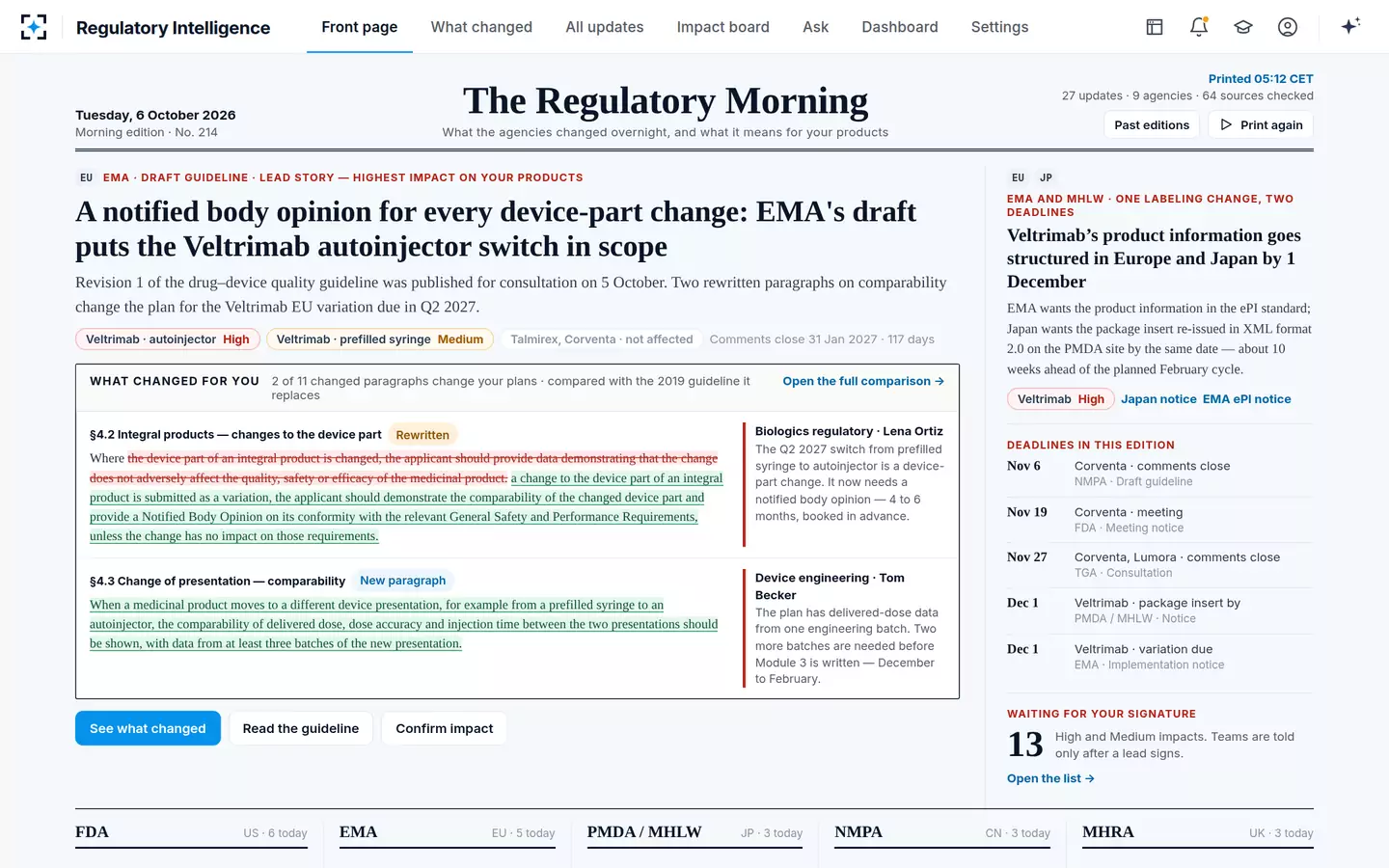
The choice the front page makes is the function's whole argument. Twenty-seven updates arrived; one of them moved a filing, and that one leads. A feed sorted by publication time, or by agency, buries that choice in the reader and gives it back to them every morning.
And the rest of the morning, where a feed would have started
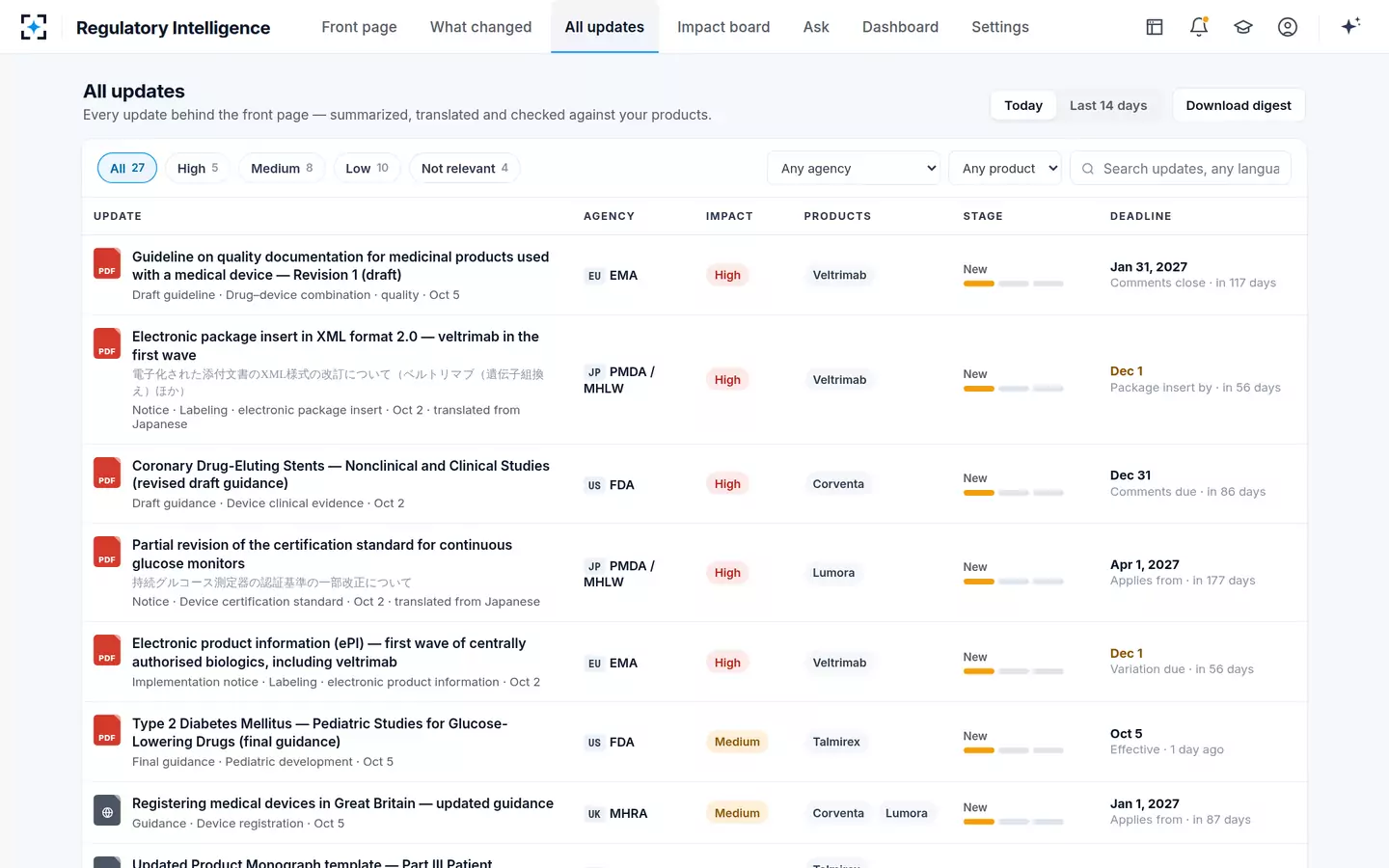
Behind both screens, the thing that makes routing possible is the join the analyst used to make by hand: each update read against the portfolio register, the labelling plan and the submission calendar. That is the integration the PDA review names as the condition for the three components working, and it is the part that cannot be bought as a feed. To see it against a real portfolio, start from Regulatory Intelligence.
Questions people ask
Is there an agreed definition of regulatory intelligence?
There is an agreed shape rather than an agreed sentence. The 2026 PDA Journal review defines it by its focus on "the systematic collection, analysis, and dissemination of regulatory information" and identifies the same three components — collection, analysis, dissemination — as its core. The same review notes that the discipline "remains underrepresented in the academic literature", which is why company definitions differ so much in what they include beyond those three.
What are the sources of regulatory intelligence?
Primarily what the authorities themselves publish: guidance documents and guidelines, notices in official registers, safety communications, approval and assessment reports, and the forward plans agencies publish of what they intend to draft. Standards bodies and harmonisation bodies such as ICH add a second layer, and a global portfolio needs the authorities of the markets it sells in, in their own languages. The hard part is not the list; it is checking every source every day and knowing when one has gone quiet.
Why is regulatory intelligence important?
Because a requirement you learn late costs more than the same requirement learned early. A revised guideline can add a data expectation that takes months to generate — comparability batches, a longer follow-up period, an extra opinion from a third party — and the deadline is set by the authority, not by your plan. The function's value is the interval between publication and the owning team hearing about it, and that interval is measurable.
Who needs regulatory intelligence?
Anyone whose products are licensed by more than one authority, which in practice means anyone selling a medicine or a device outside a single market. The threshold is not company size, it is portfolio spread: a small company with one product in four countries has four regulators publishing at it, and no slack to absorb a missed requirement. Larger portfolios need the function industrialised rather than needed more.
Is regulatory intelligence a growing career?
The US Department of Labor projects average growth of 3% to 4% over 2025–2035 for the compliance-officer group that includes Regulatory Affairs Specialists, with 436,400 people employed in 2025, at median pay of $80,730. Headcount growing at that rate against document volumes like the FDA's 576 Federal Register publications in a single year is why the reading, rather than the judgement, is the part now being automated.
Does regulatory intelligence work the same way for medical devices?
The three jobs are identical; the source list is not. The 85-topic guidance plan counted on this page belongs to the FDA's drug centre, and a device portfolio watches a different centre, a different set of standards bodies and, in Europe, notified bodies as well as the authority. Companies with drug–device combination products have to watch both at once, which is where a single changed paragraph most often lands on two teams that do not normally talk.