AI regulatory intelligence — software agents that read, translate, compare and assess what health authorities publish — sits inside a larger question about artificial intelligence in pharmaceutical regulatory affairs, and that question is no longer whether it is allowed. Both of the agencies that matter most have published their thinking: FDA in a draft guidance on using AI to support regulatory decision-making, EMA in an adopted reflection paper covering the whole medicinal product lifecycle. Neither bans it, neither approves a tool, and both answer the same way — the model may produce the information, the sponsor or marketing authorisation holder remains accountable for it, and how hard you have to work to justify it depends on how much the output influences a regulatory decision. The practical consequence is that the design question for any AI in this work is not which model reads the guideline. It is who signs what the model concluded, what they can see when they sign, and what their signature means. Botminds' Regulatory Intelligence is built to that answer: seven agents read, translate, compare and propose, and a named lead confirms every High and Medium impact before a single team is told.
What follows is the published position of each agency, the only systematic count of how often AI actually turns up in European regulatory evidence, and one measured test of how well a general-purpose model reads FDA labeling text. Where the page shows the solution, the products and people are fictional sample data and it says so. No regulator has reviewed, qualified or endorsed this or any other commercial tool, and nothing here should be read as saying otherwise.
How much AI is actually in European regulatory evidence
26,480
EMA public reports and development advice documents screened in a 2026 systematic analysis
52
of them described an actual use of AI
43tools
distinct AI tools behind those 52 documents, across quality, nonclinical, clinical and pharmacovigilance work
0.2%
of the screened documents — the authors call the trend increasing and the base still limited
Artificial intelligence in pharmaceutical regulatory affairs: where it actually stands
The honest summary is that the rules are arriving faster than the use. The Nollen study is the only systematic count we could find of AI in European regulatory evidence, and it is sobering: of 26,480 EMA public reports and scientific advice documents screened, "52 documents contained AI use, reflecting 43 unique AI tools used across quality, nonclinical, clinical, and pharmacovigilance domains." The authors are careful about what that means — "AI use in regulatory evidence is still limited but showing an increasing trend" — and about the position everyone is working from: "As the field is still novel, there are limited regulatory precedents, and AI-specific guideline development and harmonization across regulatory jurisdictions are still ongoing."
Two things follow for a regulatory affairs department. First, nobody can tell you "this is how the industry does it", because fifty-two documents is not an industry practice. Second, the framework questions are already written down, so you can answer them now rather than waiting for a precedent that is several years away.
It is also worth separating two uses that get argued as one. Using a model to generate evidence that goes into a submission — a synthetic control arm, a model-derived endpoint, an image classifier in a pivotal study — is the subject of both agencies' documents. Using a model to read what an agency published this morning and route it to the right person internally is a different thing: it produces no evidence, it changes no submission on its own, and its errors are caught by the person who has to act on them. Conflating the two is how departments end up either validating a news reader as though it were a clinical endpoint, or waving through a clinical endpoint as though it were a news reader.
What FDA asks: credibility for a stated context of use
FDA's draft guidance, announced on 7 January 2025, does not evaluate models. It proposes a framework, scaled to risk, for establishing how far a model can be trusted in one particular context of use. Two defined terms carry the whole thing. Credibility is trust in the model's performance for that context, built by collecting evidence; the context of use is the specific role and scope the model has in answering one question of interest. And the agency says in the same notice that it is endorsing no particular AI approach or technique.
Read that as a sentence you have to be able to write about your own tool: this model, doing this specific job, inside this process, with this much influence on the decision. Everything else — how much testing, how much documentation, how much oversight — is said to scale with the risk that that job carries. A model that proposes which of your products a published guideline touches, where a named person then reads the passage and decides, is a different context of use from a model whose output is the evidence.
The guidance is also explicit about where it stops. It leaves out two uses: drug discovery, and operational efficiencies — internal workflows, resource allocation, drafting a submission — that do not affect patient safety, drug quality or the reliability of a study's results. Monitoring agency publications and routing them internally sits in that second exclusion. That is not permission to be careless; a later sentence of the notice is the one to pin above the desk: "Sponsors remain responsible for compliance with statutory and regulatory requirements … regardless of the technology utilized."
One fact about status, because it is easy to assume otherwise: as of 27 October 2026 this is still a draft. A Federal Register search across FDA documents for the guidance's title finds no final version — only the January 2025 announcement of the draft, and a later notice that mentions it. The agency has moved elsewhere in the meantime: in April 2026 it published a request for information on a pilot programme for AI-enabled optimisation of early-phase trials, a programme it says "will be guided by principles aligned with the National Institute of Standards and Technology (NIST) AI Risk Management Framework (AI RMF)". That is a useful signal about which vocabulary FDA is reaching for.
What EMA asks: a risk-based approach and an accountable holder
EMA's reflection paper was adopted by its human medicines committee on 9 September 2024, after a consultation that closed on 31 December 2023. It covers the whole lifecycle, from discovery to post-authorisation, and its central sentence is about responsibility rather than technology.
To strengthen procedural fairness, accountability and prevention of bias, the use of transparent models is preferred.
EMA, Reflection paper on the use of Artificial Intelligence in the medicinal product lifecycle, adopted 9 September 2024
The paper's key principle puts the duty on the sponsor, the marketing authorisation applicant or holder, or the manufacturer: each must make sure that every algorithm, model, dataset and data pipeline it uses is fit for purpose and meets EU law, GxP standards and current EMA guidelines.
The paper then does something useful: it splits risk in two. It keeps "high patient risk", for systems that affect patient safety, apart from "high regulatory impact", for cases where the system substantially shapes a regulatory decision. A tool can be high on one scale and low on the other, and the two call for different controls. And the level is not a property of the software alone: the paper ties it to the context of use and to how much influence the technology has on the decision, as well as to the technology and its data.
Three further expectations in the paper are worth lifting out because they turn into design decisions. Transparency is preferred, for the reasons in the sentence quoted above. A plan for failure is expected, and expected most where nobody is watching: every model should have a risk management plan that sets out how it is likely to fail, above all where no human is in the loop. And large models are singled out for a specific hazard — "Large language models, often containing billions of parameters, are at particular risk of memorisation due to their size."
Two frameworks, one question each makes you answer
FDA, draft guidance (January 2025): The context of use: the specific role and scope of the model in addressing one question of interest.
EMA, reflection paper (adopted September 2024): The context of use and the degree of influence the technology exerts, together with data quality.
FDA, draft guidance (January 2025): Credibility — trust in the model’s performance for that context, established by collecting credibility evidence.
EMA, reflection paper (adopted September 2024): That every algorithm, model, dataset and pipeline is fit for purpose and in line with EU law, GxP and EMA guidelines.
FDA, draft guidance (January 2025): The sponsor, for compliance with statutory and regulatory requirements regardless of the technology used.
EMA, reflection paper (adopted September 2024): The trial sponsor, marketing authorisation applicant or holder, or the manufacturer. Named, in the paper’s key principle.
FDA, draft guidance (January 2025): Model risk: how much the output influences the decision, and the consequence of being wrong.
EMA, reflection paper (adopted September 2024): Two scales kept apart — high patient risk and high regulatory impact.
FDA, draft guidance (January 2025): Not an endorsement of any AI approach or technique; not binding; a draft as of October 2026.
EMA, reflection paper (adopted September 2024): A reflection paper, setting out current thinking ahead of guidance, not a standard to certify against.
FDA, draft guidance (January 2025): Drug discovery, and operational efficiencies such as internal workflows that do not affect patient safety, drug quality or study reliability.
EMA, reflection paper (adopted September 2024): Nothing is carved out; the paper spans the lifecycle and scales its expectations by risk instead.
Is AI allowed in regulatory affairs?
Yes, and no agency has said otherwise. What neither agency does is approve a tool, which is the thing buyers most often hope to hear. FDA's framework establishes credibility for a model in a context of use; EMA places the duty on the applicant. Any supplier who tells you their product is "FDA approved" for regulatory intelligence work is describing something that does not exist.
The more useful way to put the question to your own quality function is in three parts. Does this use produce evidence that goes to an agency, or does it produce an internal prompt that a person acts on? How much does its output influence a regulated decision, and what happens when it is wrong? And can you show, at any moment, who decided and on what? A tool that answers the third question in its design makes the first two much easier to argue, because the model's output is never the last word.
How accurate is AI at reading regulatory documents?
Accurate enough to be useful and not accurate enough to be trusted unaided — and the published measurements are fewer than the demonstrations suggest. One of the cleaner tests comes from the FDA's own researchers. A 2024 study by scientists at the agency's National Center for Toxicological Research and its drug centre, in Experimental Biology and Medicine, asked a general-purpose open model, Llama3.1-70B, to extract drug–biomarker pairs from the FDA's Table of Pharmacogenomic Biomarkers in Drug Labeling. It "achieved 91.4% accuracy in identifying drug-biomarker pairs from single labeling texts and 82% from mixed texts".
One measured extraction test on FDA labeling text — and what happens when the text gets messier
Read the two numbers as a pair. The source was an unusually tidy one — the authors describe the FDA table as "well-structured with drug names, biomarkers, therapeutic area, and related labeling texts" — and still roughly one answer in eleven was wrong on single texts, and nearly one in five once the texts were mixed. A morning's agency output is messier than that table: scanned annexes, translated notices, revisions that do not say what they changed.
That is why a cited passage is not a nicety. A model's wrong answer usually reads exactly like its right one, so the only defence that scales is to make every statement carry the passage it came from, so that checking the claim costs one click rather than a re-reading of the source. And it is why the number that matters is the one measured on your own documents, not the one in a paper or a sales deck.
Automation bias: the failure mode the frameworks name out loud
There is a second failure mode, and it is not the model's. NIST's AI Risk Management Framework warns that human-AI pairings do not automatically beat either half: "Under certain conditions – for example, in perceptual-based judgment tasks – the AI part of the human-AI interaction can amplify human biases, leading to more biased decisions than the AI or human alone." The same passage adds the escape: when those variations are taken into account in how the team is organised, the pairing can instead produce complementarity and better performance.
Taking it into account means designing the human step so it is a real one. A screen that shows a conclusion and an Approve button produces approvals. A screen that shows the conclusion, the passage it rests on, the confidence attached to it and the products it would touch produces a decision, because disagreeing is as easy as agreeing. NIST is blunt about the organisational half, too: the people's roles in deciding and in overseeing an AI system have to be defined and kept distinct, on a span that runs from fully autonomous to fully manual. Somebody has to write down where on that span each step sits.
The line that holds: agents propose, a named person confirms and signs
In Regulatory Intelligence that line is drawn in the same place for every agent. The agency watcher reads only approved sources and keeps the original file and its address. The translator always keeps the original beside the translation, takes regulated terms from a glossary and flags passages it is unsure of. The summarizer cites a passage for every line it writes, and offers no advice. The version comparer compares a revision only with the version the agency names as replaced, never a guess. The impact assessor proposes High, Medium, Low or not relevant per product with a reason, the passage and its confidence — and proposes only. The assistant answers only from sources it can cite, and says so when nothing answers the question.
The authority line: what an agent may do, what a person must do, what only a signature can do
An agent may
- Read a published page and keep the original file and its address
- Translate it, with the source text beside the translation
- Find the version a revision replaces and compare them word for word
- Propose an impact level for each product, with the passage behind it
- Draft the note that would go to each team
A person must
- Decide whether the proposed impact is right for this product and this market
- Decide whether a passage the agent flagged as unsure is usable
- Decide which teams hear, and what they are being asked to do
- Decide when the agent is out of its depth and the question needs a specialist
Only a signature can
- Release the assessment to the teams that will act on it
- Put a named person, a date and time and a stated meaning on the decision
- Start work that changes a filing plan, a label or a study
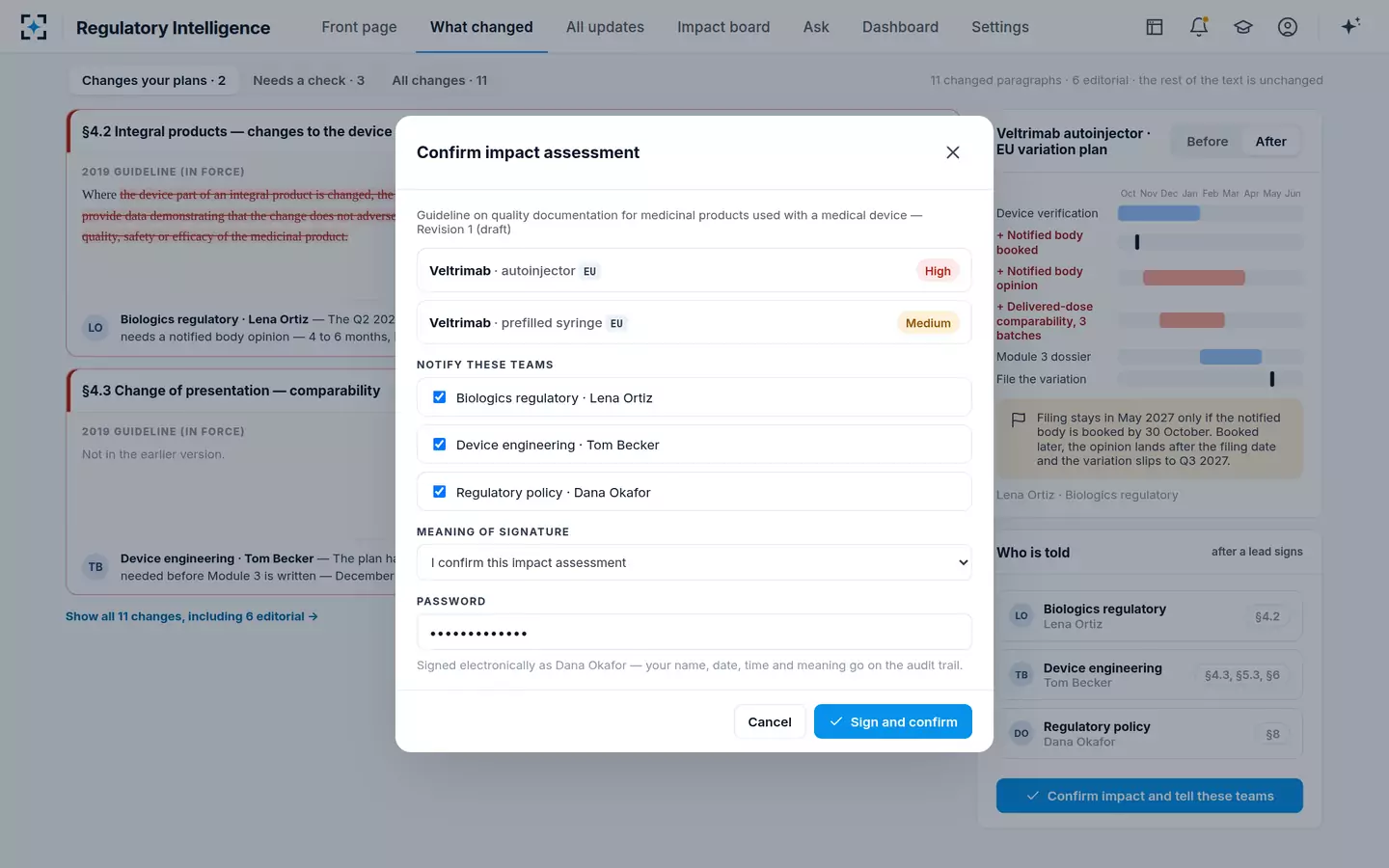
The signature is the part that is easy to under-build and impossible to retrofit. On a regulated record an electronic signature has to show three things — the printed name of the signer, the date and time it was executed, and the meaning associated with it, such as review, approval or responsibility. A system that captures a click and a user ID has captured none of them. In the solution the lead confirms with the meaning stated on the screen — "I confirm this impact assessment" — and the name, the time and that meaning go onto the audit trail together.
After the signature: each team gets the paragraphs that land on it
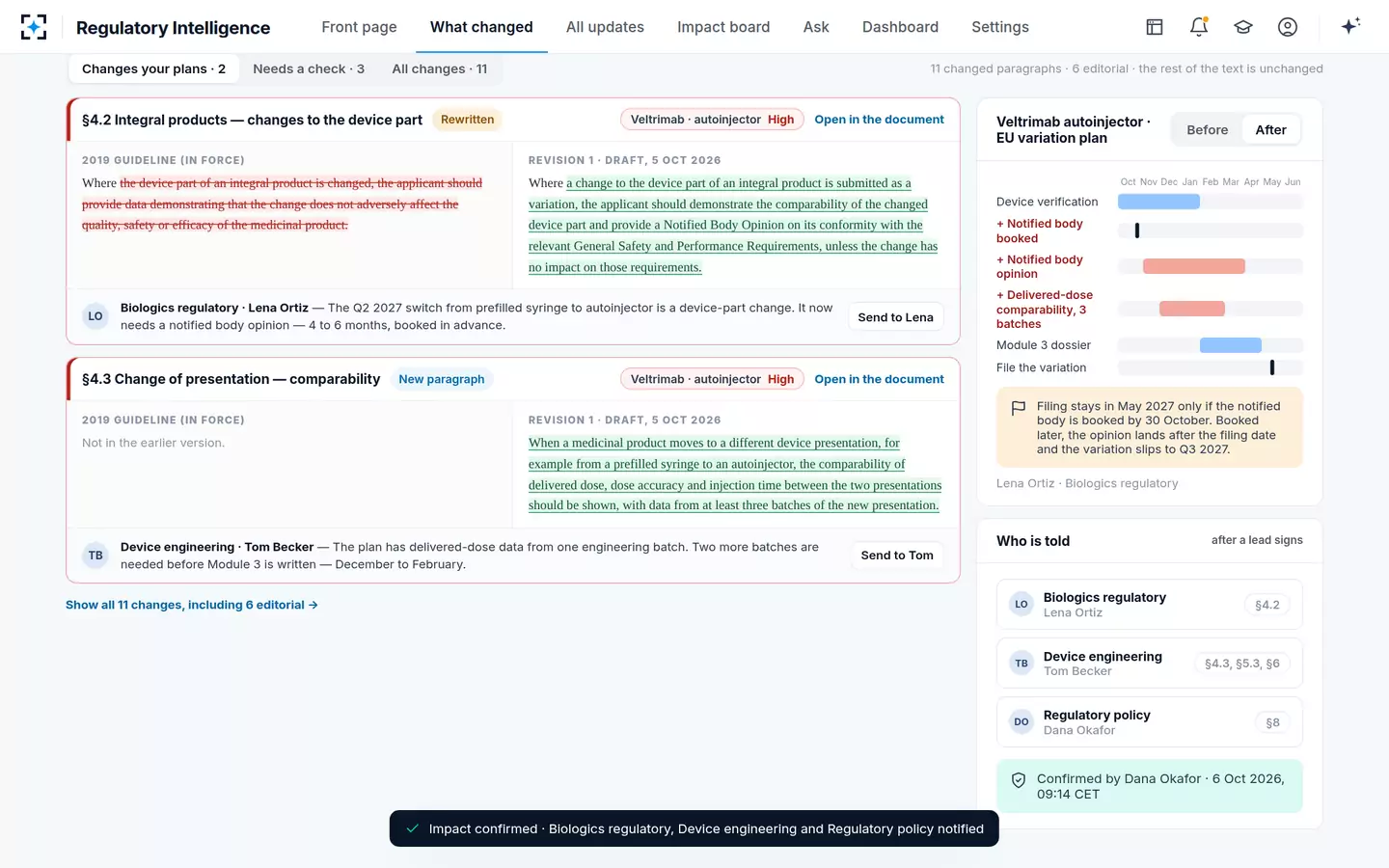
The signature, with its meaning on the screen rather than in the manual
What to document before anyone asks
Every framework on this page asks for the same small pile of paper, in different words. NIST puts the first item plainly: an accuracy figure belongs with a clearly defined, realistic test set that represents the conditions of real use, with the test method written down alongside it. A supplier's accuracy number with no test set attached is not a measurement.
The file for an AI tool used in regulatory work
- The context of use, in one paragraph
What the model does, inside which process, with how much influence on which decision — and what it explicitly does not do. Both frameworks start here.
- Your own test set, and how it was built
Real documents from your own portfolio with known right answers, representative of what the tool will actually see. Keep the methodology with the number.
- The error types you looked for, not just the score
Invention, omission and misclassification fail differently, and an invented answer reads like a right one. Count each type separately.
- The human step, written down
Who reviews what, with what in front of them, and what they are accountable for. NIST asks for roles clearly defined and differentiated; this is that document.
- What happens when it fails
How a wrong output is noticed, who may suspend the tool, and what the fallback is. EMA expects a plan for failure modes, most of all where nobody is in the loop.
- Ongoing monitoring, with a trigger
NIST notes that a deployed system is usually shown to be valid and reliable by ongoing testing or monitoring — so decide what you watch, how often, and what number makes you stop.
- The signature record
Name, date and time, and meaning, for every decision the tool contributed to — on the same record as the decision itself.
Who is responsible when the model is wrong?
You are, and both agencies say so without hedging. EMA's key principle names the sponsor, the applicant or holder, and the manufacturer. FDA's notice says sponsors remain responsible for compliance regardless of the technology used. There is no arrangement with a supplier that moves this, and nobody has ever explained a missed deadline by naming a tool.
What you can do is make the responsibility discharge-able. GAO's accountability framework for AI is built on four principles — governance, data, performance and monitoring — and it names the obstacle that makes all four hard: "Third-party assessments and audits are important to achieving these goals. However, AI systems pose unique challenges to such oversight because their inputs and operations are not always visible." NIST makes the same link in its own framework: trustworthiness rests on accountability, and accountability on transparency.
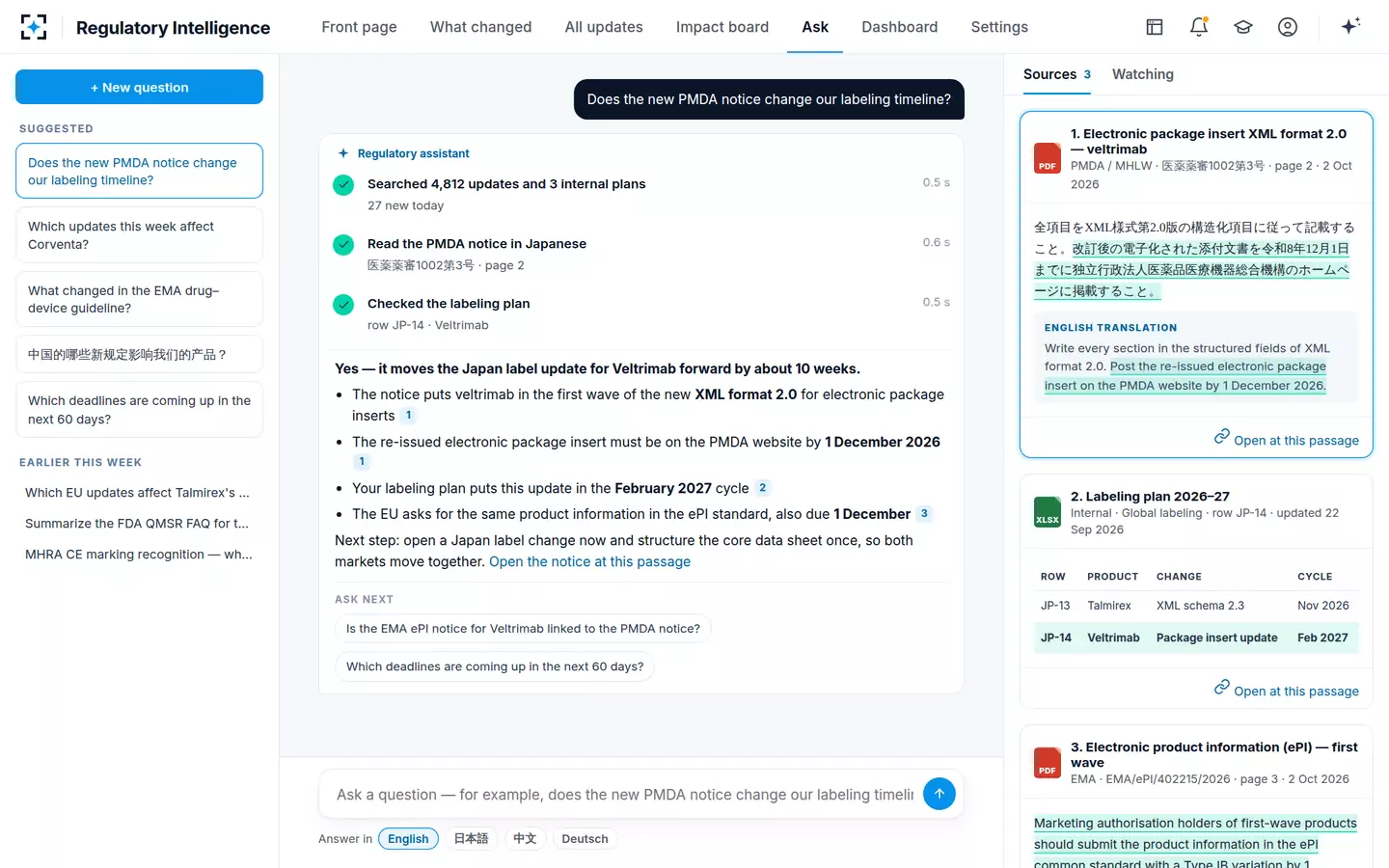
In this kind of work, transparency has a concrete meaning that has nothing to do with model internals. It means you can see which sources were checked and when; the original document beside anything translated; the old and new wording of a revision side by side rather than a summary of the difference; the passage behind every proposed impact; and the full record of who was told what, and when. Those are all observable properties of a system. You can ask to see every one of them in a demonstration, on your own documents, in ninety minutes.
An answer that can be checked: the passage, the translation and the internal plan beside it
Will AI replace regulatory affairs?
Not on this evidence, and the shape of what it does change is already visible. The reading, the translating, the finding of the version a document replaces and the first pass at who is affected are jobs where a machine is fast and tireless and a person is neither. The judgement about whether a changed expectation moves a filing, what to say to an assessor, how much risk a wording carries and which argument to make is the job, and nothing in the published measurements suggests a model is close to it.
What does change is where a regulatory affairs professional's hours go. A department that spends most of a week moving documents around and a few hours deciding is, after this, a department that spends most of its time deciding. That is a better job and a harder one, and it needs people who can tell a good argument from a confident one.
For the surrounding questions — what the function is for, which authorities to watch and what a programme costs to stand up — see what regulatory intelligence is, the questions to ask before you buy, and building the programme in ninety days. To see the line between proposing and signing in the product itself, open Regulatory Intelligence.
Questions people ask
Does FDA accept AI-generated documents?
FDA does not approve or reject tools; it asks you to establish the credibility of a model for a particular context of use, and the amount of evidence it expects scales with how much the output influences a regulatory decision. Its January 2025 draft guidance explicitly excludes drug discovery and internal operational uses — workflows, resource allocation, drafting — that do not affect patient safety, drug quality or study reliability. Whatever the use, the sponsor remains responsible for compliance regardless of the technology.
What does EMA's reflection paper on AI ask of a company?
Its reflection paper, adopted by the human medicines committee on 9 September 2024, takes a risk-based approach across the whole product lifecycle and puts the duty on the sponsor, applicant, holder or manufacturer to ensure every algorithm, model, dataset and pipeline is fit for purpose and in line with EU law, GxP standards and EMA guidelines. It separates high patient risk from high regulatory impact, prefers transparent models, and expects a risk management plan for failure modes — especially where no human is in the loop.
Do we need to validate an AI tool used in regulatory affairs?
If it touches a regulated record or a regulated decision, treat it like any other computerised system and establish that it does what you say it does for the job you say it does. In practice the useful work is narrower than a classical validation exercise: define the context of use, build a test set from your own documents with known answers, measure error types separately, write down the human step, and monitor after deployment. NIST's framework insists that any accuracy number be published with its test set and methodology.
How accurate is AI at reading regulatory documents?
One peer-reviewed test by FDA scientists had a general-purpose model, Llama3.1-70B, extract drug–biomarker pairs from the FDA's pharmacogenomic biomarker table: it was right 91.4% of the time on single labeling texts and 82% on mixed texts. That is one model on one tidy source, so treat it as an order of magnitude rather than a benchmark — but the point stands: unaided, a general model gets a meaningful share of regulatory extraction wrong, which is why a cited passage and a human decision are structural, not decorative.
Who is responsible when AI gets a regulation wrong?
The sponsor, applicant, marketing authorisation holder or manufacturer — EMA names them in its key principle, and FDA says sponsors remain responsible regardless of the technology used. No contract with a supplier changes that. What you can control is whether the decision is traceable: a named person, a date and time, a stated meaning, and the passage the decision rested on.
Will AI replace regulatory affairs professionals?
The published evidence points to reallocation rather than replacement. Reading, translating, comparing versions and proposing who is affected are mechanical and are being automated; deciding what a change means for a filing, negotiating wording with an assessor and judging regulatory risk are not, and the measured error rates of general models on regulatory text argue against letting them try.