Any useful list of regulatory agencies in pharma starts from a count and ends in a decision about scope. The count: the World Health Organization lists 41 medicines regulators it has formally assessed, "41 authorities from 39 countries" as of December 2025, and the European Economic Area contributes 34 national competent authorities of its own, listed by EMA and sitting alongside it rather than under it. The decision: which of those hold a licence of yours, publish something you have to read, and publish it in a language you cannot read. Botminds' Regulatory Intelligence watches 64 sources across 38 countries each morning, translating as it goes, so the watch list is something a lead maintains in a settings page rather than something an analyst remembers.
This page gives the lists, what each authority actually publishes, how the English-language surfaces differ in quality, and eight questions to answer before a source goes on your own list. Where the solution is shown working, the products, notices and people on screen are fictional sample data.
The arithmetic of a global watch list
41
medicines regulators WHO has assessed and listed, across 39 countries
34
national competent authorities EMA lists in the European Economic Area, in 30 countries
24
official languages of the European Union, in all of which legal acts are published
8
separate regulatory functions a WHO listing can cover, listed one by one per authority
The list of regulatory agencies in pharma, and how to use it
Three different lists get called "the list of regulatory agencies in pharma", and they answer three different questions. WHO's list of listed authorities answers "whose assessment can be relied on". EMA's list of national competent authorities answers "who authorises a medicine in Europe outside the centralised route". Your own licence register answers "who can stop us selling", and it is the only one of the three that is actually your watch list.
The mistake worth avoiding is treating the first two as the third. A regulator missing from WHO's list still issues the marketing authorisation in its own country, and its notices still carry deadlines. A regulator on WHO's list may publish nothing that touches your portfolio for a year. The published lists tell you who the serious regulators are; only the licence register tells you which of them are yours.
So use the lists in this order. Start from the markets you hold licences in, add the markets you intend to file in, and then check that list against the published ones to see which authorities you have left out — usually the ones whose text is not in English. That order produces a different watch list from the one you get by starting with "the big five".
What is a WHO Listed Authority, and which 41 agencies hold it?
A WHO-Listed Authority is a regulator whose system WHO has assessed against international standards and formally listed. WHO describes the basis plainly: it "grants WLA status following a rigorous, science- and data-driven assessment based on internationally agreed standards". The designation is not a blanket seal — a listing names the product streams it covers, such as medicines or vaccines, and the regulatory functions it covers, one at a time.
Those functions are worth reading before quoting a listing at anyone. WHO's published list enumerates eight: "1. Registration and marketing authorization · 2. Vigilance · 3. Market surveillance and control · 4. Licensing establishments · 5. Regulatory inspection (GMP, GSDP and GCP) · 6. Laboratory testing · 7. Clinical trials oversight · 8. Regulatory Authority (RA) lot release". An authority may be listed for three of them and not the other five, and the entry says which. A procurement team that reads "WLA" as a single badge will get the scope wrong in both directions.
The December 2025 update completed a long-running change of vocabulary. With Australia's Therapeutic Goods Administration listed, WHO recorded that "all regulatory authorities previously classified as 'stringent regulatory authorities' (SRAs) have now formally transitioned into the WLA framework". If your internal procedures still say "stringent regulatory authority", they are pointing at a category that no longer has occupants, which matters for any document that defines a reliance pathway by reference to it.
Read as a watch list, the 41 are neither a floor nor a target: a portfolio watches the authorities of the markets it sells in, whether or not WHO has listed them. The 41 span 39 countries, including every Member State of the European Union, plus Iceland, Liechtenstein, Norway, Switzerland, the United Kingdom, the United States, Canada, Japan, the Republic of Korea, Singapore, Australia and Indonesia — and the European Medicines Regulatory Network as a region in its own right. Most global portfolios also sell in markets outside that set.
Europe is not one agency: EMA, the Commission and 34 national authorities
Treating "EMA" as Europe is the most common and most expensive simplification in a pharma watch list. EMA runs the centralised procedure and publishes the scientific guidelines, but it says itself that the national authorities are "primarily responsible for the authorisation of medicines available in the EU that do not fall under the scope of the centralised procedure", and its own page exists to list them: "a list of competent authorities of the Member States responsible for the authorisation of medicinal products for human use at national level and/or for the authorisation of clinical trials is provided below".
Counted on 28 October 2026, that list holds 34 authorities across 30 countries — the 27 Member States plus Iceland, Liechtenstein and Norway. The arithmetic does not reduce to one per country. Germany lists the Federal Institute for Drugs and Medical Devices and the Paul Ehrlich Institute; Poland lists the registration office and the Chief Pharmaceutical Inspectorate; the Netherlands lists three, including the committee that oversees research involving human subjects. A watch list built on "one authority per Member State" is four entries short before it starts, and the missing four are exactly the ones that handle biologicals, inspection and trial oversight.
The third European layer is the European Commission, which issues the decisions and the legislation that the guidelines interpret. Its output is law rather than guidance, and it arrives in every official language at once. The three jobs of regulatory intelligence all get harder at this layer, because the same requirement arrives 24 times in 24 languages and the version your affiliate quotes may not be the version your submission team read.
Which regulatory agencies do I need to watch?
Every authority that holds one of your licences, every authority you have an open or planned application with, and every authority whose standards your filings cite. That is the whole rule, and it produces a longer list than most teams expect, because the third clause pulls in harmonisation and standards bodies as well as regulators.
Six sources, what each publishes, and what its English surface actually gives you
FDA (United States)
What it publishes
Guidance documents, notices in the Federal Register, safety communications, and an annual plan of the guidances each centre intends to draft or revise.
Language of the original
English
Its English surface
The original. There is no translation layer to go wrong.
What catches people out
The forward plan is explicit that it binds nobody: the agency "is not bound by this list of guidances, nor required to issue every guidance document on the list".
EMA (European Union, centralised)
What it publishes
Scientific guidelines, committee outcomes, and the assessment record behind centrally authorised medicines.
Language of the original
English
Its English surface
The original.
What catches people out
It is not the whole of Europe. EMA itself points at the national authorities as "primarily responsible for the authorisation of medicines available in the EU that do not fall under the scope of the centralised procedure".
The 34 national authorities of the EEA
What it publishes
National marketing authorisations, clinical trial authorisations, national guidance and inspection outcomes — the whole of the decentralised and national routes.
Language of the original
Each country's own; the EU has 24 official languages
Its English surface
Varies by authority. Some publish an English surface, some publish none.
What catches people out
Thirty-four entries across thirty countries: Germany lists two authorities, Poland two and the Netherlands three, so "one per country" undercounts the list by four.
PMDA and MHLW (Japan)
What it publishes
Notices, review reports, package insert revisions and safety instructions.
Language of the original
Japanese
Its English surface
A machine-translated site, with the attached files left untranslated — which is where the requirement normally is.
What catches people out
The agency says so on its own front page, in a notice the reader has to dismiss to read the site.
NMPA (China)
What it publishes
Announcements, draft guidelines out for comment, policy interpretations and standards.
Language of the original
Chinese
Its English surface
A selected English subset: on 28 October 2026 its English site offered News, Drugs, Medical Devices, Cosmetics and a Resources section with a database, a newsletter and "Policies Interpretation".
What catches people out
The English newsletter arrives by the volume — Volumes I, II and III of 2026 and a special issue were the editions on offer — so it is a digest, not a feed.
WHO
What it publishes
The list of authorities it has assessed, with the product streams and regulatory functions each listing covers, and the date each one falls due for renewal.
Language of the original
English
Its English surface
The original.
What catches people out
It is a list of systems WHO has assessed, not a list of the regulators that can stop your product. An authority absent from it still licenses in its own country.
Two tests separate a source that belongs on the list from one that does not. First, can something published there create work for a named team inside your company? A standards body whose standard your technical file cites can; a regulator in a market you have exited cannot. Second, would you find out another way? A requirement that will reach you through a notified body, a partner or an affiliate may not need its own watch, as long as somebody has written down which of those routes you are relying on.
What each agency actually publishes, and how often
Publication rhythms differ more than the document types do, and the rhythm decides how a source has to be watched. Three patterns cover most of them.
The first is continuous and dated: an official register. Documents appear on their own schedule, each with a publication date and a stable address, and the only sensible way to watch is daily. The second is periodic and planned: a forward agenda, published once or twice a year, listing what the authority intends to draft. It needs reading when it appears and comparing against the previous edition — the change between two editions is the signal, because a topic dropped from the plan is as informative as one added. The third is episodic: notices and safety communications that arrive when there is something to say and carry the shortest deadlines of the three.
The forward agendas invite a particular mistake. An agency plan is an intention, and the FDA's drug centre says so in the same breath as publishing it — "we currently intend to develop guidance documents on these topics, but we are not bound by this list of guidances, nor required to issue every guidance document on the list". Planning a data package around a guidance that has not been drafted is a choice about risk, not a reading of a requirement. What a horizon scan can and cannot see works through what those agendas are worth.
The watched sources, as a setting rather than a folder of bookmarks
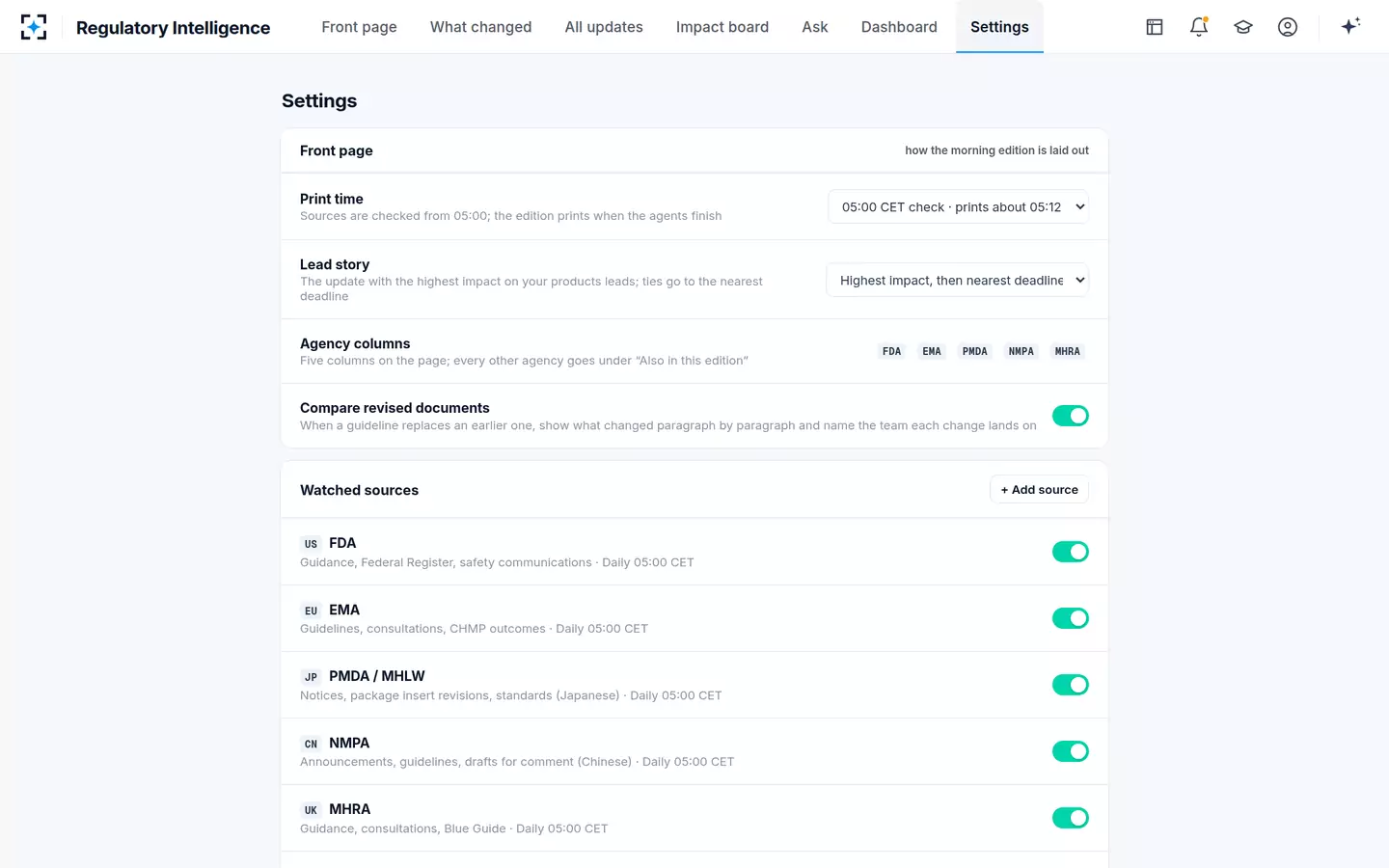
Making the list a setting matters more than it sounds. A watch list that lives in one person's bookmarks has no answer to the question an inspector or an auditor will eventually ask: what were you watching in March, and who decided to add this source in April? A list with a date on each change does.
The language problem: 24 official EU languages, plus Japanese, Chinese and Portuguese
The European Union has, in its own words, "24 official languages: Bulgarian, Croatian, Czech, Danish, Dutch, English, Estonian, Finnish, French, German, Greek, Hungarian, Irish, Italian, Latvian, Lithuanian, Maltese, Polish, Portuguese, Romanian, Slovak, Slovenian, Spanish and Swedish", and it publishes the consequential material in all of them: "legal acts and their summaries are available in all official EU languages". For a company with national authorisations across the Union, that is not a translation problem to be solved once. It is 24 parallel texts, any of which an affiliate may be reading as the operative one.
Outside Europe the problem changes shape. Japan and China publish their binding text in Japanese and Chinese, and what reaches an English reader is a derived surface of uncertain completeness. Brazil publishes in Portuguese, Switzerland in German, French and Italian, and Korea in Korean. A watch list that only covers sources with full English publication is a watch list that has quietly excluded several of the largest medicines markets in the world.
The practical cost is a waiting period. A notice that needs translating before anyone can tell whether it matters sits in a queue while its own deadline runs, and the translation is usually commissioned after someone has guessed that it is important — which means the guess, not the text, decides what gets read. Reading the original paragraph by paragraph, with a translation beside it, removes the guess from the front of the process.
Are agency English pages reliable?
Sometimes, and the honest ones tell you when not. Japan's agency puts a notice on its own English front page that the reader has to dismiss before reading the site.
"Please note that this site may not be accurate due to machine translation, and all files (PDF, Excel, Word, PowerPoint) are not translated."
Pharmaceuticals and Medical Devices Agency, on its English site
Read the second clause twice. The pages are machine-translated, and the attachments are not translated at all — and in Japanese regulatory practice the attachment is usually where the requirement lives. An English page that summarises a notice whose annexes are only in Japanese has told you that something exists, which is job one of three, and nothing about what it requires.
China's English site is a different kind of partial. On 28 October 2026 it offered News, Drugs, Medical Devices, Cosmetics and a Resources section holding a database, a worldwide pharmacopoeia, a newsletter, "Policies Interpretation" and "Popular Science" — a curated surface rather than a mirror. Its English newsletter is issued by the volume, with Volumes I, II and III of 2026 and a special issue on offer that day. A digest issued a few times a year is a useful thing to read; it is not a source you can watch for a deadline.
An English-first authority and a translated surface: what each costs to watch
English-first (FDA, EMA, WHO): The authority's own text, at its own address, on its own date.
Translated surface (PMDA, NMPA): Two things: the original-language page that carries the requirement, and the English surface that may mention it later or not at all.
English-first (FDA, EMA, WHO): The document.
Translated surface (PMDA, NMPA): Usually the original. The English version, where there is one, follows — and the attachments may never be translated at all.
English-first (FDA, EMA, WHO): Volume. There is more than anyone can read, so the risk is in triage.
Translated surface (PMDA, NMPA): Silence. A notice that nobody in the central team can read looks identical to a quiet week.
English-first (FDA, EMA, WHO): Reading time, and a rule for what gets escalated.
Translated surface (PMDA, NMPA): Reading the original and keeping it beside the translation, so the argument about what it requires happens on the authority's words.
English-first (FDA, EMA, WHO): The central intelligence function.
Translated surface (PMDA, NMPA): The affiliate, informally, on top of its day job — which is why the central function often does not know the deadline exists.
One Japanese notice, read beside its original, in Regulatory Intelligence
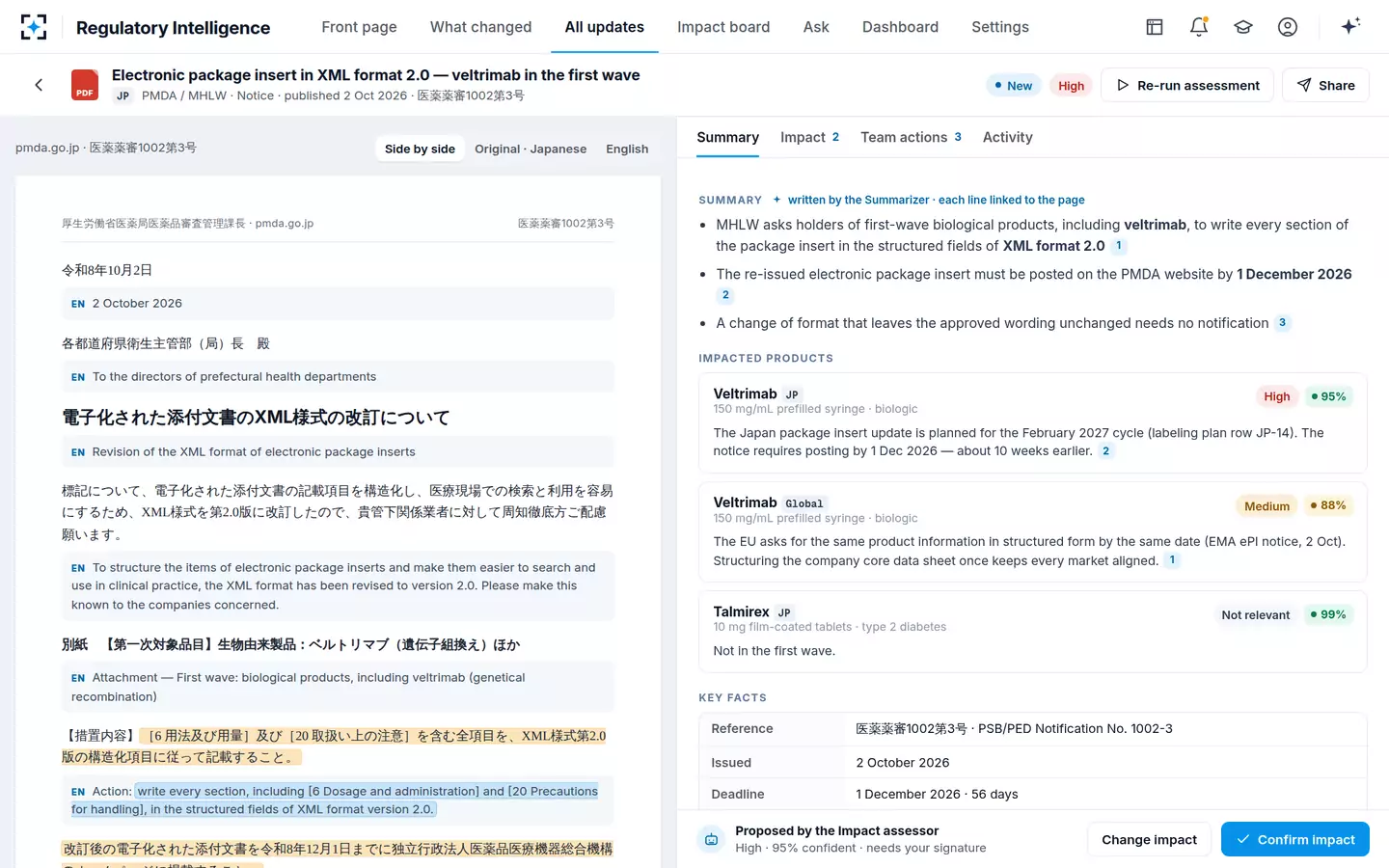
The design point behind that screen is narrow and important: the translation is never the record. A regulatory argument about what a Japanese notice requires has to be conducted on the Japanese text, with the translation as an aid. Any system that keeps only the English loses the ability to settle the argument.
Divergence: why one watch list cannot be shared across markets
Watch lists used to be shorter because markets used to move together. They move apart now, and the clearest documented case is the United Kingdom's separation from the European system. A 2026 review in Reviews on Recent Clinical Trials finds that "regulatory divergence has necessitated dual submissions, separate clinical trial approvals, and independent safety reporting systems, increasing costs and complexity", and that "despite shared safety objectives, the absence of harmonized processes complicates regulatory operations for pharmaceutical companies".
For a watch list, divergence has a specific consequence: two authorities that once produced one requirement now produce two, and the second one does not announce itself. Nobody sends a notice saying "this guideline no longer applies in the United Kingdom". The team finds out when a submission comes back. Each divergence event adds a source, a set of deadlines and a reader, and nothing retires in exchange.
It also breaks the habit of reading one market and assuming the rest. A paragraph in a European guideline and the corresponding paragraph in a British one may differ by a sentence, and that sentence may be the one that decides a data package. Comparing two texts word for word stops being an occasional exercise and becomes part of the weekly work — which is the argument for knowing exactly what weight each document carries before anyone changes a plan on it.
Building your own watch list: eight questions to ask of every source
A source that passes these eight can be watched reliably by a person or by software. A source that fails one of them needs a named compensating arrangement, written down, rather than optimism.
Eight questions to answer before a source joins the watch list
- Which of our licences or applications does this authority hold?
If the answer is none, and no filing of ours cites its standards, it is background reading rather than a watched source. Say which licence, not which region.
- What does it publish that creates work, as opposed to news?
Guidance, notices, standards and safety communications create work. Press releases, conference speeches and annual reports rarely do, and they crowd out the ones that do.
- In what language is the text that actually binds?
Not the language of the summary. If the binding text is Japanese or Chinese, the watch has to reach the original, and somebody has to be able to read it the same day.
- Does it publish attachments the index page does not describe?
Where the annex carries the requirement and is not translated, an English index entry is a notification that something exists, and nothing more.
- Does it say which document a revision replaces?
If it does, a word-for-word comparison is possible. If it does not, somebody has to find the predecessor, and that search is where revisions get missed.
- How often does it publish, and would we notice silence?
A source checked daily that has been quiet for a month is either genuinely quiet or broken. Only one of those is good news, and nothing distinguishes them unless the check itself is recorded.
- Is there a stable address, or does the content move?
A watch that depends on a search page will drift. An address and a publication date per document are what make a citation checkable a year later.
- Who inside the company owns what this authority publishes?
A source with no named owner produces updates with no named recipient, which is how a watch list becomes a mailing list. Name the person, not the team.
The sixth question is the one most lists never answer. Collection failures are silent by construction: a source with nothing new and a source that has stopped being checked produce the same empty result. The only defence is a record of the check itself — this source was read at this time on this day, and here is what it held — which is why a watch list is better kept as a dated log than as a set of bookmarks.
What a watched list looks like once the morning's reading is done
The output of a watch list is not the list. It is the morning after, when 27 things have arrived from nine authorities, some of them in languages the central team does not read, and someone has to say which ones matter. That is the test a watch list is for.
Nine authorities in one morning, sorted by what they do to your portfolio
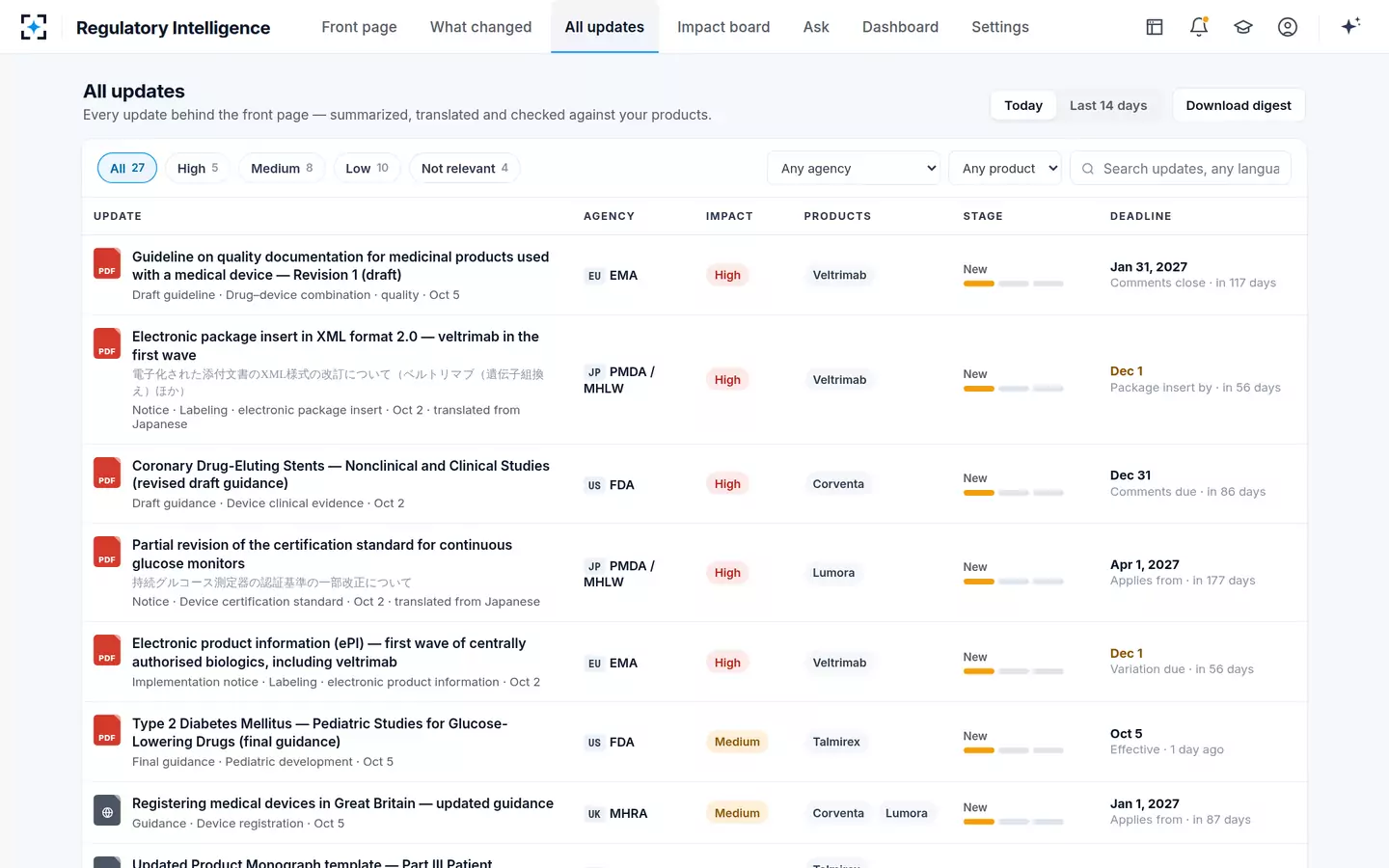
A watch list that produces that screen is doing its job; a watch list that produces a folder of unread PDFs is a liability with a budget line. To see one built on your own markets and licences, start from Regulatory Intelligence; to see what a watch list is worth against the one source every portfolio shares, the ICH E6(R3) transition is the clearest current example.
Questions people ask
Is there a single PDF list of pharma regulatory bodies?
The closest thing is WHO's list of listed authorities, published as a document and current as of December 2025, which names each authority with the product streams and the regulatory functions its listing covers and the date it falls due for renewal. It is not a complete list of the world's medicines regulators, and it is not meant to be: it lists the systems WHO has assessed. Any authority that licenses your product belongs on your list whether or not it is on WHO's.
What is a stringent regulatory authority, and does the term still apply?
It was the older category that reliance pathways and procurement rules used to point at. WHO recorded in December 2025 that all authorities previously classified as stringent regulatory authorities "have now formally transitioned into the WLA framework", so the term now describes a set with no current members. Internal procedures and contracts that still define a requirement by reference to an SRA need rewriting against the listed-authority framework.
Is the list of regulatory authorities in pharmacovigilance a different list?
Largely the same authorities, read for a different function. WHO's listings are granted function by function, and vigilance is the second of the eight, so an authority may be listed for registration and marketing authorisation, vigilance and laboratory testing and not for the other five. A safety team's watch list should therefore be built from the same licence register, filtered to the authorities that receive its reports and publish safety communications.
How many medicines regulators are there in Europe?
Counting EMA as one, the European Economic Area had 34 national competent authorities for human medicines on EMA's own list on 28 October 2026, spread over 30 countries, plus EMA itself and the European Commission, which issues the decisions and the legislation. Germany, Poland and the Netherlands each list more than one authority, so counting one per country gives 30 and misses four.
Which agencies publish guidance only in their own language?
Japan and China are the two largest cases a global portfolio meets. Japan's agency warns on its own English pages that the site "may not be accurate due to machine translation" and that the attached files are not translated at all; China's English site is a selected subset with a newsletter issued by the volume rather than a mirror of the Chinese original. Within the European Union, legal acts appear in all 24 official languages, but national authorities' own guidance often appears only in the national language.
How often do agencies publish new guidance?
It varies by channel rather than by agency. Official registers publish continuously and need a daily check; forward agendas appear once or twice a year and are worth reading against the previous edition; notices and safety communications are episodic and carry the shortest deadlines. The rhythm, not the volume, is what decides how a source has to be watched — and a source whose rhythm you have not written down is a source you cannot tell has gone quiet.