Regulatory horizon scanning is the practice of looking for rule changes before they bind you, and the honest answer to how far ahead you can see is: it depends which of four published signals you are watching. A rule change announces itself on an authority's own forward agenda, in the drafting step that later appears on a draft's cover page, as a draft released for consultation with a closing date, and as a final text with an effective date — and one class of document skips all four and takes effect the day it is posted. Botminds' Regulatory Intelligence reads all four signals every morning and records three dates for every update: published, comments close, effective.
This page measures the horizons rather than describing them, using two guidelines whose own cover pages carry every date: the revision of a European quality guideline published for consultation in December 2025, and ICH E6(R3), whose development history and two effective dates are a matter of public record. Where the solution is shown working, the products and notices on screen are fictional sample data.
What is regulatory horizon scanning?
It is the part of regulatory intelligence that looks forward rather than sideways. Monitoring tells you what changed last night; horizon scanning tells you what is likely to change in the next one to three years, so that a filing plan, a data package or a budget can be built with the change already in it. The two are different jobs with different outputs — monitoring produces a decision this week, scanning produces a line in a plan — and they fail differently too.
The confusion worth clearing up first is between a horizon scan and a rumour. A scan is built on published traces: an agenda the authority has posted, a draft with a docket number, a committee minute with a date on it. Anything without a published trace is market intelligence, which has its own value and should never appear in the same document, because the two carry completely different evidential weight and a reader cannot tell them apart once they are in the same bullet list.
The second thing worth clearing up is that scanning is not the same as reading everything. A scan is selective by design: it watches the small number of channels on which an authority announces intentions, and ignores the large number on which it announces facts. That is what makes it cheap, and it is why almost nobody does it — the channels are published, free and dull, and nothing in them demands a response this week.
The four horizons: agenda, drafting, consultation, final text
Each horizon is a point at which something about a future requirement becomes publicly visible. They differ in how early they appear, how reliably they predict the final text, and what a company may responsibly do with them.
The four horizons, what each buys, and what each costs to watch
What it gives you: A topic, a year, and nothing else. No text, no dates, no commitment — FDA's drug centre states on the page that it is "not bound by this list of guidances, nor required to issue every guidance document on the list".
What it is worth: The longest lead time available and the cheapest to watch: one document, once or twice a year. Also the least reliable, which is why it belongs in a risk register rather than on a plan.
What it gives you: A date on the cover page of a draft, naming when a working party agreed it, before the committee released it. Visible only once the draft is published.
What it is worth: No forecasting value at all, and real calibration value: it tells you how long this authority takes between agreeing a text internally and showing it to anyone.
What it gives you: The actual words, a closing date for comments, and the document the revision says it replaces.
What it is worth: The horizon where a company can still change the outcome, and the one most worth staffing. Provisional for planning, decisive for comment.
What it gives you: The requirement, and the day it starts to apply.
What it is worth: What a programme is built on. If this is where you first heard about it, the lead time the other three horizons offered has already been spent.
Reading down the right-hand column gives the uncomfortable shape of most functions. Horizon four is fully staffed, because a final text with a date forces itself on somebody. Horizon three is partly staffed, usually by whoever happens to see the notice. Horizon one, the cheapest and longest, is read by nobody, because it has no deadline and asks for nothing.
How far ahead can you see a regulatory change?
Between about two years and zero days, depending on the horizon and the channel. Two measured examples set the range, and both are drawn from the documents' own published dates rather than from any estimate.
ICH's good clinical practice guideline is the long case. The draft was endorsed for public consultation on 19 May 2023 and the final version adopted on 6 January 2025 — 598 days later. The European regulator then published the Principles and Annex 1 on 27 January 2025, with a legal effective date of 23 July 2025: another 198 days after adoption, and 796 days in all from the first public draft to the day it applied. A company that read the Step 2 draft in May 2023 had more than two years. A company that first heard of it when the effective date was announced had six months.
ICH E6(R3): 598 days of public draft, then 198 more before it applied
- Public draft, Step 2 to Step 4598 days
- Adopted, then waiting198 days
- After adoption on 6 January 2025Annex 2 published 15 July 2026
- Published to effectiveeffective 15 January 2027
The second lane is the part people miss. Adoption is not one event: E6(R3) arrived in parts, and the annex that lands on a sponsor's trial operations was published eighteen months after the guideline was adopted, with a further six months before it applies. What actually changed between E6(R2) and E6(R3) goes through the substance; the point here is only that the guideline was final in January 2025 and its second annex does not apply until January 2027 — 739 days, or a little over two years, and no single announcement covered both ends of it.
Horizon one: the published agenda, and the sentence that limits it
The longest horizon is a list, published on a schedule, of what an authority intends to write. In the United States two such lists exist side by side. The good guidance practices regulation obliges the agency to publish one annually: "once a year, FDA will publish, both in the Federal Register and on the Internet, a list of possible topics for future guidance document development or revision during the next year". Separately, draft regulations under review are described through what the Office of Information and Regulatory Affairs calls "bi-annual submissions of the Unified Agenda, which are published descriptions of each agency's upcoming regulatory actions".
Those are two different horizons for two different document classes — guidance on one, regulations on the other — and a scan that watches only one of them has a blind spot the size of the other. Both are cheap to watch. Both come with an explicit disclaimer that they commit the agency to nothing.
One centre's guidance agenda, July 2026: what was on it, and what had moved since February
85
guidance topics the centre says it is considering for 2026
14
categories, from administrative and procedural to artificial intelligence
7
of the 85 marked as already published since the February 2026 posting
5
carrying the agenda's mark for a new entry as of the February 2026 posting
Those two small numbers are the honest measure of what horizon one is worth. Over five months, seven of 85 topics became documents, and five of the topics still listed carry the new-entry mark. An agenda is therefore not a forecast of next quarter; it is a statement of direction over years, and it should be read for the categories that are growing rather than for the individual lines. The appearance of an artificial intelligence category with a single entry on it says more about where the centre is heading than any one of the 85 titles does.
The page hosting the agenda is unusually frank about its own limits. It records that the agency is "not bound by this list of guidances, nor required to issue every guidance document on the list" and adds, in the same paragraph, "we are not precluded from developing guidance documents on topics not on this list". Read together, those two clauses say the list is neither a commitment nor a limit — which is precisely the right way to use it, and precisely why putting a date from it on a programme plan is a mistake.
Horizon two: the drafting step printed on a draft's cover page
Between an authority deciding to write something and anyone outside seeing it, there is an interval that is invisible while it runs and precisely dated afterwards. European guidelines print their own development history on the cover, and the revision of the quality guideline for radiopharmaceuticals is a clean example: "draft agreed by Quality Working Party July 2025 · Adopted by CHMP for release for consultation 01 December 2025 · Start of public consultation 10 December 2025 · End of consultation (deadline for comments) 30 April 2026".
One European guideline revision, from a working party's draft to the close of comments
- Working party had agreed a draftJuly 2025 to 1 December
- Public consultation, 10 December 2025 to 30 April 2026141 days to comment
Five months of drafting, then nine days from committee adoption to the consultation opening, then 141 days of consultation. None of the first five months was usable: nobody outside the committee could have known the text existed. What the dates are good for is calibration. An organisation that records the cover-page history of every revision it reads builds, over a couple of years, a reasonable expectation of how long each authority takes between each step — which is the only defensible basis for answering "how long have we got" about the next one.
The cover page carries one more line that is worth more than the dates: the sentence naming the document the revision replaces. A guideline that names its predecessor has handed you the comparison, and in this case the predecessor dates from 2007. Eighteen years of accumulated practice is about to be restated, and the only way to know which parts changed is to put the two texts side by side. What a document weighs decides how hard you then have to argue about the difference.
Horizon three: the consultation window, measured on two guidelines
The consultation is the horizon where a company can still change the text, and it is also the horizon with a hard date on it. Two measured windows: the radiopharmaceuticals draft ran from 10 December 2025 to 30 April 2026, 141 days, with comments collected through a survey form the cover page links; the European consultation on the E6(R3) draft ran from 26 May 2023 to 26 September 2023, 123 days. Four months is a reasonable planning assumption for a European consultation, and it is an assumption, not a rule — the closing date is stated on each document and nowhere else.
That window is short relative to the work a comment takes. A comment worth submitting on a quality guideline needs a position agreed across development, manufacturing and regulatory affairs, often with data behind it. Four months is enough for that only if the draft is noticed in the first few weeks. A draft noticed in month three produces either no comment or a thin one, and the company then lives with the final text for years.
What a draft tells you that the final text does not
Three things, none of which survives into the final document. First, what the authority was originally minded to require: the difference between the draft and the final text is a record of which arguments worked, and it is the best available evidence of where the flexibility in this area lies. Second, the closing date, which is the only point at which your view has formal standing. Third, the identity of the predecessor, since a draft revision states the document it replaces and thereby tells you which of your own procedures were written against the old text.
There is a fourth, quieter signal. A draft that appears with no concept paper, no working-party interval of any length and no prior mention on the agenda is a draft the authority wrote quickly, which usually means it is responding to something. Reading it for what it is responding to is often more informative than reading it for what it requires.
The horizon you do not get: documents in force the day they appear
Not every change comes with a warning. Two routes in the American system produce a document that is in effect immediately. The regulation itself provides for the first: "FDA will not seek your comment before it implements a Level 1 guidance document if the agency determines that prior public participation is not feasible or appropriate", in which case the notice, the posting and the implementation all happen together and comment is invited afterwards. The second is the ordinary route for the whole Level 2 class, which is posted and implemented at once with no Federal Register notice at all.
For a horizon scan, those documents are a structural gap rather than a failure of effort. No amount of scanning produces lead time on a document whose first public appearance is also its effective date. The only countermeasure is speed on the other side: a daily check of the guidance index rather than a weekly one, and a routing step that puts the document in front of its owner the same morning.
It is worth being precise about the cost of the gap, because it changes where a function should spend. A missed agenda item costs a year of comfort. A missed Level 2 guidance means working against the agency's current thinking from the day it appeared, without knowing it, and with no notice to point at. The first is a planning problem and the second is an operational one, and a team that treats them as the same problem will solve neither.
Turning a horizon into a date on a filing plan
A horizon becomes useful at the moment somebody writes a date next to it, and dangerous at the moment somebody writes the wrong kind of date. The table below is how we would govern that: what each horizon may put on a plan, and what it may not.
What each horizon may put on a plan, and what it may not
Horizon one — the published agenda
Goes on the plan
A watch item with an owner and a review date. A note in the risk register. A question at the next portfolio review.
Does not
A date. A budget line. A change to a data package. Nothing on this horizon has a text to read, let alone a requirement.
Horizon two — the drafting step on the cover page
Goes on the plan
Nothing, while it is happening. Once a draft appears, the dates on its cover go in the record so the next scan knows how long this authority takes.
Does not
A forecast. This horizon is only visible after the fact, which is exactly what makes it useless for planning and useful for calibration.
Horizon three — the draft out for consultation
Goes on the plan
A comment, if the draft would be expensive. A provisional plan with the requirement in it, flagged as provisional. A named owner for the final text. The consultation close date as a hard diary entry.
Does not
A commitment that cannot be reversed. The draft may change, and comments exist to change it.
Horizon four — the final text with an effective date
Goes on the plan
Dates. The effective date on the plan, the work backwards from it, the budget and the people. This is the horizon a programme is built on.
Does not
Surprise. If this is the first horizon at which anyone looked, the lead time has already been spent.
The rule behind the table is that a plan should record the horizon alongside the date, so that a reader a year later can tell a firm date from a provisional one. "Comparability data required from Q3" means something different if it came from a final text with an effective date than if it came from a line on an agenda, and a plan that does not say which has lost the information that matters most about it.
Deadlines in one morning's edition, counted down rather than listed
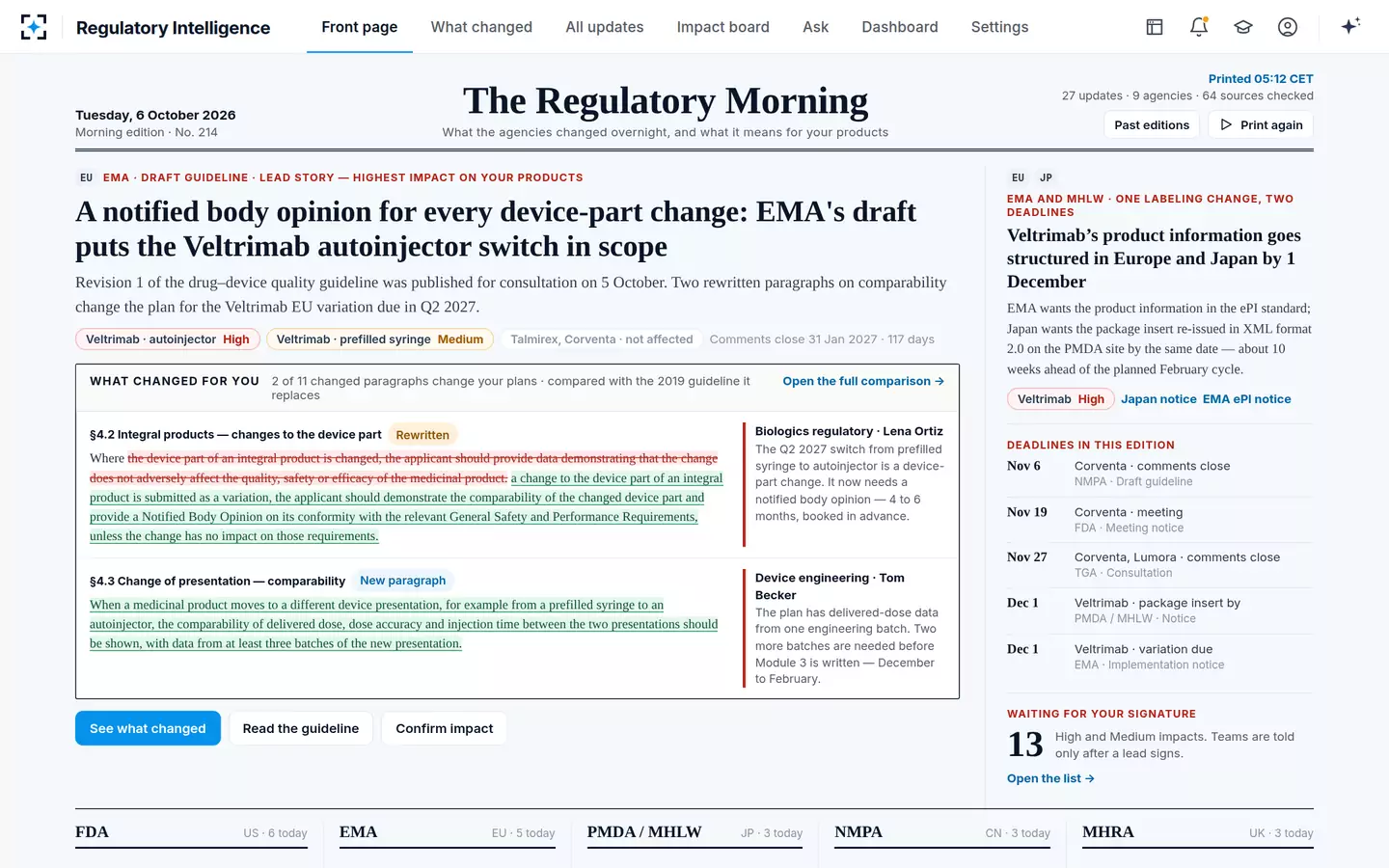
A countdown is a different object from a date. A date in a list is a thing to be remembered; a countdown is a thing that gets shorter whether or not anyone looks. On a consultation window of about four months, a reader who first sees "117 days" has time to assemble a comment, and a reader who first sees "11 days" does not — and the only difference between the two readers is whether the draft was spotted in the first week.
How often should you scan?
At two cadences, because the horizons move at two speeds. The forward agendas change once or twice a year and should be read when each edition appears, against the previous one: the signal is the difference between the editions, not the list itself. A topic that has dropped off is as informative as one that has arrived, and nobody announces a deletion.
Everything else needs a daily check, for the reason set out above: a document that takes effect on posting gives no notice, and the only variable you control is how long it sits unread. Weekly monitoring turns a zero-notice document into an average of three and a half days of unnoticed non-compliance, and the deficiency is not in the scanning, it is in the interval.
Between those two sits the quarterly job nobody schedules: re-reading the watch list itself. Sources move, authorities reorganise, a consultation page becomes an archive page. A scan that has been running for two years without anyone checking that each source is still being answered is a scan that may already have stopped, silently, on the sources that matter least often — which, by construction, are the ones nobody would notice.
What to record so the scan survives the person who ran it
A horizon scan held in one person's head is a scan with a single point of failure and no audit trail. Five records make it transferable, and each of them is a by-product of doing the work rather than extra effort.
Five records that turn a scan into an asset
- The source, the date it was checked, and what it held
Including the days it held nothing. Without the empty days, a source that has stopped being checked is indistinguishable from a source with nothing to say.
- Three dates per document: published, comments close, effective
The first fixes the version, the second is your only window to influence it, and the third is the one that goes on the plan. A document recorded with one date out of three cannot be planned around.
- The document the revision names as replaced
Taken from the new document's own front matter, not inferred. It is what makes a word-for-word comparison possible, and what tells you which of your procedures were written against the old text.
- The horizon the information came from
Agenda, drafting step, consultation or final text. A plan that records the requirement but not its horizon has thrown away the only thing that says how firm the date is.
- Who was told, when, and what they decided
A scan's output is somebody else's decision. If the decision is not recorded beside the document that prompted it, the scan has produced reading rather than change.
Every morning's front page, kept as it was printed
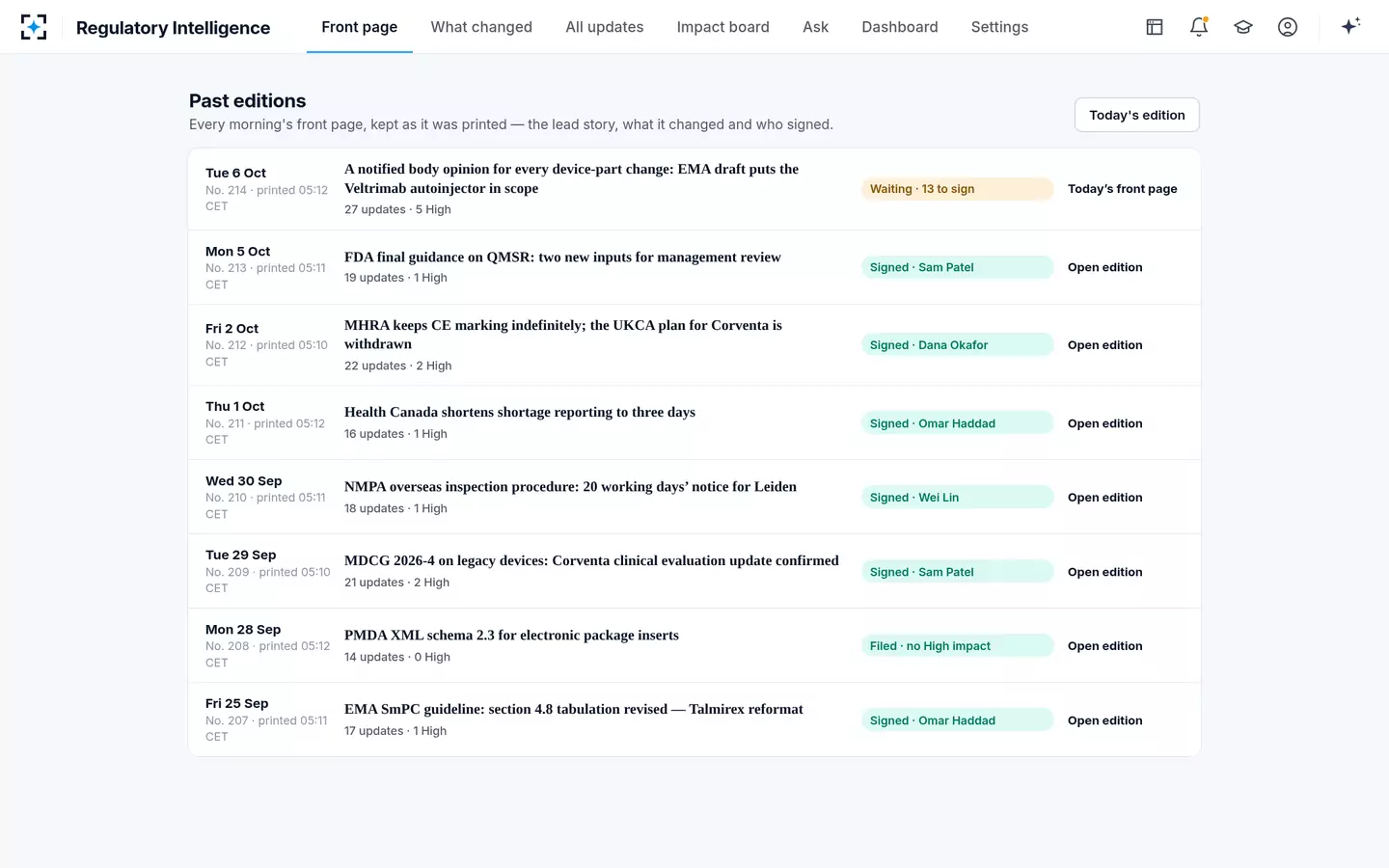
That record is also the thing that makes a scan improvable. Once a year of editions exists, the interval between an authority's publication and the owning team hearing about it is a number rather than an impression, and so is the share of agenda items that became documents. A scan you can measure is a scan you can argue for. To see the horizons, the countdowns and the record on your own portfolio, start from Regulatory Intelligence.
Questions people ask
What is the FDA guidance agenda?
It is the list of guidance documents a centre intends to draft or revise in a calendar year, published in satisfaction of the good guidance practices regulation's requirement that the agency publish, once a year, "a list of possible topics for future guidance document development or revision during the next year". The July 2026 edition for the drug centre carried 85 topics in 14 categories. The page hosting it states that the agency is not bound by the list and is not precluded from writing guidance on topics that are not on it.
What is the Unified Agenda?
A separate forward list, covering regulations rather than guidance. The Office of Information and Regulatory Affairs describes the descriptions of draft regulations under its review as coming from "bi-annual submissions of the Unified Agenda, which are published descriptions of each agency's upcoming regulatory actions". Because guidance and regulations are announced on different lists at different cadences, a horizon scan that watches one of the two has a gap the size of the other.
Should we act on draft guidance?
Act on it provisionally, and comment on it. A draft is not enforceable and may change, so a commitment that cannot be reversed is premature. But the closing date is the only moment your view has formal standing, and a draft that would be expensive deserves a comment with data behind it rather than an objection. Put the requirement in the plan marked provisional, name an owner for the final text, and diary the closing date as hard.
How long is an EMA public consultation?
The window is stated on each document rather than fixed by a rule, and the two measured here were 141 days — 10 December 2025 to 30 April 2026 on the radiopharmaceuticals revision — and 123 days, 26 May to 26 September 2023, on the European consultation about the E6(R3) draft. About four months is a reasonable planning assumption, and the actual date should always be read off the document.
What is a concept paper?
It is the earliest public trace a guideline development can leave: a short document setting out the problem an authority thinks needs addressing and the scope of the text it is considering, published before any draft exists. Where there is one, it is the longest horizon available on that guideline and the cheapest to comment on, because nothing has been drafted yet. Where there is none, the first visible step is usually the dated drafting history printed on the eventual draft's cover page.
What are regulatory horizon scanning tools?
Anything that watches the forward channels and puts a date beside what it finds — which can be a diary, a spreadsheet of agenda editions, a subscription service, or software that reads the agendas, drafts and final texts against a product portfolio. The useful question to ask of any of them is not how many sources it covers but which of the four horizons it reports, whether it records all three dates per document, and whether it can show you what it checked on a day when it found nothing.