A regulatory intelligence database is a subscription that collects what health authorities publish and puts it in one searchable place, usually with alerts. It answers one question well — what published? — and it is the easiest of the three jobs to buy, which is why it is the one most departments buy first. It cannot answer the second question, what does this mean for our products?, because it does not know your products, your labelling plan or your filing dates; and it cannot answer the third, who needs to act?, because it does not know your organisation. This page sets the four ways of covering all three jobs against each other — a database, people in-house, an outsourced desk, and agents such as Botminds' Regulatory Intelligence — with the arithmetic of each, and it is honest about the one number nobody publishes.
Where the page uses the solution's own figures they are from its sample data or are stated estimates, and each is labelled. Subscription prices are negotiated rather than published, so this page quotes no price at all; instead it prices the work in hours, so you can apply your own rates.
The size of the job, in figures you can check
594
documents from FDA alone in the Federal Register, 1 January to 27 October 2026 — about 2.8 every working day
436,400
people employed in 2025 in the US compliance-officer group that regulatory affairs specialists belong to
32,700
projected job openings for that group in the 2025–2035 projection, from growth and replacement
30tasks
in the occupation’s own task list — watching regulations is one of them
What a regulatory intelligence database gives you, and what it does not
What it gives you is real and should not be sneered at. One place to search instead of forty bookmarks; a history, so you can see what a guideline said in 2019; alerts, so a change does not depend on somebody remembering to look; and coverage of agencies whose sites you would never get round to watching. For a department that currently finds things through email newsletters and a colleague's forwarded message, that alone is a step change.
What it does not give you is relevance. Relevance is not a property of a document; it is a relation between a document and a portfolio, and the portfolio is yours. A subscription can tell you that a drug–device quality guideline has been revised. It cannot tell you that paragraph 4.3 of the revision lands on the one product of yours that is moving from a prefilled syringe to an autoinjector, that the change means two more batches of delivered-dose data, or that the variation planned for May now depends on booking a notified body before the end of the month. That is the part that takes a person a day, and it is the part the business is actually paying for.
A subscription and a decision: the same guideline, two outputs
What a database can tell you: Revision 1 of a quality guideline was published for consultation, with its reference number and date.
What somebody still has to work out: Which version it replaces, and whether the agency names it or you have to find it.
What a database can tell you: That the document is a revision. Sometimes a supplied summary of it.
What somebody still has to work out: Which paragraphs changed, which of those are editorial, and the exact old and new wording of the ones that are not.
What a database can tell you: Keyword matches against your saved searches.
What somebody still has to work out: Which of your products, presentations and market licences it touches — and which it does not, which matters just as much.
What a database can tell you: Nothing.
What somebody still has to work out: What it does to a planned variation, a labelling cycle or a study, and which dates move.
What a database can tell you: Everyone on the alert list.
What somebody still has to work out: The one person who owns that product area, and what they are being asked to decide.
What a database can tell you: That an alert was sent.
What somebody still has to work out: Who assessed it, on what evidence, when, and who was told as a result.
The three ways to buy the work
The academic framing is useful here because it is neutral. A 2026 integrated literature review in the PDA Journal of Pharmaceutical Science and Technology sets regulatory intelligence out as a function defined by the systematic collection, analysis and dissemination of regulatory information, and notes that how well those parts work depends on how mature and how integrated the systems behind them are. Its forward view is the reason the decision is live now rather than next year: "As regulatory frameworks become more dynamic and digital technologies advance, the role of RI will become increasingly central to proactive compliance, innovation strategy, and global market access."
So: three jobs, four ways to cover them. A subscription covers collection. People in-house cover analysis and dissemination, and partly collection. An outsourced desk covers collection and analysis and hands you a report. Agents cover collection, translation, comparison and a proposed analysis, and leave the decision and the signature with your own named people. Nobody covers all three without somebody of yours at the end, because the last step is an accountable judgement about your products.
Three jobs, four ways to cover them — and who is left holding each one
| A database | People in-house | An outsourced desk | Agents | |
|---|---|---|---|---|
| Collection — finding what published | Its whole value. Strong on major agencies, weaker on national authorities and non-English sources. | As good as the time available, which is the first thing to go in a busy month. | Covered, to the scope in the contract. | Covered on a fixed schedule, with the original file and address kept, and sources you add yourself. |
| Translation — reading what is not in English | Usually a title translation, sometimes none. | Depends entirely on who you employ and where. | Covered where the provider has the language. | Covered paragraph by paragraph with the original kept beside it, and uncertain passages flagged. |
| Comparison — what the revision changed | Rarely. You get both documents, at best. | Done by hand, well, slowly, and only for the documents somebody has time for. | Usually covered, as prose in a report. | Old and new wording word for word, against the version the agency names as replaced. |
| Analysis — what it means for our products | Not possible: it does not know your portfolio. | The core of the job, and the reason you hired them. | Partly. The provider knows your products only as well as you have told them. | A proposed level per product with the reason and the passage — proposed, never confirmed. |
| Dissemination — getting it to the right person | An alert to a list. | Email, if the person remembers who owns what. | A report to whoever commissioned it. | The owning team gets the exact paragraphs, in its own language, after a lead signs. |
| The decision and the record | None. | Yours, if somebody wrote it down. | Yours. The provider’s opinion is not your assessment. | Yours: a named approver per product area, with name, time and the meaning of the signature. |
What one person can actually read in a day: the arithmetic
Do this arithmetic before you do anything else, because the answer is not what most plans assume. Start with volume. FDA alone published 594 documents in the Federal Register between 1 January and 27 October 2026 — about 2.8 every working day, and that is one agency's notices, not its guidance pages, its safety communications or its databases. Add the European agency and the national competent authorities, Japan, China, the United Kingdom and the markets where you hold licences, and a realistic watch list produces a few thousand items a year, of which a few hundred need real reading.
Then put a time on each. A title and a date can be triaged in under a minute. A document that has to be opened, read, summarised with citations and assessed against a portfolio takes ten to twenty minutes if it is routine. A revised guideline that must be compared with the version it replaces, paragraph by paragraph, takes an hour to half a day. These are our estimates; put your own in and the shape will not change.
The staffing arithmetic, and the surprise inside it
Updates a year
sources × what each publishes
Count your real watch list, not a supplier’s total. A few thousand items; a few hundred that need reading.
Your own count
Minutes each
triage + read + assess
Under a minute to triage; 10–20 minutes to read, summarise and assess a routine item; an hour or more for a revision needing comparison.
Our estimate
Productive hours a year
≈ 1,600 per person
What is left of 2,080 after leave, public holidays, training, meetings and the rest of the 30 tasks the job contains.
Our assumption
The people the work needs
(updates × minutes) ÷ 60 ÷ 1,600
4,000 items at an average of 14 minutes is about 933 hours — roughly 0.6 of a person for the reading alone.
The number to argue about
Here is the surprise. On any honest set of assumptions the reading comes out at well under one full-time person. Departments do not fail at this because the hours are impossible; they fail because the hours are scattered. Fifteen minutes here, an afternoon there, split across six people who each have a filing of their own, interrupted by anything with a deadline on it. The total is small and the elapsed time is enormous, and elapsed time is the thing a regulatory change actually costs you.
That is why headcount is a poor instrument. Adding a person to a department whose problem is elapsed time usually buys you another person with a backlog. What shortens elapsed time is removing the handoffs: the gap between a document being published and somebody noticing, between noticing and translating, between translating and knowing who it lands on.
Where the days go on one update by hand, against the same six steps with agents
What a regulatory affairs specialist costs — and why the published wage is not your number
There is one caveat worth making before anybody quotes a salary at you. The US occupational data for Regulatory Affairs Specialists carries a note that is easy to miss: the median wage shown on the occupation's page is median wage data for Compliance Officers, the broader group the occupation sits inside, drawn across every industry including government and finance. It is a real figure and a poor proxy for what a pharmaceutical regulatory affairs professional earns in a research-based company in Basel, Boston or Tokyo. Price the work with your own loaded rate, not a national median for a different population.
What the occupational data is genuinely good for is the shape of the job. The task list runs to thirty entries, and watching regulations is one of them. The others include preparing and reviewing submissions, talking to agencies about pre-submission strategy, pathways and the follow-up of submissions under review, and reviewing adverse drug reactions and filing the reports they require. Those are the jobs that get dropped when the morning's reading expands, and they are the jobs with their own deadlines.
The labour market is the other half of the picture: 436,400 people employed in 2025 in the broader compliance-officer group, with 32,700 projected openings in the 2025–2035 projection from growth and replacement. A plan that assumes you can hire your way out of a monitoring backlog is a plan competing with every other company's plan for the same people.
Where a subscription stops: your portfolio, your labelling plan, your calendar
Three inputs turn a document into a decision, and none of them can be bought: a product and licence list that says what you sell, in which presentations, under which licence, in which market, owned by whom; a labelling plan that says which label changes are already scheduled and in which cycle; and a submission calendar that says what you are filing and when. Without them, "relevance" is keyword matching.
With them, the questions change completely. Not "is this guideline about drug–device products?" but "does this change the data package for the variation we are filing in May, and does the notified body have to be booked before the end of this month?". Every option on this page becomes more valuable once those three inputs exist, and less valuable than advertised while they do not — which is why the first weeks of any programme are usually spent on them rather than on software.
Is a free source list enough?
For a very small company in one or two markets, a disciplined list of bookmarks and agency email alerts is a defensible starting point, and it costs nothing but attention. Two things break it.
The first is that agencies publish in order to be read, not to be monitored. In a 2015 review of four federal departments, Health and Human Services among them, GAO found that components "used different strategies to disseminate guidance and all relied primarily on posting the guidance on their websites" — and that there were real obstacles to finding anything, "including long lists of guidance and documents dispersed among multiple web pages". A page that a human can read is not a page a human can watch.
The second is currency. The same review found that of the 25 components examined, "nearly half did not regularly evaluate whether issued guidance remained current and effective". If the publisher is not systematically reviewing whether a document is still the right one, a bookmark to it is not a control; you have to know what superseded it, and that is exactly the work a comparison step does.
So: free is enough while the list is short, nobody is on leave, and every source is in a language you read. It stops being enough at the first non-English market, the first revised guideline, and the first week somebody is away.
The department of one, and the two jobs it has to drop
In a company with one or two regulatory people, all three jobs land on the same desk, and the arithmetic above lands with them. What actually happens is predictable: collection survives, because it is visible and anxious-making; dissemination survives, because somebody asks; and comparison and impact assessment quietly stop. Nobody decides to stop them. They are the jobs with no inbox.
The tell is in the artefacts. There is a spreadsheet of updates with a "reviewed" column and no "impact" column. There is a folder of downloaded guidelines and no copy of the versions they replaced. There are emails that say "FYI, EMA has revised the drug–device guideline" and nothing that says which paragraph, for which product, by when. If that is your department, the choice is not between buying a database and hiring: it is which of the two dropped jobs you are going to get back first, and comparison is usually the cheaper one to automate.
Every update behind the front page, in one list
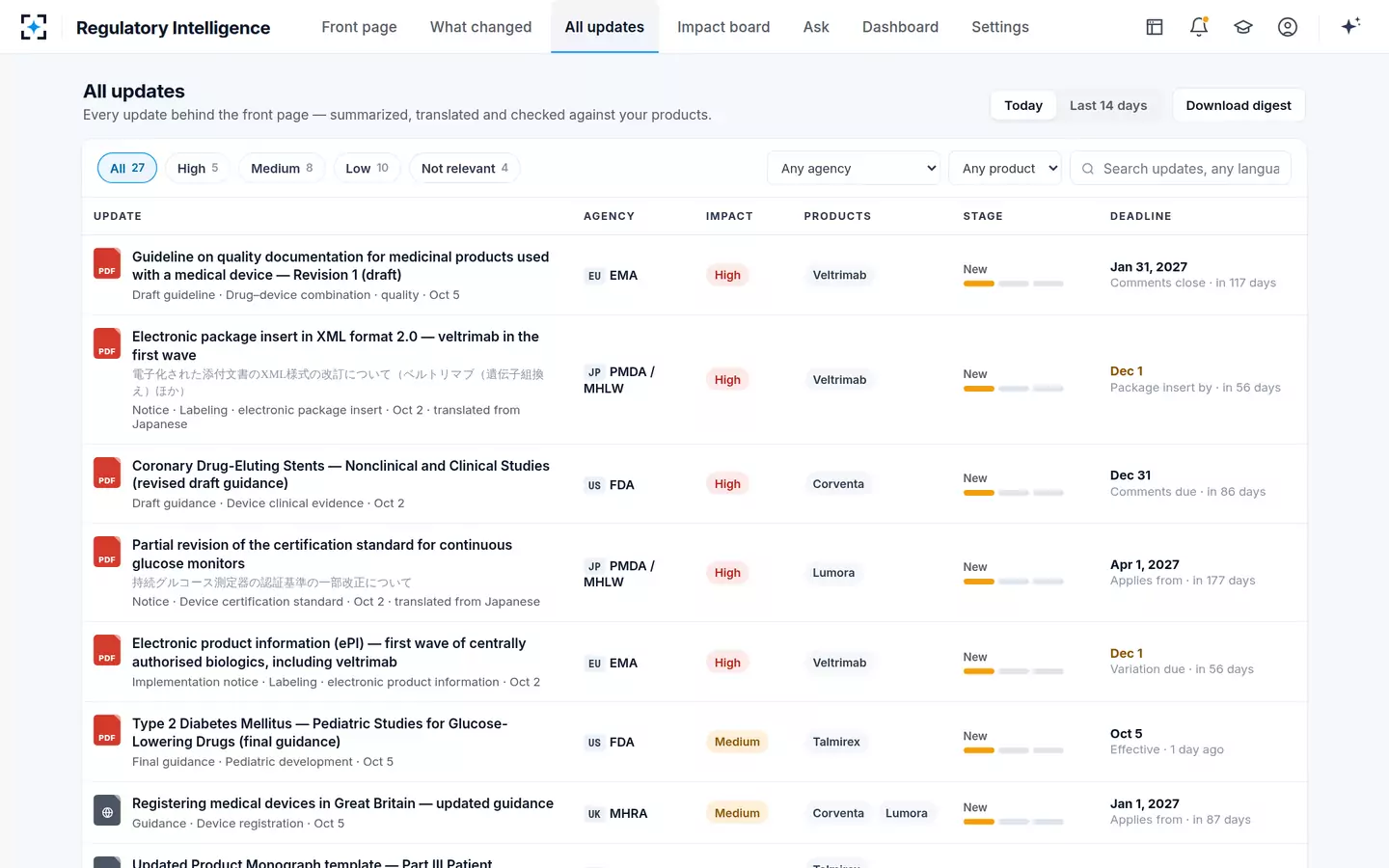
In-house, outsourced or agents: what each option really covers
An in-house team gives you judgement that improves with time, because the person who assessed last year's guideline remembers this year's. It costs salary, it competes for scarce people, and it has a single point of failure in every specialist language and therapeutic area. It is the right answer when the analysis is genuinely strategic and close to the business.
An outsourced desk converts a fixed cost into a variable one and buys you coverage in languages and regions you cannot staff. What it cannot buy is the thing that makes an assessment yours: the provider knows your portfolio only as well as you have described it, and a provider's opinion is not your regulatory assessment. It works best for breadth — watching markets you file in rarely — and worst for the products at the centre of your business.
Agents change the shape rather than the headcount. They do the mechanical parts without tiring: checking every source on a schedule, keeping the original of everything, translating with the source text alongside, finding the replaced version and comparing it word for word, and proposing a level per product with the passage behind it. They do not decide; a named person confirms every significant impact, and nothing reaches a team before that signature. The failure mode to guard against is the opposite of the human one — not a missed document, but a confident wrong proposal — which is why the citation and the human confirmation are structural rather than optional.
Most real departments end up with a mixture, and that is fine as long as it is deliberate. The question to answer explicitly is which option owns each of the three jobs, and who signs.
How much should a regulatory intelligence database cost?
We will not quote a price, and you should be wary of pages that do. These subscriptions have no published price list; prices are negotiated, vary by the number of users, the number of markets and the modules, and change every year. Any number you read on a vendor-neutral-looking page is somebody's guess or somebody's marketing.
What you can do instead is price the alternative, which is the only comparison that matters. Take your own loaded hourly cost for the people who would do the work, multiply by the hours the arithmetic above gives you, and add the cost of the elapsed time — the amendment that was filed without the data the assessor now expects, the label change that had to be done twice, the week a market stayed uninformed. The last part is the biggest and the hardest to estimate, and it is usually the one that decides the business case.
The honest answer on price, and how to work out your own number
Do it in four lines, and do it on your own files rather than a template. First, take ten real updates from the last six months and reconstruct the dates: when was it published, when did somebody here see it, when did the owning team hear, when was a decision made? Second, add up the hours those ten consumed, across everyone who touched them. Third, multiply out to a year using your real volume. Fourth — the line most business cases skip — write down what the elapsed time cost on the two worst of the ten, in money or in rework.
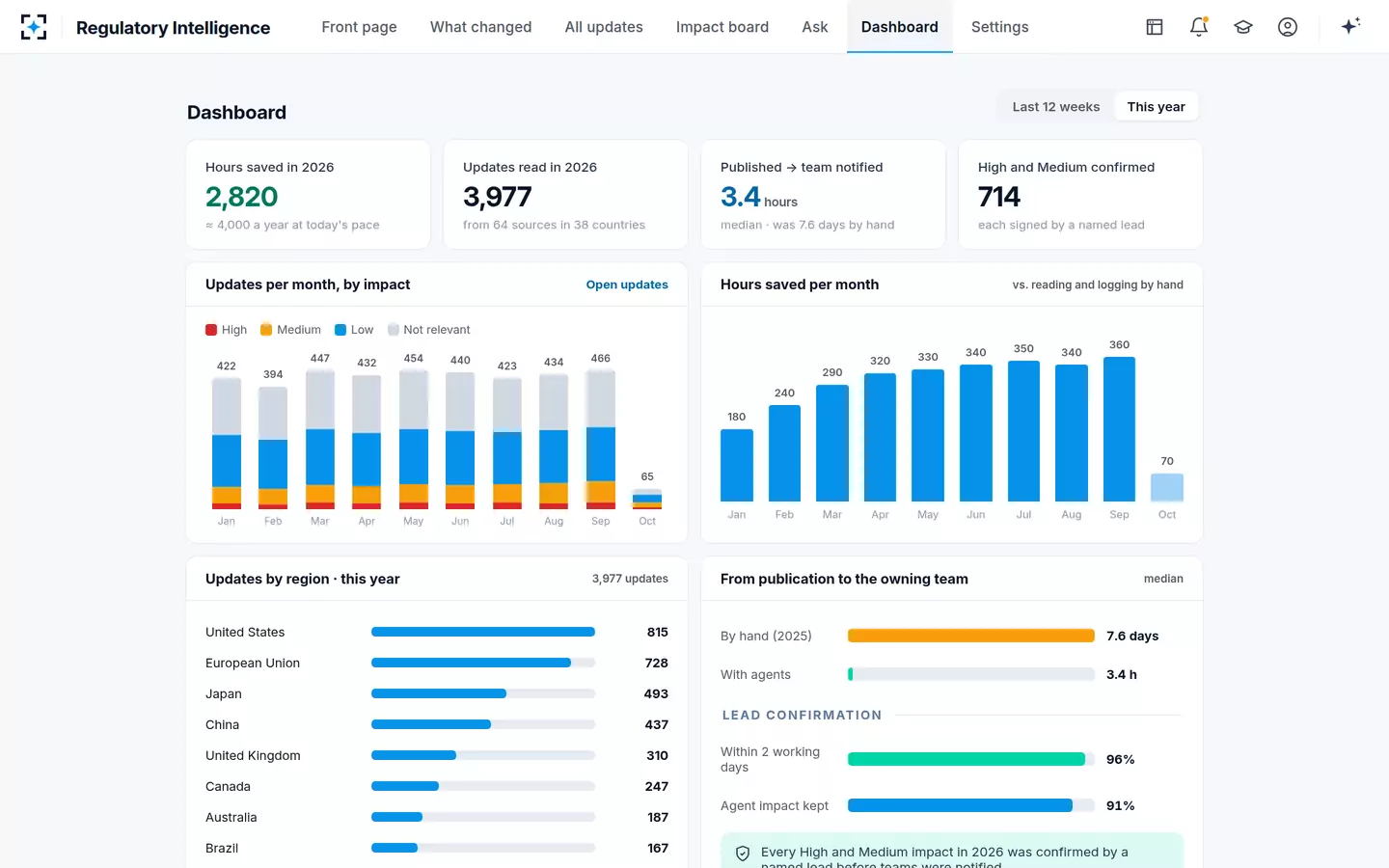
Now you have a number with your own name on it, and every option on this page can be priced against it. A subscription that halves the first step but leaves the other five is worth exactly the hours in step one. An outsourced desk that covers steps one to four but reports monthly does nothing for elapsed time. Agents that compress the first five steps into a morning are worth the elapsed-time number, which is the one you had to work out for yourself.
What the measurement looks like when it is kept continuously
For the questions to put to any supplier once you have that number, see the eighteen questions to ask before you buy; for how to stand the function up once you have decided, see the first ninety days. To price the agents option against your own ten updates, start at Regulatory Intelligence.
Questions people ask
What is a regulatory intelligence database?
A subscription service that collects what health authorities publish — guidance, regulations, notices, safety communications — into one searchable place, usually with alerts and a history of earlier versions. It covers the first of the three jobs of regulatory intelligence, collection. It does not know your products, your labelling plan or your filing dates, so it cannot tell you what a document means for you or who should act on it.
Is there a free regulatory intelligence database?
Not as a single product, but the underlying sources are free: agencies publish their own guidance, notices and databases, and several offer email alerts and machine-readable feeds. A disciplined list of those is a workable starting point for a small portfolio in one or two markets. It breaks down at the first non-English market, the first revised guideline that has to be compared with the version it replaces, and the first fortnight the person who maintains the list is away.
Can I build my own regulatory intelligence database?
You can build the collection half, and some departments do. The hard parts are not technical in the way people expect: agencies redesign sites and move documents, so watchers break quietly; deciding a document is the same one you already have is fiddly; and keeping a record of which version replaced which is a discipline rather than a feature. The analysis and dissemination halves are where the value is, and those depend on your own portfolio data, which no amount of scraping will produce.
How many people do you need in regulatory intelligence?
Fewer than most plans assume for the reading, and that is the wrong question. On a realistic volume the reading, summarising and assessing comes out at well under one full-time person; the problem is that the hours are scattered across people who each have a filing deadline, so the elapsed time from publication to the owning team is measured in days. Decide what elapsed time you can accept, then work backwards.
Should we outsource regulatory intelligence?
Outsource breadth, keep depth. A desk that watches markets you file in rarely, in languages you cannot staff, buys real coverage. For the products at the centre of your business, the analysis depends on knowing your portfolio, your plans and your appetite for risk, and the accountable assessment is yours whoever drafted it. A provider's opinion is an input to your assessment, not a substitute for it.
What is the best regulatory intelligence database?
There is no answer to that question that is not an advertisement, and we will not pretend otherwise. The useful version is: which of the three jobs are you short of, and what evidence will you ask for? If you are short of collection, compare source lists against your own markets. If you are short of analysis, no database will fix it. If you are short of elapsed time, measure it on ten real updates first, because that number is what any option has to beat.