The FDA safety labeling changes database — formally the Drug Safety-related Labeling Changes database, or SrLC — is the public record of approved changes that add or strengthen safety information in a prescription drug's or biologic's labeling: a boxed warning, a contraindication, a warning, an adverse reaction. It shows what has already changed; it cannot show what is about to, because the notification letters that start the one US regulatory deadline written into statute are not published. Section 505(o)(4) of the Federal Food, Drug, and Cosmetic Act gives the application holder 30 days to answer a notification letter, allows up to 30 more days of discussion, lets the agency issue an order within 15 days of the end of that discussion, requires a supplement within 15 days of the order, and leaves 5 days to appeal it. The clock starts when the letter arrives, not when the labeling team hears about it, which is why a safety change that reaches labeling through a weekly summary has already spent part of its budget. Botminds' Regulatory Intelligence watches the agency sources every morning, and when a labeling change lands it goes straight to the named person who owns that product's prescribing information, with the deadline attached.
Where the page shows the solution working, the products, people and dates are fictional sample data, and it says so.
The safety labeling change, in numbers that can be counted
610
approved safety-related labeling changes listed for calendar 2025 — about a dozen a week
70
safety labeling change order letters published since the first in 2008, the most recent on 2 March 2026
7sections
of the prescribing information are in scope, from the boxed warning to patient counselling
30days
to answer a notification letter — counted from the letter, not from the day you read it
What are safety labeling changes?
A safety labeling change is an approved change to the safety information in a prescription drug's or biologic's labeling. Three different things travel under the name, and confusing them is the first way the clock is lost.
The first is the change the company starts itself, because its own pharmacovigilance work or the published literature has turned up something that belongs in the label. The second is the change FDA recommends, usually in a letter or a meeting, which the company then files. The third — the narrow, statutory meaning — is the change FDA requires. Section 505(o)(4) of the Act, the agency's own overview explains, "authorizes FDA to require application holders for certain drugs to make labeling changes based on new safety information", including information about reduced effectiveness, that becomes available after approval.
All three end in the same place: an approved supplement and a new printed label. Only the third carries the statutory deadlines, and only the third can end in an order. In practice the required change is rare and the other two are routine, which is exactly why a regulatory intelligence function has to tell them apart on the morning the news arrives rather than a week later.
The statutory clock: 30 days, then 30, then 15, then 15
Read the statute and the sequence is unambiguous. Following notification, the responsible person "shall within 30 days" either submit a supplement proposing labeling changes or notify the agency that it does not believe a change is warranted, with a statement of reasons. If the agency disagrees with either, it begins discussions, and those "shall not extend for more than 30 days after the response to the notification" unless the agency decides an extension is warranted.
Then the agency may act. Within 15 days of the end of the discussions it may issue an order directing the labeling change it thinks the new safety information requires; within 15 days of that order the holder must submit a supplement containing the change; and the holder has 5 days from receiving the order to appeal it through dispute resolution. A holder that has not filed the supplement 15 days after the order, with no appeal pending, "shall be considered to be in violation of this subsection".
One safety labeling change, as the statute times it
- You answer · 30 days30 d
- FDA reviews and acts "promptly" · no fixed number of dayspromptly
- You answer · 30 days30 d
- Discussion · up to 30 days30 d
- Order issued · 15 days15 d
- Supplement due · 15 days15 d
- Appeal, from the order5 d
Two details in the statute matter more than the arithmetic. The first is that the agency may accelerate all of it: where it concludes a labeling change is necessary to protect the public health, it may shorten the timelines in every one of those subparagraphs. A regulatory intelligence function that is built around a 30-day minimum will be wrong exactly in the cases that matter most. The second is the rule of construction at the end, which says none of this relieves the holder of its ordinary duty to keep the label current under the labeling regulations. The statutory clock is an addition to the day job, not a replacement for it.
Who at FDA can require one, and who cannot
Not everyone at the agency can start this clock. The statute's non-delegation provision requires that determinations under the subsection "be made by individuals at or above the level of individuals empowered to approve a drug (such as division directors within the Center for Drug Evaluation and Research)". A review division's comment in a meeting is not a notification under 505(o)(4); a notification letter is.
That distinction is worth writing into your own procedures, because the two arrive looking similar. A letter that triggers the statute will normally cite it and describe the new safety information; a request that does not will still deserve an answer, but on the agency's informal timetable rather than a statutory one. The practical rule is to treat every labeling communication as the statutory case until somebody senior confirms it is not — which is cheap — rather than the reverse, which is not.
What a safety labeling change order looks like, and how many there have been
Orders are published. FDA posts every order letter issued by its drug centre on one page, and the whole list is short: 70 letters between 30 July 2008, when the first two went to two erythropoiesis-stimulating products, and 2 March 2026, the most recent as we counted it. The pattern inside the list is more instructive than the total. Twenty-two orders fall in 2013 alone and thirteen in 2016, many of them sent in batches on a single day to the makers of products in one class — ten on 10 May 2013 for codeine and dihydrocodeine combinations, six on 16 December 2016 for opioid and benzodiazepine products — while the nine years from 2018 to 2026 produced six letters between them.
Order letters by year, 2008 to 2026
2008
2009
2010
2013
2014
2016
2017
2018
2019
2021
2023
2025
2026
Read that the right way round. The order is not the normal outcome; it is the outcome when agreement fails, and in eighteen years it has happened seventy times. The thing that happens hundreds of times a year is the notification letter and the supplement that answers it, neither of which is published. Which means a desk cannot watch for safety labeling changes by watching the order page. It has to watch the things that are published — the database of changes already approved, the safety communications, the drug safety podcasts and notices — and it has to have a route for the letters that arrive in the post.
Company-initiated changes: what is a CBE-30, and when is it a prior approval supplement?
Here is where practitioners most often mis-speak, and the regulation is clear enough to settle it. Under 21 CFR 314.70, an applicant must tell FDA about every change to a condition established in an approved NDA, and describe the change in full. The regulation then sorts changes into three buckets by how much they could hurt the product: major changes need approval before you distribute, moderate changes go in a supplement submitted at least 30 days before distribution, and minor changes go in the annual report.
The 30-day supplement — the one everybody calls a CBE-30 — is the moderate bucket. It must be labelled as a supplement for changes being effected in 30 days, and pending approval, product made using the change may be distributed no sooner than 30 days after FDA receives the supplement. The agency keeps a veto inside that window: the applicant must not distribute if, within those 30 days, FDA says the change needs prior approval or that required information is missing.
Labeling, though, is not in the moderate bucket by default. The regulation lists "changes in labeling" among the major changes that need approval before distribution, with three exceptions — and the important exception is the one that lets a company distribute the moment the supplement is received, with no 30-day wait at all, for changes to the labeling that reflect newly acquired information in order "to add or strengthen a contraindication, warning, precaution, or adverse reaction". That is the route a company uses when its own safety data will not wait. In the trade it is a changes-being-effected supplement with no number; the 30-day wait in CBE-30 belongs to the moderate manufacturing, control and container changes, not to a safety label addition.
Three routes to a changed safety label, and who starts the clock
| Route | What triggers it | Who starts the clock | When you may distribute |
|---|---|---|---|
| FDA order under 505(o)(4) | New safety information the agency decides belongs in the label, after notification, your answer and a discussion that failed to agree. | FDA, with a notification letter; the order follows only if agreement fails. | The order directs the change; a supplement containing it is due within 15 days of the order. |
| Changes being effected, no waiting period | Newly acquired information that adds or strengthens a contraindication, warning, precaution or adverse reaction. | You. Nobody tells you to file it. | On FDA’s receipt of the supplement, under 21 CFR 314.70(c)(6)(iii). |
| Changes being effected in 30 days (CBE-30) | A moderate change — container closure, a process or control change, a compendial relaxation — not a safety label addition. | You. | Not less than 30 days after receipt, and not at all if FDA objects inside the 30 days. |
| Prior approval supplement | Any other labeling change, including the highlights and the Medication Guide, and any major product change. | You, but the agency decides when it ends. | Only after approval. |
For a biologic licensed under a biologics licence application the parallel regulation is 21 CFR 601.12, with the same three-way split. The practical point for a regulatory intelligence desk is that the route decides the deadline, so the route has to be in the note that goes to the labeling owner. "EMA has revised the guideline" is a fact; "this is a newly acquired information change we can effect on receipt, and here is the paragraph that says so" is a decision someone can act on.
Which labeling sections are safety related?
FDA answers this precisely in the overview of its own database, which covers changes to safety information in the "BOXED WARNING, CONTRAINDICATIONS, WARNINGS AND PRECAUTIONS, ADVERSE REACTIONS, DRUG INTERACTIONS, USE IN SPECIFIC POPULATIONS, and PCI/PI/MG" sections — the last being patient counselling information, patient information and the Medication Guide. Seven sections, and a change in any of them is the kind of change a safety desk has to route.
Two edge cases catch people. Products still carrying labeling in the old pre-2006 format do not have a Warnings and Precautions section at all; the agency maps safety changes in their WARNINGS section into Warnings and Precautions for presentation, and changes in their PRECAUTIONS section into whichever of the modern sections fits. And indications and dosage are not on the list, even though a dosing change is very often made for safety reasons. A watch list built on section names alone will miss those; one built on the agency's own classification will not.
Where to find the safety labeling changes already made
The public record of changes that have already happened is the Drug Safety-related Labeling Changes database, usually called SrLC. It covers safety updates in the labeling of prescription drugs under NDAs and prescription biologics under BLAs, and, as the same page says, the updates run from January 2016. Anything earlier is on the agency's older safety-information pages. You can search it by drug name or by date range and labeling section, which is what makes it countable: the 2025 date search with all seven sections selected returns 610 rows.
What it leaves out matters as much as what it holds, and the page is admirably blunt about it.
What the SrLC database covers, and what you still have to watch yourself
In the database: Prescription drugs under NDAs and prescription biologics under BLAs regulated by the drug centre.
Not in it — your own problem: Generic labeling under ANDAs, and products regulated by the biologics centre — vaccines, blood and blood products, plasma derivatives, cell and gene therapies.
In the database: The seven safety sections of the prescribing information, including the Medication Guide and patient information.
Not in it — your own problem: "Other sections of the Prescribing Information (e.g., INDICATIONS AND USAGE and DOSAGE AND ADMINISTRATION)" — the agency’s own words.
In the database: Nothing.
Not in it — your own problem: All non-prescription labeling. If your portfolio has a switched product, this database will never mention it.
In the database: January 2016 to now, added to as supplements are approved.
Not in it — your own problem: Anything before January 2016, which sits on the older safety-information pages.
The counts move in a way worth watching, too. The same date search returns 610 changes for 2025 and 411 for 2024 — about a dozen a week against about eight. Some of that is the database catching up, since rows appear as supplements are approved and the search is run on a given day. But a labeling desk that sized its process on the 2024 number and did not look again has sized it for about two-thirds of the work.
Why the clock is usually lost before anybody starts it
None of the deadlines above are hard to meet. What is hard is noticing in time. Take the ordinary case: a change is published or a letter arrives on a Tuesday; the person who sees it is not the person who owns that product's label; the finding goes into a summary that goes out on Friday; the labeling owner reads it on Monday; by the time the right person has the document in front of them, five of the thirty days are gone and nobody has made a decision yet.
Every one of those days is spent on routing, not on regulatory judgement. The fix is not a faster reader. It is that the arrival of the document and the identification of its owner happen in the same step, and that the deadline travels with the document from the first minute. In Regulatory Intelligence that is what the morning run is for: sources are checked before anyone is at a desk, each update is compared against the portfolio register, the labeling plan and the submission calendar, and the proposed impact arrives with the passage behind it and the team it lands on already named. The first human act is a decision, not a sort.
A labeling change on the morning front page, with its deadlines attached
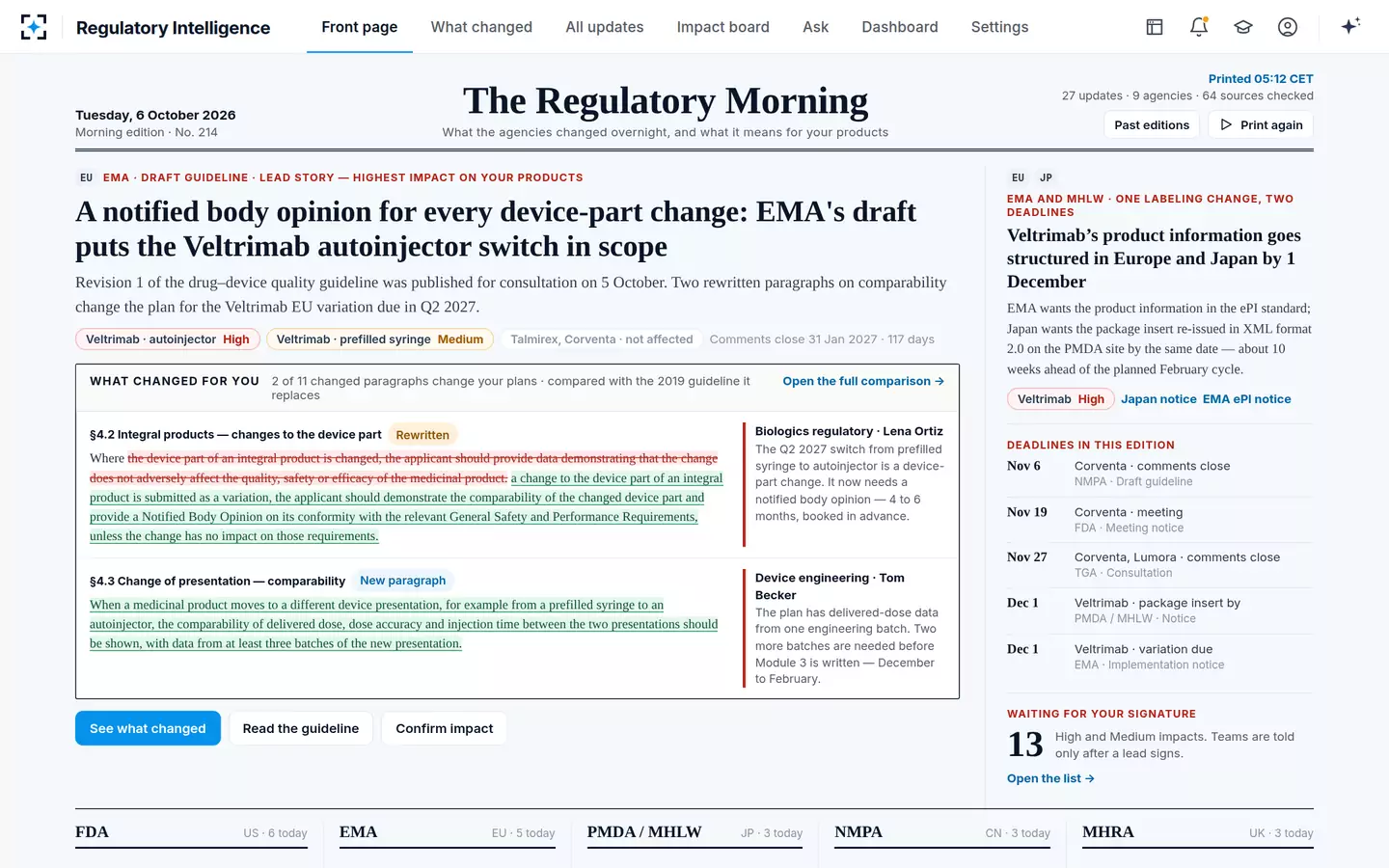
How do you make sure a labeling change reaches the right team?
By deciding, in advance and in writing, three things: which changes are always serious, who is allowed to confirm that judgement for each product area, and what the person who receives the note is being asked to do. The first is a rule, not a reading. In the sample settings of the solution one rule says that any labeling change for a marketed product is at least High — which means the system is not permitted to propose a lower level for one, whatever the model thinks of the wording.
The second is a name. Routing to a function — "send it to labeling" — is how a change waits for somebody to pick it up. Routing to a person, with the authority to confirm the impact for that product area, is how it gets answered. In the solution each product area has one named approver, and every High or Medium impact waits for that person's signature before any team is told.
The third is the hardest and the most often skipped. A note that says "FDA has strengthened the warning on this class" asks the reader to work out what to do. A note that says which section changed, which of your presentations carry it, which planned submission it collides with and what the next date is, asks the reader to decide. The difference is a paragraph of work at the sending end and a week of work at the receiving end.
The impact confirmed by a named lead before any team hears
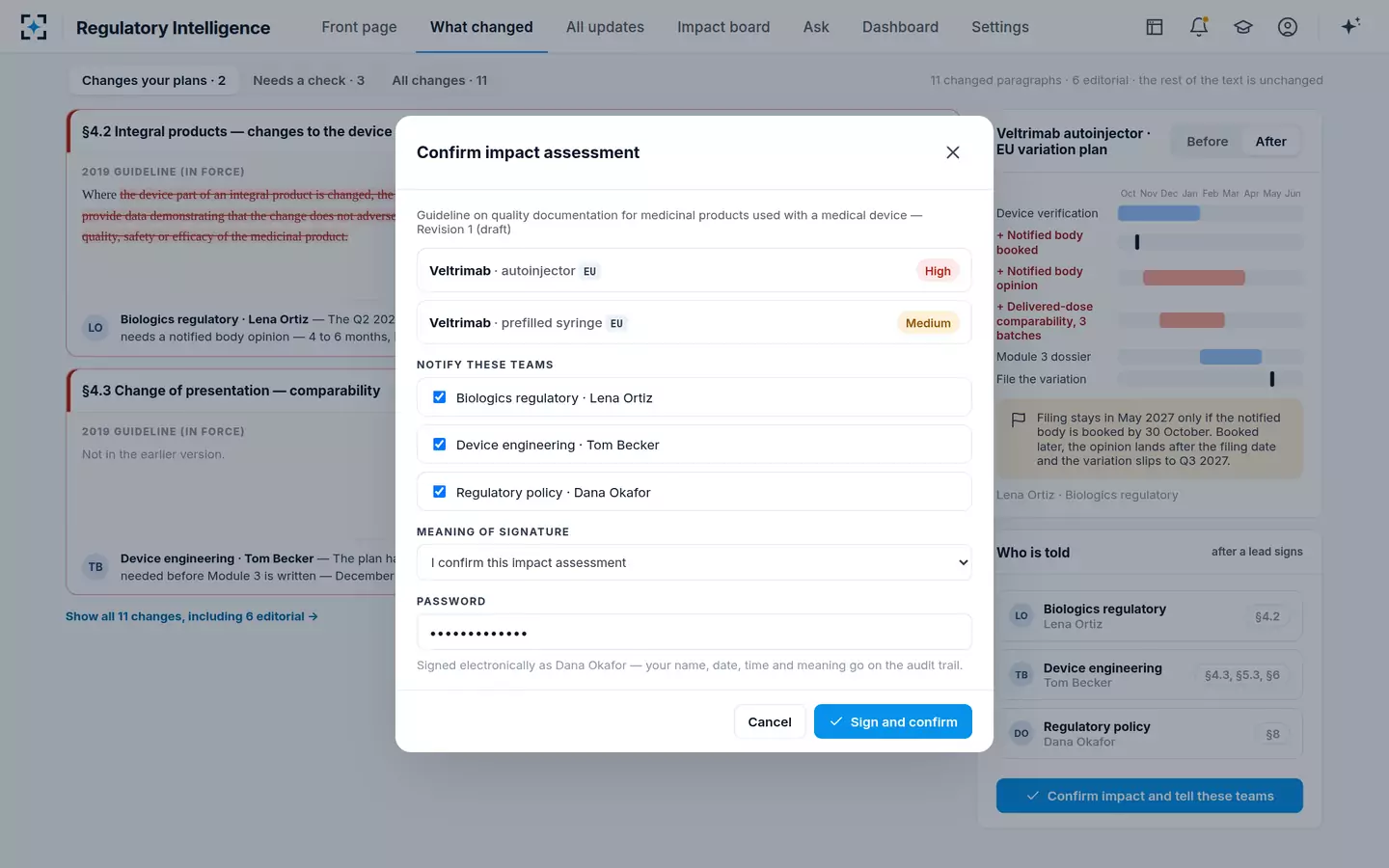
What the labeling file should hold when the change is done
A safety labeling change ends in a file somebody will read years later, possibly an inspector. The test of that file is whether a stranger can reconstruct the decision without talking to anyone. In practice that means the passage that triggered it, the route you took and why, the dates, the people, and the assessment that connects the change to your products.
The safety labeling change file: what a stranger needs to follow your decision
- The source document and the passage
The original file as published, its address and its publication date — and the specific paragraph relied on, not a summary of it. A translation never replaces the original.
- The date of arrival, and how it arrived
Notification letter, published change, safety communication or your own pharmacovigilance finding. This is the date every statutory deadline is counted from.
- The affected products, presentations and markets
Checked against the portfolio register rather than from memory. A change that applies to one presentation and not another is the commonest quiet error.
- The route, and the regulation that permits it
Prior approval supplement, changes being effected, or a supplement answering a notification. Name the paragraph: 314.70(c)(6)(iii) is a different commitment from 314.70(b).
- The impact assessment, with its reason and the person who confirmed it
Why this change is High, Medium, Low or not relevant for each product, who decided, when, and what their signature meant.
- What each team was told, and when
The exact paragraphs sent to labeling, to pharmacovigilance, to the affiliates, with the original attached — and the dates, so the days between publication and notification can be measured.
- The collision with the plan, and what moved
The planned submission or label cycle this change lands on, the new date, and the approval of the change of plan.
One more thing belongs in that file: the measurement. If you cannot say how many days passed between publication and the owning team hearing, you cannot tell whether your process is improving, and the next time a 30-day clock is nearly missed you will have nothing but an anecdote. Count it on every change, and look at the distribution rather than the average — the tail is where the risk is.
For the wider question of what else a desk should be watching, and how to put a watch list together, start with what regulatory intelligence is and what it produces, and the health authorities worth watching. To see a change arrive, get compared and reach its owner on one morning, open Regulatory Intelligence.
Questions people ask
What is a safety labeling change?
An approved change to the safety information in a prescription drug's or biologic's labeling — a boxed warning, contraindication, warning, precaution, adverse reaction, drug interaction, use in a specific population, or the patient-facing information. It may be started by the company, recommended by FDA, or required by FDA under section 505(o)(4) of the Federal Food, Drug, and Cosmetic Act. Only the required kind carries statutory deadlines.
How long do I have to respond to an FDA labeling change request?
Thirty days from the notification, under 21 U.S.C. 355(o)(4)(B), and you may answer in one of two ways: a supplement proposing the labeling change, or a statement that no change is warranted with the reasons. The agency may accelerate the deadline where it concludes the change is needed to protect the public health, so treat 30 days as the longest you are likely to get, not the standard.
Can FDA force a label change?
Yes, but only after the sequence runs. If the agency disagrees with your supplement or your reasons, it opens a discussion period of up to 30 days; within 15 days of the end of it, it may order the change. You then have 15 days to submit a supplement containing it and 5 days from the order to appeal through dispute resolution. Seventy such orders have been published since 2008.
Is a safety label change filed as a CBE-30?
Not usually. Labeling changes are prior approval supplements by default under 21 CFR 314.70(b)(2)(v), and the 30-day wait belongs to moderate manufacturing and container changes. The exception that matters is 314.70(c)(6)(iii): a change reflecting newly acquired information that adds or strengthens a contraindication, warning, precaution or adverse reaction may be effected as soon as FDA receives the supplement, with no waiting period at all.
What is the SrLC database, and what is not in it?
FDA's Drug Safety-related Labeling Changes database, which lists approved changes to the seven safety sections of the prescribing information for NDA drugs and BLA biologics from January 2016 onward. It excludes generic labeling under ANDAs, products regulated by the biologics centre such as vaccines and cell and gene therapies, over-the-counter labeling, and the non-safety sections including indications and dosage.
Where can I find the safety labeling changes FDA has ordered?
On FDA's Safety Labeling Change Orders page, which publishes every order letter issued by the drug centre with its date, the application number, the product and the applicant. It is a short list — 70 letters as of October 2026 — and it is not a substitute for watching the database of approved changes, since almost every safety labeling change is settled before an order is needed.