The changes from E6(R2) to E6(R3) are of two kinds, and they are easy to confuse. The structural change is that E6(R2) was an addendum — its changes were, in the guideline's own document history, "integrated directly into the following sections of the parental Guideline: Introduction, 1.63, 1.64, 1.65, 2.10, 2.13, 4.2.5, 4.2.6, 4.9.0, 5.0, 5.0.1 … 8.1" — whereas E6(R3) replaces the whole thing with a different architecture: "principles and annexes that expand on the principles". The substantive change is a shift in what good practice is taken to mean, stated in the introduction as a preference for "a risk-based and proportionate approach to the conduct of a clinical trial". Botminds' Regulatory Intelligence exists for revisions like this one: it compares a revised document against the version the issuing body itself names as replaced, and shows the old and new wording word for word.
Where the solution is shown working, the guideline, products and people on screen are a fictional sample used to demonstrate the comparison — the paragraph numbers in those screens belong to the invented example, not to E6(R3).
One revision, measured end to end
2,980days
between the adoption of E6(R2) and the adoption of E6(R3)
598days
from the E6(R3) Step 2 draft to Step 4 adoption; the European comment window itself ran four months
198days
from Step 4 to the day the Principles and Annex 1 applied in the European Union
739days
from Step 4 to the day Annex 2 applies
ICH E6(R3): what changed from E6(R2)
Three things, in descending order of how much work each creates. The guideline is now built as a short set of principles with annexes beneath them, rather than as one long document with an addendum layered on top. The principles themselves are written around proportionality and designing quality in, rather than around a fixed list of procedures. And the guideline is no longer delivered all at once: the Principles and Annex 1 applied from 2025, and Annex 2 applies from 2027, so an organisation has to comply with one part while planning for another.
What the rewrite did not touch is the objective, which the new text states plainly: "the objective of this ICH GCP Guideline is to provide a unified standard to facilitate the mutual acceptance of clinical trial data for ICH member countries and regions by applicable regulatory authorities". The standard is still about producing data that more than one authority will accept, and the same text records that it "builds on key concepts outlined in ICH E8(R1) General Considerations for Clinical Studies", including "fostering a quality culture" and "using a proportionate risk-based approach". The argument is about how prescriptively to get there.
The practical reading, for anyone who has to turn this into changed procedures: the structural change tells you which documents to rewrite, the substantive change tells you what the rewrite has to say, and the dates tell you by when. Those are three separate pieces of work, and the usual failure is to start the first before anyone has read the third.
The document history, read as a clock
Both E6(R3) and its Annex 2 carry the same document history on their front matter, and read in order it is a nine-event chain running from 2016 to 2027. Nobody publishes it as a chain; it has to be assembled from two documents and two regulators' pages.
Nine dated events behind one revision, assembled from the documents' own histories
9 November 2016
E6(R2) adopted under Step 4, as an integrated addendum to E6(R1): changes written into 25 numbered provisions of the parental guideline plus its introduction.
ICH Assembly
19 May 2023
E6(R3) endorsed under Step 2 and released for public consultation. The first day anybody outside could read the new text.
ICH Assembly
6 November 2024
Annex 2 endorsed under Step 2 and released for public consultation — two months before the main text was adopted, with the European comment deadline falling on 28 February 2025.
ICH Assembly
6 January 2025
E6(R3) endorsed under Step 4 — the Principles and Annex 1 recommended for adoption to the regulatory bodies of the ICH regions.
Regulatory members of the ICH Assembly
23 July 2025
The Principles and Annex 1 become effective in the European Union.
EMA (EMA/CHMP/ICH/135/1995)
9 September 2025
FDA announces the availability of the final guidance in the Federal Register, 246 days after Step 4, finalising its draft of 7 June 2023.
FDA (Docket FDA-2023-D-1955)
24 October 2025
An error correction: typographical corrections to references in sections 1.2.5 and 3.16.4. The only announcement is a line in the document history.
ICH
3 June 2026
Annex 2 endorsed under Step 4.
Regulatory members of the ICH Assembly
15 January 2027
Annex 2 comes into effect in the European Union, 226 days after its Step 4 endorsement and two years after the main guideline was adopted.
EMA (EMA/CHMP/ICH/495903/2024)
Two of those nine are the ones a monitoring function tends to miss. Annex 2 was endorsed for consultation on 6 November 2024, two months before the main guideline was adopted, and the European comment deadline fell on 28 February 2025 — so the window to influence the second part closed seven weeks after the first part was adopted, while most organisations were still reading it. And the error correction of 24 October 2025 landed three months after the Principles and Annex 1 had already taken effect in Europe — which means every copy of the January 2025 text downloaded before that date differs from the current one, in two numbered references, with no notice beyond a row in a table.
What changed in structure: principles plus annexes
E6(R2) added to an existing document. The history records it as an "integrated addendum to ICH E6(R1) document" whose changes were integrated into the parental guideline's introduction and 25 numbered provisions — three in section 1, two in section 2, three in section 4, sixteen in section 5 and one in section 8. The numbering is itself a map of the old architecture: a glossary, principles, an investigator section, a long sponsor section and a section on essential documents.
E6(R3) does not patch; it re-architects. Its own account of itself is explicit: "this ICH GCP Guideline is composed of Principles and Annexes that expand on the principles, with specific details for different types of clinical trials. The principles are intended to apply across clinical trial types and settings and to remain relevant as technological and methodological advances occur". In practice that is eleven principles, an Annex 1 organised into four sections — the ethics committee, the investigator, the sponsor, and data governance shared between investigator and sponsor — three appendices on the investigator's brochure, the protocol and essential records, and a glossary.
E6(R2) and E6(R3) side by side: where the requirement lives, and what you compare against
| E6(R2), adopted 9 November 2016 | E6(R3), adopted 6 January 2025 | |
|---|---|---|
| What kind of document it is | An integrated addendum: changes written into an existing guideline, E6(R1). | A replacement: principles with annexes that expand on them. |
| How the change was expressed | As a list of amended provisions — the introduction plus 25 numbered sections of the parental text. | As a new document. Nothing in the guideline lists the paragraphs that differ from E6(R2). |
| Top-level structure | The numbering in that amendment list implies a glossary, principles, an investigator section, a long sponsor section and essential documents. | Introduction · eleven Principles · Annex 1 in four sections (ethics committee, investigator, sponsor, data governance) · three appendices · glossary. |
| Where flexibility sits | In how each procedure is implemented. | Explicit in the text: "various approaches to the provisions in the Annexes may be considered provided they are justified and achieve the intended purpose of the application of the principles." |
| How it is delivered | One adoption, one text. | In parts. Principles and Annex 1 first, Annex 2 endorsed seventeen months later and applying from 2027. |
| What you compare a copy against | The parental guideline, section by section, using the published amendment list. | The whole previous text, paragraph by paragraph — and, after 24 October 2025, a corrected version of E6(R3) itself. |
The fifth row is the one that changes how a quality function has to work. A guideline delivered in parts cannot be absorbed in a single project with a single end date, because the second part's requirements arrive after the first part's procedures are already in use. The row above it is the one that changes how an argument with an inspector goes: the flexibility is written into the text, which means a justified alternative approach is contemplated by the guideline rather than conceded by the reader.
What changed in substance: proportionality, quality by design, fitness for purpose
The substantive shift is compressed into one sentence in the introduction, and the rest of the guideline is that sentence worked out.
"This guideline encourages a risk-based and proportionate approach to the conduct of a clinical trial."
ICH E6(R3), Guideline Scope, final version adopted 6 January 2025
The first word to look up is "quality", because E6(R3) redefines it. Principle 6 states that "quality should be built into the scientific and operational design and conduct of clinical trials", and the clause beneath it gives the definition: "quality of a clinical trial is considered in this guideline as fitness for purpose". The same principle requires the factors critical to a trial's quality to be identified in advance — in advance being the operative word, since a critical-to-quality factor identified after the protocol is written cannot influence the design.
Principle 7 supplies the proportionality half, and it is unusually direct about burden. Processes "should be implemented in a way that is proportionate to the risks to participants and to the importance of the data collected and that avoids unnecessary burden on participants and investigators", with the focus placed "on the risks associated with trial participation" and, for trials in patients, "on risks that go beyond those associated with usual medical care". Read as an instruction to a monitoring plan, that sentence says: justify the effort against the risk, and be prepared to explain procedures that exist for their own sake.
Principle 10 settles a question that outsourcing had blurred. The sponsor may transfer, and the investigator may delegate, tasks, duties and functions while keeping overall responsibility for their own activities; and where work goes to service providers, responsibility for the conduct of the trial, including the quality and integrity of its data, stays with the sponsor or the investigator respectively. Nothing about that is new in spirit; what is new is that it is a numbered principle, which makes it the first thing an inspector reads rather than something inferred from an agreement.
The American regulator's own summary of the guidance lands on the same three words. Announcing its availability, the FDA wrote that "notably, the guidance highlights the importance of quality-by-design, proportionality, and risk-based approaches in conducting clinical trials to ensure safety and reliability of results", adding that it "encourages use of innovative design elements and technology in clinical trials, while avoiding unnecessary complexities". When the issuing body and the adopting authority pick out the same concepts, the summary is as close to authoritative as a summary gets.
When did ICH E6(R3) come into effect?
On different days in different places, which is why the question needs a region attached to it. ICH endorsed the Principles and Annex 1 under Step 4 on 6 January 2025, and Step 4 is a recommendation rather than an effective date: the guideline says the final draft is then "recommended for adoption to the regulatory bodies of ICH regions". In the European Union the Principles and Annex 1 have a legal effective date of 23 July 2025. In the United States the FDA announced the final guidance in the Federal Register on 9 September 2025, 246 days after Step 4, noting that it "finalizes the draft guidance of the same title issued on June 7, 2023" — and a guidance, as the good guidance practices regulation makes plain, is not legally binding on anybody.
Annex 2 has its own clock. It was endorsed under Step 4 on 3 June 2026 and comes into effect in the European Union on 15 January 2027, 226 days later, with the European committee's final adoption recorded on 25 June 2026. So a sponsor running a trial with decentralised elements in 2026 is working under the Principles and Annex 1 while a further set of considerations for exactly that kind of trial is adopted but not yet in force.
Four clocks on one guideline: endorsement, European effect, American notice, and Annex 2
- Step 2 draft to Step 4 adoption19 May 2023 to 6 Jan 2025
- Step 4 to European effect198 days
- From Step 4 endorsementnotice on 9 Sep 2025
- Step 2 draft to Step 4 adoption6 Nov 2024 to 3 Jun 2026
- Step 4 to European effect226 days
One guideline, three texts: what Annex 2 adds
Annex 2 is not a tidy-up. It addresses the trials that the older architecture had least to say about, and it names them: it "provides additional GCP considerations, focusing on trials that incorporate decentralised elements, pragmatic elements and/or real-world data (RWD)". For its purposes, "decentralised elements in a clinical trial are those trial-related activities conducted outside the investigator's location" — home visits, local healthcare centres, mobile units, video calls and digital health technologies used to conduct visits, perform procedures and collect data.
The annex is careful about its own standing in two ways that matter for a procedure writer. It states that it "is not meant to be comprehensive of all methodologies, recognising that clinical trial ecosystems may continue to evolve", and that it "should not be read as an endorsement of any specific methodologies and should be read in conjunction with the Principles and Annex 1". A procedure that quotes Annex 2 without the principles behind it has quoted the detail and dropped the standard.
Which raises the question of how many documents "ICH E6(R3)" now is. The FDA's notice puts it at three: the guidance it announced "includes a principles document and annex 1 and is the precursory guidance to the draft guidance entitled 'E6(R3) Good Clinical Practice: Annex 2.' Once complete, the guidance will be composed of a principles document, annex 1, and annex 2". In Europe there are already three texts to version — the Principles and Annex 1, Annex 2, and the consolidated guideline EMA published in July 2026 combining them — each with its own reference number and date.
Is E6(R2) still the standard anywhere?
The honest answer is that it depends on the region and the date, and that this is exactly the kind of question a monitoring function should be able to answer from its own records rather than from memory. E6(R3)'s Principles and Annex 1 have a European legal effective date of 23 July 2025 and an American Federal Register notice of 9 September 2025; what a particular authority outside the ICH founding regions has adopted, and from when, is a question for that authority's own page.
There is a second sense in which E6(R2) persists, and it is the one that bites. Trials designed, and procedures written, under E6(R2) do not rewrite themselves. A sponsor with a portfolio spanning the effective date is running some trials whose documentation was built against a guideline that has been replaced, which is a live question about what has to be updated rather than a historical one. Answering it needs the old text, the new text and a record of which of your own documents cited which.
What settles both senses of the question is a record rather than a reading. If the watch list carried the ICH page and the two regulators' pages, and each change was logged with its date and its effective date, then "what applied to this trial in March 2025" has an answer. If it did not, the answer has to be reconstructed, and reconstruction is where a version question becomes an inspection finding.
Why you cannot diff two PDFs and call it a comparison
Three reasons, each of which this revision demonstrates. First, the texts are not comparable paragraph by paragraph: E6(R2) amended an older document provision by provision, while E6(R3) is a new document, so there is no paragraph mapping between them. A mechanical difference between the two files returns almost every line as changed, which is true and useless.
Second, a comparison is only as good as its knowledge of which version it is comparing against. The copy in a company's document system is whichever file somebody downloaded, on whichever day. After the error correction of 24 October 2025 there were two E6(R3) texts in circulation, differing in references in sections 1.2.5 and 3.16.4, and nothing on either file's face says which you are holding. The only safe comparison is against the version the issuing body itself names as replaced — which is why the good guidance practices regulation obliges FDA to "note if it is a revision to a previously issued guidance and identify the document that it replaces", and why European guidelines carry the same statement on their cover page.
Third, a mechanical difference cannot distinguish the kinds of change, and the kinds are what decide who has work to do. This revision contains clean examples of the two extremes.
An editorial change and a substantive one, in the same guideline
The error correction of 24 October 2025: Typographical corrections to references in sections 1.2.5 and 3.16.4, recorded as one row in the document history.
Principle 6, quality as fitness for purpose: A definition: "quality of a clinical trial is considered in this guideline as fitness for purpose", with critical-to-quality factors to be identified prospectively.
The error correction of 24 October 2025: It was not. A line appears in the history table of the document itself; there is no notice to read.
Principle 6, quality as fitness for purpose: As a numbered principle in a guideline that was out for public comment first, and took 598 days from draft to adoption.
The error correction of 24 October 2025: Whoever maintains the controlled copy, and anybody whose procedure quotes one of those two references.
Principle 6, quality as fitness for purpose: Trial design, monitoring strategy, the quality management procedures, and the people who write the protocol.
The error correction of 24 October 2025: Two reference numbers differing. Thirty seconds of reading, and the certainty that nothing else moved.
Principle 6, quality as fitness for purpose: The definition in the authority's own words, next to whatever the previous text said, so the argument about what changed happens on the guideline's wording.
The error correction of 24 October 2025: Everything: a summary would not mention it, and the stale copy stays in the system.
Principle 6, quality as fitness for purpose: The wording. "Risk-based approach" as a phrase in a digest tells a reader nothing they can write a procedure against.
Old and new wording, word for word, with each difference classified
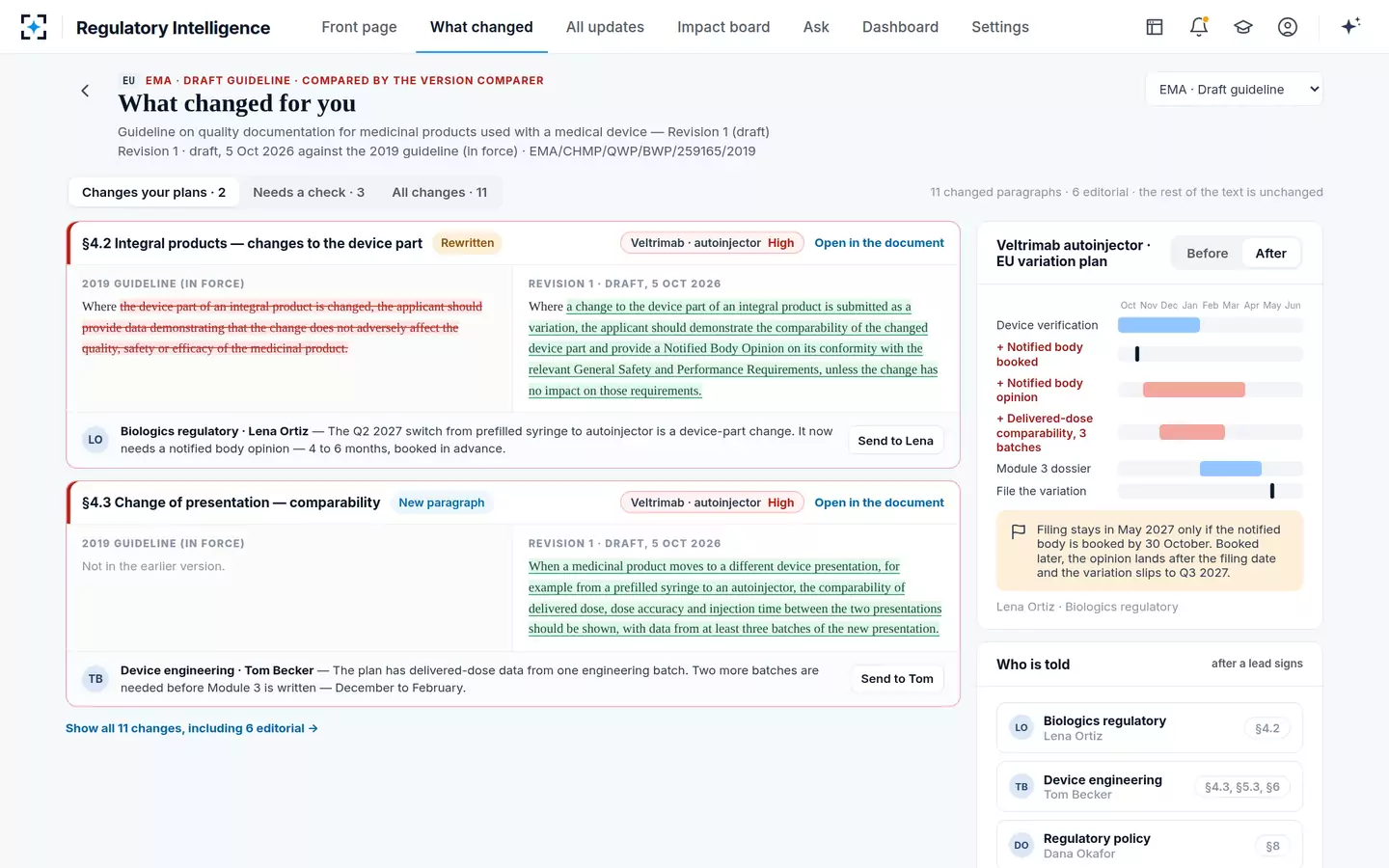
The classification is the part that converts reading into routing. Six editorial differences need one person to confirm they are editorial. Two that change a plan need the people who own those plans, by name, with the paragraph in front of them. A single number — "eleven paragraphs changed" — supports neither decision.
Who each change lands on, and what they have to do differently
A revision of this shape lands on four groups, and the work is different for each. Trial design and biostatistics own the critical-to-quality factors, because the guideline asks for them prospectively and a protocol written without them cannot be retrofitted. Clinical operations and monitoring own proportionality: a monitoring plan now has to explain why its effort matches the risk, and procedures that exist for their own sake are the ones that will be asked about.
Quality assurance owns the document rewrite, including the awkward part — procedures that cite the old guideline by section number, which the new architecture has renumbered out of existence. And vendor management owns Principle 10, since the sponsor retains overall responsibility for transferred activities and the agreements have to say who does what in terms that survive an inspection.
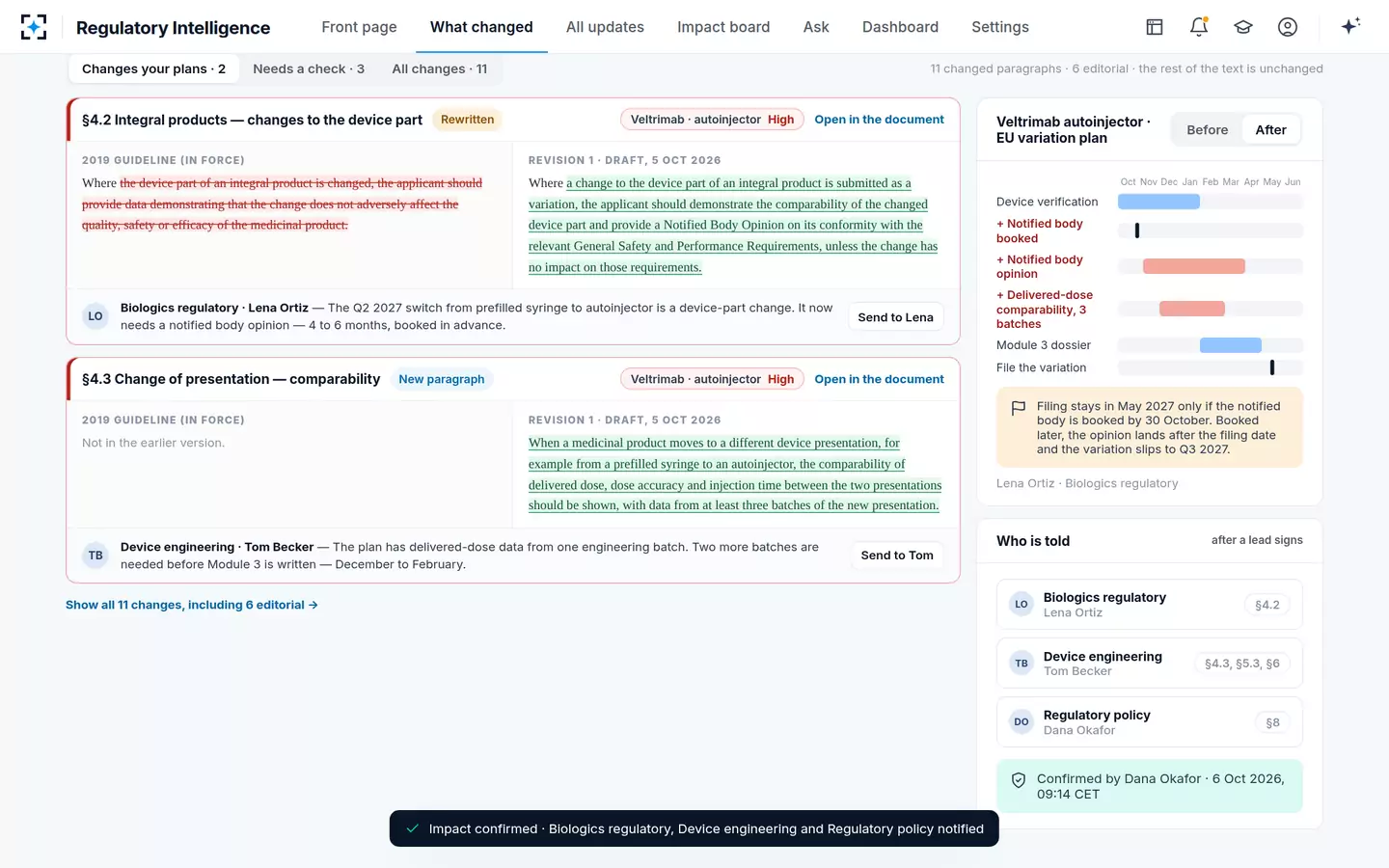
None of that assignment can be made by software, which is the point at which this page stops being about a guideline and starts being about a process. The agents find the revision, name the version it replaces, show the difference and propose which team each one lands on. A named lead confirms the impact and signs for it, and nothing reaches a team until that signature exists.
The signature, then each team gets the paragraphs it owns
What to keep so an inspector can follow the comparison
Five records, and each of them is something this revision would have forced you to produce anyway. The version you compared against, named as the issuing body names it — not "the previous version" but the document identifier and its date. The date you became aware, which is different from the publication date and is the number a monitoring function is actually judged on. The classification of each difference, with the name of whoever confirmed that the editorial ones were editorial.
Then the two that matter most at an inspection. The assignment: which team was told, what they were told, and when — because "the organisation was aware" is not an answer and "Lena in biologics regulatory was sent sections 4.2 and 4.3 on 6 October and confirmed the plan change on the 9th" is. And the decision: what changed in your procedures as a result, or the reasoned conclusion that nothing needed to.
The thing that makes all five cheap is keeping them as a by-product of the work rather than as a separate exercise. A function that records what it checked, what it found, what it classified, who it told and what they decided has an audit trail without anybody writing one. A function that reads carefully and emails the result has done the same work and kept none of it. To see the comparison, the classification and the record on your own portfolio, start from Regulatory Intelligence; the agencies to watch covers which sources this one would have arrived on.
Questions people ask
What was the ICH E6(R3) release date?
There are two release dates and they are often confused. The draft was released for public consultation on 19 May 2023, when the ICH Assembly endorsed it under Step 2. The final version was adopted on 6 January 2025, when the regulatory members endorsed it under Step 4. Neither is an effective date: Step 4 recommends the text for adoption to the regulatory bodies of the ICH regions, and each region then sets its own.
What is Annex 2 of ICH E6(R3)?
The second annex to the guideline, adopted under Step 4 on 3 June 2026 and coming into effect in the European Union on 15 January 2027. It "provides additional GCP considerations, focusing on trials that incorporate decentralised elements, pragmatic elements and/or real-world data", defining decentralised elements as trial-related activities conducted outside the investigator's location. It states that it is not comprehensive of all methodologies, is not an endorsement of any of them, and should be read with the Principles and Annex 1.
How many principles does ICH E6(R3) have?
Eleven, each with numbered clauses beneath it. They cover ethical conduct, informed consent, independent review by an ethics committee, scientific soundness, qualified individuals, quality built in by design, proportionality, clear trial descriptions, reliable results, clear roles and responsibilities, and the manufacture and management of investigational products. Annex 1, which expands on them, is organised into four sections rather than following the principles one by one.
Did ICH change E6(R3) after it was adopted?
Yes, once that is recorded in the document history: on 24 October 2025 an error correction made typographical corrections to references in sections 1.2.5 and 3.16.4. It came three months after the Principles and Annex 1 took effect in the European Union, and the only announcement is the row in the history table, which is a good illustration of why a controlled copy needs a date and a source address rather than just a filename.
Do I have to update my procedures for ICH E6(R3)?
That is your quality function's decision, and the guideline is unusually explicit about the room it leaves: "various approaches to the provisions in the Annexes may be considered provided they are justified and achieve the intended purpose of the application of the principles." What the revision does force is a mapping exercise, because procedures that cite the old guideline by section number point at an architecture that no longer exists — so even a procedure whose substance is unaffected may need its references rewritten.
What is the difference between E6(R2) and E6(R3) in one sentence?
E6(R2) was an addendum that amended an existing guideline in 25 numbered provisions; E6(R3) replaces it with eleven principles and annexes that expand on them, built around proportionality and quality defined as fitness for purpose, and delivered in parts, with European effective dates about eighteen months apart.