No: FDA guidance documents are not legally binding. The regulation that governs how the agency writes them answers the question with a single word and then explains it — "No. Guidance documents do not establish legally enforceable rights or responsibilities. They do not legally bind the public or FDA". What makes the question worth a page rather than a sentence is the next few paragraphs of the same regulation, which allow a company to take a different approach, require that approach to stand up against the statute, and tell FDA's own staff that they may depart from guidance "only with appropriate justification and supervisory concurrence". Binding on nobody, decisive for almost everybody. Botminds' Regulatory Intelligence reads each new and revised guidance against a portfolio and records which paragraph changed, what it replaces and who decided what to do about it.
What follows is a reading of the good guidance practices regulation, 21 CFR 10.115, and of one recent notice that shows it working — not legal advice, and no substitute for your own counsel on a particular document. Every quotation is linked to the text it comes from. Where the solution is shown working, the products, documents and people on screen are fictional sample data.
"No. Guidance documents do not establish legally enforceable rights or responsibilities. They do not legally bind the public or FDA."
21 CFR 10.115(d), good guidance practices — the regulation's own answer, in full
Are FDA guidance documents legally binding?
They are not, and the distinction that matters is between binding and consequential. A regulation creates an obligation a court can enforce. A guidance states what the agency currently thinks, which is a different thing in law and almost the same thing in a review division. The practical weight of a guidance comes from three places at once: the agency's staff are instructed to follow it, the people assessing your submission have read it, and a departure from it has to be explained in writing by you rather than assumed away.
That is why "the guidance says" is both a weak argument and a hard one to beat. It is weak because the guidance cannot create a requirement the statute and the regulations do not support. It is hard to beat because the alternative is not "ignore it" but "write the case", and writing the case takes evidence, time and somebody senior enough to sign it.
The consequence for a regulatory intelligence function is that guidance cannot be filtered out as merely advisory. A new guidance is often the earliest reliable signal of what an assessor will ask for, months before any regulation changes, and it is usually the only signal that arrives in time to change a data package.
What the regulation actually says: 21 CFR 10.115(d)
Paragraph (d) of the good guidance practices regulation is three short numbered statements, and it is worth reading all three together because each qualifies the one before it. The first is the plain answer quoted above. The second grants the alternative: "You may choose to use an approach other than the one set forth in a guidance document. However, your alternative approach must comply with the relevant statutes and regulations" — and the regulation adds that FDA "is willing to discuss an alternative approach with you to ensure that it complies with the relevant statutes and regulations". The third turns to the agency's own staff: "Although guidance documents do not legally bind FDA, they represent the agency's current thinking. Therefore, FDA employees may depart from guidance documents only with appropriate justification and supervisory concurrence".
Read as a system, those three sentences describe a specific kind of asymmetry. You are free to differ, provided you can defend the difference against the law. The reviewer is free to differ too, but only with a justification and a supervisor's agreement — which means a reviewer who waves a guidance at you is on firmer institutional ground than one who waves it away. The route to a different approach therefore runs through a conversation, not around it.
The regulation also provides a remedy if the asymmetry is abused. Where someone at FDA "treated a guidance document as a binding requirement", paragraph (o) says to contact that person's supervisor in the issuing centre or office, then the next supervisor, then the centre or office ombudsman. The existence of that escalation path is the clearest evidence that treating guidance as binding is a known failure, anticipated by the rule itself.
What is the difference between a regulation and a guidance?
They differ in what creates them, who they bind, how they change and how you object to them. The table below sets the two side by side; the guidance column is from 21 CFR 10.115 throughout, and the regulation column describes the notice-and-comment rulemaking that produced 10.115 itself.
A regulation and a guidance: who each one binds, and how each one changes
A regulation: A rule with the force of law, codified in the Code of Federal Regulations and enforceable as written.
A guidance document: A statement of the agency's "current thinking" — the regulation's own words — on how to meet a requirement that lives somewhere else.
A regulation: The public and the agency.
A guidance document: Nobody. "They do not legally bind the public or FDA."
A regulation: Not without an exemption, a variance or a waiver provided for in the rule itself.
A guidance document: Yes — "you may choose to use an approach other than the one set forth in a guidance document" — provided the alternative complies with the statutes and regulations.
A regulation: Apply it.
A guidance document: Depart from it "only with appropriate justification and supervisory concurrence".
A regulation: Proposed, published for comment, finalised with responses to comments, and effective from a stated date.
A guidance document: Depends on the level. A Level 1 draft is announced in the Federal Register and invites comment; a Level 2 document is posted and implemented immediately.
A regulation: Comment during rulemaking; petition for a change; litigate.
A guidance document: Comment at any time — "you can comment on any guidance document at any time" — or raise the handling of it with the issuing office's supervisors and ombudsman.
A regulation: Rare, slow, well signposted, and usually visible a year ahead.
A guidance document: Frequent, fast, and in the Level 2 case without a Federal Register notice of its own.
The last row is the one a watch list is built on. A company that watches the Federal Register has good coverage of regulations and of Level 1 guidance, and almost no warning of the class of documents that takes effect the day it appears: a Level 2 guidance gets no notice of its own, and reaches the register only in the comprehensive list of guidance documents the regulation has FDA publish there once a year.
Level 1 and Level 2 guidance, and why the level changes your clock
The regulation sorts guidance into two levels, and the sorting is substantive rather than administrative. "Level 1 guidance documents" include guidance documents that: (i) Set forth initial interpretations of statutory or regulatory requirements; (ii) Set forth changes in interpretation or policy that are of more than a minor nature; (iii) Include complex scientific issues; or (iv) Cover highly controversial issues". Everything else falls into the second class: "Level 2 guidance documents" are guidance documents that set forth existing practices or minor changes in interpretation or policy. Level 2 guidance documents include all guidance documents that are not classified as Level 1".
The difference that reaches your calendar is procedural. For Level 1, the agency publishes a Federal Register notice that the draft is available, posts it, and invites comment; after the comment period it reviews the comments, publishes a second notice that the final document is available, posts it and implements it. For Level 2, the agency posts the document and "immediately implement[s] the guidance document, unless FDA indicates otherwise when the document is made available", inviting comment afterwards. There is no Federal Register notice in that path.
Two paths to an implemented guidance, and where each one gives you a comment period
- Early inputoptional
- Notice: draft outin the register
- Comment periodyour window
- Notice: final, in forcein the register
- Notice, posted, in forceall at once
- Comment invited afterwardsrevised if appropriate
- Posted, in forceday one
- Comment invited afterwardsrevised if appropriate
Two things follow for anybody maintaining a watch. First, the level is not printed on the document as a label you can filter on; you infer it from how the document arrived. A guidance you found in the Federal Register is Level 1 or is being treated as one. A guidance that appeared on a centre's web page with no notice is almost certainly Level 2 — and is already in force. Second, the regulation requires the agency to keep the list that makes the second case findable: "FDA will maintain on the Internet a current list of all guidance documents. New documents will be added to this list within 30 days of issuance". Thirty days is the published tolerance on the only complete index there is, which is the gap a daily check of the index closes.
Can you deviate from FDA guidance?
Yes, and the regulation says so in terms: "you may choose to use an approach other than the one set forth in a guidance document". The sentence that follows is the whole of the obligation — "however, your alternative approach must comply with the relevant statutes and regulations" — and it relocates the burden rather than removing it. You are not arguing against the guidance. You are arguing that your approach meets the law the guidance was interpreting, which means you have to know which statute or regulation that is.
That is a harder question than it looks, and it is the reason departures fail. A guidance usually interprets several provisions at once and does not always say which. An alternative approach built against the guidance's recommendation, rather than against the underlying requirement, can satisfy nothing: it differs from the agency's current thinking and does not demonstrate compliance with anything.
Five things to record when you depart from a guidance
- The document, its date, and whether it is a draft or final
With the issuing centre. A file that records "per FDA guidance" without naming the version cannot be defended two years later, when the guidance has been revised twice.
- The statute or regulation the guidance is interpreting
This is what your approach has to comply with. If nobody can name it, the departure has no standard to be measured against and the decision is not yet made.
- The recommendation you are not following, quoted
In the document's own words, not a paraphrase. A paraphrase imports an interpretation, and the interpretation is the thing in dispute.
- The approach you are taking instead, and the evidence it rests on
Including what you will generate and when. "Scientifically justified" is a conclusion; the data and the argument are the justification.
- Who decided, when, and whether the agency was asked
The regulation says FDA "is willing to discuss an alternative approach with you". Whether you took that offer, and what was said, belongs in the record either way.
Why FDA reviewers cannot simply ignore guidance either
The constraint runs both ways, and the agency side of it is the stricter of the two. Where a company may choose another approach and defend it, an FDA employee "may depart from guidance documents only with appropriate justification and supervisory concurrence". A reviewer who wants to ask for something a guidance does not recommend needs a justification and a supervisor; a reviewer who asks for exactly what the guidance recommends needs neither.
This shapes negotiations in a way worth knowing before entering one. The path of least resistance for the review division is the guidance's path, and every step away from it costs the reviewer internal process. An alternative approach is therefore easiest to land when it is raised early, in a meeting, with the statutory basis set out — and hardest to land as a surprise inside a submission, where accepting it costs the reviewer a justification they did not plan to write.
It also explains why a withdrawn or superseded guidance is dangerous to rely on. The agency's "current thinking" is a moving object, and the reviewer's low-friction path moves with it. A programme designed around a 2019 guideline is designed around a position the reviewer may now need a justification to hold.
The words a guidance may not use, and what it means when one appears
The regulation controls the vocabulary as well as the procedure: "guidance documents must not include mandatory language such as 'shall,' 'must,' 'required,' or 'requirement,' unless FDA is using these words to describe a statutory or regulatory requirement". The exception is the interesting half. A "must" in a guidance is not a drafting slip and not the agency overreaching; it is a signal that the sentence is reporting a requirement that exists in the statute or the regulations, which the guidance is pointing at rather than creating.
That makes mandatory language a useful search. Run through a new guidance for "must", "shall", "required" and "requirement", and you have a short list of the sentences that are not advisory at all — and a short list of the provisions you should be able to name. Everything in the surrounding text is recommendation. The two call for different responses, and reading the whole document at one weight produces either an over-engineered programme or a missed obligation.
The same logic applies to the standard disclaimer. A draft guidance notice from January 2025 puts it the usual way: the document creates no rights for anyone and binds neither FDA nor the public, and will, when finalised, "represent the current thinking of FDA". A reader who stops at that sentence concludes the document is optional. A reader who then searches it for mandatory language finds the parts that are not.
When guidance takes effect immediately, with no comment first
Two routes skip the comment period. The first is the exception inside the Level 1 procedure: "FDA will not seek your comment before it implements a Level 1 guidance document if the agency determines that prior public participation is not feasible or appropriate". In that case the agency publishes the notice, posts the document, implements it immediately and invites comment afterwards, revising it when appropriate. The second is the ordinary Level 2 path, where the document is posted and implemented on the day with no notice at all.
The volume behind those routes is what makes them a monitoring problem rather than a legal one. The Federal Register is a well-indexed, dated, searchable channel, and it is where the Level 1 traffic appears.
One agency's Federal Register traffic, three years, and how much of it announces guidance
774
FDA documents published in the Federal Register in 2023
748
in 2024
576
in 2025
75
of the 2025 documents were notices that a guidance for industry was available
Read the last two figures together. Seventy-five guidance notices in a year is a manageable reading list; 576 documents is not, and the notices are not labelled in a way that lets you take the 75 without reading the 576. And the figure that matters most is not on the chart at all, because the documents that take effect on the day they appear get no notice in this channel. Watching an authority properly means watching the guidance index as well as the register.
How to read a new guidance in five minutes: seven marks on the first page
The regulation tells the agency exactly what the front matter must carry, which means a reader knows in advance what to look for and what its absence implies. Paragraph (i)(1) lists seven standard elements, and each one answers a question you would otherwise have to work out from the body.
The seven standard elements of a guidance, read as a first-page checklist
- The word "guidance"Is this a guidance at all, or a regulation, a notice, a letter or a manual chapter? The weight of each is different, and only one of them is this.
- The issuing centre or officeWhose thinking is it? A drug centre's document does not speak for a device centre, and a combination product may answer to both.
- The activity and the people it applies toDoes it reach us at all? This is the line that decides whether the document is ours to read or somebody else's.
- A prominent statement of nonbinding effectConfirms the document's legal weight in its own words. Its absence on a document presented as guidance is itself worth a question.
- The date of issuanceFixes the version. Everything downstream — which plan it changes, which submission it reaches — hangs off this date.
- Whether it revises a previous guidance, and which document it replacesThe single most useful line on the page. It tells you there is an earlier text to compare against, and names it.
- The word "draft", if it is a draftDecides whether you are reading current thinking or proposed thinking, and whether there is a comment period you can still use.
The sixth is the one worth reading first. A guidance that notes it is a revision and names the document it replaces has handed you the comparison: there is an earlier text, it is identified, and the difference between the two is the only part of the new document that is news. Without that line, somebody has to find the predecessor, and that search is where revisions are quietly missed.
A revised guideline, compared against the version it names as replaced
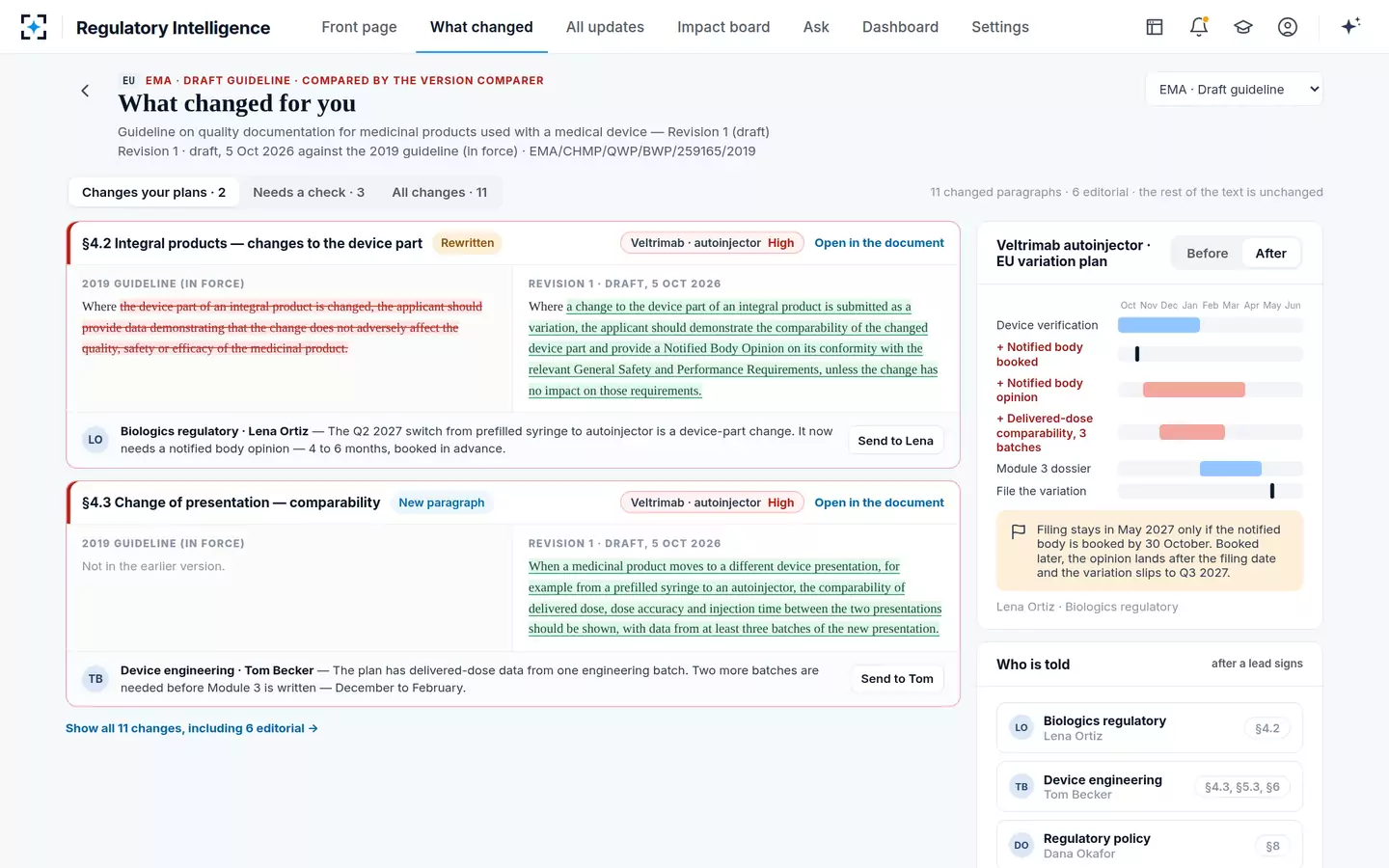
That screen exists because the alternative is a person reading two PDFs in two windows and trusting their eyes, on a document where six of eleven differences are editorial and two decide a filing. The agents propose which paragraphs matter; they never decide that a guidance applies to a product. A named lead confirms the impact and signs for it.
What to do when a guidance you rely on is revised or withdrawn
Revision is routine and expected. The regulation commits the agency to "periodically review existing guidance documents to determine whether they need to be changed or withdrawn", and specifically to revisit them "when significant changes are made to the statute or regulations". It also records that anyone may suggest a revision at any time. So a guidance in your file is a snapshot, and a file that cites "FDA guidance" without a version and a date is already out of date in a way nobody can detect.
The work on a revision is in four steps, and only the first is reading. Identify the version the new document replaces, which the front matter should name. Compare the two paragraph by paragraph, keeping the agency's wording on both sides. Decide which of the differences change a commitment you have already made — a filing date, a data package, a labelling cycle — rather than which are interesting. Then route each one to the person who owns the commitment, and record that they were told and what they decided.
A withdrawal is the same work with a sharper edge, because nothing arrives to replace the document. Any plan built on a withdrawn guidance is now built on nothing, and the reviewer's low-friction path has moved. The question for a programme team is not whether the withdrawal was announced but whether anyone has looked at what the plan was relying on.
One signature, and the meaning that goes on the record with it
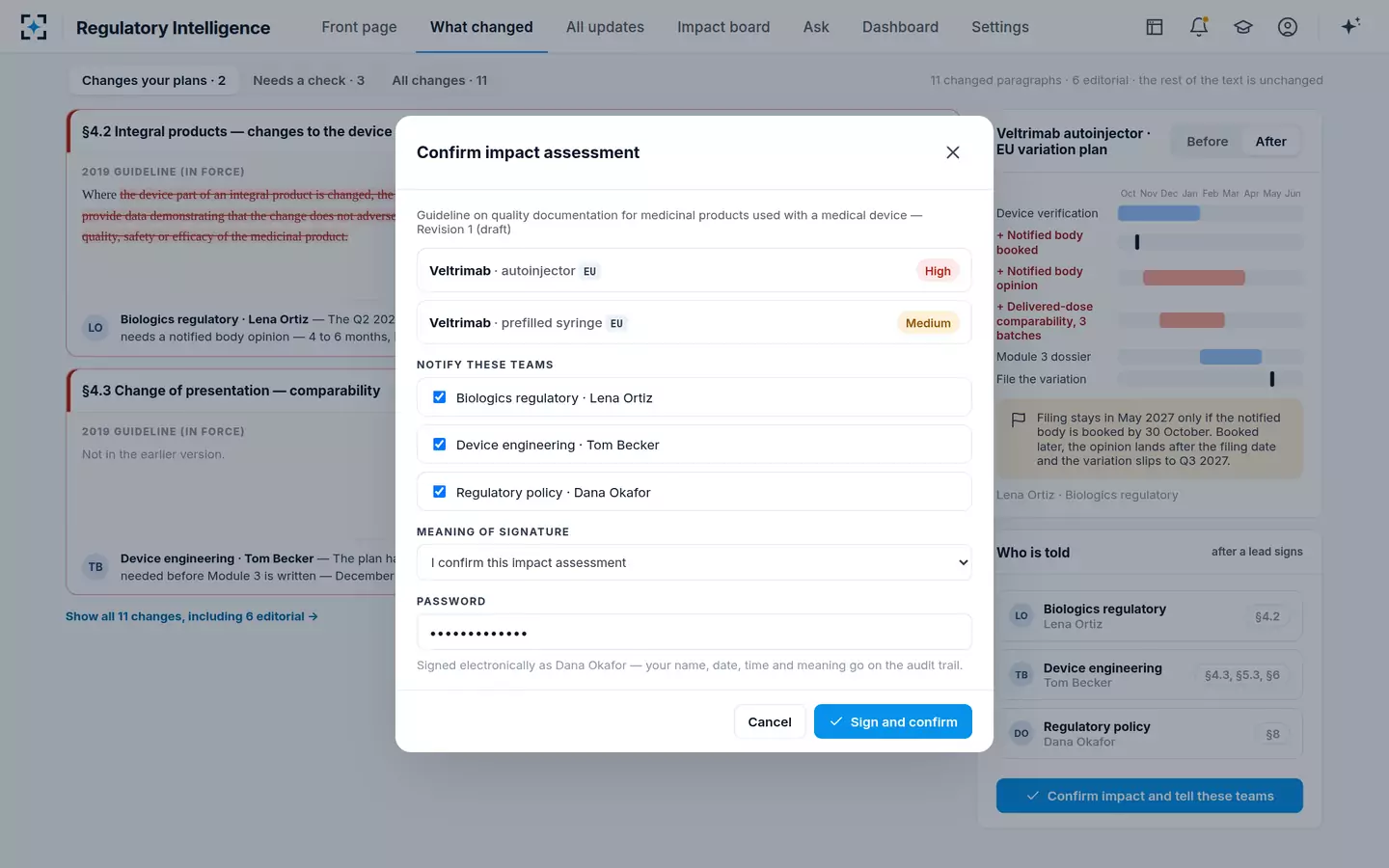
Nothing on this page decides whether a guidance applies to your product. The software finds the document, names the version it replaces, shows the difference in the authority's own words and puts it in front of the person who owns the plan. The decision, and the written case behind any departure, stay where the regulation puts them. To see that chain on your own portfolio, start from Regulatory Intelligence.
Questions people ask
Are FDA guidelines legally binding?
"Guideline" is not a category FDA uses for its own documents; the word usually means either a guidance document, in which case it is not binding, or a European guideline, which is a different system. The test is what the document says about itself: 21 CFR 10.115 requires a guidance to prominently display a statement of its nonbinding effect, so a document that lacks one is probably not a guidance and its weight should be established before anyone relies on it.
Does FDA guidance have the force of law?
No. Only the statute and the regulations have that, and a guidance cannot create a requirement they do not support. What a guidance has instead is institutional force: it is the agency's current thinking, FDA staff may depart from it only with justification and supervisory concurrence, and a company that departs from it carries the burden of showing that its alternative complies with the statutes and regulations.
Is draft guidance enforceable?
A draft is not enforceable, and neither is a final guidance — nothing in the class is. The practical difference is what each tells you. A draft announces where the agency's thinking is going and, in the Level 1 path, opens a comment period you can use; a January 2025 draft guidance notice, for instance, asked for comments by 7 April 2025 "to ensure that the Agency considers your comment on this draft guidance before it begins work on the final version". A final guidance tells you where the thinking has landed.
How do I comment on FDA guidance?
Through the docket. A notice announcing a draft names a docket number and a closing date, and comments should identify that docket number, or the document's title where there is none. The regulation is also explicit that the window is not the only opportunity: "you can comment on any guidance document at any time", including a final one, and FDA will revise guidance in response to comments when appropriate.
Where does FDA keep the list of its guidance documents?
The regulation requires a current list of all guidance documents to be maintained on the internet, with new documents added "within 30 days of issuance". It also requires the agency to publish, once a year and both in the Federal Register and online, a list of possible topics for guidance development or revision in the coming year. Once a year FDA must also publish its comprehensive list of guidance documents in the Federal Register, marking what was added or withdrawn since the last one. The annual topics list is an intention rather than a commitment, and the 30-day window on the index is the published tolerance a daily check is closing.
What can you do if someone at FDA treats a guidance as a binding requirement?
The regulation sets out a route. If you believe someone at FDA did not follow the good guidance practices procedures, or "treated a guidance document as a binding requirement", you contact that person's supervisor in the centre or office that issued the guidance, then the next highest supervisor, and the centre or office ombudsman can help resolve it. That the rule anticipates this specific failure says a good deal about how often the binding question is asked in practice.