A regulatory intelligence program is the standing arrangement by which a company finds out what health authorities have published, works out what each change means for its own products and markets, and gets that to the person who can act — with a record of who decided. Building one looks like a software project and is not: the software is the last and smallest part. Five decisions have to be made by people with the authority to make them, and three inputs have to exist in a usable form; once they do, twelve weeks is enough to be running a real morning edition, because most of what remains is configuration. This page sets out those decisions, the inputs, a week-by-week plan with a checkpoint at the end of each block, and what usually goes wrong. It is written around Botminds' Regulatory Intelligence, but the first six weeks are the same whatever you buy — and if you skip them, nothing you buy will work.
The twelve weeks below are a plan for you to adapt and a target to measure yourself against, not a delivery commitment from anyone. Where the page shows the solution running, the products, people and dates are fictional sample data, and it says so.
The five decisions, who owns each, and what breaks if it is skipped
1
The watch list
Which sources, checked how often, in which languages — and which markets you have decided not to watch.
Owns it: The intelligence lead, with each product regulatory lead
If it is skipped: It becomes whatever the first supplier offers, and nobody can say what is not covered.
2
The impact rules
Which kinds of change are always serious whatever a reading suggests, and which may be filed without review.
Owns it: The intelligence lead with quality
If it is skipped: Every update is argued from scratch, and two people grade the same change differently.
3
The approver per product area
One named person who may confirm an impact for biologics, for devices, for small molecules, for each affiliate market, and who covers them on leave.
Owns it: The head of regulatory affairs
If it is skipped: Assessments wait for whoever is in the meeting, and nobody owns the ones nobody claims.
4
What a signature means
What the person is attesting to when they confirm — reviewed, approved, responsible — and what happens next because of it.
Owns it: Quality, with the head of regulatory affairs
If it is skipped: You have a click, not a signature, and the record cannot carry the decision.
5
Who hears first, and in what form
Which teams get which paragraphs, in which language, on what timetable — and who is told nothing.
Owns it: The intelligence lead with the affiliates
If it is skipped: Everything goes to everyone, and within a month nobody reads any of it.
What is a regulatory intelligence program?
It is three jobs with a name on each and a record underneath. Collection is finding what published. Analysis is working out what changed and what it means for your portfolio. Dissemination is getting it to the person who can act, in a form they can act on. The programme is what makes those three happen on a schedule rather than when somebody has time, and what makes the result auditable eighteen months later.
What it is not is a tool, a mailing list or a quarterly report. The test is simple: can you say, for any agency change in the last year, when it was published, when you knew, who assessed it, what they concluded and who was told? If the answer depends on searching somebody's mailbox, you have monitoring, not a programme.
It is also not the same thing as horizon scanning, though the two share sources. Horizon scanning is about what is coming — agendas, consultations, effective dates. A programme is about what has arrived and what you do about it this morning. Build the second first; the first is much easier once the plumbing exists.
The five decisions to make before any tool
Three of the five are unfamiliar enough to be worth expanding.
The impact rules are the ones people most often leave to judgement, and they are the cheapest insurance in the programme. A rule says that a class of change is always at least a given level, whatever an individual reading concludes — for example, that any labelling change on a marketed product is at least High. It constrains the assessment rather than replacing it: the assessor can argue the change is bigger, never smaller. Three or four such rules remove most of the variance between assessors and most of the arguments about borderline cases.
What a signature means sounds like a formality and is the load-bearing decision. On a regulated record, a signature has to carry a name, a date and time and a meaning, and it has to be possible to print all three. More importantly, your own written policy has to connect the signature to a person: the controls for closed systems require "The establishment of, and adherence to, written policies that hold individuals accountable and responsible for actions initiated under their electronic signatures, in order to deter record and signature falsification." Deciding what "I confirm this impact assessment" commits the signer to, before anyone signs one, is the difference between a record and a log.
Who hears first is where programmes die quietly. The temptation is to send everything to everyone, because then nobody can say they were not told. Six weeks later nobody reads any of it, and you are back to a person walking down the corridor. Decide per team which paragraphs they receive, in which language, and on what timetable — and be explicit about who is deliberately told nothing, because that decision is also one somebody has to own.
The three inputs you have to bring
No supplier has these and none can build them for you. They are the difference between a system that matches keywords and one that says a change lands on a particular product in a particular market with a particular date attached.
Readiness: the three inputs, and the minimum each must contain
- The product and licence list
Every product, every presentation, every market where you hold an authorisation — with the licence or application number, the status, and the name of the person who owns it. A list without owners cannot route anything.
- The labelling plan
Which label changes are already scheduled, for which market, in which cycle, and what is already in the core data sheet. Without it the system cannot tell you that a new requirement arrives ten weeks before your planned update.
- The submission calendar
Planned variations, supplements and filings with their dates and the data packages behind them. This is what turns "the expectation has changed" into "the May filing needs two more batches".
- One honest gap list
Markets, products or affiliates whose data you know is stale. Write it down in week one; it will otherwise be discovered in week eleven as a surprise.
- A refresh route for each
Who updates each input, how often, and how the system gets the new version. An input that is loaded once decays into a quiet source of wrong answers.
If one of the three does not exist, say so out loud and put it in the plan as work, not as a prerequisite someone else will handle. In most departments assembling them is the single longest task in the ninety days, and it is also the one with value independent of the programme.
Weeks 1–3: the watch list, and the first honest count
Three things happen in the first block: the five decisions are made, the three inputs are assembled, and you take a baseline. The baseline is the one most plans skip, and it is the one that makes everything afterwards arguable. NIST's framework names the difficulty plainly — managing the risk of a system meant to augment human work needs a baseline to compare it against, and that is hard to systematise because the machine and the person do the task differently. Hard is not optional. Take ten real updates from the last six months and reconstruct their dates: published, first seen here, owning team told, decision made. That is your before.
Then build the watch list, and count what it actually produces. Agencies publish far more than the documents people picture. Of the 594 documents FDA placed in the Federal Register between 1 January and 27 October 2026, 470 were notices, 95 were rules and 29 were proposed rules — four in five are notices, the category that includes guidance availability, meetings and information collections. A watch list aimed only at rules misses most of what the agency actually tells you. Run the equivalent count for each of your own agencies before you decide how often to check them.
Checkpoint at the end of week 3. Can you produce the source list as a file, the five decisions as a signed-off page, the three inputs loaded, and the ten-update baseline? If any is missing, do not start configuring; the block has failed and should run another week. A checkpoint that cannot fail is not a checkpoint.
Weeks 4–6: impact rules and a named approver per product area
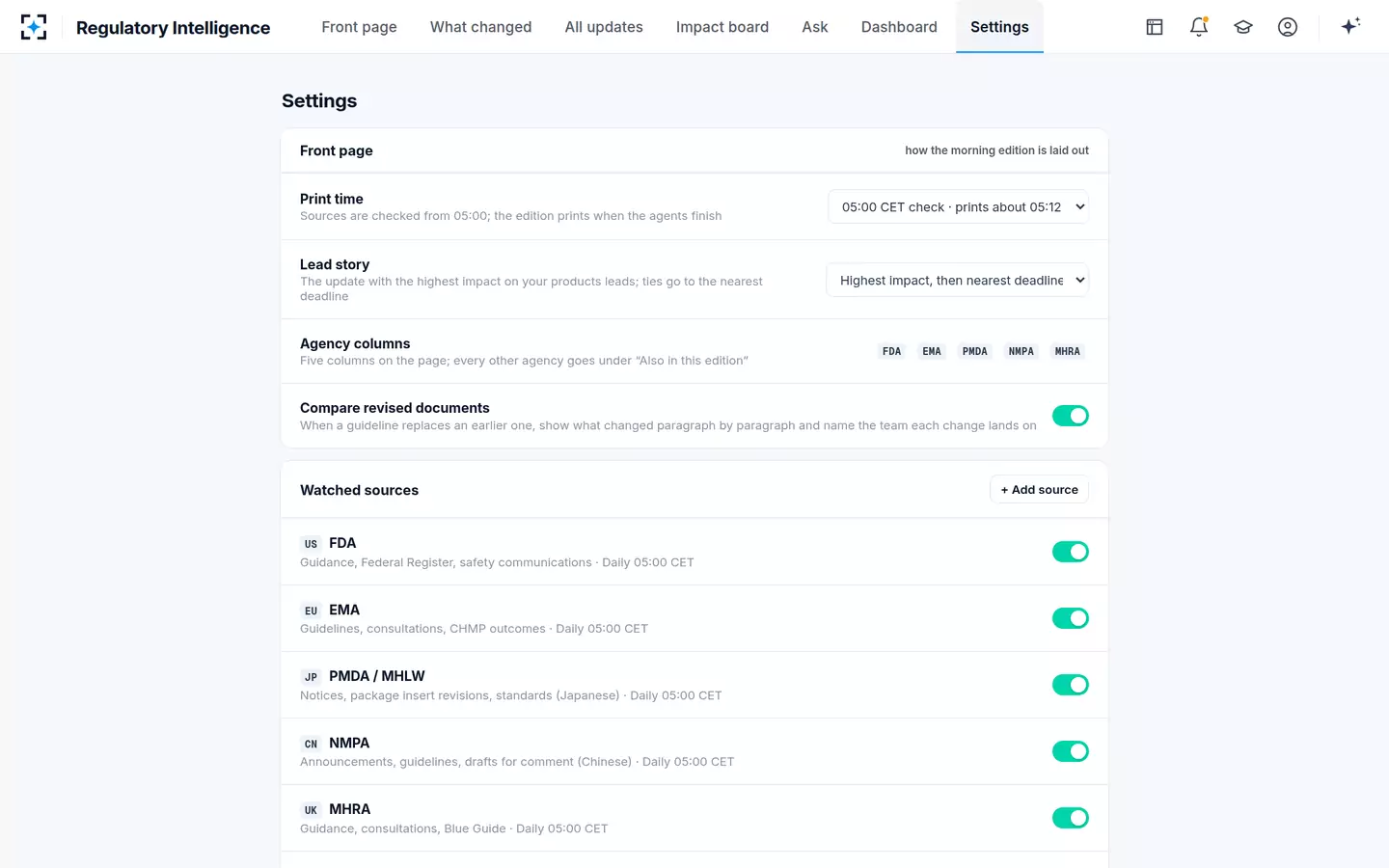
Now the decisions become settings. Each product area gets a named approver; each impact rule is entered as a minimum level rather than a guideline; the levels themselves are defined in a sentence each, so that two people grading the same change land in the same place. In Regulatory Intelligence these are settings on one page, and a changed rule applies from the next morning's run — which means you can tune in a week rather than in a release.
Spend the time in this block on the hardest thirty updates you can find, not the easiest. Take real changes from your baseline set, run them through, and compare the proposed level with what your team concluded at the time. Disagreements are the product of this block: each one is either a rule you have not written, a level you have not defined, or an input that is wrong. Fixing them now is cheap.
The five decisions, as settings somebody can change in front of you
Weeks 7–9: version comparison, and the note each team will actually read
This block is about the two steps that separate a programme from an alert list. The first is comparison: when a guideline is revised, the version it replaces is found from the document itself — agencies name what they supersede — and the two are set against each other paragraph by paragraph, with editorial changes separated from substantive ones. Test it on a revision your team has already analysed by hand, and mark the output against their work. If it finds the same paragraphs, you have something. If it summarises instead of showing the wording, you do not.
The second is the note that each team receives. Draft three of them for real teams, in their own language, and then do the unglamorous thing: show each note to the person who would receive it and ask what they would do next. If the answer is "forward it to someone", the note is not finished. The target is a note that names the paragraph, the products affected, the date that moves and the decision being asked for.
This is also the block in which the record gets tested rather than described. Two provisions are worth testing literally. Can the system produce accurate and complete copies of its records, readable by a person as well as electronically, fit for an agency to inspect and copy? And does it keep a secure, computer-generated, time-stamped audit trail of every entry and change, where a change never hides what was recorded before? Ask for a printed copy of one signed assessment and read it as though you were an inspector.
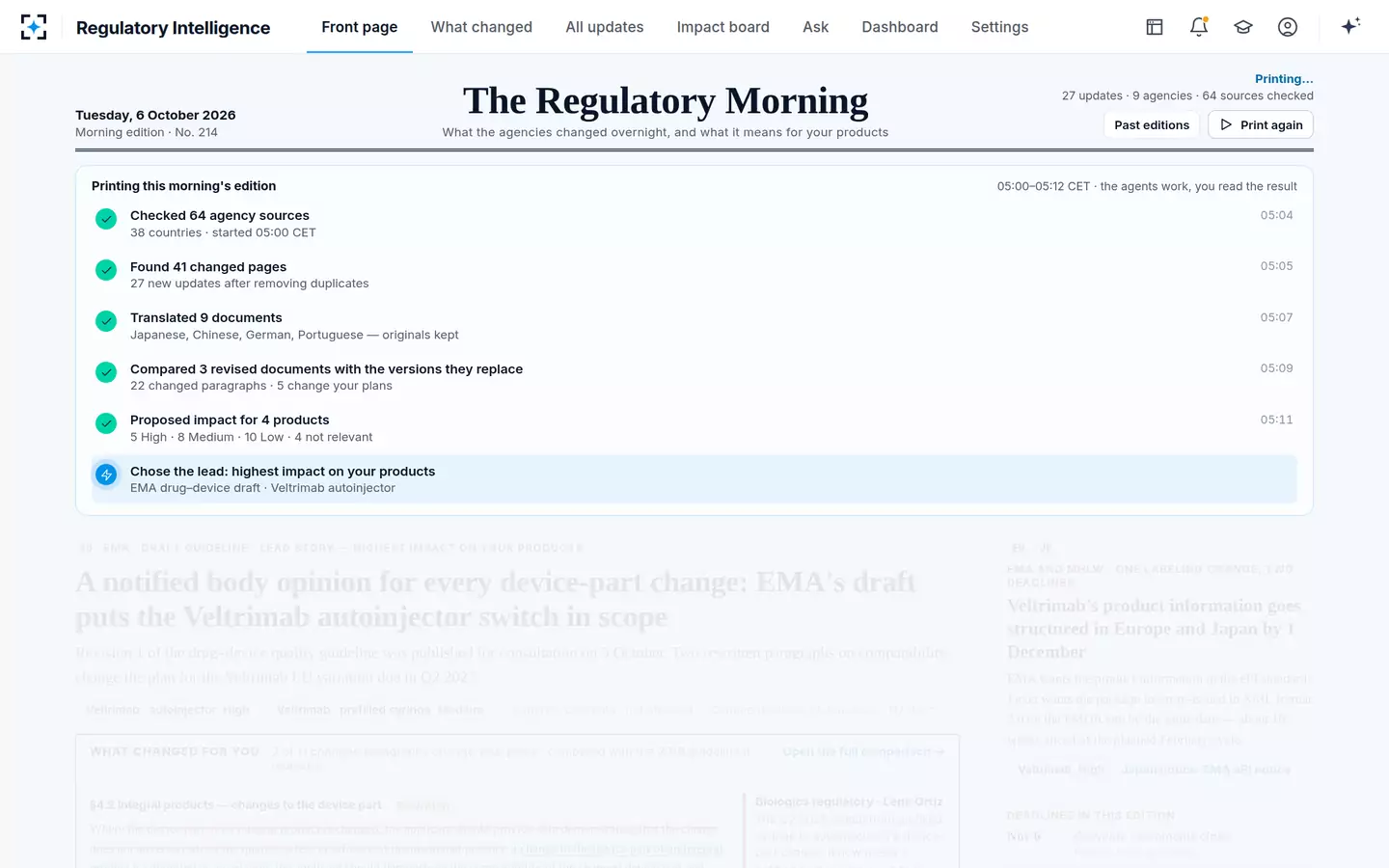
The morning run, step by step — the thing a checkpoint can actually inspect
Weeks 10–12: run it beside the team, and the checks that must pass
The last block is a parallel run, and it has to be genuinely parallel: the team keeps doing what it does now, and the programme runs alongside, and at the end of each week somebody compares the two. This is slightly painful and entirely necessary, because it is the only way to find the updates the new arrangement missed — and missed updates are invisible by definition unless something else is still looking.
Twelve weeks, with the checkpoint at the end of each block
- Five decisions signed offwk 1
- Three inputs assembled, gaps listedwk 2
- Watch list built; ten-update baseline measuredwk 3
- Approvers and levels configuredwk 4
- Impact rules entered as minimumswk 5
- Thirty hard updates run and disagreements resolvedwk 6
- Comparison tested on a revision you analysed by handwk 7
- Team notes drafted and shown to their readerswk 8
- One signed assessment printed and read as an inspector wouldwk 9
- Parallel run begins; weekly comparisonwk 10
- Measure against the baselinewk 11
- Decide to go on, extend or stop — with the evidencewk 12
The four checkpoints: what passes, what fails, and the evidence each needs
| End of | Passes when | Fails when | Evidence to keep |
|---|---|---|---|
| Week 3 | The five decisions are written and approved, the three inputs are loaded, and ten real updates have been reconstructed into a before-measure. | Any of the five is still "to be agreed", or the baseline is an opinion rather than ten dated files. | The decisions page with approvals; the three inputs with their load dates; the ten-update table with four dates each. |
| Week 6 | Thirty hard updates have been graded and every disagreement with the team’s own historical conclusion has been explained by a rule, a definition or a bad input. | Disagreements are recorded as "the model was wrong" with no change made to a rule, a definition or an input. | The thirty updates with both gradings and the resolution of each disagreement. |
| Week 9 | A revision you analysed by hand has been compared and the same substantive paragraphs found; three team notes have been read by their actual readers; one signed assessment has been printed and reviewed. | The comparison produces a summary instead of the old and new wording, or the printed record does not show the name, time and meaning of the signature. | The marked comparison; the three notes with the readers’ comments; the printed assessment. |
| Week 12 | The parallel run found nothing the programme missed in a full cycle, and the time from publication to the owning team is better than the baseline. | The parallel run was not really parallel, or nobody compared the two each week. | The weekly comparison sheets, and the after-measure beside the week-3 before-measure. |
How long does it take to set up regulatory intelligence?
The honest answer has two halves. The configuration — sources, rules, approvers, routing, notes — is a matter of weeks, because it is settings rather than software. The preparation is as long as your three inputs take to assemble, and that is the part nobody can estimate for you: a company with a current product and licence list, a labelling plan and a submission calendar can be running in six to eight weeks; a company that has to build them first should budget for that work separately and honestly.
Twelve weeks is a reasonable target for a first complete cycle including a parallel run, and it is a target rather than a promise. If a supplier offers you a date without having seen your three inputs, they are guessing at the half of the work that is yours.
What to measure from the first morning
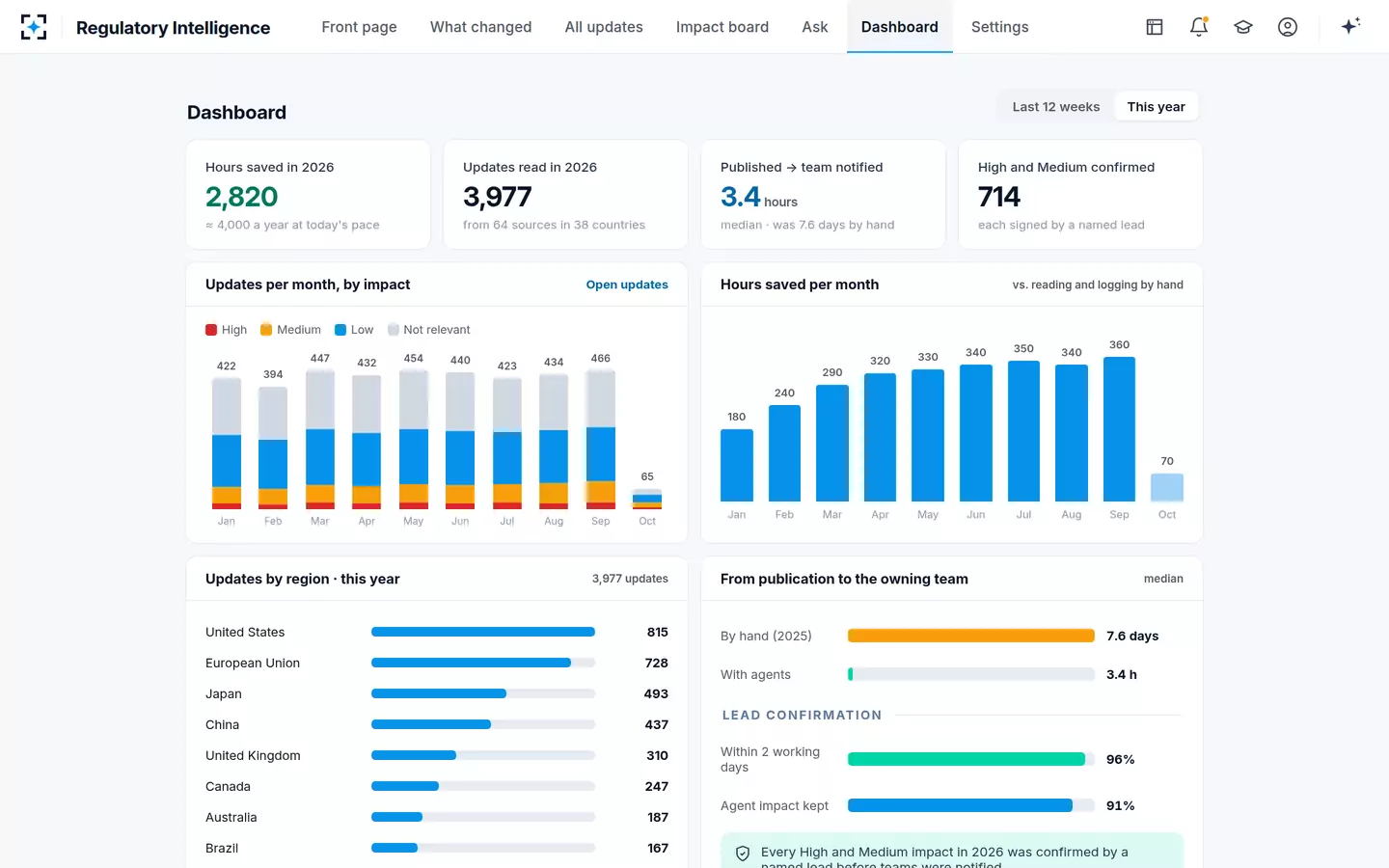
Four measures, from day one, and keep them visible. Elapsed time from publication to the owning team being told: the headline, measured per update and read as a distribution rather than an average, because the tail is where the risk is. Coverage failures: how often a source was not successfully checked, and how long it stayed broken. Agreement: how often the confirmed level matched what was proposed, which tells you whether the rules are right and whether the approvers are really reading. Backlog: how many assessed impacts are waiting for a signature, and for how long.
Two traps. The first is measuring volume — updates read, alerts sent — which rises when things get worse and tells you nothing about whether the right person acted. The second is measuring agreement and celebrating a high number: if the proposed level is confirmed every single time, either the proposals are excellent or nobody is reading them, and only the sampled review of filed updates can tell you which.
GAO's framework for accountable AI is organised around governance, data, performance and monitoring, and its framing of what federal guidance asks for is a decent definition of a working programme in five adjectives: that it be "responsible, equitable, traceable, reliable, and governable". Traceable and governable are the two your checkpoints are really testing.
The measures, kept from the first morning rather than reconstructed at the review
Who does what, by week
A programme with one owner and no participants becomes that person's hobby. Four roles have real work in the ninety days, and three of them have work in week one.
Four roles, and what changes for each one
Today
Reads the overnight output, decides who should know, and chases owners by email — the single point of failure for the whole function.
With agents
Owns the watch list and the impact rules, confirms cross-product impacts, and spends the morning deciding rather than sorting.
Still theirs: The judgement about what matters, and the signature on it.
Today
Hear about a change when somebody forwards it, usually after the week in which they could have acted cheaply.
With agents
Receive the paragraphs that affect their own products, with the plan collision named, and confirm impacts for their area.
Still theirs: Accountability for what their products file, and for the assessment.
Today
Translate local notices themselves and report upward in English, days later.
With agents
Read the original beside its translation the same morning, and get their note in their own language.
Still theirs: Local regulatory judgement, which no translation replaces.
Today
Finds out what the process was when an inspection asks.
With agents
Writes the meaning of the signature and the sampling rule in week one, and reviews the week-9 printed record.
Still theirs: The right to stop the programme going live on the evidence at a checkpoint.
What usually goes wrong, and the week it shows up
Week 2: the inputs are worse than anyone said. The product and licence list turns out to be two spreadsheets that disagree about an affiliate's presentations. This is the commonest failure and the most recoverable — if it is named in week two rather than discovered in week eleven.
Week 5: nobody will be the named approver. Being the person who signs is a real commitment, and the first time it is asked for, calendars fill up. The fix is structural, not personal: approvers are appointed by the head of regulatory affairs, with named cover for leave, and the commitment is written down with the signature meaning beside it.
Week 8: the notes are too long. The first drafts always carry everything, because nobody wants to be the person who left something out. Readers skim them, and the programme loses the only outcome it exists for. Cut to the paragraph, the products, the date and the decision.
Week 10: the parallel run is not parallel. Everyone is busy, the old process quietly stops, and the comparison each week becomes a conversation instead of a sheet. Then nothing is missed, because nothing is looking. Protect the parallel run or admit you have skipped the checkpoint.
Week 14, after everyone has moved on: the inputs decay. No refresh route was agreed for the labelling plan, three new market licences are not in the product list, and the assessments begin to be quietly wrong about a growing minority of products. Agree the refresh route in week two, give it an owner, and put it on the same page as the rest of the settings.
For the decision that comes before this plan — whether to buy a subscription, hire, outsource or put agents on it — see what each option really covers; for the questions to put to any supplier at week four, see the eighteen questions. To walk the twelve weeks against your own portfolio, start at Regulatory Intelligence.
Questions people ask
Who should own the regulatory intelligence program?
Regulatory affairs, with a named lead who has the standing to appoint approvers in each product area, and with quality involved from week one rather than at the end. Putting it under IT or a central knowledge function tends to produce excellent collection and no analysis, because the judgement about what a change means belongs to people accountable for filings.
What should a regulatory intelligence SOP cover?
The watch list and how a source is added or removed; how often each source is checked and what happens when a check fails; how a revised document is compared with the version it replaces; the impact levels with a sentence defining each, and the rules that set a minimum; who may confirm an impact for each product area and who covers them; what a signature means and what it commits the signer to; which teams are told what, in which language and when; what is filed without review and what proportion of that is sampled; and the measures kept and reviewed.
How do you measure a regulatory intelligence program?
Elapsed time from publication to the owning team, read as a distribution rather than an average; coverage failures and how long a source stayed broken; how often a confirmed level differed from the one proposed; and the backlog of assessed impacts waiting for a signature. Take a baseline on ten real updates before you start, or you will have no honest way to claim an improvement.
Do we need an SOP for regulatory intelligence before we start?
You need the five decisions written down before you configure anything; the full procedure can be drafted alongside the twelve weeks and approved at the end, when it describes what you actually do rather than what you imagined. Writing the procedure first tends to produce a document about a process nobody has run; writing it last, from the checkpoints, produces one people follow.
How long does it take to set up regulatory intelligence?
Six to eight weeks to a working morning cycle if your product and licence list, labelling plan and submission calendar already exist and are current; twelve weeks to the end of a parallel run that proves nothing is being missed. If those three inputs do not exist, assembling them is the real schedule, and it should be planned and resourced as its own piece of work.
What are good regulatory intelligence KPIs?
Ones that get worse when the work gets worse. Elapsed time to the owning team, the share of updates whose source check failed, the share of proposed levels changed on confirmation, and the age of the oldest unsigned assessment all have that property. Volume measures — updates collected, alerts sent — do not: they rise when the watch list is noisy, which is the opposite of an improvement.