An R&D portfolio review committee is the body that takes a research organisation's funding decisions at each stage-gate: it hears one programme at a time, marks it against criteria agreed in advance and chooses go, go with conditions, hold or stop. Who sits on it is usually a handful of people — a chair with budget authority, the therapeutic-area heads, nonclinical safety, chemistry and manufacturing, finance, with a secretary who owns the paperwork and a programme leader who presents. Who decides is a narrower question, and the one worth getting right: the committee votes, but one named person signs, and only the signature is accountable later. R&D Stage-Gate Governance is Botminds' agentic solution for the evidence behind those decisions, and it keeps the three jobs apart on purpose — the agents prepare, the members vote, the chair signs.
The people, the company and the programmes on this page are fictional sample data inside the solution: Northwind Bio's Portfolio Review Committee, meeting on Wednesday 14 October with four decisions and $73.5 million of budget asked. The regulatory texts quoted are real and linked where they appear.
What a portfolio review committee is for
It exists to spend a fixed research budget on the best available programmes, and to be able to say why. That is a different job from a scientific advisory board, which argues about how the science should be done, and from a programme team, which does it. A portfolio committee's whole output is three things: a decision, the conditions attached to it, and the record of both.
Notice what follows from that. The committee does not need to be the cleverest group of scientists in the company; it needs to be the group whose members can be held to a mark. Its difficulty is rarely a shortage of scientific opinion. It is that the evidence, the vote and the signature arrive as one undifferentiated event — a deck presented, heads nodded, a project continuing — leaving nothing anyone can audit, and no way to tell a programme that was argued through from one that was waved through.
The five seats, and what each one is accountable for
A workable committee is small. The sample company runs five people through every decision, and each of them is accountable for something different: the chair for the decision, the secretary for the process, the programme leader for the completeness of the evidence, the safety head for the safety mark, and finance for the money.
Five seats at one stage-gate, and what each owns
Today
Reads a slide deck for each programme between meetings, each therapeutic area scoring its own way, and cannot see where a number came from.
With agents
Takes any score apart down to the study behind it, casts the last vote, keeps or edits the conditions and signs.
Still theirs: The decision, its rationale and the meaning of the signature
Today
“Ten days before every committee I used to chase twelve slide decks.”
With agents
Runs the calendar, the criteria templates and the decision registry; dossiers build ten days ahead and pre-read status is on one screen.
Still theirs: Agenda, quorum, versions, minutes, the register of conditions
Today
Gathers ten documents from six functions, then formats them into slides.
With agents
Checks the dossier the agents built and releases it to the committee. “I want the committee to see the data, not my formatting.”
Still theirs: The completeness and accuracy of the package
Today
Hunts for the exposure margin and the NOAEL in a slide, without the study page behind it.
With agents
Reads the cited passage, votes, and owns the safety condition with a due date the register tracks.
Still theirs: The safety mark, and any safety condition
Today
Checks every cost to the next stage-gate against the plan, by hand, before each meeting.
With agents
Sees the cost, the months and the risk-adjusted value cited to the latest approved estimate.
Still theirs: The money, and the co-signature on an IND budget
The voting membership is not the same list. In the sample decision five votes were cast — the chair, the therapeutic-area head whose programme it was, the head of nonclinical safety, the head of CMC development and finance — while the secretary and the presenting programme leader sat without a vote. That distinction is the page's whole argument in one line: the person who assembles the evidence does not mark it, and the person who runs the process does not decide it.
The secretary: the least visible seat, and the one that decides whether the meeting works
Ask a committee that has gone bad what went wrong and you will hear about the science. Look at the artefacts and you will usually find a secretarial failure: an agenda issued too late to be read, a quorum nobody checked, a criteria template that changed between the dossier and the vote, conditions recorded in prose rather than as dated obligations with owners, and minutes written from memory a week later.
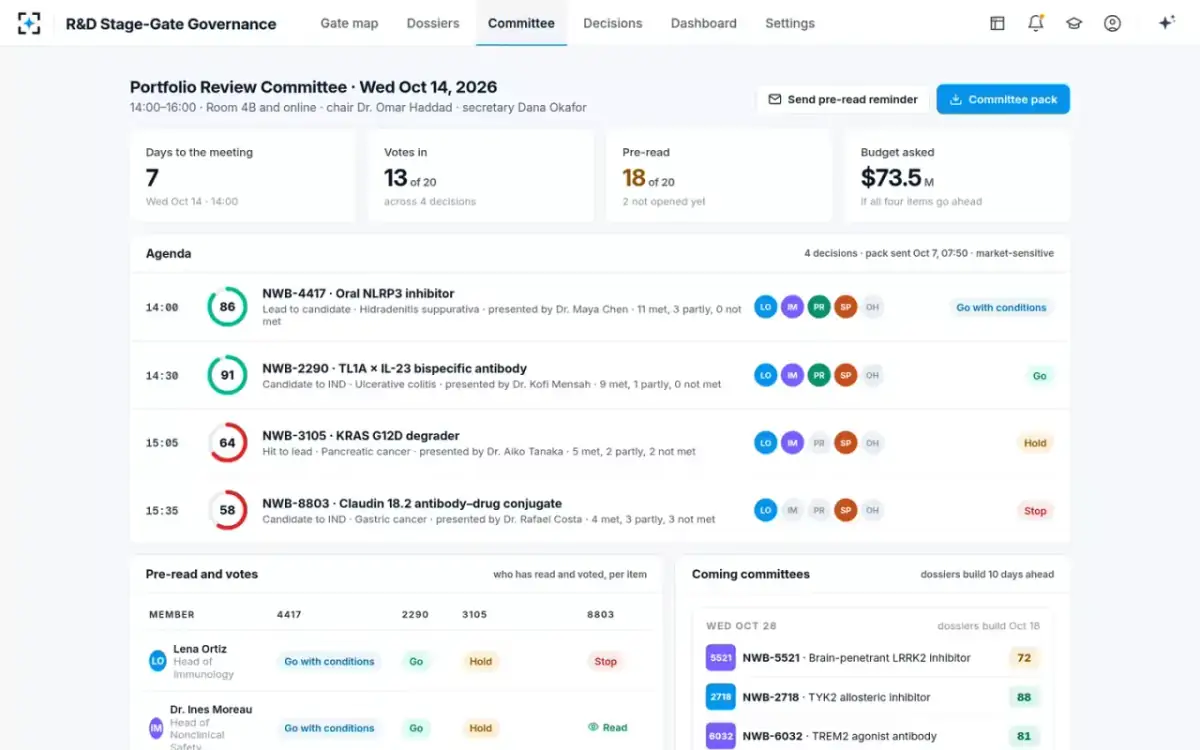
The secretary — usually a portfolio governance lead rather than an administrator — owns the calendar, the committee papers, the version of the criteria in force, the register of decisions and the register of open conditions. In the sample company the role is explicit, and the screens are built for it: seven days before the October committee, four decisions on the agenda, thirteen of twenty votes already cast, eighteen of twenty pre-reads opened, and the papers timestamped as sent on 7 October at 07:50, marked market-sensitive.
The secretary's screen seven days out
Who prepares the evidence, and why they must not also vote
Preparation is advocacy unless it is constrained. A programme leader assembling a package knows which numbers help and which invite questions, and no amount of integrity removes the pull. The ordinary answer — let them prepare and present, and give the vote to people who did not — only works if the package itself is hard to shade: if every value carries the study, the page and the passage it came from, a selective summary is visible to anyone who opens one.
That is the division of labour the solution implements. Agents read and score; people judge and decide. The scorer applies the template as written and records the version it used; the risk analyst turns partly-met criteria into draft conditions; the dossier writer drafts six sections and never expresses a vote.
Evidence, vote, signature: three artefacts, not one event
Agent
ReadersRead the programme’s ten documents — pharmacology, in vivo, DMPK, toxicology, safety pharmacology, route and solid form, the patent memo, the landscape assessment and finance’s estimate — and pull every value a criterion needs with its page and passage.
Never: Never infers a value that is not reported; a draft report is flagged as draft.
Agent
Criteria scorerApplies the stage-gate’s template exactly as written — thresholds, partly-met bands, weights — and marks each criterion met, partly met or not met.
Never: Never changes a threshold. The template version is recorded on every score, and the recommendation is advisory.
A person decides
Programme leaderChecks the drafted dossier against the evidence and releases it to the committee. Owns its completeness.
Never: Holds no vote on the programme being presented.
A person decides
MembersRead the pre-read, open the cited passages, question the marks that are contested, and vote one of the four outcomes with a comment for the record.
Never: No agent casts, weights or summarises a vote.
A person decides
ChairKeeps or edits every condition, writes the rationale, chooses the meaning of the signature and signs, which seals the record.
Never: The signature cannot be delegated to the system that prepared the evidence.
There is a cultural claim buried in this arrangement, and it has been made by people who studied their own pipeline. Reviewing AstraZeneca's small-molecule projects from 2005 to 2010, Cook and colleagues built a framework of five technical determinants of success and then added a sixth that is not technical at all: "A sixth factor — the right culture — is also crucial in encouraging effective decision-making based on these technical determinants" (Cook et al., Nature Reviews Drug Discovery, June 2014). Culture is hard to mandate. Separating preparation from voting is the version of it you can put on paper.
Does the programme leader vote at a stage-gate?
In many research organisations, no. The programme leader presents, answers questions and owns the accuracy of the package; the vote belongs to members who are not accountable for the programme's survival. Where a company does give the leader a vote, the useful safeguard is to record it separately in the minutes, so a reader can see whether the outcome turned on it.
The same logic applies downwards. A study director, a chemistry lead or a toxicologist may hold the most important opinion in the room without holding a vote; their job is to make the evidence legible and to say plainly what it does not support. The regulations treat that responsibility seriously in their own domain: a GLP final report carries the study director’s own signature and date (21 CFR 58.185(b)), and that named accountability for the study is a different thing from a vote on the programme.
Who may do what, at each stage-gate
| Decision | Who prepares | Who votes | Who signs |
|---|---|---|---|
| Target to hit | Programme leader, with the agents building the dossier | The voting members present | Committee chair, on the therapeutic-area head’s recommendation |
| Hit to lead | Programme leader, with the agents | The voting members present | Committee chair |
| Lead to candidate | Programme leader, with the agents; safety and CMC confirm their own sections | The voting members present, programme leader excluded | Committee chair, full review |
| Candidate to IND | Programme leader, with the agents; the GLP reports signed by their study directors | The voting members present | Committee chair, with finance co-signing the budget |
| A change to the criteria themselves | Anyone may propose a new version | Not a committee vote | The template owner approves it; dossiers already in committee keep the version their votes were cast on |
Quorum, votes and the four outcomes
A quorum is the number of votes below which a decision may not be taken, and it is worth writing in the committee's terms of reference rather than discovering it at 14:05. Two points usually need deciding: whether the chair's presence is required (it normally is, because the chair signs), and whether a seat with a direct interest in the programme counts towards the quorum when it has recused itself. In the solution, signing opens at quorum, and the screen shows how many of the committee's votes are in.
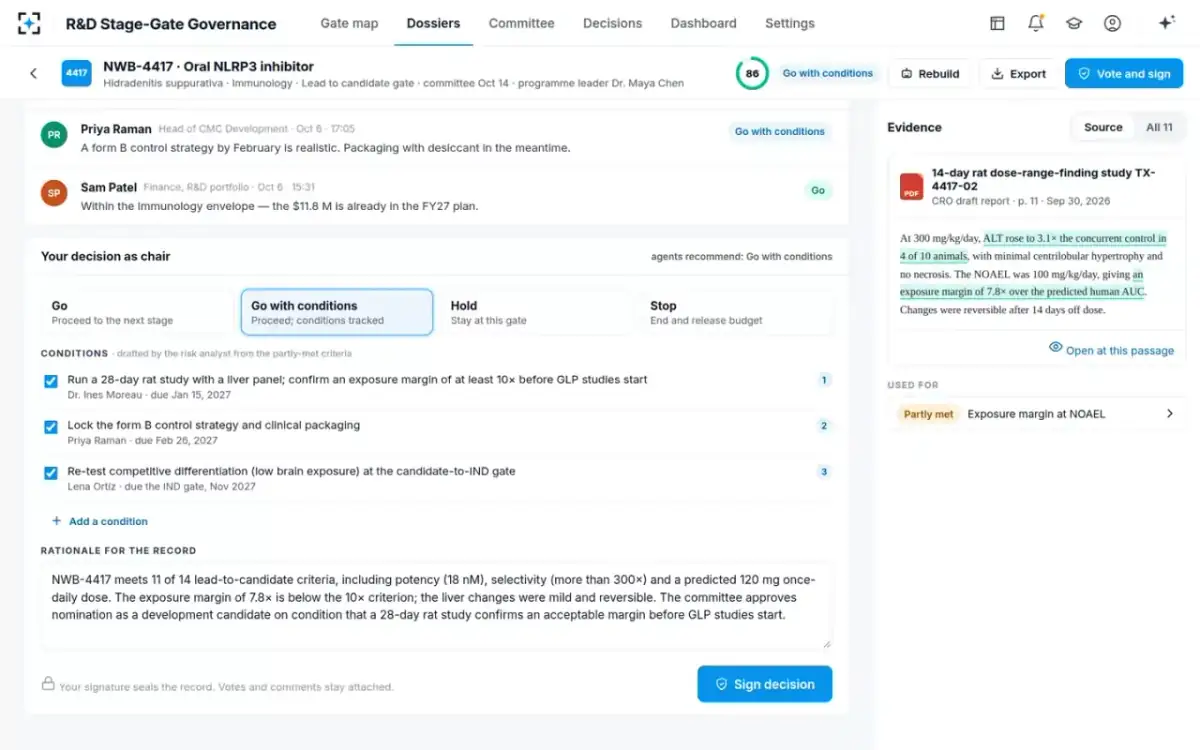
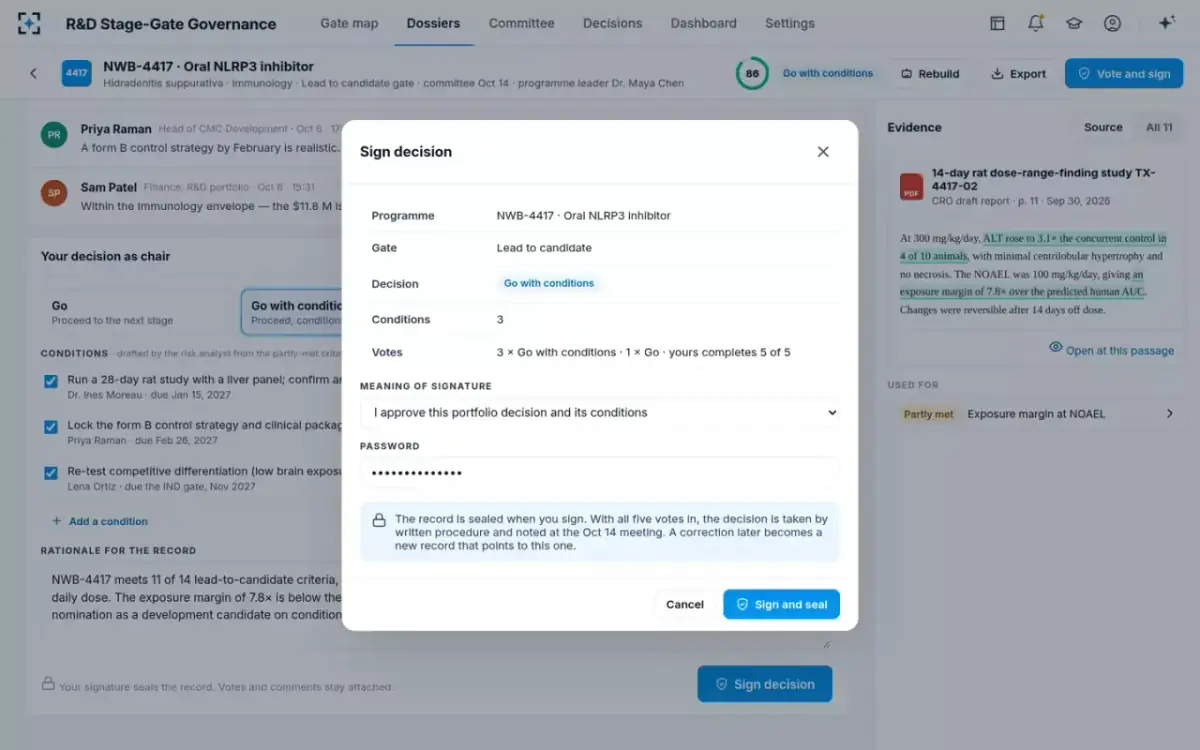
The outcomes are four, not two: go, go with conditions, hold, stop. Two outcomes push every difficult programme into an approval with unrecorded reservations; four make the reservation itself the thing that is agreed and tracked. In the sample decision three members voted go with conditions, one voted go, and the chair's signature completed five of five, so the decision was taken by written procedure and noted at the 14 October meeting rather than re-opened in the room. The conditions themselves carried owners and dates: a 28-day rat study with a liver panel by 15 January 2027, a locked form B control strategy by 26 February 2027, and competitive differentiation re-tested at the next stage-gate.
The chair's own screen: four votes in, the conditions drafted, the rationale in his words
What a signature means, and why the regulations care
A signature on a research decision is not a formality. It is the one point in the process where a person takes personal responsibility for a conclusion drawn from evidence they did not produce. The clearest statement of what that requires comes from the regulation on electronic signatures: a signed electronic record has to show clearly who signed, by printed name; when, by date and time; and what the signature meant — review, approval, responsibility or authorship are the rule’s own examples (21 CFR 11.50(a)).
Part 11 governs electronic records a predicate regulation requires, and a portfolio committee's own decision is usually not one of them. The three elements are worth copying anyway, because they are exactly what an investigator, a partner's due-diligence team or a successor chair will ask for: who signed, when, and what they meant by it. "Approved the budget" and "approved the nomination of this molecule as a development candidate" are different meanings, and a record that cannot distinguish them has lost the decision while keeping the signature. The next section of the same part adds the obvious companion requirement: each signature has to be bound to its own record, so that it cannot be cut out, copied or carried across to another one (21 CFR 11.70).
There is also a point where the committee's record and the regulator's file touch. An application has to carry the sponsor's conclusion that it is reasonably safe to begin, and that conclusion comes with names: the application has to name the individuals who evaluated the animal and laboratory results and concluded that the proposed investigations are reasonably safe to begin, and state their qualifications (21 CFR 312.23(a)(8)). A committee that has been signing its decisions, with the meaning attached, already has those names and the evidence they read. One that kept minutes has an archaeology problem.
Signing in R&D Stage-Gate Governance: programme, stage-gate, decision, conditions, votes, meaning
What should portfolio committee minutes record?
Minutes are a summary of a meeting; what a committee actually needs is a record of a decision. The difference is that the second can be read, alone, years later, by someone who was not there. Eight things make that possible.
Eight things a stage-gate decision's record must carry
- The programme, the stage-gate and the date
Which decision this is, in a form that can be cited by other documents without ambiguity.
- The criteria template and its version
A score is meaningless without the template it was produced by: the sample dossier records lead-to-candidate v4.2 on every mark.
- The dossier version the votes were cast on
Evidence moves. If a value changed after the committee papers went out, the record should say which version each vote belongs to.
- Each member’s vote, by name
Not a tally. A unanimous go and a three-to-two go are different decisions, and only one of them is worth revisiting when the programme struggles.
- Absences, recusals and the reason for each
A recusal is evidence that the conflict was managed; an unexplained absence looks, later, like avoidance.
- The outcome in the committee’s own four words
Go, go with conditions, hold or stop — not "approved in principle", which is none of them.
- Every condition with an owner, a due date and a measurable test
A condition nobody owns is a wish. "Confirm an exposure margin of at least 10× in a 28-day rat study before GLP studies start" can be closed or missed; "look again at safety" cannot.
- The signer, the meaning of the signature and the time
The three elements the electronic-signature rule asks for, and the only part of the record that fixes accountability on a person.
Conflicts, recusal and the therapeutic-area head who owns the programme
The therapeutic-area head is the committee's hardest seat. They usually know the science better than anyone in the room, they are accountable for the area's output, and their programme is on the agenda. Excluding them wastes the best-informed voice; letting them vote invites the obvious.
Three conventions keep the seat workable. The head speaks first on the science and last on the recommendation, so the discussion is not anchored by their conclusion. Their interest is recorded in the register of conflicts at the start of the item, not mentioned in passing. And where a decision commits budget from a pool their area competes for, they abstain and the abstention is minuted. The same conventions apply, unchanged, to an external member who advises more than one company in the same disease area — a reason to prefer fewer external members on a research portfolio committee than on a scientific advisory board.
How a committee's calendar actually works
A monthly cadence is common and roughly right; the thing that matters more is what happens in the three weeks between meetings. In the sample company the dossiers build about ten days before each committee, the committee papers go out a week ahead, votes come in through the week, and the next committee's dossiers are already building while the current one meets. The coming-committees panel shows the next meeting's items with their scores before anyone has written a slide.
Two rules keep the calendar honest. First, no item joins the agenda after the committee papers are issued; an urgent decision is taken by written procedure, with the same quorum and the same signature, rather than by surprise. Second, a programme that has been held appears again on a named date, not "when it is ready" — a hold without a return date is a stop that nobody has had to defend. What the committee needs between meetings is not fewer decisions but a register of the ones it has already taken: open conditions, their owners and what is overdue. How a committee says stop, hold or yes picks that up where this page leaves it.
If you are standing a committee up from nothing, write three documents before the first meeting: the terms of reference (seats, votes, quorum, who signs each stage-gate), the criteria template for each stage-gate, and the template of the decision record itself. The first meeting will then be about a programme. What a stage-gate review is covers the four decisions, and criteria two reviewers score the same way covers the second document.
Questions people ask
What is a quorum for a portfolio review committee?
Whatever the terms of reference say — commonly a simple majority of the voting seats with the chair present, because the chair signs. The two details worth settling in advance are whether a recused member still counts towards the quorum and whether votes cast by written procedure before the meeting count towards it. In the sample company, signing opens at quorum and the screen shows how many votes are in.
Who signs off a go/no-go decision?
One named person with the budget authority the decision commits, which in many research organisations is the committee chair, and in practice the head of research. Where a decision releases a large external spend — an IND-enabling programme bought mostly from contract research organisations — a finance co-signature is common. What should not happen is a decision whose signer is "the committee": a body cannot be asked what it meant.
Can a committee overrule the science?
It can decide against a recommendation, and sometimes should: a scientifically sound programme can still lose to a better use of the same money, and that is a portfolio judgement, not a scientific one. What a committee cannot do is overrule a measurement. A threshold that is missed is missed; the honest routes are a condition, a hold, or a documented change to the criteria for everyone, approved by the template's owner and applied to future dossiers.
Who is the secretary of a portfolio review committee?
Usually a portfolio governance lead or a head of the portfolio office — a professional seat, not an administrative one. They own the agenda, the quorum, the version of the criteria in force, the pre-read status, the minutes and the registers of decisions and open conditions. Many of the committee's visible failures are failures of this seat, which is why it should be filled before the membership is argued about.
How often should a research portfolio committee meet?
Often enough that no programme waits more than about a month for a decision it is ready for, which for many companies means monthly, with written procedure between meetings for items that cannot wait. Quarterly meetings create their own pathology: programmes are "parked" until the next one, and the agenda grows until each item gets fifteen minutes whatever it is worth.
Should a programme leader be in the room for the vote?
Yes for the discussion, so questions get answered from the evidence rather than guessed at, and the choice is the committee's for the vote itself. Many chairs ask presenters to leave before the vote on their own programme, for the same reason the presenter does not hold one. Either way the record should show who was present at the vote.