AI in biopharma R&D is usually sold as discovery — new chemistry, new targets, better screens. The place it can arrive first in many organisations is duller and closer to the money: the decision points where a portfolio committee reads a programme's evidence and chooses whether it proceeds. That is a governance problem before it is a capability problem, because the evidence a committee reads is the basis on which people later sign that a trial is reasonably safe to begin. R&D Stage-Gate Governance is Botminds' solution for that work: six agents read a programme's study, manufacturing, IP, competitive and cost documents, score each criterion against the written template with every value cited to its passage, and draft the dossier, the risks and the conditions — while the vote, the edit and the signature stay with named people. This guide is about where that line falls, and why it falls there.
The programme, people and timings in the examples are fictional sample data from the solution's demonstration portfolio at Northwind Bio. The standards and regulations quoted are linked where they appear.
One rebuild of one dossier, on sample data
6agents
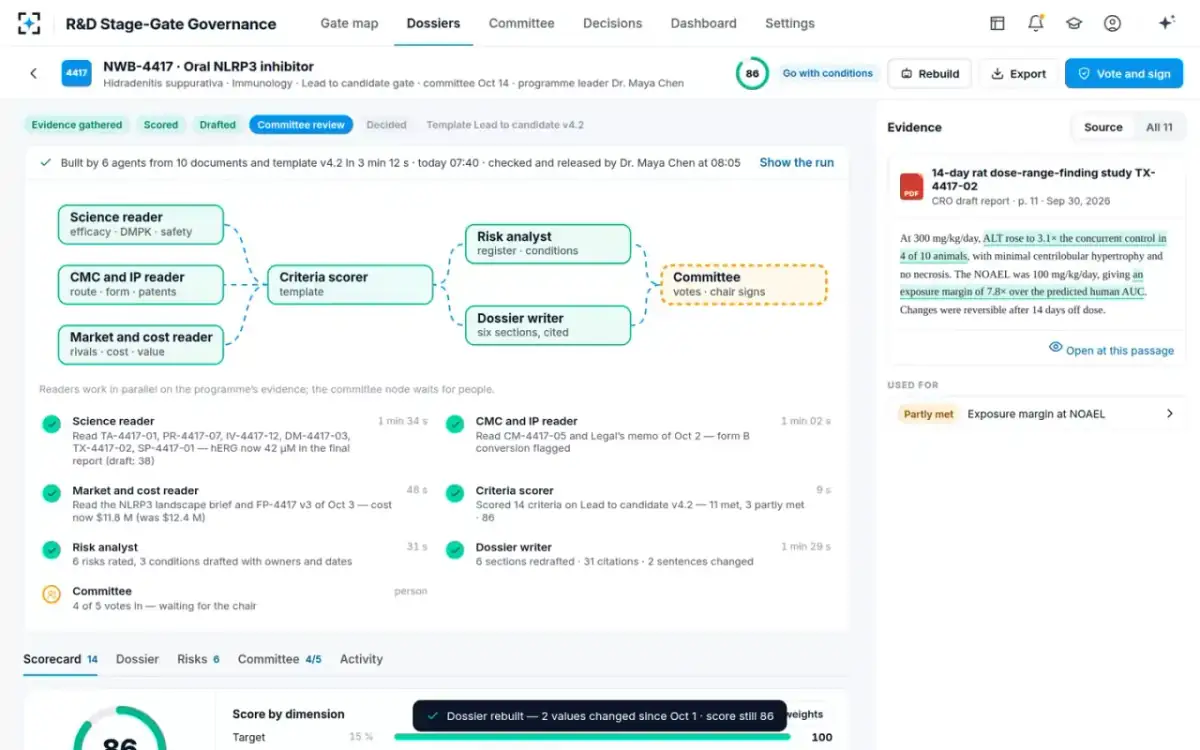
reading a programme’s evidence: three readers, a scorer, a risk analyst and a writer
31citations
in 10 documents — every number in the dossier opens onto its passage
3:12
to rebuild the whole dossier after two values changed, with the score unchanged at 86
What agents are actually doing at a stage-gate
Four jobs, none of which is deciding. They read documents a committee would otherwise have read unevenly or not at all. They extract values with a pointer back to the exact passage. They apply thresholds that someone else wrote, and say which criteria are met, partly met or not met. And they draft — a risk register, a set of conditions, a six-section dossier.
Three of those four are worth having because they are mechanical and the people doing them today are expensive. The fourth, drafting, is the one that needs the most care, because a draft that reads like a conclusion is treated like one. The design answer in this solution is blunt: the writer never expresses a vote or a decision, and the scorer's recommendation is marked advisory wherever it appears.
Six agents: what each reads, what it may assert, and what it may never do
The useful way to specify an agent is not by its model or its tools but by its permissions. Below is the whole set for this solution, written as limits rather than capabilities — because the limits are what a reviewer, an auditor or a committee member needs to be able to check.
The limits matrix: six agents, and the boundary on each
| Agent | What it reads | What it may assert | What it may never do |
|---|---|---|---|
| Science reader | Target assessments, pharmacology, in vivo, DMPK, toxicology and safety pharmacology reports | A value with its unit, species, study and page | Infer a value that is not reported, or let a draft figure pass unmarked |
| CMC and IP reader | Route, solid-form and stability reports; legal memos on filings and freedom to operate | Route length, scale, polymorph risk, filing dates — and a summary of a legal opinion | Re-interpret a legal opinion, or let a dossier leave the committee and the programme team |
| Market and cost reader | Competitive landscape briefs and the finance estimate of cost, months and risk-adjusted value | Rivals by phase, the claimed differentiator, cost and months to the next milestone | Use any finance figure other than the latest approved version |
| Criteria scorer | The milestone’s criteria template, and every value the readers extracted | Met, partly met or not met against each written threshold, and the weighted total | Change a threshold, or let its recommendation stand as anything but advice |
| Risk analyst | Partly-met criteria and the caveats in the source documents | A risk with likelihood, impact, owner and mitigation, and a drafted condition | Draft a condition that is not measurable, dated and owned |
| Dossier writer | Everything above | Six sections a committee can read in ten minutes, every number cited | Write a vote, or state a decision |
Read down the fourth column and a pattern appears. Every limit is about leaving something behind — a number that is not on a page, a threshold that moved, an opinion that was re-worded, a decision that nobody voted on. None of them is about what the model can compute. That is the distinction that makes the boundary testable: capability is a moving target, but "did this value come from a cited passage?" is a question with an answer.
Can AI make a go/no-go decision?
No, and the reason is accountability rather than competence. The regulation that governs what is eventually filed asks for named people: the information on the animal and in vitro work must identify the individuals who evaluated the results and concluded that it is reasonably safe to begin the proposed investigations. A conclusion that cannot be attributed to a person who will answer for it is not the kind of conclusion the system is asking for.
The electronic-records rules make the same point from the other side. Among the controls a closed system must have are written policies, actually followed, that make individuals answerable for whatever is done under their electronic signatures, so that falsifying a record or a signature is deterred. An agent cannot be held accountable or responsible, so there is nothing for that control to attach to. It is not that a model's judgement would necessarily be worse; it is that the record would have nobody in it.
In the sample solution that boundary is enforced at the point of signature. Committee members vote; the chair keeps, edits or removes each drafted condition and records the rationale; the chair signs, choosing the meaning of the signature, and at the candidate-to-IND milestone finance co-signs the budget. The agents' recommendation sits beside all of that, labelled as advice. The full committee and its roles is where that authority is defined.
The four things an agent may never do
Stated once, in the order a committee would worry about them.
It may not vote. A recommendation is not a ballot. The distinction has to survive the interface: a recommendation that appears in the same place, in the same style, as the members' votes will be read as one.
It may not sign. A signature carries a name, a time and a meaning, and all three have to belong to a person who could be asked to defend them.
It may not change a threshold. This is the quietest and most dangerous of the four. An agent that adjusts a partly-met band, or reinterprets a criterion it cannot satisfy, rewrites the decision rule while appearing to apply it. The template is owned, versioned, and changed by its owner — never by the thing scoring against it.
It may not state a number that is not on a cited page. No inference, no reconciliation of two figures into a third, no carrying a value forward from a previous dossier. If the passage does not say it, the dossier does not say it.
From a document to a signed decision: who does each step
Agent
ReadThe three readers open the programme’s study, manufacturing, IP, competitive and finance documents and extract the values each criterion needs, with unit, species, study and page.
Never: infer a value that is not reported
Agent
ScoreThe criteria scorer applies the milestone’s template exactly as written — thresholds, partly-met bands, weights — and records the template version on the score.
Never: change a threshold
Agent
DraftThe risk analyst turns partly-met criteria into risks and conditions; the dossier writer produces six sections with every number cited to its passage.
Never: write a vote or a decision
A person decides
Check and releaseThe programme leader reads the drafted dossier against the evidence and releases it to the committee. Nothing reaches the committee without that release.
A person decides
VoteCommittee members open the cited passages, vote and comment. The agents’ recommendation is visible and labelled as advice.
A person decides
Decide and signThe chair keeps or edits each condition, records the rationale, and signs with the meaning of the signature. The record is sealed at the signature.
Citation as the control: no value without a passage
Of all the controls available, one does most of the work: a number may not appear in the dossier unless it points at the passage it came from. It is cheap to implement, hard to fake convincingly, and it converts the hardest question about a language model — is this true? — into a question anyone can answer in seconds by clicking.
In the sample dossier that is 31 citations across 10 documents. The condition on the programme's exposure margin opens the 14-day rat dose-range-finding study, draft report, page 11, where alanine aminotransferase rose to 3.1 times the concurrent control in 4 of 10 animals at 300 mg/kg/day, the no-observed-adverse-effect level was 100 mg/kg/day, and the exposure margin over the predicted human exposure was 7.8-fold, with the changes reversible after 14 days off dose. A committee member reading that is not evaluating a model's output. They are reading a study page, which is what they were trained to do.
Meaningful transparency provides access to appropriate levels of information based on the stage of the AI lifecycle and tailored to the role or knowledge of AI actors or individuals interacting with or using the AI system. By promoting higher levels of understanding, transparency increases confidence in the AI system.
NIST, Artificial Intelligence Risk Management Framework (AI RMF 1.0), NIST AI 100-1, section 3.4, January 2023
The citation rule is the smallest practical form of that idea: the level of information a committee member needs is the passage behind the number, in front of them at the moment they read it. It does not make the system explainable in any deep sense; it makes every claim it produces attributable to a document that existed before it ran. That is a weaker property, and it happens to be the one a committee actually needs.
Draft versus final: how an agent handles two reports that disagree
This is the case where an extraction system either earns its place or quietly fails. Research evidence arrives in versions. A draft contract-research report precedes a final one; a finance estimate is revised; a stability result is amended. An agent that silently takes the first number it finds will be wrong in a way nobody notices.
Three rules handle it. Draft reports are flagged as draft wherever their values appear. When two reports disagree, the newer final report wins and the older one is flagged rather than discarded. And values that changed since the last build are marked beside the criterion and in the dossier, so the committee sees the movement rather than only the result.
The sample rebuild shows why the third rule matters most. Two values changed: the hERG half-maximal inhibitory concentration became 42 µM in the final safety pharmacology report, where the draft had said 38, and the cost to a first-in-human filing fell to $11.8 M from $12.4 M. The weighted score stayed at 86. A system that reported only the score would have reported nothing; a committee that knows two inputs moved and the total did not can decide, in ten seconds, that neither mattered — which is a decision, properly made.
The handling of amendments is not an invention of this solution, either. Under the good-laboratory-practice regulations, a final report is corrected or added to only by an amendment from the study director that identifies the part changed and the reason, signed and dated by the person responsible. Evidence that arrives with that discipline deserves to be read with it.
The agents at work: what each read, what it found, how long it took
How do you audit what an agent did in a dossier?
By keeping the same things you would keep for a person — six of them — and by making them readable without special tooling.
What an audit of an agent-built dossier needs
- Which documents were read, and which versions
Ten documents in the sample dossier, each identified. A document that was available and not read is as interesting as one that was.
- Which value came from which passage
The citation, not a confidence score. A reviewer should reach the page in one click and judge the extraction themselves.
- Which template version was applied
Scores are only comparable within a version. The version is recorded on the score, not inferred from the date.
- What changed between builds, and when
Two values changed in the sample rebuild. The audit question is not only what the dossier says but what it said last week.
- Who released, who voted, who signed and what the signature meant
The agent steps are inspectable; the person steps are accountable. Both belong in the same trail.
- What the agents recommended, and what the committee decided
Keeping both is what lets an organisation ever ask whether the advice was any good.
The last line is the one many systems drop, and it is the one with the longest-term value. An organisation that keeps the advisory recommendation alongside the decision taken can, after thirty or forty decisions, ask whether the two diverged and who was right. Without it, nobody can ever say whether the agents helped.
Human oversight, in the words of the standard
The AI Risk Management Framework published by the United States' National Institute of Standards and Technology is unusually direct about the thing most AI policies leave vague — that the configuration has to be chosen and written down, rather than emerging. It asks for the human roles in deciding and in overseeing an AI system to be defined clearly and kept distinct, and it sets out the range: a system can decide on its own, hand the decision to a human expert, or serve a human decision maker as an additional opinion.
Those three configurations are a useful test to apply to any proposal. At a research milestone this solution sits in the third: an additional opinion, delivered with its working shown, to a decision maker who signs. It is worth saying out loud that the third configuration is also the most expensive of the three in human time, and that is the point. The saving is in the reading and the assembly, not in the deciding.
The framework adds a second point that bears directly on extraction from scientific documents: risk management should put minimising potential harm first, and may need a person to step in wherever the system cannot itself detect or correct its errors. An extraction agent cannot tell that a study it read has been superseded by one it was never given. That failure is invisible from inside the system, which is exactly why the programme leader's release step exists.
How you would test this before trusting it
Not with a demonstration. With a back-test on dossiers you have already built, scored by people, where the answer is known.
The procedure is straightforward. Take ten past dossiers with their source documents. Run the agents over the same documents, with the template version that was in force at the time. Then compare three things: the values extracted against the values the team recorded, the criteria judgements against the ones the committee accepted, and the drafted conditions against the ones actually signed. The first comparison tests the reading; the second tests whether the template is written precisely enough to be applied consistently; and the third tests the only part that is genuinely a judgement.
Expect the second comparison to be the interesting one. A template that two careful people score differently cannot be scored consistently by anything, and discovering that is worth the exercise on its own. The comparability of two scores is where that problem is worked through in detail.
The FDA's January 2025 draft guidance on using artificial intelligence to support regulatory decision-making — a draft, issued for comment and explicitly not for implementation — offers the cleanest vocabulary for what such a test establishes. It frames everything around a context of use: credibility, in the guidance, is trust in how an AI model performs in one particular context of use, earned by collecting evidence for it — and the context of use is the specific role and scope the model is given in answering a question. Credibility is not a property of the model; it is a property of the model in a stated role. An agent that extracts exposure margins from toxicology reports reliably has told you nothing about how it would read a legal memo.
Where agents do not help, and what still takes a person
Four things, and being honest about them is what makes the rest credible.
Judging whether a model system means anything. Whether a disease model predicts human outcome is the hardest question in the field, and it is not an extraction problem. Scannell and colleagues describe it as under-managed, largely because predictive validity is so hard to measure until a project has already succeeded or failed further down the line. No agent in this solution has an opinion about it.
Deciding what the criteria should be. The template is the organisation's theory of what predicts success. Writing it is a judgement about science and risk appetite, and it is the highest-leverage thing a research leader does.
Weighing a trade the template did not anticipate. A programme with an unusual safety profile in an indication with no alternative is exactly the case a written threshold handles badly. That is what a committee is for.
Knowing what is missing. An agent reads what it is given. A person who has run the programme knows that the stability study was not repeated after the form change, and that absence is often the most important fact in the room.
The boundary, row by row
An agent may: Read every document and extract each value with its unit, species, study and page.
Only a person may: Decide that a document which should exist is missing, and say so.
An agent may: Apply the written threshold and partly-met band exactly as the template states them.
Only a person may: Change a threshold or a weight — as the template owner, in a new version.
An agent may: Prefer the newer final report, flag the older one, and mark drafts as drafts.
Only a person may: Decide that a disagreement between two reports is itself a reason to pause.
An agent may: Mark a criterion met, partly met or not met, and compute the weighted total.
Only a person may: Decide what the total means for this programme, in this indication, this year.
An agent may: Draft a condition that is measurable, dated and owned, from a partly-met criterion.
Only a person may: Keep it, edit it, delete it, and accept responsibility for the ones that are set.
An agent may: Present an advisory recommendation, labelled as advice.
Only a person may: Vote, and sign with a name, a time and a stated meaning.
The dossier a committee reads in ten minutes, every number cited
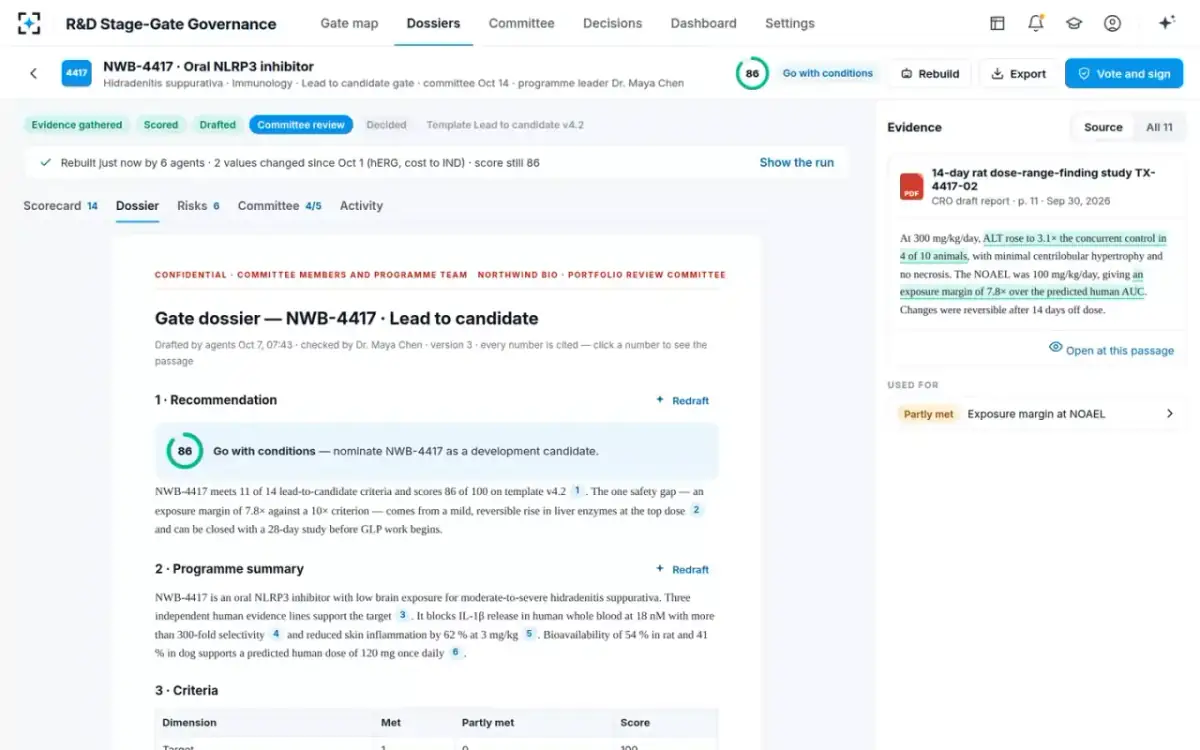
To see the six agents, their limits and the cited passages on one portfolio, start from R&D Stage-Gate Governance. What the decision they support is worth is set out in what IND-enabling studies cost.
Questions people ask
What can AI do in biopharma R&D at a decision point?
Read the programme's documents, extract each value with a pointer to the passage it came from, apply the written criteria of the milestone exactly as the template states them, and draft the risk register, the conditions and the dossier. In the sample programme that is six agents producing 31 citations across 10 documents in a rebuild of three minutes and twelve seconds. What it does not do is vote, sign, change a threshold or assert a number that is not on a cited page.
How does an agent read a toxicology report?
By locating the values a criterion needs — the no-observed-adverse-effect level, the exposure margin, the finding and its reversibility — and recording each with its unit, species, study and page, so the committee opens the passage rather than trusting the extraction. Draft reports are marked as drafts. When a draft and a final report disagree, the newer final one is used and the older is flagged rather than deleted.
How do you stop an AI from inventing a number?
By refusing to let an uncited number into the dossier at all, which turns the question from "is this output true?" into "does this passage say this?" — something any reviewer can check in seconds. The rule has to be absolute to work: no inference, no reconciling two figures into a third, and no carrying a value forward from a previous dossier.
Does an AI-drafted dossier need a human to release it?
Yes, and the step is not a formality. An agent reads what it is given and cannot know that a study was superseded by one it was never shown, or that a stability run was not repeated after a form change. In the sample case the programme leader checks the drafted dossier against the evidence and releases it; nothing reaches the committee without that release.
What does NIST say about human oversight of AI?
That the configuration must be chosen explicitly rather than drifting into place: human roles in decision making and oversight need to be clearly defined and differentiated, and systems can span from fully autonomous to fully manual, including being used by a human decision maker as an additional opinion. The framework also notes that human intervention may be needed where the system cannot detect or correct its own errors — which is the case for any agent reading documents it did not choose.
How do you audit an agent-built stage-gate dossier?
Keep six things and make them readable without special tooling: which documents were read and in which versions, which value came from which passage, which template version was applied, what changed between builds, who released and voted and signed and what the signature meant, and what the agents recommended against what the committee decided. The last pair is the one many systems drop, and the only one that ever answers whether the advice was any good.