A target product profile is the written description of the medicine a programme is trying to make — the indication and population, the route and regimen, the efficacy worth having, the safety that would be acceptable, and what would make a prescriber choose it. A target product profile template is the blank form that prompts for all of those, and many blank forms in circulation have one column where they need two: the minimum that is still worth developing, and the target worth aiming at. That pair is the difference between a document a committee can mark against and a document that can only be admired. R&D Stage-Gate Governance is Botminds' agentic solution for the decisions downstream of the profile. It does not hold your profile for you; what it holds is the criteria a profile is turned into — the thresholds, the bands and the evidence marked against them at each stage-gate — which is the form the profile has to take before anyone can score a programme with it.
The worked examples are fictional sample data inside the solution: Northwind Bio and NWB-4417, an oral NLRP3 inhibitor for hidradenitis suppurativa, scored against a lead-to-candidate template. The company, the people and the programme are invented. The guidance and research quoted are real, and linked where they appear.
What a profile has to become before a committee can use it
2
numbers every attribute needs: the minimum still worth having, and the target
4
criteria templates in the sample company, one for each decision point in research
3
of the sample programme’s criteria marked partly met — each one traceable to a profile attribute
1
named owner per threshold, without whom the number is an opinion
What a target product profile is, and what it is for
The simplest definition comes from the FDA's own review manual for IND development: "A target product profile, which is a concise version of the prototype product label, can be included and used to enhance communication and promote a shared understanding of the drug development program by delineating the sponsor's goals" (FDA CDER, MAPP 6030.9, effective 29 April 2013). Two things in that sentence are easy to skim past. It is a label, which means it is written in the language of what the product will claim rather than of what the team is doing. And it is for communication — with the agency, and at least as often inside the company, between people who think they agree about the goal and do not.
The internal use is the one this guide is about. A profile that nobody scores against is a statement of intent; a profile whose attributes have become criteria at each stage-gate is the thing that makes a portfolio committee's marks mean something, because it ties every threshold back to a product someone wants.
What goes in a target product profile template?
The sections are stable across companies and disease areas. What varies is how many of them carry numbers.
The attributes a profile for a small-molecule programme should carry, and who owns each
- Indication, population and line of therapy
Owned by clinical. The population decides the comparator, the endpoint and the risk a patient is accepting — nothing else can be written until it is fixed.
- Route, dose and regimen
Owned by clinical pharmacology. "Oral, once daily" is a commitment that reaches all the way back into chemistry: it sets the exposure the molecule has to achieve and the toxicology dose range.
- Efficacy: endpoint, magnitude, time point, comparator
Owned by clinical. An efficacy attribute without all four is unmarkable; with them it becomes the yardstick every preclinical model is asked to predict.
- Safety: what would be unacceptable, and what monitoring you could live with
Owned by safety. The most useful line in a profile is often the exclusion — the finding that would end it — written before anyone has seen one.
- Duration of therapy and setting of use
Owned by medical. Chronic dosing changes the toxicology package, the margin you need and the formulation; it is the attribute most often left implicit.
- Differentiation: the sentence a prescriber would use
Owned by commercial. If nobody outside the programme can state it in one sentence against the rivals already in the clinic, the attribute is not yet written.
- Formulation, stability and packaging constraints
Owned by CMC. A profile that assumes a tablet has made a decision about solid form, and a solid form that converts under warm, humid storage can break it.
- The patient-selection test, if the population needs one
Owned jointly by clinical and diagnostics. An attribute that requires a biomarker needs an assay that is feasible and a prevalence that is known, or the population is hypothetical.
- Cost-of-goods and access constraints
Owned by finance with commercial. A molecule that works at a dose nobody can manufacture economically has met every scientific attribute and failed the profile.
- Exclusions: what this product is explicitly not
Owned by the programme leader. The list that stops a profile from quietly widening every time a result disappoints.
The pair of numbers every attribute needs
An attribute written once can only be argued about. Written as a pair — minimum and target — it prices a decision: it says what the team would still be willing to develop and what it is aiming at, which is exactly the information a committee needs when the evidence lands between the two.
One efficacy attribute, written four ways
| How it is written | The attribute | What a reviewer can do with it |
|---|---|---|
| As a wish | Best-in-class efficacy in moderate-to-severe disease. | Nothing. No quantity, no comparator, no time point: two reviewers will mark it differently and both will be defensible. |
| As a minimum | At least 40% of patients reaching the accepted clinical response at week 16. | Mark it, eventually. But nothing says what success would be worth, so a result of 41% and a result of 60% land in the same box. |
| As a minimum with a target | Minimum 40%, target 55% of patients reaching the accepted clinical response at week 16, against placebo on background therapy. | Compare options and trade them off. The pair is what lets a committee prefer a slower programme with a higher ceiling. |
| As a criterion a research stage-gate can score | In vivo efficacy: ≥ 50% effect in the accepted disease model, at an exposure the predicted human dose achieves. | Mark it today, years before a patient. The criterion names evidence that exists now and states the link it assumes to the clinical attribute. |
The fourth row is where many profiles stop being useful, because it requires an admission: at a research stage-gate nobody can measure the clinical attribute, so the criterion measures a stand-in. Saying which stand-in, and how good it is, is the honest version of what every team does anyway.
Minimal and optimal: what WHO's own profiles do, and why it works
The clearest public examples of the two-number discipline are the World Health Organization's profiles, which are written for products that do not exist yet and have to be commissioned from whoever will build them.
WHO TPPs define a set of product attributes and contain both minimally acceptable and preferred criteria in response to emergency or epidemic scenarios.
World Health Organization, WHO target product profiles (TPPs)
The organisation's description of how its product profiles are structured is worth copying wholesale: the documents "describe the (a) preferred and (b) minimally acceptable profiles" for the product class, with an overview stating the purpose, a methods section describing how the profile was developed, and the profile itself under compulsory headings (WHO, Target product profiles, preferred product characteristics and target regimen profiles). It also draws a distinction a company template usually blurs: a target product profile "contain[s] minimal and optimal characteristics", while the looser preferred product characteristics "should not contain minimal acceptable criteria". A document that gives only the preference is a different instrument from one that gives the floor, and it cannot be scored.
Why the floor matters more than the aspiration: the minimum is the number that tells a committee when to stop. A programme whose evidence sits below the minimum on an attribute nobody is willing to relax has answered its own question, and the decision that follows is not a disappointment but a saving.
How an attribute becomes a criterion a reviewer can mark
Three moves do the translation, and all three should be written into the criterion rather than held in somebody's head.
Name the evidence that exists at this stage. At nomination there is no clinical response rate; there is an effect size in a model, a predicted human dose and an exposure. The criterion must be expressed in those terms.State the stand-in and the assumption. "≥ 50% effect in the accepted disease model" assumes that model predicts the clinical endpoint; the assumption belongs in the criterion's note, where it can be challenged when the model's record is poor. Keep the profile's number visible behind the criterion's. A reviewer who can see that a 10-fold margin criterion exists because the profile commits to chronic daily dosing in a non-life-threatening disease will mark a 7.8-fold result differently from one who thinks the threshold is a house rule.
The second move carries the most risk, and it has a name. Reviewing the evidence on how predictive research tools really are, Scannell and colleagues define "'predictive validity'" as "the correlation coefficient between the output of a decision tool and clinical utility across therapeutic candidates", and show that the detectability of a good candidate is extremely sensitive to it (Scannell et al., Nature Reviews Drug Discovery, December 2022). A criterion is a decision tool in exactly that sense. Its threshold can be perfectly written and still be worth nothing if the assay behind it does not track the attribute the profile cares about — which is an argument for recording, beside each criterion, where its stand-in came from and how it has performed.
Who owns the profile, and who may change an attribute
The programme leader drafts it, the functions own their own attributes, and one named person approves a change — usually the same seat that owns the criteria templates, because the two documents have to move together. A profile with no named owner drifts into whatever the latest result allows, which is the failure mode that makes experienced reviewers sceptical of profiles in general.
Treat the two numbers differently. A target may be revised with a note: it is an aspiration, and new information legitimately moves it. A minimum should be hard to change, because the minimum is what the organisation said it would still be willing to fund — and the moment to re-examine it is before a programme's evidence lands, not after. The same mechanism the sample company uses for criteria applies: a proposed change is visible, attributed and pending its owner's approval, and programmes already in committee keep the version their marks were made against. Criteria two reviewers score the same way sets that machinery out in full.
When does a target product profile change?
Four events justify it. New human evidence about the target or the mechanism, which can move what is achievable in either direction. A competitor's read-out, which changes what counts as differentiation — the sample programme's landscape carried six clinical-stage rivals, and a seventh with a better result would rewrite the attribute. A change in what regulators accept as an endpoint or a population. And the programme's own evidence showing that an attribute cannot be reached at a tolerable dose.
A profile's life against the decisions it has to serve
- Draft: a hypothesisbefore target to hit
- Challenged: every attribute testedhit to lead
- Firm: minimums fixed, targets keptlead to candidate
- Fixed: changes recordedcandidate to IND
What should never trigger a change is the arrival of a disappointing result on the attribute itself. Lowering a minimum to match the molecule in front of you converts the profile from a test into a mirror, and every score taken against it afterwards is uninterpretable. The legitimate routes are the ones a stage-gate already provides: mark the criterion partly met and attach a mitigation, hold the programme with a defined restart condition, or stop it.
The attributes teams leave out, and what it costs later
Five omissions recur. Duration of therapy — a profile that does not say the medicine will be taken for years has not committed to the safety margin and the long-term studies that implies. Storage and packaging — an attribute nobody writes until a second crystalline form appears under warm, humid conditions and the programme owes a control strategy. The competitor set at launch, rather than today's: the rivals that matter are the ones that will have read out by the time this product arrives. The patient-selection test, where the population is defined by a marker nobody has an assay for. And the exclusions, the list of what the product is not, without which a profile widens quietly every time a result disappoints.
The fourth is visible in the sample company as a template change in flight: a proposed new version of the lead-to-candidate criteria adds a patient-selection biomarker criterion — assay feasible, prevalence known — in the target dimension, and sits waiting for its owner's approval while existing dossiers keep the current version. That is what it looks like when a company notices a missing attribute and fixes it in the instrument rather than in the argument.
Reading a profile against the evidence you actually have
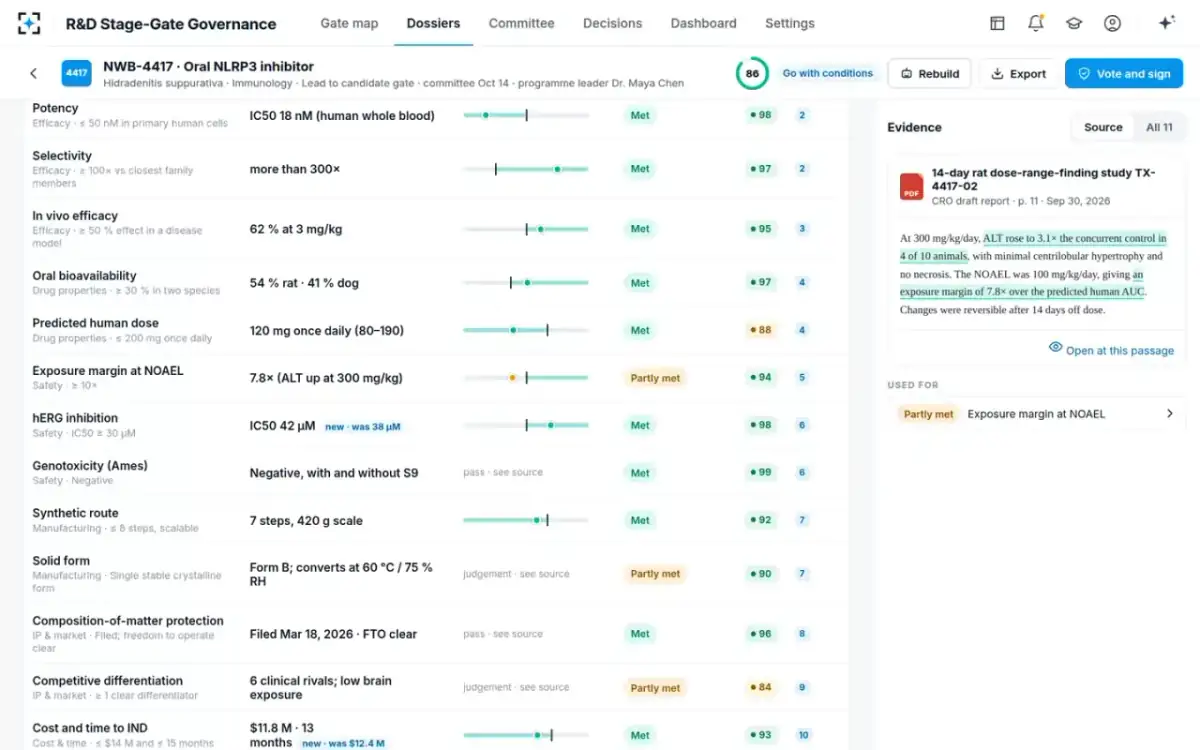
This is the moment the profile is worth the work. In the sample programme, eleven of fourteen criteria were met and three were partly met, and each of the three traces straight back to an attribute.
The exposure margin was 7.8-fold against a ten-fold threshold — and a profile that commits to daily dosing in a chronic skin disease is the kind of commitment that justifies a demanding margin, rather than ten being a round number. The committee's safety head said as much in her comment on the decision: a margin of that size is workable for a long-term skin indication only if a 28-day study confirms that the liver change reverses. The solid form was a single crystalline form that converts at 60 °C and 75% relative humidity, which is a packaging and stability attribute the profile had left implicit. And competitive differentiation was marked partly met against six clinical-stage rivals, on a differentiator — low brain exposure — that is plausible from the preclinical data and untested in people.
Each attribute, as a criterion with its threshold, its value and its source
Carrying the profile from one decision point to the next
A profile that lives in a folder is consulted when it agrees with the plan. A profile attached to each dossier is read at every decision, which is the only way its attributes stay honest. Three habits make that happen: attach the current version to the package, so the committee sees the profile and the marks on one screen; keep each criterion's line of descent from its attribute, so a reviewer can ask why a threshold is what it is; and re-read the exclusions at every stage-gate, because they are what the programme's own optimism erodes first.
The requirement grows as the programme does. The regulations are explicit that the amount of information an application has to carry depends on the novelty of the drug, how much it has been studied before, the known or suspected risks and the stage of development (21 CFR 312.22(b)). A first-in-class programme in an unprecedented target class therefore owes more evidence against the same profile than a well-trodden mechanism does — and a committee that marks both against one template, without reading the profile behind it, will treat those two programmes as though they were the same risk. The evidence a nomination package needs shows what that looks like document by document, and the four stage-gates and what each asks places the profile against the decisions it has to serve.
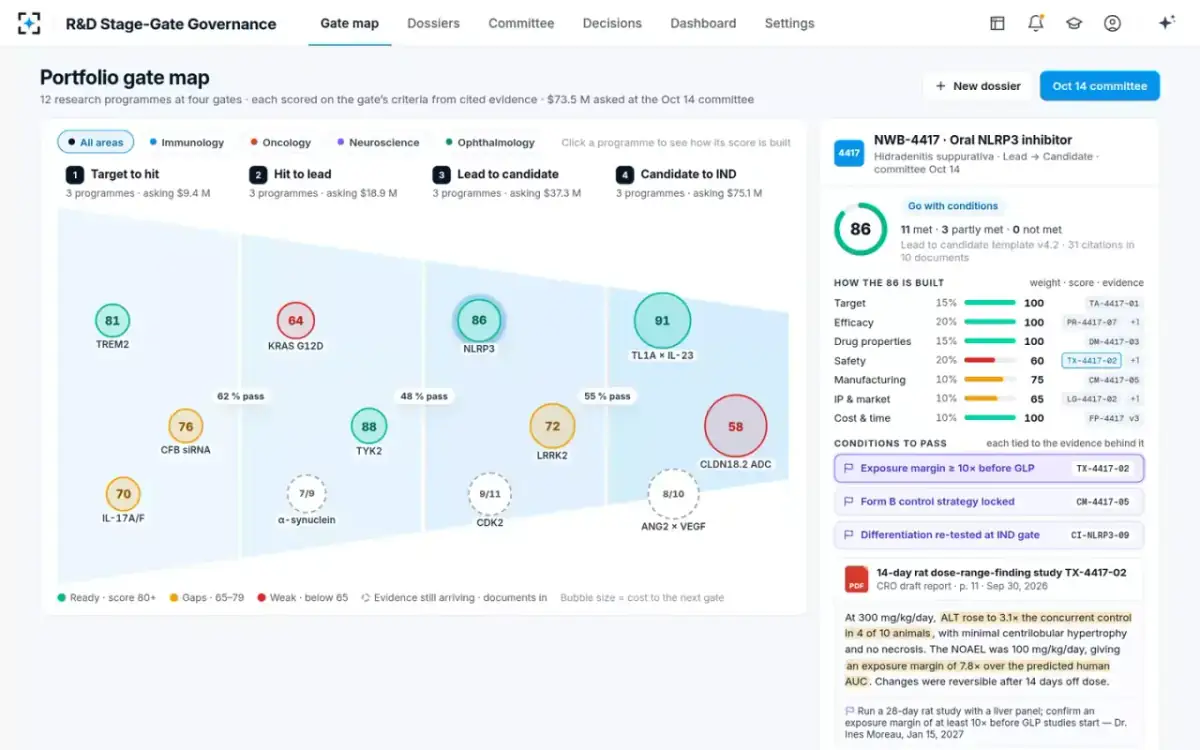
One portfolio, every programme scored against its own profile's thresholds
Questions people ask
What is the difference between a TPP and a QTPP?
A target product profile describes the medicine clinically — indication, population, regimen, efficacy, safety, differentiation. A quality target product profile is its manufacturing counterpart: ICH Q8(R2) says "the quality target product profile forms the basis of design for the development of the product", and lists what it should consider — intended use and route, dosage form and delivery system, strengths, container closure, release and pharmacokinetic attributes, and quality criteria such as sterility, purity, stability and drug release (ICH Q8(R2), Pharmaceutical Development). One says what the product must do; the other says what it must be.
Who writes the target product profile?
The programme leader drafts it and each function owns its own attributes — clinical the endpoint, safety the exclusions, CMC the formulation constraints, commercial the differentiation, finance the cost-of-goods ceiling. A profile written entirely by one function reads as that function's wish list, and the attributes the others would have contributed are the ones that turn up later as conditions at a stage-gate.
How detailed should a target product profile be?
Short enough that the committee reads it, specific enough that each attribute can be marked: two pages with twelve attributes, each carrying a minimum and a target, beats twenty pages of narrative. Detail is best spent on the attributes that constrain the programme — regimen, duration, the safety exclusions — rather than on the ones everyone agrees about.
How is a target product profile used in decision making?
Indirectly, and that is the point. At a research decision nobody marks the profile itself; the committee marks criteria that stand in for its attributes using evidence that exists today, and the profile is what justifies each threshold. Used well, it answers the awkward question in the room — why is this number ten and not five? — with a product decision rather than a precedent.
What happens when the evidence misses the target product profile?
It depends which number it misses. Short of the target but above the minimum is an ordinary result: the programme continues, and the gap is recorded. Below the minimum on an attribute nobody will relax is a stop, and saying so is what the minimum was written for. In between sits the partly-met band, where the right answer is usually a condition with an owner and a date — the sample programme's 7.8-fold margin, against a ten-fold threshold, closed by a 28-day study before the expensive work starts.
Is a target product profile required by regulators?
No. The FDA's own manual describes it as something that "can be included" in a submission to enhance communication and shared understanding of a development programme, and refers to its separate draft guidance on the profile as a strategic development tool. The obligation is internal: nothing requires the document, and nothing rescues a committee that has been scoring programmes for three years without one.