A go/no-go criteria template is the list a committee marks a programme against at a decision point, and the test of a good one is uncomfortable: hand the same evidence to two reviewers who have not spoken, and they should produce the same marks. Many templates fail that test, because many criteria are written as aspirations — "an acceptable safety margin", "clear differentiation" — rather than as a measurable quantity with a threshold, an explicit band for the awkward middle, and a named owner of the number. This guide sets out the four parts a criterion needs, how to weight them, how to stop them being rewritten in the meeting, and how to test a template before a live programme depends on it. R&D Stage-Gate Governance is Botminds' agentic solution for the work around that template: the criteria are a versioned setting, the scorer applies them exactly as written, and the version it used is recorded on every score.
The examples are fictional sample data inside the solution — Northwind Bio's lead-to-candidate template v4.2 and the programme NWB-4417 that was marked against it. The thresholds shown are one invented company's, not an industry standard; the regulatory texts quoted are real and linked where they appear.
What a go/no-go criterion has to do
A criterion carries three jobs at once, and confusing them is where templates go wrong. It has to bedecidable — a reviewer can say met or not met without a conversation. It has to be proportionate — the evidence it demands exists at that stage of the programme. And it has to be honest about the middle — real evidence is often nearly good enough, and a template with no vocabulary for that forces the reviewer into a false choice, which they resolve politically.
There is a formal version of this argument. Modelling research decisions as rules that segment a space of candidates, Scannell and Bosley "apply decision rules to segment the space, and assess the probability of correct R&D decisions", and find that a small gain in the predictive validity of the models a decision rests on can offset a tenfold or even hundredfold gain in how many candidates are screened (Scannell and Bosley, PLOS ONE, February 2016). A criterion is a decision rule in exactly that sense: its value is not that it exists, but that the quantity it reads correlates with the thing you actually care about.
The four parts of a criterion that holds
Every criterion that survives contact with a committee has four parts written down before the evidence arrives. A criterion missing any one of them is an opinion with a number next to it.
The same criterion, written weakly and written to hold
As it usually arrives: "Acceptable safety margin."
As it has to be written: The ratio of the exposure (AUC) at the no-observed-adverse-effect level in the most relevant species to the exposure predicted in humans at the intended dose.
As it usually arrives: Implied. Everyone "knows" roughly what is wanted.
As it has to be written: ≥ 10×. One number, one comparison, written in the template.
As it usually arrives: Unstated, so two studies answer it differently.
As it has to be written: From the repeat-dose study in the species carrying the lower exposure, against the predicted human AUC at the intended dose.
As it usually arrives: None. A 7.8× result is argued, not marked.
As it has to be written: 5–10× is partly met and requires a mitigation plan; below 5× is not met.
As it usually arrives: Whoever is most senior in the room.
As it has to be written: The template owner. A change needs their approval and applies to dossiers built after it.
The fourth row is the one teams leave out and the fifth is the one they think is bureaucracy. Both are what make the template survive its first difficult programme: the band gives the committee somewhere to put a near miss other than a fight, and the owner gives it somewhere to send a request to move the line other than the agenda.
Thresholds: a number, a unit, a method and a source
A threshold without a method is half a threshold. "Potency ≤ 50 nM" can be met by a recombinant enzyme assay and missed by the same molecule in human whole blood, and the difference is not a detail — it is the difference between a criterion that predicts clinical exposure and one that predicts nothing. The sample template writes the method into the criterion: potency is "≤ 50 nM in primary human cells", selectivity is "≥ 100× against closest family members", oral bioavailability is "≥ 30% in two species".
Where a threshold is inherited from guidance rather than invented, say where it came from — and say when you depart from it. The FDA's guidance on estimating a maximum safe starting dose is explicit that its default tenfold safety factor is a starting point, not a rule: "A safety factor of 10 may not be appropriate for all cases. The safety factor should be raised when there is reason for increased concern, and lowered when concern is reduced because of available data that provide added assurance of safety" (FDA CDER, July 2005).
It is incumbent on the evaluator to clearly explain the reasoning behind the applied safety factor when it differs from the default value of 10, particularly if it is less than 10.
FDA, Center for Drug Evaluation and Research, Estimating the Maximum Safe Starting Dose in Initial Clinical Trials for Therapeutics in Adult Healthy Volunteers (July 2005)
Copy that obligation into the template. A therapeutic area that wants a different threshold from the house standard should be able to have it — and should have to write down why, once, in the template, rather than arguing it again at every programme. The reasoning becomes part of the criterion, which means it can be reviewed, cited and inherited by the next person in the seat.
The partly-met band, and why leaving it out costs you the meeting
The partly-met band is the range in which the evidence is short of the threshold but the shortfall can be managed. It is not a softer pass. Its purpose is to convert a judgement that would otherwise be made by rhetoric into a decision with an attached obligation: a condition, with a named owner, a date and a test.
Three criteria with their bands written out, and the mitigation each one implies
| Criterion | Met | Partly met — with a mitigation | Not met |
|---|---|---|---|
| Exposure margin at NOAEL | ≥ 10× over the predicted human exposure at the intended dose | 5–10×, with a mitigation plan: a longer repeat-dose study in the same species confirming the margin before GLP work starts | Below 5×, or an adverse finding that is not reversible |
| Solid form | One stable crystalline form across the storage conditions tested | A second form appears under accelerated conditions and a control strategy is possible: the strategy and the packaging are locked by a named date | Conversion under ambient conditions, or no form study |
| Competitive differentiation | At least one differentiator that survives comparison with the rivals already in the clinic | A differentiator that is plausible but not yet tested in human data: re-tested at the next stage-gate against a refreshed landscape | No differentiator that a reviewer outside the programme can state |
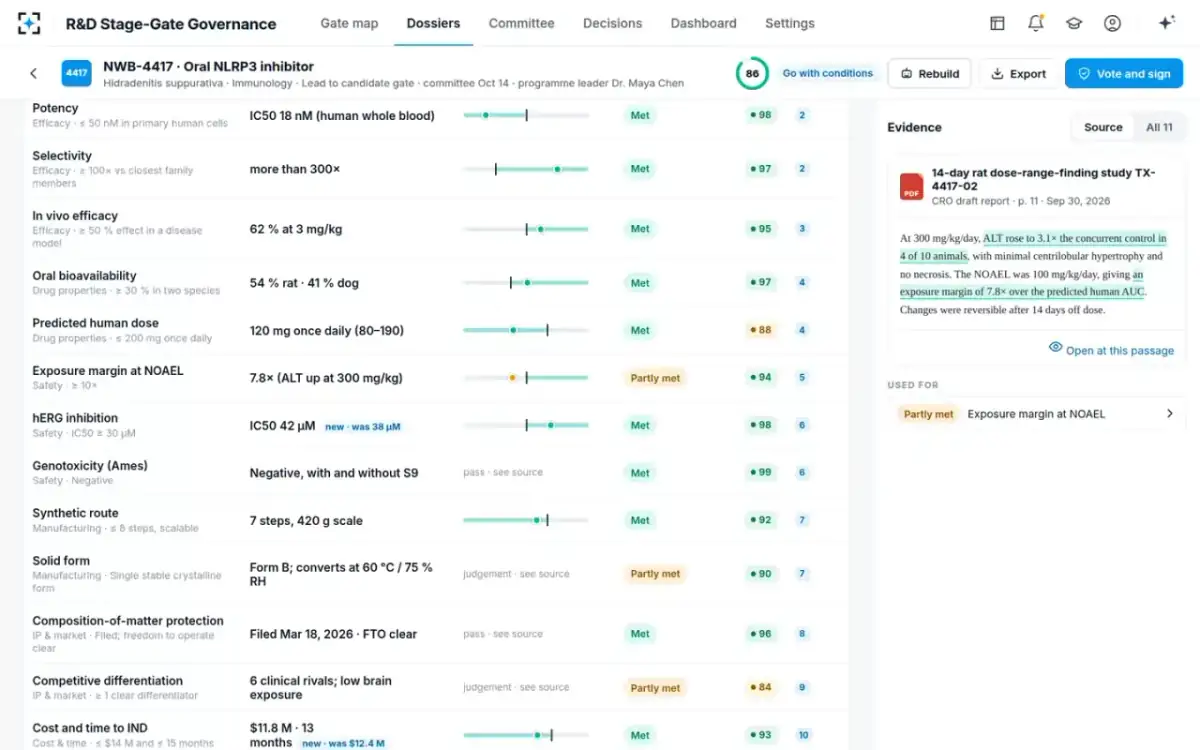
The sample programme landed in the first row's middle column: an exposure margin of 7.8-fold against a ten-fold threshold, from a 14-day rat study in which liver enzymes rose at the top dose, mildly and reversibly. Without the band, that programme arrives at a committee as an argument about whether 7.8 is "close enough". With it, the mark is partly met, the mitigation is a 28-day study with a liver panel before GLP work starts, and the meeting spends its time on whether that study is the right test — which is a question the committee is qualified to answer.
How do you stop criteria being renegotiated in the room?
You cannot stop anyone from arguing, and you should not want to. What you can do is make a change to a threshold impossible to apply retrospectively and invisible to nobody. Four devices do almost all the work.
Version the template and stamp the version on every score. A mark that carries "lead-to-candidate v4.2" can be compared with another mark that carries the same string, and cannot be quietly compared with one that does not. Give the template an owner. A proposed change goes to a named person between meetings, not to the chair at 14:30. Freeze dossiers in flight. A programme already in committee keeps the version its votes were cast on, so improving the template never re-scores work in progress. Give the committee a legitimate alternative. Much of the pressure to move a threshold is really a wish not to say no to a programme that is nearly there; go with conditions is the honest form of that wish.
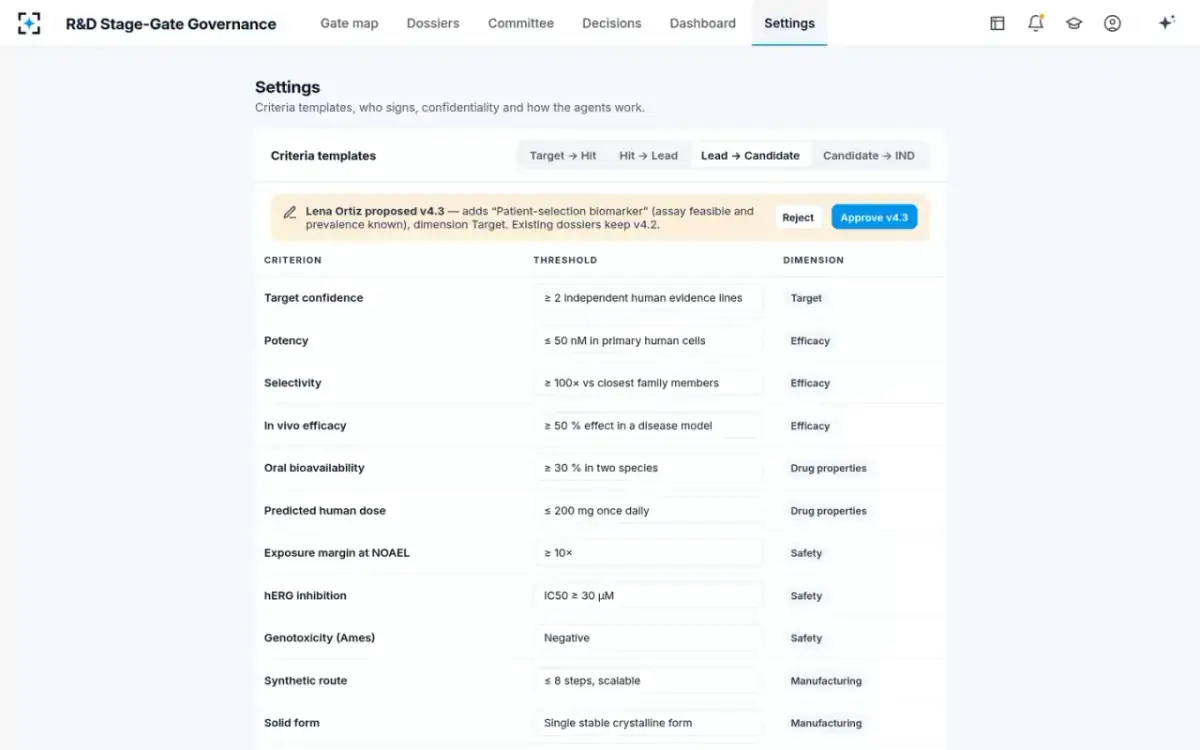
Criteria as a versioned setting in R&D Stage-Gate Governance, with a change waiting for its owner
Should go/no-go criteria be weighted?
Yes, if the committee wants a single number to sort a portfolio by — and never as the thing that decides. A weighted score is a summary, and like every summary it hides exactly what a decision needs to see: a programme scoring 86 with its weakest dimension at 60 is not the same programme as one scoring 86 with every dimension in the seventies, and the committee must be able to see which it is looking at.
What a weighted score is made of, and what it must carry
The criterion mark
met · partly met · not met
Marked against a written threshold and an explicit band. The marks, not the total, are what the committee argues about.
The reviewer, applying the template
The dimension score
the template’s own rule for its criteria
Not necessarily an average: a template may let one criterion dominate its dimension, which is a legitimate choice only if it is written down.
The template owner
The weighted total
Σ (dimension weight × dimension score)
In the sample programme: 0.15×100 + 0.20×100 + 0.15×100 + 0.20×60 + 0.10×75 + 0.10×65 + 0.10×100 = 86.
Computed, never typed
The stamp on the result
template + version + date
A score without the version it was produced by cannot be compared with any other score, including the same programme’s score last quarter.
Recorded automatically
Two refinements keep weighting honest. First, decide which criteria are non-compensatory — the ones no amount of strength elsewhere can outweigh. A genotoxicity signal is the obvious example: a programme with a positive Ames result does not pass because its potency is excellent. Write those criteria as a separate list and mark them before the total is computed. Second, resist the urge to tune weights until the ranking looks right. If a weighting produces an answer the committee refuses to accept, the useful response is to find the criterion that is missing, not to re-weight the ones that are there.
Stopping rules borrowed from the clinic, and what they teach a stage-gate
Clinical research solved a version of this problem first, under more pressure. Guidance on first-in-human trials requires that "the protocol should define unambiguous stopping rules which result in an immediate stop to dosing", and adds a second requirement that research committees easily forget: "It should further be specified in the rule if the stop is a final end of dosing or a temporary halt" (EMA, Guideline on strategies to identify and mitigate risks for first-in-human and early clinical trials, Rev. 1, July 2017).
Then comes the part worth stealing outright. "Restart is possible without a substantial amendment if review leads to a conclusion which is fully within predefined conditions for the relevant stopping criterion" (EMA, Rev. 1). In other words: define, in advance, not only what stops the work but what it would take to start it again. A research committee that holds a programme without saying what would lift the hold has created an indefinite pause that nobody has had to defend, and a programme that is neither funded nor dead consumes attention for years.
The discipline transfers directly. For every criterion that can produce a stop, write the restart condition in the same sentence: what evidence, from what study, reviewed by whom. That is what turns "hold pending further data" into "hold until the 28-day study reports; the programme returns to the next committee with the margin re-measured".
Versioning: a change needs an owner, and a dossier keeps the version it was voted on
Templates should change. A criteria set that has not moved in three years is either perfect or ignored, and the second is more likely. What matters is that every change has an author, an approver and a date, and that no change ever reaches backwards.
In the sample company the mechanism is visible on the settings screen: a proposed v4.3 adds a patient-selection biomarker criterion in the target dimension — assay feasible, prevalence known — and sits waiting for the template owner's approval, with an explicit note that existing dossiers keep v4.2. That note is the whole control. Without it, approving an improvement silently re-scores every programme in flight, and the committee discovers at the meeting that a dossier it has already read now says something different.
Keep the version history readable too. A regulated final report has to describe every circumstance that may have affected the quality or integrity of its data (21 CFR 58.185(a)(9)), which is the same instinct one layer down: the reader of a result is entitled to know what could have bent it. For a criteria template, that means each version says what changed and why, in a sentence a person who was not there can read.
Testing a criteria template before you use it
A template is a measuring instrument, and an instrument nobody has calibrated will be trusted exactly as much as one that has been — which is the problem. Test it on decisions already taken, where the outcome is known and nobody's programme is at stake.
Ten tests to run on a criteria template before a live programme depends on it
- Two reviewers, one package, no conversation
Mark an old dossier independently and compare. Every disagreement points at a criterion whose wording is doing less work than you thought.
- Every criterion names the document that could answer it
If no document in the standard package can produce the value, the criterion will be answered by assertion.
- Every threshold carries a unit and a method
"≤ 50 nM" is not a threshold until it says in what assay and what matrix.
- Every criterion has a partly-met band, or an explicit note that it has none
Binary criteria exist — a filed patent is filed — but the template should say so rather than leave the reviewer guessing.
- The weights sum to 100, and the committee can defend the two largest
If nobody can say why safety carries 20% rather than 30%, the number is decoration.
- Name the non-compensatory criteria
The ones a high total may never override. Mark them before the total is computed.
- Run it against a programme you stopped
A template that scores a known failure comfortably is measuring the wrong things — the cheapest finding you will ever get.
- Run it against a programme that worked
If your best molecule would have been marked not met at nomination, find out which criterion did it, and whether that criterion is right.
- Check it against the stage it belongs to
A criterion whose evidence only exists one stage later moves the decision without anyone deciding to.
- Count the criteria
As a rule of thumb, aim for roughly ten to twenty at a nomination decision. Forty criteria is a questionnaire, and it will be answered like one.
A template in use: every criterion with its threshold, its value, its mark and its source
What a criterion should never be
Five shapes recur, and each one can be recognised in a draft template before it does any harm. A criterion that scores the team rather than the molecule — "strong programme leadership" — belongs in a different conversation. A criterion that is a restatement of another, such as potency scored twice in two dimensions, silently doubles a weight. A criterion whose evidence does not exist yet at this stage converts the decision into a wish. A criterion phrased as a direction — "improving solubility" — cannot be marked at all. And a criterion whose threshold is an industry average rather than a requirement of this programme imports someone else's risk appetite without debate.
The replacement in every case is the same move: name the quantity, name the method, name the number, name the band, name the owner. It takes an hour per criterion and it is the hour that decides whether the committee's year is spent deciding or arguing. What a stage-gate review is covers where these templates are used, and turning a target product profile into scored criteria covers where their thresholds should come from.
Questions people ask
What is the difference between a criterion and a stopping rule?
A criterion is marked at a planned decision point and contributes to an outcome; a stopping rule fires whenever its condition is met and halts the work immediately. Research programmes need both: criteria at the stage-gates, and a short list of findings — an unexplained death in a study, a positive genotoxicity result, a competitor reporting the same mechanism failing in the clinic — that stop work the day they appear. Clinical guidance also requires a stopping rule to say whether the stop is final or temporary, which is a discipline worth copying.
Who approves a change to stage-gate criteria?
A named template owner, usually the portfolio governance lead with the head of research, and never the committee mid-meeting. The approval should produce a new version, a one-line statement of what changed and why, and an explicit rule for programmes already in flight — in the sample company, dossiers already in committee keep the version their votes were cast on.
Can go/no-go criteria be different by therapeutic area?
They can, and often must: an oncology programme and a chronic dermatology programme do not have the same safety margin requirement, because the patients are not accepting the same risk. The cost is comparability — two scores from two templates are not the same currency. The workable compromise is one house template with a named set of area-specific thresholds, each carrying a written reason, so a reader can see exactly where and why the areas diverge.
What makes a criterion measurable?
That a reviewer can point at a value in a document and compare it with the threshold without judgement. Three properties do it: a quantity with a unit, a stated method of measurement, and a comparison operator with a number. Criteria that resist this — differentiation, strategic fit — can still be used, but they should be labelled as judgements, marked by a named person, and carry the evidence the judgement rests on rather than a score pretending to be a measurement.
How many criteria should a stage-gate have?
Few enough to be argued in an hour — as a rule of thumb, roughly ten to twenty at a nomination decision (the sample company uses fourteen) and fewer at the earlier stage-gates, where less evidence exists. A long template is usually a sign that criteria have been added after each unpleasant surprise and never removed; the cure is to ask of each one when it last changed a decision.
Where should the thresholds come from?
Three places, in order: the product you are trying to make, which sets the dose, the regimen and the tolerable risk; regulatory guidance, where it fixes a method or a default, such as the tenfold safety factor in starting dose estimation; and your own history, which is the only source that tells you which criteria have actually predicted failure in your hands. A threshold with no stated source is the one that gets renegotiated first.