Candidate nomination in drug discovery is the decision that turns one optimised molecule into a development candidate and releases the money for the studies that take it towards a first human dose. It is one of the most document-heavy decisions in research: in the sample small-molecule programme on this page, ten reports from six functions are read against fourteen criteria, and a committee has about ten minutes a programme to satisfy itself that the evidence supports the recommendation. The useful question for a team preparing its first package is therefore not "what should the deck say" but "which document answers which criterion, and on what page". R&D Stage-Gate Governance is Botminds' agentic solution for exactly that map: agents read the programme's own reports, pull every value a criterion needs with its page and passage, mark each criterion against its threshold and draft the dossier the committee reads.
The worked example is fictional sample data inside the solution — Northwind Bio's NWB-4417, an oral NLRP3 inhibitor for hidradenitis suppurativa, at its lead-to-candidate decision. The company, the people, the molecule and the studies are invented. The regulatory requirements and the published research quoted are real.
One lead-to-candidate package, counted
10
documents, from six functions: research, DMPK, toxicology, CMC, legal and finance
14
criteria the committee marks, each with a written threshold
7
dimensions the criteria group into, each carrying a share of the weight
3
criteria marked partly met in the sample programme, and the reason it passed with conditions
What candidate nomination decides
It decides three things at once, which is why it is contested. First, that this molecule, and not its backups, is the one the company will spend on. Second, that the evidence is complete enough to predict what the regulated studies will find — an exposure margin, a solid form, a dose. Third, that the organisation will fund a programme whose next stage is mostly bought from outside: toxicology at a contract research organisation, manufacturing at another, with little of it reversible once started.
The guidance that governs the regulated work describes the shape plainly: "The development of a pharmaceutical is a stepwise process involving an evaluation of both animal and human efficacy and safety information" (ICH M3(R2), January 2010). Candidate nomination is the step where that process stops being iterative. Up to this point a programme can change its molecule in response to a result; afterwards, an unwelcome result costs a year.
What is the difference between a lead and a development candidate?
A lead is the best member of a chemical series — potent enough and clean enough to justify optimisation, but characterised mainly in vitro and in a few in vivo experiments. A development candidate is a specific structure, in a specific salt and solid form, with a predicted human dose, a route that can be scaled, a patent filed and a costed plan to an application. The gap between them is measured in what is written down, not in potency.
That matters because the common failure is a lead promoted on the strength of its efficacy, carrying unexamined drug properties. A large published analysis of the problem pooled candidate attrition from four major companies and found that "control of physicochemical properties during compound optimization is beneficial in identifying compounds of candidate drug quality", and that there is "for the first time a link between the physicochemical properties of compounds and clinical failure due to safety issues" (Waring et al., Nature Reviews Drug Discovery, July 2015). The same paper is honest about the limit: further control of those properties is "unlikely to have a significant effect on attrition rates", because the remaining failures are not of that kind. Properties are a filter, not a guarantee — which is an argument for scoring them explicitly at nomination rather than trusting them to the chemistry.
The ten documents a lead-to-candidate package is built from
Every company numbers them differently; the set is remarkably stable. One: the target assessment, carrying the human evidence that modulating this target changes this disease. Two: the pharmacology report — potency in a human-relevant assay and selectivity against the nearest relatives. Three: the in vivo efficacy report, the effect in a disease model at a stated exposure. Four: the DMPK report — absorption, clearance, bioavailability in two species and the human dose predicted from them. Five: the toxicology report, usually a non-GLP dose-range-finding study that produces the first no-observed-adverse-effect level. Six: the safety pharmacology report, carrying the in vitro cardiac work and, in this sample package, the in vitro genotoxicity result. Seven: the route and solid-form report — how the molecule is made at scale, and which crystalline form survives storage. Eight: legal's memo on the composition-of-matter filing and freedom to operate. Nine: the competitive landscape assessment. Ten: finance's cost and timeline estimate to the next decision.
Read that list against what the regulated package will later contain and the logic of the order appears. The nonclinical safety assessment for a marketing application "usually includes pharmacology studies, general toxicity studies, toxicokinetic and nonclinical pharmacokinetic studies, reproduction toxicity studies, genotoxicity studies and, for drugs that have special cause for concern or are intended for a long duration of use, an assessment of carcinogenic potential" (ICH M3(R2)). Nomination reads the cheap, early, non-GLP version of several of those and buys the expensive version with its decision.
What documents are needed for candidate nomination, and what can wait?
All ten, in some form — but "in some form" is where committees waste their hour. Three distinctions make the difference between a package that can be marked and one that has to be argued about.
Final versus draft. A draft contract-research report is legitimate evidence at nomination; a draft presented as final is not. The sample programme nominated on a draft dose-range-finding report, explicitly marked as a draft, and the committee's condition was written against the study that would replace it.Measured versus predicted. A predicted human dose is a model output and should be labelled as one, with its range: in the sample, 120 mg once daily with a range of 80 to 190. In scope versus not yet. Nothing requires a GLP toxicology package at nomination — that is what the decision pays for — and a committee that asks for one has moved the stage-gate rather than raised the bar.
What may not wait is anything the decision's own arithmetic depends on: the solid form, because it changes formulation and the whole toxicology plan; the patent filing date, because it starts the clock the commercial case is built on; and the cost estimate, because the committee is being asked to approve it. Modality moves the list — a biologics programme brings cell-line and immunogenicity work in place of route and solid form — but the principle holds: the documents that the next stage's cost depends on are the ones that must be final.
Fourteen criteria, and which document answers each
This is the map. Each row is a criterion with its written threshold, the document that answers it and what the sample programme's evidence actually said. A package assembled this way can be marked by two different reviewers without discussion; one assembled as a narrative cannot.
The criteria-to-document map at one lead-to-candidate stage-gate
| Criterion | Threshold | The document that answers it | What the sample programme showed |
|---|---|---|---|
| Target confidence | ≥ 2 independent human evidence lines | 1 · Target assessment | Three independent human evidence lines — met |
| Potency | ≤ 50 nM in primary human cells | 2 · Pharmacology report | IC50 18 nM in human whole blood — met |
| Selectivity | ≥ 100× against closest family members | 2 · Pharmacology report | More than 300× — met |
| In vivo efficacy | ≥ 50% effect in a disease model | 3 · In vivo efficacy report | 62% at 3 mg/kg — met |
| Oral bioavailability | ≥ 30% in two species | 4 · DMPK report | 54% rat, 41% dog — met |
| Predicted human dose | ≤ 200 mg once daily | 4 · DMPK report | 120 mg once daily, range 80–190 — met |
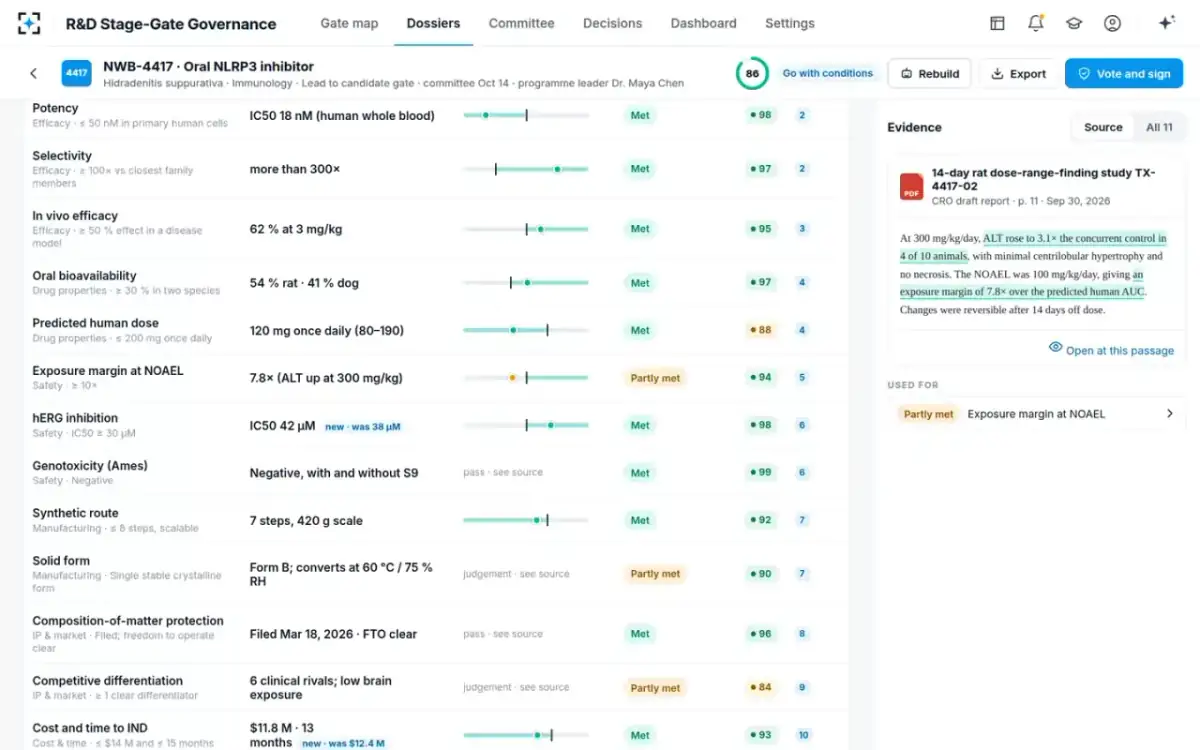
| Exposure margin at NOAEL | ≥ 10× | 5 · Toxicology report (14-day rat, draft) | 7.8×, with ALT raised at 300 mg/kg — partly met |
| hERG inhibition | IC50 ≥ 30 µM | 6 · Safety pharmacology report | 42 µM in the final report; the draft said 38 — met |
| Genotoxicity (Ames) | Negative | 6 · Safety pharmacology report | Negative with and without S9 — met |
| Synthetic route | ≤ 8 steps, scalable | 7 · Route and solid-form report | 7 steps at 420 g scale — met |
| Solid form | Single stable crystalline form | 7 · Route and solid-form report | Form B converts at 60 °C / 75% RH — partly met |
| Composition-of-matter protection | Filed; freedom to operate clear | 8 · Legal’s IP memo | Filed 18 March 2026, freedom to operate clear — met |
| Competitive differentiation | ≥ 1 clear differentiator | 9 · Competitive landscape assessment | Six clinical-stage rivals; low brain exposure — partly met |
| Cost and time to IND | ≤ $14 M and ≤ 15 months | 10 · Finance’s cost and timeline estimate | $11.8 M and 13 months — met |
Two things are worth noticing about the right-hand column. The three partly-met rows are not scattered — they are a safety number, a manufacturing risk and a commercial judgement, which is a different programme from one whose three gaps are all in safety. And the hERG row carries its own history: the final report moved the value from 38 to 42 µM after the committee papers had been drafted. A dossier that cannot show that movement is a dossier the committee has to take on trust.
Where the weight sits at lead to candidate
Lead-to-candidate template v4.2, 100% of the weight
- Efficacy · 20%
- Safety · 20%
- Target · 15%
- Drug properties · 15%
- Manufacturing · 10%
- IP & market · 10%
- Cost & time · 10%
Drug properties: the criteria that quietly decide the programme
Potency gets the attention and bioavailability decides the outcome. The drug-property criteria — solubility, permeability, clearance, bioavailability in two species, and the human dose predicted from them — are where a beautiful molecule turns into a tablet nobody can take, and they are also the criteria most often reported as a range rather than a number.
The predicted human dose is one of the most load-bearing values in the package, because almost everything else is expressed relative to it. The exposure margin compares an animal no-effect exposure with the exposure the predicted dose implies. The cost of the toxicology programme depends on the dose the studies have to cover. The formulation work depends on whether the dose fits one capsule. In the sample programme, 120 mg once daily with a range of 80 to 190 was marked met against a threshold of 200 mg once daily, with a confidence lower than any other met criterion — which is the honest way to carry a modelled number into a decision.
The safety criteria, and the one number that moves them
At nomination the safety evidence is thin by design: an in vitro cardiac assay, an in vitro genotoxicity screen, and a short dose-range-finding study in one species. The dimension nonetheless carries a fifth of the weight, because the study that the decision buys is the one most likely to stop the programme.
The number that moves the whole dimension is the exposure margin — the ratio between the exposure at the no-observed-adverse-effect level in the animal study and the exposure predicted in humans at the intended dose. In the sample programme it was 7.8-fold against a ten-fold threshold, derived from a 14-day rat study in which alanine aminotransferase rose to 3.1 times the concurrent control in four of ten animals at 300 mg/kg/day, with minimal centrilobular hypertrophy, no necrosis and reversibility after 14 days off dose. Every clause of that sentence is a reason the committee chose a condition rather than a refusal: the change was mild, explained and reversible, and a 28-day study can test whether it stays that way.
Alongside it sits the work that must be done before anyone is dosed. ICH M3(R2) is explicit that "the core battery of safety pharmacology studies includes the assessment of effects on cardiovascular, central nervous, and respiratory systems, and should generally be conducted before human exposure" (ICH M3(R2), section II). At nomination a committee is usually looking at one third of that — the cardiac part — and should say so rather than let a single in vitro result stand in for a battery it has not seen.
Fourteen criteria, each with its measured value, its mark, its confidence and its source
Manufacturing and IP: the two criteria chemists under-prepare
Research teams can arrive with the biology argued to a standstill and these two criteria, which often end up as conditions, half-written. Both are owned outside the programme team, which is part of the reason.
The solid form criterion asks whether one crystalline form has been shown to be the stable one across the conditions the material will see. In the sample programme the answer was no: form B converts at 60 °C and 75% relative humidity, a hot and humid stress condition the material could meet in storage or transport, so the committee signed a condition that a control strategy and clinical packaging be locked by a named date. A programme that reaches nomination without a form study has not reached nomination; it has reached an argument about whether to nominate.
The intellectual property criterion is usually read as a single question — is it filed? — when it is three: is composition of matter filed, with a date; is freedom to operate clear on a documented search; and is the filing broad enough to cover the form and the salt the programme is actually going to develop. The legal memo answers all three, and a committee that reads only the first sentence gets a surprise two years later. In the sample package the memo of 2 October gave a filing date of 18 March 2026 and a clear freedom-to-operate opinion.
How a value gets from a study page to a criterion
This is the mechanical part of the work, and the part that takes the fortnight. Someone reads a 90-page contract research report, finds the number a criterion needs, copies it with its units and species into a slide, and does it again for thirteen other criteria across nine more documents. Then a report is finalised and three of the numbers move.
Nine checks before a nomination package goes to the committee
- Every value carries its study, page and passage
A number a reader cannot trace is a number the committee has to take on trust, and the first question in the room will be about it.
- Units and species travel with the number
18 nM in human whole blood and 18 nM in a recombinant enzyme assay are not the same claim; a criterion that says "primary human cells" is only met by one of them.
- Drafts are marked as drafts
Contract research reports arrive in draft and change. Marking them is what makes the later change visible instead of embarrassing.
- Where two reports disagree, the newer final one wins — and the older is flagged
The sample package took 42 µM from the final safety pharmacology report over the draft’s 38 µM, and showed both.
- Predicted values are labelled, with their range
A predicted human dose of 120 mg with a range of 80 to 190 is a different input to a decision from a measured 120 mg.
- The criteria template version is recorded on the score
Scores from two different template versions are not comparable, and the comparison is usually made by someone who was not in the room.
- Every partly-met criterion has a proposed mitigation
The committee can reject or rewrite it, but arriving without one turns a decision meeting into a drafting session.
- The cost estimate is the latest approved version
Finance revises; a dossier quoting a superseded figure invites the one objection that cannot be answered in the room.
- Nothing in the package expresses a vote
The package recommends; it does not decide. A recommendation written as a conclusion makes dissent feel like obstruction.
In the solution this is what the six agents do, and the time it takes is visible: the sample dossier was rebuilt by six agents in a little over three minutes, with the two values that had changed since the previous build flagged beside their criteria and the score unchanged at 86. The point is not the speed. It is that a rebuild costs nothing, so the committee can read the current evidence rather than the evidence as it stood when the committee papers were frozen.
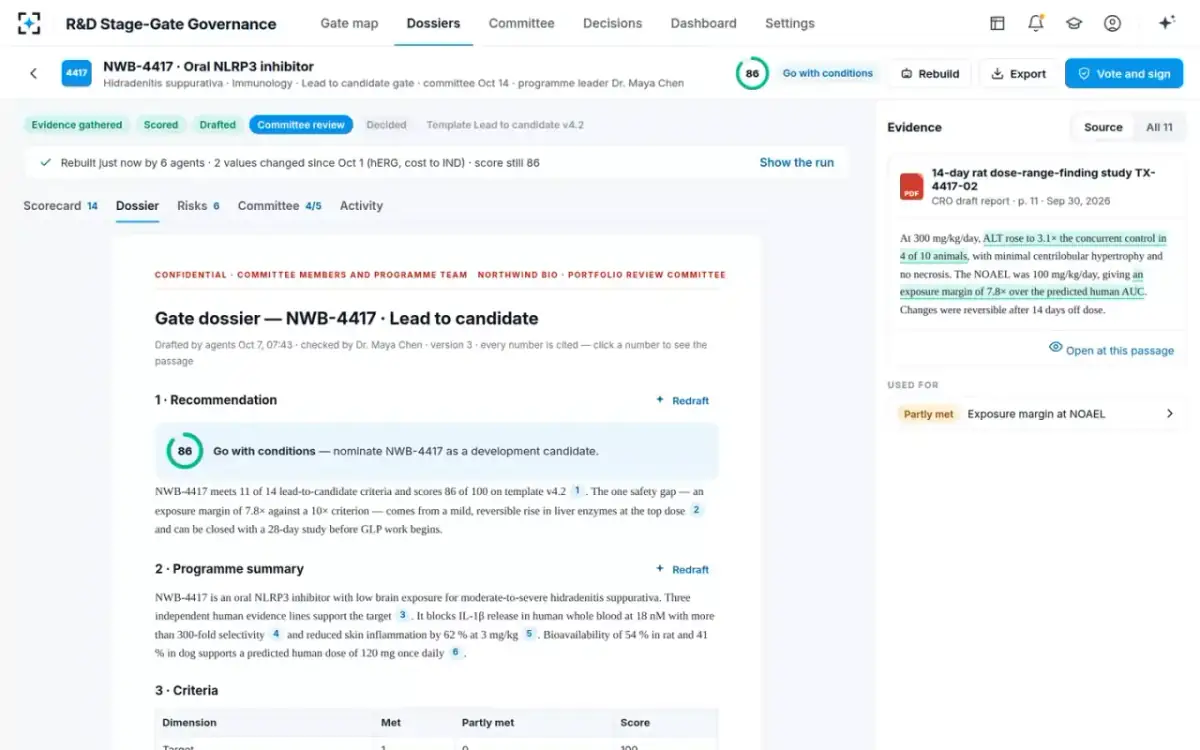
The six-section dossier the committee reads
The package is heading for one requirement. An IND must carry enough information from the animal and in vitro pharmacology and toxicology studies to support the sponsor’s conclusion that the proposed clinical investigations are reasonably safe to conduct (21 CFR 312.23(a)(8)). That conclusion is the destination of the whole package. Nomination is not the moment the sponsor draws that conclusion, but it is the moment it decides to go and get the evidence for it, and the evidence it buys is governed from the start: for each study subject to the good laboratory practice regulations, the application must state that the study complied with the part 58 good laboratory practice regulations, or briefly explain why it did not (21 CFR 312.23(a)(8)(iii)). A committee that signs a nomination is, among other things, committing the organisation to that paper trail.
What happens after nomination, and what the next stage-gate will ask
The decision releases the IND-enabling programme and starts a different kind of clock. The next package is regulated rather than internal: GLP repeat-dose toxicology in two species, the full in vitro and in vivo genotoxicity battery, the complete safety pharmacology core battery, toxicokinetics, a manufactured batch with its stability data, and a human starting dose derived from the no-effect level. Very little of it is new science; almost all of it is evidence of the quality the regulations require.
The committee's own conditions travel into that stage, which is the part teams underestimate. In the sample decision three conditions were signed with owners and dates — a 28-day rat study with a liver panel confirming an exposure margin of at least ten-fold before GLP work starts, a locked form B control strategy, and competitive differentiation re-tested at the next stage-gate — and the programme moved on the portfolio map with those conditions attached to its score. The candidate-to-IND review opens by asking what happened to them. The four stage-gates and what each one asks sets the sequence out, and what IND-enabling studies cost puts a figure on what this decision has just bought.
Questions people ask
What is a candidate nomination package?
The assembled evidence a committee reads to decide whether a molecule becomes a development candidate: the ten reports and memos listed above, plus the scored criteria, a risk register with mitigations, the cost and time to the next decision, and an explicit recommendation. Companies also call it a nomination dossier or a candidate drug document. Its quality is measured by one test — can a reader get from any number in the recommendation to the page it came from.
Who approves candidate nomination?
The portfolio review committee votes and one named person signs, usually the committee chair or head of research, because the decision commits budget. The programme leader prepares and presents the package but normally holds no vote on it. Who sits on the committee, and who decides works through the seats and the signature.
What criteria are used to select a development candidate?
Grouped into dimensions, they are: target confidence; efficacy, meaning potency, selectivity and an in vivo effect; drug properties, meaning bioavailability and a predicted human dose; safety, meaning the exposure margin at the no-effect level, cardiac risk and genotoxicity; manufacturing, meaning a scalable route and a stable solid form; intellectual property and market position; and cost and time to the next stage. The sample company's template uses fourteen criteria across those seven dimensions, each with a written threshold.
How long does it take to go from lead to candidate?
The optimisation itself commonly runs for a year or more, and varies with target class and modality far too much for an average to be useful. The part that can be measured and shortened is the preparation of the package itself: in the sample company's own estimate, assembling and maintaining a nomination dossier by hand took nineteen working days of a team's time, most of it spent collecting documents and re-checking values rather than analysing them.
What makes a good development candidate?
One whose weakest criterion is known, bounded and testable. A molecule meeting every criterion comfortably is rare; what distinguishes a candidate worth nominating is that its gap has a named cause, a measurable test and a study that will settle it before the expensive work starts — the sample programme's 7.8-fold margin, with a mild and reversible liver change and a 28-day study to confirm it, is the shape to look for.
Can a molecule be nominated with a criterion not met?
Yes, if the template says how. A criterion that misses its threshold but falls inside an explicit partly-met band, with a mitigation the committee accepts, is an ordinary go with conditions. What causes trouble is a threshold quietly reinterpreted in the meeting so that a miss becomes a pass — the one move that makes every later score unreadable. Criteria two reviewers score the same way is about preventing exactly that.