IND-enabling studies cost what the four choices made at the previous milestone commit you to: which second species, how long the repeated-dose studies run, by which route, and how much of the package has to be done under good laboratory practice. That is why the honest answer to "what do IND-enabling studies cost" is a method rather than a number — the package is specified by published guidance, but its price is set by a programme's own choices and by a market that does not publish. R&D Stage-Gate Governance is Botminds' solution for the decision that authorises the spend: six agents read a programme's study, manufacturing, IP and cost evidence, score it against the written criteria of the milestone, and put the money, the months and the risk-adjusted value in front of the committee cited to the estimate they came from.
This guide prices the whole candidate-to-first-filing package and the decision behind it, not an individual study; it takes the package's composition from ICH M3(R2) and the portfolio-level figures from peer-reviewed research, both linked where they appear. The programme figures are fictional sample data from the solution's demonstration portfolio at Northwind Bio.
The two numbers a board paper is read against
$1,395M
estimated average out-of-pocket cost per approved new compound, in 2013 dollars
$2,558M
the same figure capitalised to marketing approval at a 10.5% real discount rate
$11.8M
cost to a first-in-human filing for one sample programme, down from $12.4 M at the previous build
Put those side by side and the shape of the problem appears. The programme-level number a board paper carries is in the low tens of millions. The published cost of getting a compound approved is roughly a hundred to two hundred times larger, because the study tied the cost of every compound abandoned in testing to the cost of the compounds that were approved. Much of that money belongs to programmes that stopped. A committee authorising an IND-enabling package is therefore not mainly deciding how to spend $11.8 M; it is deciding which of its programmes will carry the cost of the ones that do not survive.
What 'IND-enabling' actually buys
It buys the right to ask a regulator for permission to dose a human being, and the evidence needed to defend the request. The regulation is explicit that the package is not a fixed list: the sponsor must provide adequate information from animal and in vitro studies on the basis of which it has concluded that the proposed trial is reasonably safe, and "the kind, duration, and scope of animal and other tests required varies with the duration and nature of the proposed clinical investigations".
Read that sentence as a budget instruction and it reorganises the whole question. The package is a function of the clinical trial it is meant to support. A single-ascending-dose study in healthy volunteers and a three-month trial in patients do not need the same package, and a programme that has not settled its first clinical protocol has not settled its IND-enabling budget either. Finance partners who are handed a package cost without the clinical plan beside it are being asked to approve an answer whose question is missing.
The package, study by study
Six families of work sit between a nominated candidate and a filing, and they overlap in time rather than queueing.
What sits between candidate nomination and a first-in-human filing
| Family | What it establishes | What drives its cost |
|---|---|---|
| Repeated-dose toxicity, two species | The no-observed-adverse-effect level and the exposure margin that sets the starting dose | Duration, the choice of second species, group sizes and the recovery arms |
| Safety pharmacology | Effects on the cardiovascular, respiratory and central nervous systems before first dosing | Whether the cardiovascular work runs in the same species as the toxicity study |
| Genotoxicity | Whether the compound damages DNA, by a standard battery | Largely fixed; the cost appears when a result is positive and follow-up is needed |
| Pharmacokinetics and toxicokinetics | Exposure in the toxicology species against predicted human exposure | Bioanalytical method development and validation, and the number of matrices |
| Manufacturing and the drug product | A batch made to the right standard, with a specification, a stability programme and a clinical form | Route length, scale, solid-form risk and how early the final form is fixed |
| The filing itself | The integrated summaries, the protocol and the investigator brochure | How much of the underlying data has to be re-tabulated for review |
Two of those lines carry costs that budgets routinely miss. The bioanalytical work is a prerequisite for the toxicokinetics, not a line item under it, and a method that will not validate in a second matrix delays the study that depends on it. And the regulation asks for more than conclusions: for each toxicology study intended primarily to support the safety of the proposed trial, the sponsor must provide the complete data in tables a reviewer can examine in detail. Producing that tabulation is work, and it is work that happens after the study everyone budgeted for has finished.
What studies are required before an IND?
Enough to support the specific trial proposed, with the repeated-dose toxicity work in two mammalian species as the structural backbone. ICH M3(R2) states the principle plainly: "In principle, the duration of the animal toxicity studies conducted in two mammalian species (one non-rodent) should be equal to or exceed the duration of the human clinical trials up to the maximum recommended duration of the repeated-dose toxicity studies (Table 1)."
That one sentence is among the most useful cost controls in the whole package, because it ties the length of the most expensive studies to a clinical decision the programme team controls. A trial of two weeks is supported by two-week studies. A trial that runs the same length as the studies is supported by studies of that length. Only trials longer than six months reach the ceiling.
The duration rule: what the clinical trial asks of the animal studies
| Maximum duration of the clinical trial | Minimum study duration, rodents | Minimum study duration, non-rodents |
|---|---|---|
| Up to 2 weeks | 2 weeks | 2 weeks |
| Between 2 weeks and 6 months | Same as the clinical trial | Same as the clinical trial |
| More than 6 months | 6 months | 9 months |
The footnote is where a schedule is often won. ICH allows that, in some circumstances, a trial longer than three months may start on the strength of three-month rodent and non-rodent studies, provided the complete chronic rodent and non-rodent data are available, under the local clinical trial procedures, before dosing in the trial runs past three months. That is permission to overlap the chronic study with the start of dosing rather than waiting for it — months of calendar, at the cost of a programme that has to be able to stop if the chronic data read out badly. Which is to say: it is a condition, and it belongs in the decision record as one.
The four choices that set the cost: species, duration, route and GLP
Species. The rodent is rarely the argument; the second species is. The choice follows from metabolism, target expression and tolerability, and it moves the cost of every study that uses it, the housing, the dosing effort and the ethical review.
Duration. Set by the clinical trial the package is meant to support, under the rule above. A programme that specifies a three-month trial when a one-month trial would answer the clinical question has bought itself three-month studies in two species.
Route. The non-clinical route should match the clinical one. An inhaled or parenteral programme carries formulation, device and local-tolerance work that an oral programme does not, and the comparison of two oral programmes' budgets tells you nothing about the third.
Good laboratory practice. Not every study in the package is a GLP study, and knowing which are is a real saving. The regulation requires, for each non-clinical laboratory study subject to the GLP regulations, a statement of compliance or a brief statement of the reason for non-compliance — the exploratory dose-range-finding work that precedes the definitive studies is usually not run to that standard, and the definitive toxicology is. Confusing the two inflates a budget in one direction and a filing's risk in the other.
Why the non-rodent study drives the package
Three structural reasons, all readable off the published rules rather than off a quote sheet. It is the longest study in the package for a chronic indication — nine months against six for the rodent, with the EU accepting six. It is the one that cannot be substituted: the two-species requirement names one non-rodent, so there is no cheaper equivalent to run instead. And it is on the critical path to the starting dose, because the no-observed-adverse-effect level from the most appropriate species is what the exposure margin is calculated against.
What we cannot tell you is the number. We found no government, academic or non-profit source that publishes what a non-rodent study costs; the figures that circulate tend to come from organisations that sell the studies. A finance partner should treat any single figure for an IND-enabling package the same way — as a quotation for one programme's choices, not a benchmark — and build the number from the programme's own four choices instead.
Minimum study duration the published rule sets, by the trial it supports
What drives the schedule, and what the schedule costs
The package's calendar is usually longer than the sum of its studies, for four reasons that are predictable enough to plan against: the batch of drug substance has to exist before the definitive studies start; the bioanalytical method has to be validated before the toxicokinetic samples can be read; the chronic study's histopathology arrives well after its in-life phase ends; and the integrated summaries and full data tabulations are written after everything else is finished.
Schedule is cost in two currencies. The direct one is the team held on the programme. The larger one is the option value of the money: every month a programme spends between milestones is a month that money is not in another programme. Scannell and colleagues measured the long-run version of that pressure: the number of new drugs approved per billion US dollars of research and development spending, they found, "has halved roughly every 9 years since 1950, falling around 80-fold in inflation-adjusted terms". An organisation inside that trend cannot fix it with procurement; it can only decide earlier and stop earlier.
The decision itself has a calendar too, and it is one of the few parts a portfolio office controls. In the sample portfolio a dossier takes about 19 working days to assemble by hand, and most of that is not analysis.
Where the working days go on one dossier, by hand and with the agents reading
By hand · about 19 working days (estimated)
- Chasing documents · 31.6%
- Pulling values in · 21.1%
- Writing the dossier · 26.3%
- Rating risks · 10.5%
- Re-checking changes · 10.5%
With R&D Stage-Gate Governance · about 2.6 days (estimated)
- Chasing documents · 19.2%
- Pulling values in · 7.7%
- Writing the dossier · 30.8%
- Rating risks · 15.4%
- Re-checking changes · 26.9%
Read the two rows as shapes rather than sizes. By hand, roughly half the effort is chasing documents and transcribing values into criteria — work that produces no judgement. On the second row the largest remaining shares are writing the dossier and re-checking values that changed — the parts that most deserve a person. Shortening the dossier does not make a decision better by itself; it makes the committee's calendar move, which is what lets a programme stop three weeks earlier.
How much of R&D spend goes on programmes that are abandoned?
A large share of it, under the accounting the published cost estimates use. The $1,395 M out-of-pocket figure per approved compound is an average that carries the failures: the costs of abandoned compounds were deliberately linked to the costs of those that were approved, because an organisation cannot buy an approval without buying the failures that preceded it. The capitalised figure of $2,558 M then adds the time cost of the money at a 10.5% real discount rate.
A second body of evidence sharpens the question from a different direction. In an analysis of past studies, Freedman, Cockburn and Simcoe put it this way: "Low reproducibility rates within life science research undermine cumulative knowledge production and contribute to both delays and costs of therapeutic drug development." Some of the money a portfolio spends is not buying a failed programme; it is buying a programme that was launched on a result that would not hold up. The practical response at a milestone is narrow and achievable: require that every value in the dossier opens onto the passage it came from, flag draft reports as draft, and prefer the newer final report when two disagree.
What a stage-gate decision is really worth
Not the cost of the studies it authorises. The money a decision moves is the difference between two futures: the programme proceeds and consumes the package and whatever follows, or it stops and that money goes somewhere else. At the moment of the decision that difference is far larger than the package, because what is being authorised is not one budget line but a position in a sequence.
The sample committee makes this arithmetic visible by putting all of it on one agenda: four decisions, $73.5 M asked if all four proceed, each with its cost to the next milestone, the months, the probability of reaching launch and the risk-adjusted value, cited to the latest approved finance estimate. The finance member's comment on the programme in question is the one that shows the real test being applied — the $11.8 M is already inside the plan for the year, so the question in the room is not affordability but whether this programme is the right occupant of that money.
The portfolio dashboard: days to a dossier, outcomes, and where programmes fall short
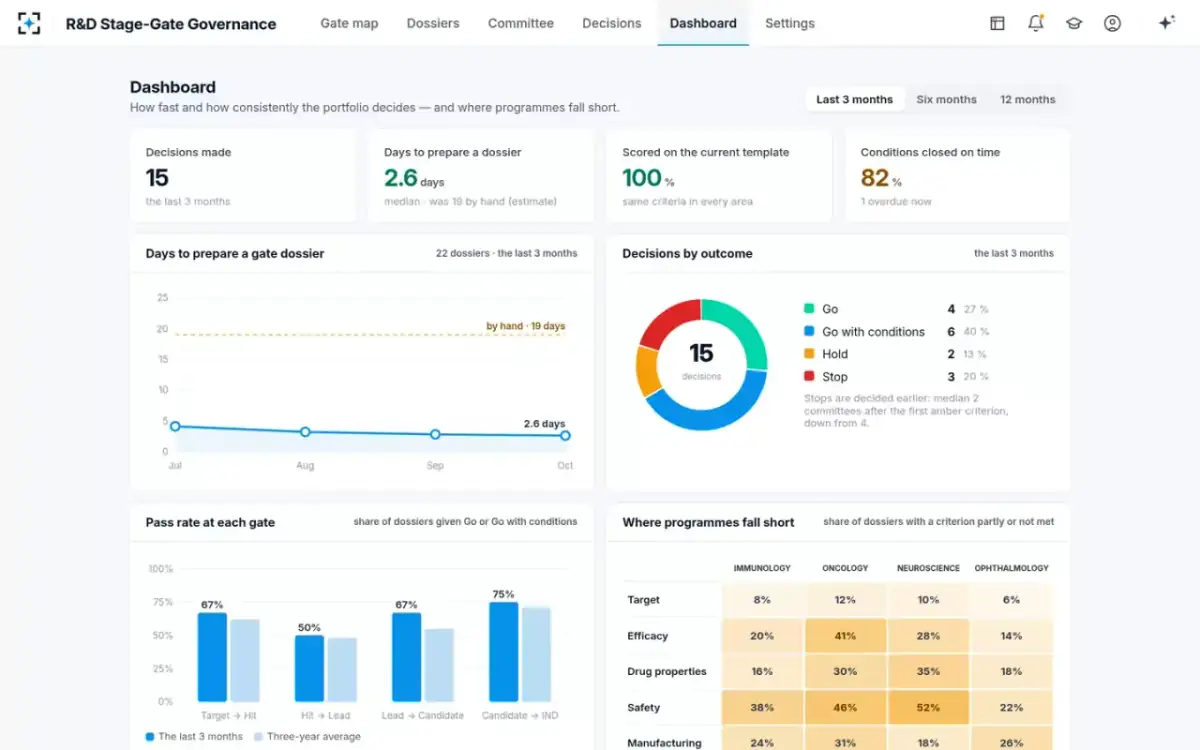
The cost of being wrong in each direction
A milestone can be wrong in two ways, and they are not symmetrical in visibility.
A false go is observable and expensive. The package is bought, the filing is made, and the programme fails for a reason that was legible in the evidence the committee had — an exposure margin that was never going to support the intended trial duration, a solid form that converts under storage conditions the clinical supply will meet, a differentiator that six rivals already claim. The cost is the package, the team's year and the position in the sequence.
A false stop is invisible and, in expectation, larger. A programme that would have worked is ended, and nobody ever learns it. Because the false stop leaves no evidence, organisations tend to over-weight the false go, which is one of the forces that keeps weak programmes alive. The only defence that survives contact with the room is a written criterion, a cited value and a condition with a date — which is the subject of how a committee says stop, hold or yes.
Both errors shrink for the same reason: the earlier the decision, the smaller the stake. A programme stopped at hit to lead costs a chemistry effort. The same programme stopped after the IND-enabling package costs the package and a year. This is why the composition of the previous milestone's criteria matters to a finance partner at all — it is the cheapest place to buy the information that would change the expensive decision.
How to build the number for a board paper
Build it from the programme's own choices, line by line, with the source of each number named. Eight lines are enough, and each one should be traceable to a document rather than to a conversation.
Eight lines for the board paper, and where each number comes from
- The clinical trial the package supports
Duration, population and route, from the draft first-in-human protocol. Every other line depends on this one; a package costed without it is costed against a guess.
- Repeated-dose toxicity, two species
Duration set by the rule above; the second species and group design from the programme's own plan. Name the species, not "non-rodent".
- Safety pharmacology and genotoxicity
Largely specified by guidance, so the variance is small — unless a genotoxicity result is positive, which is a named risk rather than a budget line.
- Bioanalysis and toxicokinetics
Method development and validation per matrix, before the studies that depend on them. Put the validation date on the schedule, not just the cost.
- Drug substance and drug product
The batch, the specification, the stability programme and the clinical form. Solid-form risk belongs here, with the control strategy that answers it.
- Writing and tabulating the filing
The integrated summaries and the full data tabulations the regulation asks for. This work starts when the studies end, so it is routinely left out of both the cost and the calendar.
- The calendar, with its four dependencies
Batch before studies, validated method before toxicokinetics, histopathology after in-life, summaries after everything. State the months as well as the money.
- What the decision is being compared against
The next programme in the queue and what the same money buys there. A paper with one option in it is asking for assent, not a decision.
Two sentences are worth adding under the table. The first names the estimate's version and date, because a cost that fell from $12.4 M to $11.8 M between two dossier builds is a different paper from one that did not. The second names what would make the number wrong — the conditions attached to the decision, with their owners and their dates, since a condition that fails is usually also a budget that changes. The questions to ask before buying portfolio software are largely about whether a tool can hold those two sentences.
The decision registry: outcome, signer, date and conditions closed
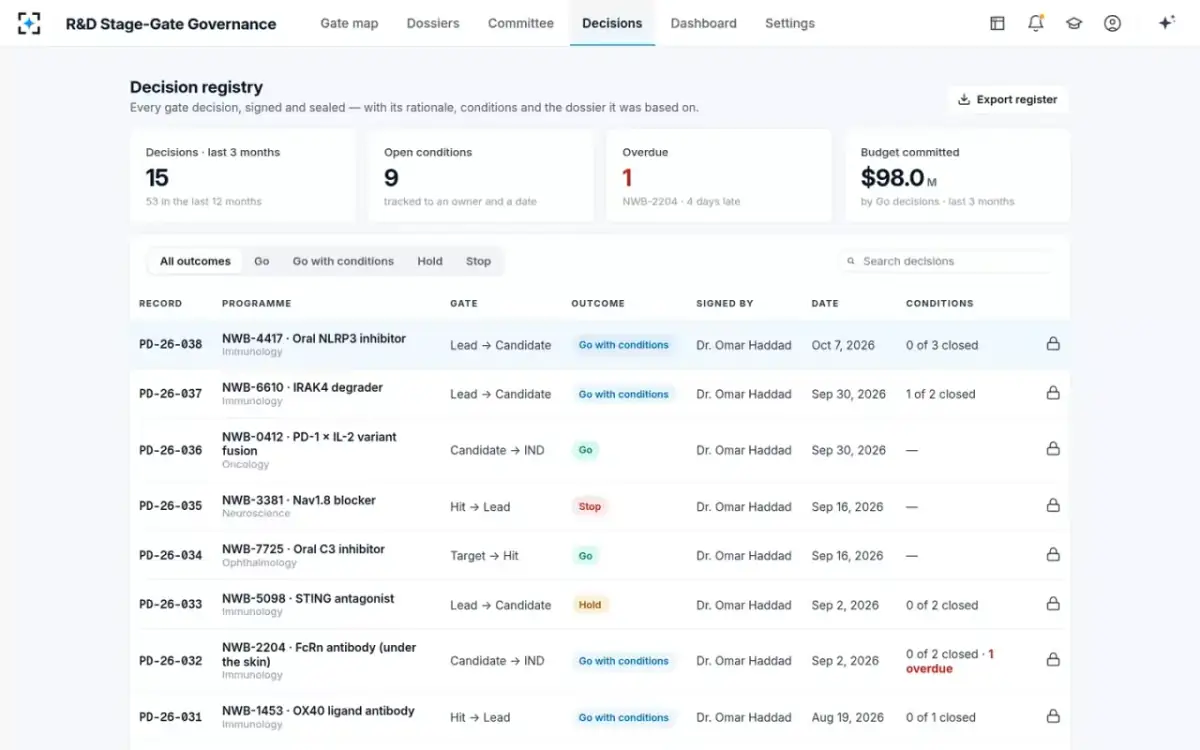
To see the cost, the months and the risk-adjusted value beside the evidence they rest on, start from R&D Stage-Gate Governance.
Three numbers a cost question is usually confused with
The package price
What one organisation would charge to run one programme's chosen studies. Specific to the species, duration, route and standard chosen. Not published by any independent source we found, and not a benchmark.
The programme's cost to the next milestone
The package plus manufacturing, bioanalysis, writing and the team. The number a board paper needs, and the one the sample programme reports as $11.8 M, down from $12.4 M.
The portfolio cost per approval
$1,395 M out-of-pocket, $2,558 M capitalised, in 2013 dollars — an average that already carries every abandoned compound. Useful for strategy, useless for a single budget line.
Questions people ask
How much do IND-enabling studies cost?
There is no honest single figure, and the figures that circulate tend to come from organisations selling the studies. The package's composition is set by ICH M3(R2) and the regulation that asks for information proportionate to the trial proposed; its price is set by four choices — the second species, the duration, the route and how much must be run to good laboratory practice. Build the number from those four and the programme's own manufacturing and bioanalytical plan, and name the version and date of the estimate.
How long do IND-enabling studies take?
Longer than the sum of the studies, because of four dependencies: the drug substance batch must exist before the definitive studies, the bioanalytical method must be validated before the toxicokinetic samples are read, the chronic study's histopathology arrives after its in-life phase, and the integrated summaries and full data tabulations are written last. The study durations themselves follow the clinical trial they support, up to six months in rodents and nine in non-rodents.
What drives the cost of a GLP toxicology package?
Duration and species, then the number of studies that genuinely have to be run to the good laboratory practice standard. Exploratory dose-range-finding work usually is not; the definitive studies are, and each one subject to those regulations needs a compliance statement, or a brief statement of why it was not compliant, in the filing. Budgets that treat the whole package as one standard are wrong in both directions.
Why are non-rodent studies more expensive?
Three structural reasons, before any quotation: for a chronic indication the non-rodent study is the longest in the package at nine months against six for the rodent, the two-species rule means there is no cheaper study to run instead, and it sits on the critical path because the exposure margin is calculated from the no-observed-adverse-effect level in the most appropriate species. We found no published price from a source a guide like this one may cite.
What is the cost of being wrong at the candidate milestone?
Asymmetric and mostly invisible. A false go costs the package, the team's year and the programme's place in the sequence, and it is observable. A false stop costs a drug that would have worked, and nobody ever learns it happened — so organisations tend to over-weight the first error. Both shrink the earlier the decision is taken, which is the argument for spending more on the evidence at the previous milestone.
How do you budget for an IND-enabling package?
Start from the first-in-human protocol, not from a template: the duration and nature of the proposed trial decide the duration and scope of the animal work. Then cost the six families — repeated-dose toxicity, safety pharmacology, genotoxicity, bioanalysis and toxicokinetics, drug substance and product, and the filing itself — and add the calendar with its four dependencies. Finish with what the same money buys in the next programme in the queue, which is the comparison the decision is actually between.