R&D portfolio management software is bought to answer a planning question — what is in the portfolio, what does it cost, when does it finish — and then asked to carry a decision: whether a programme passes its next milestone, on what evidence, and who signed for it. Those are different jobs, and a tool built for the first tends to do the second by accident. The questions that tell the two apart are almost all about evidence and signature rather than about charts, because a portfolio tool that cannot show where a number came from, or what a signature meant, is a presentation layer over the same spreadsheets you have now. R&D Stage-Gate Governance is Botminds' solution for the second job: six agents build each milestone's dossier from the programme's own documents with every value cited, and the committee's vote, conditions and signature are sealed into a record of the decision.
This guide is a buyer's checklist, not a comparison: it names what to ask and what an answer should look like, never who fails. The screens are the solution's own, on fictional sample data from a demonstration portfolio at Northwind Bio.
What a decision record has to hold, in the sample portfolio
4templates
one per milestone, each versioned, each with an owner who must approve a change
14criteria
at lead to candidate, across seven dimensions, each with a threshold and a partly-met band
1sealed record
per decision — and a correction becomes a new record that points at the old one
What R&D portfolio software should do, and what it only displays
Three jobs are genuinely different, and a product usually does one of them well.
Planning. What is in the portfolio, what each programme costs and when it finishes. Timelines, resource curves, scenario arithmetic. This is where much of the market lives, and it is genuinely useful work.
Reporting. What the portfolio looks like this quarter, by area, phase and spend. A reporting layer displays numbers that were decided elsewhere. The test is simple and unkind: ask where any number on the screen came from. If the answer is "it was entered", you are looking at a display.
Deciding. The evidence for one programme at one milestone, scored against written criteria, voted on, signed, and sealed with the conditions it carries. This is the job a research organisation cannot do in a spreadsheet, and the one a planning tool is not built for.
A buyer who needs the third and evaluates for the first will choose well and be disappointed in a year. The planning features will work. The first time a regulator, an auditor or a partner asks how a programme came to be nominated as a candidate, the system will produce a status history and no evidence.
Planning tool or record: the question underneath all the others
The distinction is not about features but about what the system is prepared to be held to later. A plan is a statement of intent that is expected to change. A record is a statement of what was true and what was decided, which is expected not to.
A planning tool and a decision record, row by row
A planning tool: Numbers are entered or imported, and the field holds the latest value.
A decision record: Every value comes from a document, and the document is part of the record.
A planning tool: Attachments sit beside the programme.
A decision record: A click on a number opens the passage it was read from, in the study, on the page.
A planning tool: A status moves to Approved, with the user and timestamp in a log.
A decision record: A signature with a printed name, a date and time, and a stated meaning, bound to the record.
A planning tool: Change history, sometimes, and usually editable by an administrator.
A decision record: A secure, time-stamped trail that does not obscure what was previously recorded.
A planning tool: The current configuration applies to everything, including last quarter.
A decision record: Each score carries the template version it was produced under; a dossier in committee keeps its version.
A planning tool: Inherited from the project or the folder.
A decision record: An access rule for the dossier itself, with a readable trail of who opened it and when.
A planning tool: Edit the field. The previous value is gone, or buried.
A decision record: A new record that points at the one it corrects, with the reason and the person responsible.
A planning tool: A spreadsheet of the current state.
A decision record: A complete, human-readable copy of the decision, its evidence and its signatures.
Twelve questions to ask, and the answer that should worry you
Ask these of a working system with a real programme in it, not of a slide. Eleven of them take under a minute each; the twelfth is the one that tells you what the implementation will actually be like.
Twelve questions for a selection, and the answers that should worry you
- Show me a number on a screen, then show me the page it came from
The whole evaluation in one request. Worrying answer: "we attach the source document." A link to a 180-page report is not evidence for a value.
- What did this score look like at the last build, and what changed?
Evidence moves between builds. Worrying answer: "the current figure is always shown." A number with no history cannot be reconciled with the committee papers that went out last week.
- Which version of the criteria was this programme scored on?
Two totals are only comparable within one version. Worrying answer: "the criteria are configurable" — that is a yes to the wrong question.
- Who can change a threshold, and what happens to dossiers already in committee?
Worrying answer: "an administrator can update it at any time." A threshold that can move during a vote is not a threshold.
- Record a decision now, and show me what the signature means
Worrying answer: a status field that changes to Approved. A signature has a name, a time and a stated meaning, and all three have to be in the record.
- Show me the audit trail for a value that was corrected
Worrying answer: the corrected value, with no trace of the original. Record changes must not obscure what was previously recorded.
- Produce a complete, human-readable copy of one decision for an inspector
Worrying answer: a screen, or a spreadsheet export of the current state. The requirement is a complete and accurate copy, readable without the system.
- Who can open this dossier, and how do I prove that later?
Worrying answer: "it inherits project permissions." A market-sensitive dossier needs an access rule of its own and a trail of who read it.
- What happens when a report is superseded after the committee papers have gone out?
Worrying answer: "the team re-uploads it." Ask whether the dossier rebuilds, what gets flagged, and who is told.
- How does a condition get from the meeting to a person with a date?
Worrying answer: minutes, or a task in a separate tracker. Ask to see an overdue condition appear beside the programme it belongs to.
- What do you do when two source documents disagree?
Worrying answer: silence, or "the latest upload wins." The rule should be stated — newer final report, older one flagged, drafts marked as drafts.
- What would you need from us to run this on three of our past decisions?
Worrying answer: a long discovery phase. The honest answer names your criteria, your governance calendar and a sample of past dossiers with their evidence.
Two habits make the list sharper. Ask for the demonstration on your own evidence — a real toxicology report with a real exposure margin in it — because a sample dataset has been shaped to answer these questions. And ask the sixth and seventh of someone who will have to live with the answer: a quality or compliance colleague will hear a difference in the reply to "show me the audit trail" that a research leader will not.
Does portfolio management software need to be 21 CFR Part 11 compliant?
It depends on what the record is used for, and the honest answer is that the question is usually asked too narrowly. Part 11 applies to electronic records that are created, modified, maintained or transmitted under a predicate rule — records a regulation requires. A research portfolio tool that only plans is not obviously in scope. One that holds the evaluation and the conclusion that a trial is reasonably safe to begin, or that holds signatures the organisation relies on for its own quality system, is heading there.
The useful move for a buyer is to stop treating this as a yes-or-no compliance question and start treating the clauses as a product specification. Each one generates a concrete question that a demonstration can answer, whether or not the system is formally in scope.
The Part 11 clauses that bite in this use, and the question each one generates
| Clause | What it requires | The question to ask in a demonstration |
|---|---|---|
| 11.10(b) | "The ability to generate accurate and complete copies of records in both human readable and electronic form suitable for inspection, review, and copying by the agency." | Export one decision as a human-readable document. Does it carry the evidence and the signatures, or only the outcome? |
| 11.10(c) | "Protection of records to enable their accurate and ready retrieval throughout the records retention period." | Retrieve a decision from three years ago, with the template version it was scored on. How long is the retention, and who sets it? |
| 11.10(e) | "Use of secure, computer-generated, time-stamped audit trails … Record changes shall not obscure previously recorded information." | Correct a value, then show me what it was before. Can an administrator remove that trail? |
| 11.10(g) | "Use of authority checks to ensure that only authorized individuals can use the system, electronically sign a record, access the operation or computer system input or output device, alter a record, or perform the operation at hand." | Who may sign at each milestone, and who may alter a criteria template? Show me the check failing. |
| 11.50 | A signed record must show the printed name of the signer, the date and time of signing, and the meaning associated with the signature. | Sign a decision. Does the record say what the signature meant, in the signer’s own words? |
| 11.70 | Signatures must be linked to their records so they cannot be excised, copied or transferred to falsify a record by ordinary means. | What stops a signature being carried onto a later version of the dossier? |
Evidence: can it show where every number came from?
This is the question that sorts the market fastest, and it has a precise form. Not "can I attach the report" — every system can attach a report. The question is whether a specific number on a specific screen points at the specific passage it was read from.
The difference is practical. A committee member who distrusts an exposure margin and is handed a 180-page report will not read it; they will ask the programme leader, who will tell them what it says. A committee member who clicks the number and lands on page 11, where the finding, the no-observed-adverse-effect level and the margin are stated, forms their own view in a few seconds. The first system generates meetings; the second generates decisions.
Three follow-up questions separate real citation from a link: does the citation survive a rebuild when the document is replaced; is a draft report marked as a draft wherever its values appear; and when two documents disagree, what does the system do? In this solution the rule is stated rather than inferred — the newer final report is used, the older one is flagged, and what the agents may and may not assert is written down as a limit rather than described as a capability.
Signature: can it record what a signature meant?
Many systems record that someone approved something. Fewer record what they meant by approving it, and the distinction matters more in a research portfolio than almost anywhere else, because several different people sign for different things at the same milestone.
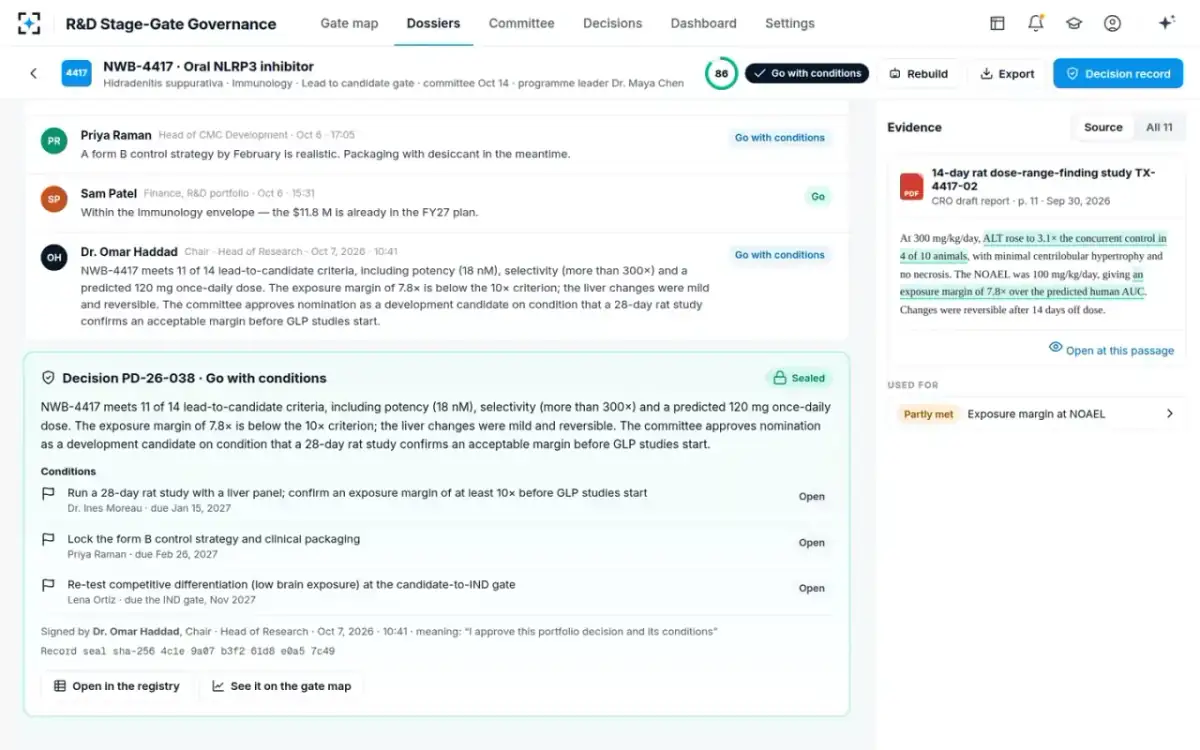
In the sample portfolio the chair signs lead-to-candidate decisions in full review, and at the candidate-to-IND milestone finance co-signs the budget. Those are not the same act, and a record that flattens both into Approved has lost the part a reader will care about in two years. The regulation's own language is the right specification to buy against: a signed record must carry the printed name, the date and time, and the meaning of the signature — review, approval, responsibility or authorship, in the rule’s own examples — and all three items fall under the same controls as the electronic record itself and must appear in any human-readable form of it, on screen or on paper. The second half is the one buyers forget: the meaning has to appear on the printout, not only in a database.
A sealed decision: rationale, conditions, signer and the meaning of the signature
The audit trail, and what 'record changes shall not obscure' rules out
One short clause in the regulation does a great deal of work: a change to a record must not obscure what was recorded before it. Read as a product requirement, that clause rules out three things a buyer should check for directly.
It rules out an in-place edit that leaves the previous value unrecoverable. It rules out an audit trail an administrator can prune — the trail has to be retained at least as long as the record it describes, and be available for review. And it rules out a correction that silently replaces a decision: in this solution a correction becomes a new record that points at the old one, which is the same discipline the good-laboratory-practice rules apply to a final study report amended after issue.
The cheapest way to test it is to break something during the demonstration. Change a value, change a threshold, change your mind about a vote, and then ask the system to show you the state before. A product that handles all three gracefully has been built by people who expected to be audited.
Criteria templates: who owns a threshold, and what happens to a dossier mid-vote
A criteria template is configuration in the way that a chart of accounts is configuration: technically a setting, practically the rulebook. Two questions matter more than how flexible it is.
Who may change a threshold? "An administrator" is the wrong answer; a named template owner whose approval is required is the right one. A threshold that any administrator can edit is not a rule the organisation can rely on having applied.
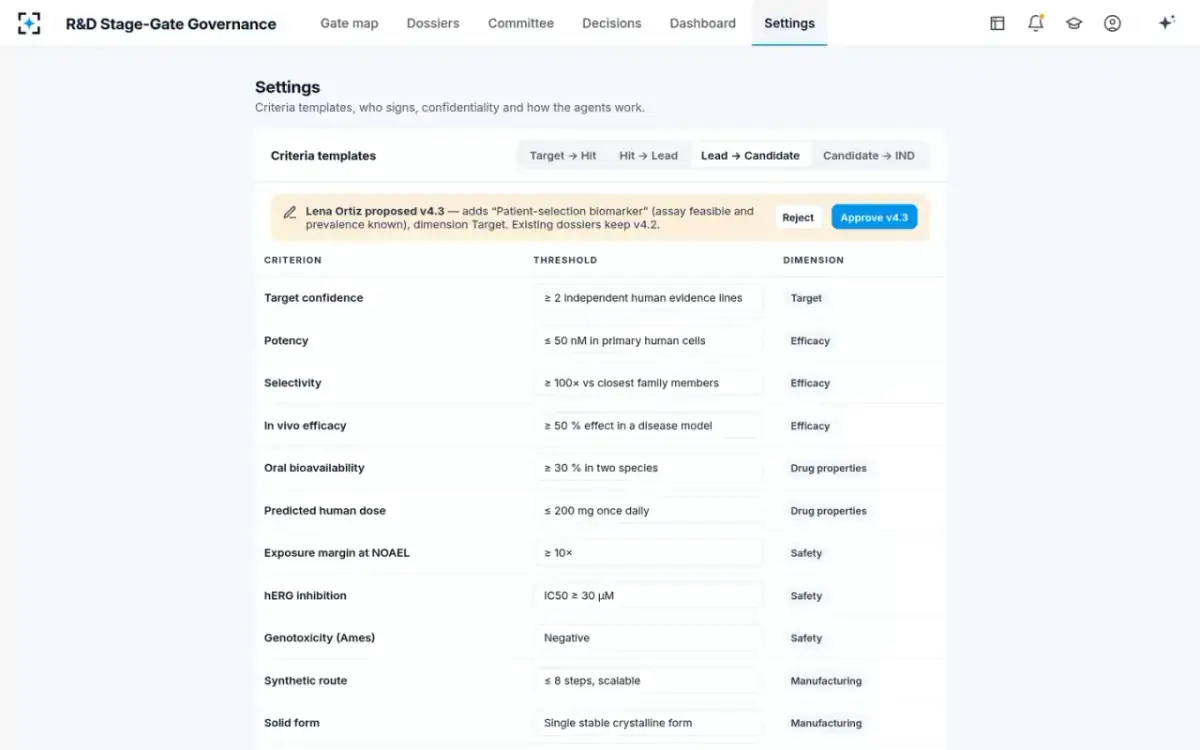
And what happens to a dossier already in committee when a template changes? The only safe answer is that it keeps the version its votes were cast on. Anything else means a member who voted on Tuesday voted on different criteria from a member who votes on Thursday, which quietly voids the decision. In the sample settings a proposed new version sits beside the one in force, awaiting approval — which is the only honest way to hold both at once, and the mechanism that makes two scores comparable at all.
Settings: a template per milestone, and a proposed version awaiting approval
Confidentiality: market-sensitive dossiers and who can open one
Research portfolio material is price-sensitive in a way most project data is not. A dossier naming a candidate, its cost to the next milestone and its probability of reaching launch is exactly the kind of information that creates obligations for a listed company and for its partners.
Four questions follow, and they are rarely on a standard evaluation template. Who can open a dossier — is the default the committee and the programme team, or everyone with a project licence? Does an export carry the reader's name and the time on every page? Can an export leave the company by email, and if not, what stops it? And is there a readable trail of who opened what, covering agents as well as people?
The last of those is worth insisting on. A system that logs human access but not automated access has an incomplete answer to the only question that gets asked after an incident, which is who saw this and when.
Can portfolio software replace the committee?
No, and a vendor who implies otherwise has misunderstood what is being bought. The committee exists to take an accountable decision under uncertainty; software can make that decision better informed, faster to prepare and far easier to reconstruct afterwards, and it cannot take it.
What software can legitimately remove is the preparation: the chasing of ten documents from six functions, the transcription of values into criteria, the formatting of slides. In the sample portfolio that is the difference between about nineteen working days of dossier preparation and a design target of a median of 2.6 days. The committee's own work — reading, questioning, trading off, setting conditions and signing — is not shortened, and should not be.
A reasonable scepticism applies to claims about the AI inside these products, too. The FDA's January 2025 draft guidance on artificial intelligence supporting regulatory decision-making — a draft, issued for comment and not for implementation — takes a deliberately neutral position on technique: "This guidance does not endorse the use of any specific AI approach or technique." A buyer can borrow that posture. What matters is not the architecture but what the output is credible for, in a stated role, with evidence to support it.
What you have to bring, and how to pilot it on decisions you already took
Three things, and gathering them is useful even if no purchase follows. Your criteria for each milestone, written as thresholds with partly-met bands rather than as headings. Your governance calendar: who sits on the committee, who signs what, and when it meets. And a sample of past dossiers with the evidence behind them — the study reports, the manufacturing and legal memos, the competitive brief and the finance estimate, as they actually existed at the time.
That third item is what makes a pilot meaningful, because it lets you run the system against decisions whose outcome you already know.
A pilot on decisions you have already taken
What to load
Three past milestone decisions with every document that existed at the time, and the criteria template in force then. Include one decision that was contentious and one that was later regretted.
What to compare
Extracted values against the values your team recorded. Criteria judgements against the ones the committee accepted. Drafted conditions against the ones actually signed. Count the disagreements and read each one.
What counts as a pass
Every value traceable to a passage; the extraction disagreements explainable; and at least one place where the system surfaced something the original dossier missed. A pilot with no disagreements has been run on too easy a case.
What to watch for
Whether the template turns out to be written loosely enough that two careful people score it differently. That is a finding about your criteria, not about the software, and it is usually the most valuable output of the exercise.
The registry: every decision, its outcome, signer, date and conditions closed
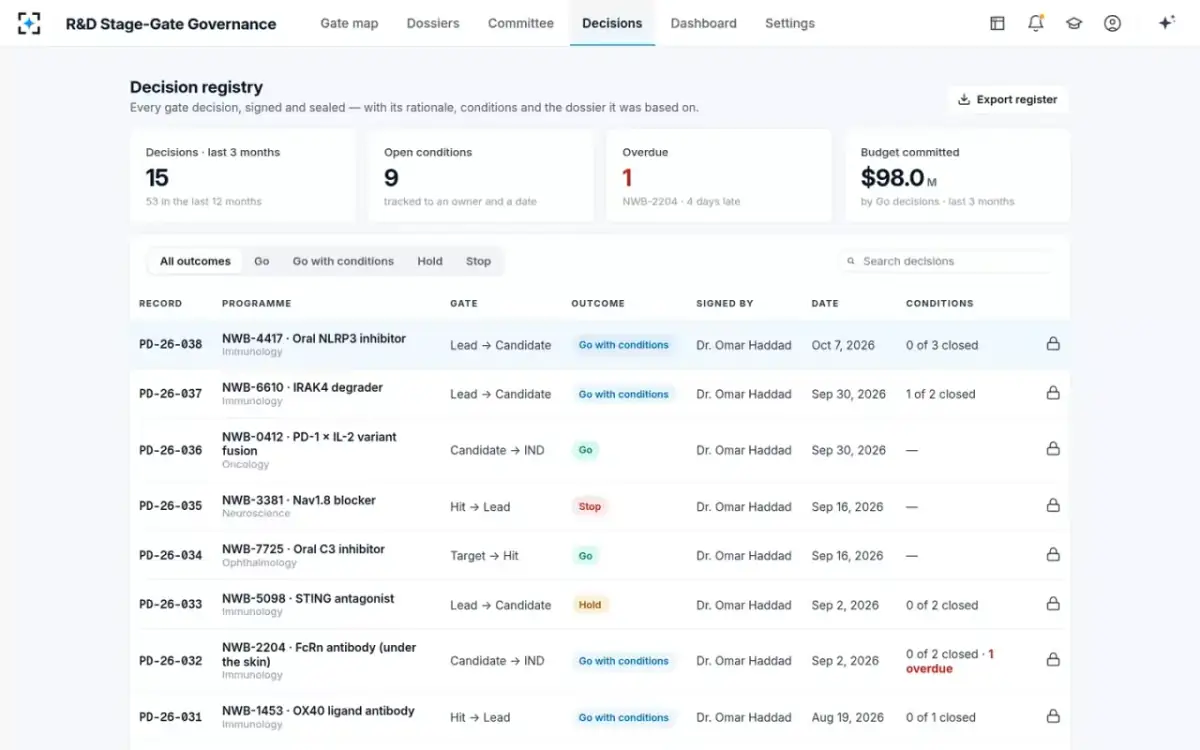
One last question, which is not on the list because it is for your own side of the table: what will you do with the registry after a year? An organisation that keeps every decision with the evidence it rested on, the conditions it set and whether they closed can test its own judgement — which is the only durable return on buying a record rather than a display. To see the evidence, the criteria, the conditions and the sealed records on one portfolio, start from R&D Stage-Gate Governance, or read how a committee says stop, hold or yes.
Questions people ask
What is R&D portfolio management software?
A system that holds the research portfolio — the programmes, their costs, their timing and their decisions. In practice the market splits into tools that plan, tools that report and tools that hold a decision record. A research organisation facing milestone reviews needs the third, and the features that distinguish it are evidence, versioned criteria, signature meaning and an audit trail rather than charts.
How do you evaluate R&D portfolio tools?
On a working system with real evidence in it, using a short list of questions whose answers are watchable: show me a number and the page it came from; show me what this score looked like at the last build; correct a value and show me what it was before; sign a decision and show me what the signature meant. Bring a compliance colleague for the audit-trail answers, because the difference between a good one and a plausible one is audible to them.
What data does portfolio management software need?
Your criteria for each milestone written as thresholds with partly-met bands, your governance calendar of who signs what and when the committee meets, and the documents a decision actually rests on — study, manufacturing and legal reports, the competitive brief and the finance estimate. Gathering those three is worthwhile on its own: many organisations discover their criteria are headings rather than thresholds.
Can portfolio software replace the committee?
No. It can remove the preparation — chasing documents from six functions, transcribing values into criteria, formatting slides — which in the sample portfolio is the difference between about nineteen working days and a design target of 2.6. The reading, the trade-offs, the conditions and the signature stay with the people who are accountable for them, and any product that implies otherwise is answering a different question.
How do you pilot portfolio management software?
On three decisions you have already taken, with the documents as they existed at the time and the criteria version in force then — including one contentious decision and one later regretted. Compare extracted values with what your team recorded, criteria judgements with what the committee accepted, and drafted conditions with what was signed. A pilot that produces no disagreements was run on too easy a case.
How do you know it worked?
Three measures, none of them a feature count. The time from the last piece of evidence arriving to the dossier being ready. The share of committee questions that are answered by opening a cited passage rather than by asking the programme leader. And, after a year, whether the registry of sealed decisions can tell you how many conditions closed on time — because that is the number that says whether the governance actually changed.