A stage-gate review is the meeting at which a research programme is tested against criteria written before its evidence existed, and a committee chooses one of four outcomes: go, go with conditions, hold or stop. In drug R&D a programme meets four of them before a molecule is ever given to a person — target to hit, hit to lead, lead to candidate, and candidate to IND — and they are not four versions of one meeting. Each asks a different question, because what can be known by then is different: a target assessment and a screening plan at the first, a four-week study in two species and a proposed human starting dose at the last. The difficulty is rarely the hour in the room. It is the weeks a programme team spends — nineteen working days in the sample company's own estimate — pulling ten documents out of six functions and turning them into a dossier. R&D Stage-Gate Governance is Botminds' agentic solution for that work: agents read the programme's own evidence, score it against the stage-gate's criteria with every value cited to the page it came from, and draft the dossier, the risks and the conditions the committee will debate.
The worked example on this page is a fictional sample portfolio inside the solution: Northwind Bio, twelve research programmes, and one of them — NWB-4417, an oral NLRP3 inhibitor for hidradenitis suppurativa — at the lead-to-candidate stage-gate. The company, the people, the programmes and the studies are invented. The regulatory requirements quoted are not; they are linked where they appear.
What a research organisation decides four times before first-in-human
4
stage-gates between a target and an IND application: target to hit, hit to lead, lead to candidate, candidate to IND
10
documents behind one lead-to-candidate dossier, from six functions
2–4weeks
to build that dossier by hand, and to keep it current until the meeting
common practice
4
outcomes open to the committee: go, go with conditions, hold, stop
What a stage-gate review is, in one paragraph
It is a decision point, not a report. The vocabulary comes from industrial product development, where a project moves through stages of work separated by points at which someone with budget authority decides whether the next stage happens. Research borrowed the shape and kept the hard part: the criteria are agreed in advance, the evidence is assembled against them, and the committee's job is to compare the two and decide. A meeting that discovers its criteria while reading the slides is a status update with a vote attached — it can approve spending, but it cannot tell anyone later why the spending was approved.
Three words get used loosely and are worth separating. A stage is the work: lead optimisation, say, or the IND-enabling programme. A stage-gate is the decision that opens the next stage and pays for it. Thedossier is the evidence package the decision is taken on. Teams argue about the first and the third and rarely design the second, which is where the value is: the criteria, the thresholds, the bands between pass and fail, and the names of the people who may sign.
The four stage-gates in drug research, and the question each one asks
Company names for the four differ — nomination, selection, declaration, candidate drug — but the sequence is stable, because each one is defined by a body of evidence that does not exist until the stage before it is finished. The table below is the shape used by the sample portfolio, with the dimension families each stage-gate scores and the seat that signs.
Four stage-gates, four questions, four different bodies of evidence
| Stage-gate | The question it asks | What it can read | Who signs |
|---|---|---|---|
| Target to hit | Is this target worth a screening campaign, and can we find starting matter for it? | Target assessment: human genetic and biological evidence, tractability, the safety of modulating the target, the patent position, who else is working on it. | Committee chair, on the therapeutic-area head’s recommendation |
| Hit to lead | Does one of these chemical series deserve a full optimisation team? | Confirmed hits with dose responses, the structure–activity relationship across a series, first solubility, permeability and metabolic stability, early safety flags. | Committee chair |
| Lead to candidate | Is this exact molecule worth the IND-enabling spend? | Potency and selectivity in human cells, efficacy in a disease model, a predicted human dose, non-GLP toxicology, solid form and route, the filed patent, cost and time to IND. | Committee chair, full review |
| Candidate to IND | Is the package complete, and is the first dose in a human being defensible? | GLP repeat-dose toxicology in two species, the safety pharmacology core battery, genotoxicity, toxicokinetics, a GMP batch, the NOAEL and the starting dose derived from it. | Committee chair, with finance co-signing the budget |
Read the third column downwards and the point of the series appears. The first stage-gate decides on arguments about biology and competition, and almost nothing about a molecule. The second decides on a series, not a compound. The third is the first time a single structure is in the room with a number attached to every property that will later matter. The fourth decides almost nothing new about efficacy and almost everything about safety. A company that runs all four with one criteria template is scoring four different questions on one answer sheet.
Why a stage-gate is a decision, not a status update
The difference is visible in the artefacts. A status review produces minutes; a stage-gate review produces a record that says what was decided, on what evidence, by whom, and what has to be true for the decision to hold. The second is the one anyone will look for in two years, when the question is why a programme that failed in the clinic was nominated at all, or why the one that worked was nearly stopped.
The same hour, run two ways
A programme status review: Each function presents what it has been doing. The order is the organisation chart.
A stage-gate decision: One programme, one question: does it pass this stage-gate’s criteria, and what does it owe if it does?
A programme status review: Implicit. They emerge in discussion, and the strongest presenter sets them.
A stage-gate decision: Written and versioned before the evidence arrived. Nobody may change a threshold inside the meeting.
A programme status review: Slides. A number on a slide has no page behind it, and a corrected number does not travel.
A stage-gate decision: The study, the page, the passage. A value that changed since the last build is flagged beside the criterion.
A programme status review: Agreement to continue, usually unrecorded, sometimes unnoticed by finance.
A stage-gate decision: One of four: go, go with conditions, hold, stop — with the budget it releases named.
A programme status review: Minutes, and a set of actions that fade.
A stage-gate decision: A signed decision with its rationale, its conditions, their owners and their dates.
There is one place where the distinction stops being a matter of taste. The last stage-gate hands its conclusion to a regulator. An IND has to carry the sponsor's own conclusion that it is reasonably safe to begin, and the identity and qualifications of the people who reached it. A decision made the second way already has that sentence and those names; a decision made the first way has to reconstruct them from memory months later.
What evidence each stage-gate can actually draw on
Evidence arrives in a fixed order, and the order is what makes the four stage-gates different. Human genetic support for a target can be argued at the first stage-gate and barely changes afterwards. Potency in a human cell assay cannot exist before a series does. An exposure margin cannot exist before an animal study has produced a no-observed-adverse-effect level, and that study is itself part of what the third stage-gate pays for.
When the evidence arrives, and where the four decisions sit against it
- Target validation18 mo
- Hit finding9 mo
- Hit to lead12 mo
- Lead optimisation15 mo
- IND-enabling12 mo
- Target case, no moleculestage-gate 1
- Confirmed hits, a seriesstage-gate 2
- One structure, predicted dosestage-gate 3
- GLP package and a NOAELstage-gate 4
This is also why borrowing the last stage-gate's rigour for the first one fails. At target to hit there is no exposure margin to measure, so a committee that insists on numbers will get numbers that mean nothing: a tractability score invented to fill a cell. The honest criteria at that stage are counts of independent evidence lines and explicit statements of what is unknown. In the sample company's own template, the first criterion of the lead-to-candidate stage-gate is still of that kind — target confidence, with a threshold of at least two independent human evidence lines — and the thirteen that follow are measurements.
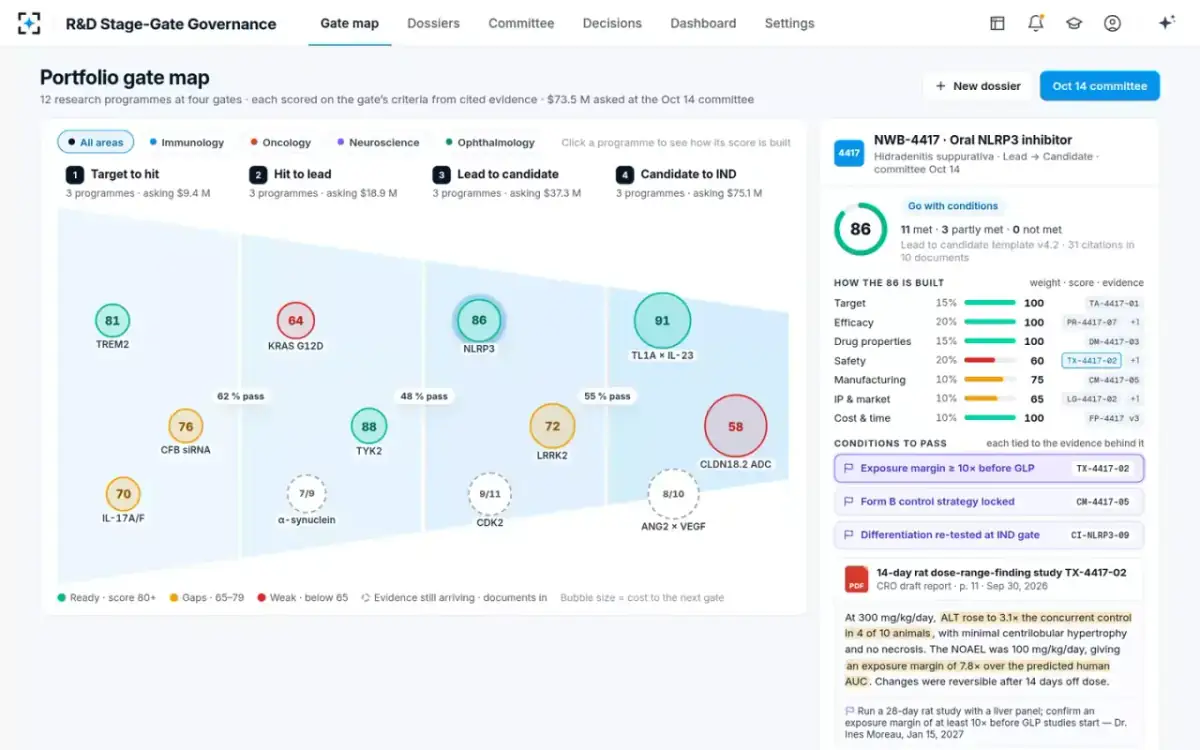
Twelve programmes at four stage-gates, on the portfolio map in R&D Stage-Gate Governance
Who runs a stage-gate review, and who owns the decision?
A portfolio review committee runs it, and one named person signs it. In the sample company the committee has five seats — the head of research as chair, a portfolio governance lead as secretary, the programme leader presenting, the head of nonclinical safety, and R&D finance — and the chair signs a lead-to-candidate decision, with finance co-signing when the decision commits an IND budget. The separation that matters is the one between preparing the evidence and voting on it: the programme leader who assembled the package should not be the person who marks it. Who sits on an R&D portfolio review committee takes the seats, the votes and the signature one at a time.
The therapeutic-area head is the awkward seat. They know the science best and have the strongest interest in the answer, which is an argument for their voice and against their vote. Many committees resolve it by letting them advise and recuse, and by recording in the minutes that they did.
What happens at a stage-gate review meeting?
The meeting is short because the reading happened before it. In the sample company the dossiers build ten days ahead, the committee papers go out a week before, and the screen the secretary watches counts what has actually been read: seven days out, four decisions on the agenda, thirteen of twenty votes already cast and eighteen of twenty pre-reads opened, with $73.5 million of budget asked if all four items go ahead. The number that predicts a bad meeting is the pre-read count, not the agenda length.
In the room, each item follows the same five steps. The programme leader presents the recommendation and the gap, in about ten minutes. The committee questions the evidence — and the test of a good dossier is that a question about a number ends by opening the study page rather than by an action to check. Members mark the criteria that are contested rather than all fourteen. The chair collects votes, and where the outcome is go with conditions, the committee agrees each condition's wording, owner and due date. Then the chair signs, and the decision is sealed with its rationale and its conditions attached.
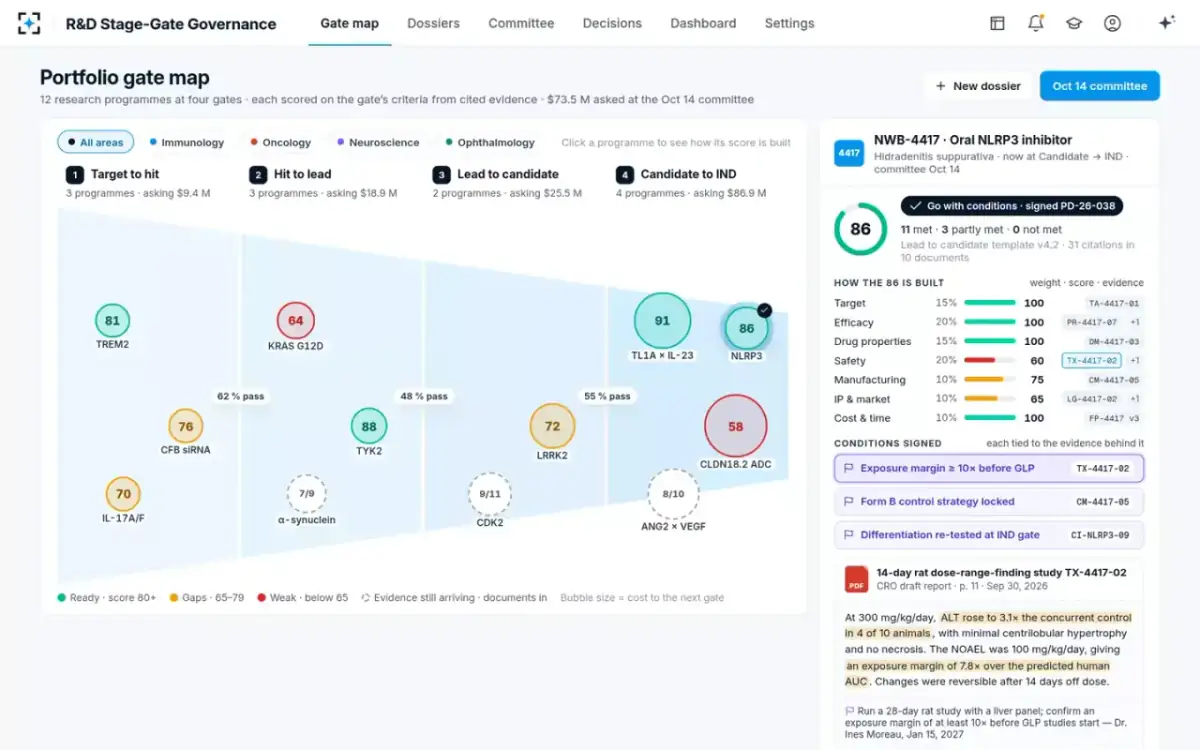
Between meetings, the same material moves by written procedure. In the sample decision all five votes were in before the meeting date: three members voted go with conditions, one voted go, and the chair's signature completed five of five, so the decision was taken by written procedure and noted at the 14 October committee rather than debated again.
The four outcomes: go, go with conditions, hold, stop
Four outcomes is the useful number. Two — approve or reject — forces every difficult programme into an approval with private reservations, which is how a condition becomes a verbal understanding and then nothing at all.
Go proceeds to the next stage and releases the budget named in the dossier. Go with conditionsdoes the same, and attaches measurable, dated obligations whose owners are named; it is the right answer when the gap is real, bounded and closable before the money is spent. Hold leaves the programme where it is, usually with a defined piece of work and a date to return — in the sample portfolio a hit-to-lead programme with one series and poor drug properties was held, with a six-month chemistry sprint proposed as the alternative to a plain hold. Stop ends it and releases the budget to the rest of the portfolio, which is the outcome a committee has to be able to reach for the other three to mean anything; how a committee says stop, hold or yes is its own discipline.
In the sample decision, the committee chose go with conditions on a score of 86 out of 100 with eleven of fourteen criteria met and three partly met. The three conditions were specific: a 28-day rat study with a liver panel, confirming an exposure margin of at least ten-fold before GLP work starts, owned by the head of nonclinical safety and due 15 January 2027; a locked form B control strategy and clinical packaging, owned by CMC development, due 26 February 2027; and competitive differentiation re-tested at the next stage-gate. Each has a name and a date, so an overdue one shows on the portfolio map rather than in last month's minutes.
After the signature: the programme moves, and its conditions travel with it
What a stage-gate dossier contains, section by section
A dossier that a committee can read in ten minutes has six sections, in this order. Recommendation — the outcome the evidence supports and the single gap against it, in a paragraph. Programme summary — what the molecule is, what it does and for whom. Criteria — every criterion with its threshold, its measured value, its mark and the document behind it. Risks and mitigations — each risk rated for likelihood and impact, with an owner. Cost and value — what the next stage costs, how long it takes and what the programme is worth risk-adjusted. Decision requested — the sentence the committee is being asked to agree.
The discipline that makes it short is citation. In the sample dossier every number is a link to the passage it came from, so the recommendation can state that the exposure margin is 7.8-fold against a ten-fold criterion and a reader who doubts it opens page 11 of the study rather than asking for a follow-up. The ten documents behind a lead-to-candidate package maps each one onto the criteria it answers.
Why stage-gates slip, and the three causes you can fix
Dates move for scientific reasons nobody can prevent: a study reads out late, a batch fails. But much of the slip in a stage-gate calendar comes from three causes that are organisational, and all three are measurable.
The first is collection. Ten documents live in six functions, and the preparation turns into chasing; in the sample company's own estimate this was the single largest block of the nineteen working days a lead-to-candidate dossier took. The second is incomparability. When each therapeutic area weights its criteria its own way, a score of 72 in neuroscience and a 72 in oncology do not mean the same thing, and the committee spends its hour re-deriving what the number meant instead of deciding. A weighted scoring model for R&D is where that gets fixed. The third is staleness: the deck freezes, and then the final report replaces a draft value or finance revises an estimate, and the committee votes on a number that has moved. In the sample programme two values changed in the fortnight before the meeting — the hERG IC50 became 42 µM where the draft said 38, and the cost to IND fell from $12.4 million to $11.8 million — and both were flagged beside their criteria when the dossier rebuilt, with the score unchanged at 86.
Each of the three has the same shape: the evidence exists somewhere in the company, and the delay is in moving it into the form the decision needs. That is the part agents can take, and it is the only part they should.
How the regulator's requirements shape the last stage-gate
No regulation requires a stage-gate review, and nothing in this section should be read as one. What regulation does is fix the content of the last package, and that content propagates backwards into what the third stage-gate has to pay for.
The starting point is blunt. "Before testing a drug in people," the FDA's own account of preclinical research says, "researchers must find out whether it has the potential to cause serious harm, also called toxicity", and it adds that the agency "requires researchers to use good laboratory practices (GLP), defined in medical product development regulations, for preclinical laboratory studies" (FDA, Step 2: Preclinical Research). Those practices are 21 CFR part 58, and the distinction between a GLP study and a non-GLP one is a budget line at the third stage-gate: dose-range finding is usually non-GLP, the pivotal repeat-dose studies are not.
What the agency is looking for is set out in its own objectives for reviewing an application. They are, "in all phases of the investigation, to assure the safety and rights of subjects, and, in Phase 2 and 3, to help assure that the quality of the scientific evaluation of drugs is adequate to permit an evaluation of the drug's effectiveness and safety" (21 CFR 312.22(a)). For a first-in-human programme, that is a safety review — which is why the last stage-gate's criteria are overwhelmingly safety criteria, and why a committee that has been marking efficacy for three stage-gates has to change its habits for the fourth.
In general, the no observed adverse effect level (NOAEL) determined in nonclinical safety studies performed in the most appropriate animal species gives the most important information.
ICH M3(R2), Nonclinical Safety Studies for the Conduct of Human Clinical Trials and Marketing Authorization for Pharmaceuticals (January 2010)
That one sentence explains why an exposure margin is so often the criterion that decides a candidate's fate. The margin is the gap between the exposure at which nothing adverse happened in the most relevant species and the exposure a human is predicted to see at the intended dose. It is the number that sets the first dose, so a programme whose margin is thin does not merely score badly — it may be unable to test its own hypothesis in the clinic at a tolerable dose. In the sample programme the margin is 7.8-fold against a ten-fold threshold, which is exactly the kind of gap a condition is written for.
Alongside toxicology sits safety pharmacology, whose scope ICH S7A states plainly: the core battery exists to examine what the test substance does to vital functions, and the guideline names the cardiovascular, respiratory and central nervous systems as the vital organ systems usually studied (ICH S7A, Step 4, 8 November 2000). Three organ systems, three study types, and a stage-gate criterion for each — this is the part of the package a committee can check as a list.
The last thing regulation offers a committee is a caution about templates. How much has to be submitted "depends upon such factors as the novelty of the drug, the extent to which it has been studied previously, the known or suspected risks, and the developmental phase of the drug" (21 CFR 312.22(b)). A fixed criteria template is how a committee compares programmes; the clause is a reminder that the template is the floor and the first-in-class programme in an unprecedented target class owes more than the template asks.
Questions people ask
What is the difference between hit to lead and lead to candidate?
Hit to lead decides on a chemical series; lead to candidate decides on one molecule. At hit to lead the evidence is confirmed activity across several related compounds, a structure–activity relationship and first drug-property measurements, and a pass funds an optimisation team. At lead to candidate a single structure is scored on potency, selectivity, in vivo efficacy, predicted human dose, early safety, solid form, route, patent position and cost, and a pass funds the IND-enabling programme — a much larger cheque, which is why this stage-gate usually carries the most criteria.
What documents do you need for a stage-gate review?
For a lead-to-candidate review, ten is typical: the target assessment, the pharmacology report, the in vivo efficacy report, the DMPK report, the toxicology report, the safety pharmacology report, the route and solid-form report, the legal memo on patent status and freedom to operate, a competitive landscape assessment, and finance's cost and timeline estimate. The earlier stage-gates read a subset; the candidate-to-IND stage-gate reads the GLP versions of several of them plus toxicokinetics and manufacturing records.
How long does a stage-gate review take?
The meeting is the short part: in the sample company the programme leader presents in about ten minutes and the committee questions only the contested criteria. The preparation is the real cost: two to four weeks of work to assemble and maintain a dossier is common practice, and in the sample company's own estimate most of it is collection and formatting rather than analysis. A committee that meets monthly, with two to four weeks of preparation behind each dossier, spends half or more of every cycle preparing.
Is a stage-gate review the same as a project review?
No. A project review asks how the work is going and may change the plan; a stage-gate review asks whether the criteria are met and changes the funding. They are often run in the same meeting series, and that is where the discipline leaks: the test is whether the outcome of the hour is recorded as a decision with a named signer, a rationale and conditions, or as minutes.
Does every company use four stage-gates?
No, and the number matters less than the alignment between a stage-gate and a funding commitment. Some organisations add a formal target-selection decision before any chemistry, split candidate nomination from candidate confirmation, or treat first-in-human readiness as two decisions — the package and the protocol. Modality changes it too: a biologics programme reaches cell-line lock and a small-molecule programme reaches a solid form, and both are stage-gates, but they are not the same stage-gate.
Can a programme pass a stage-gate with criteria unmet?
Yes, and saying so in advance is what keeps the criteria honest. The usual mechanism is an explicit partly-met band with a mitigation — in the sample company's template an exposure margin between five- and ten-fold is partly met and requires a mitigation plan — and a go with conditions that attaches the plan to the decision with an owner and a date. What should not happen is a threshold being rewritten inside the meeting to turn a miss into a pass. Writing criteria two reviewers score the same way is how that is prevented.