Project kill criteria are the conditions, written before the evidence arrives, under which a research programme stops rather than continues. They exist because the hardest thing a portfolio committee ever does is end a programme that still has advocates, a team and a plausible story — and the only reliable defence against that difficulty is to have agreed, in advance and in writing, what would count as a reason to stop. R&D Stage-Gate Governance is Botminds' solution for the decision itself: six agents read a programme's study, manufacturing, IP and cost evidence, score it against the written criteria of the milestone it is facing, draft the risk register, and draft the conditions a committee might attach — leaving the four outcomes, and the signature, to the people who are accountable for them.
The programmes, people and dates in the worked examples are fictional sample data from the solution's own demonstration portfolio at Northwind Bio. The research and regulatory material is from peer-reviewed journals and published regulatory guidance, linked where it appears.
The background against which a stop is argued
13.8%
of clinical drug development programmes, phase 1 onwards, eventually led to approval in a 406,038-entry sample of trial data
>50%
cumulative prevalence of irreproducible preclinical research in an analysis of past studies
8.5%
a year above general inflation: the growth in total capitalised cost per approved compound between two cost studies
Those three numbers set the arithmetic a committee is really working inside. Most programmes that do reach the clinic will not reach approval; a meaningful share of the preclinical evidence that keeps them alive will not reproduce; and every year a programme survives without earning its survival costs more than it did the year before. The authors of the reproducibility estimate put the consequence in money: with more than half of preclinical research irreproducible on their analysis of past studies, they estimate that about US$28 billion a year is spent in the United States alone on preclinical work that cannot be reproduced.
The four outcomes, and why two of them get no design
A research milestone has four possible outcomes, and many organisations have written down only two. Go is designed in detail: the thresholds, the budget release, the next plan. Stop is written as a possibility. Hold and go with conditions — two outcomes committees reach often — are frequently improvised in the room and recorded as prose.
Four outcomes, and what is missing from the two nobody designs
| Outcome | What it means | How well it is usually designed | What is missing |
|---|---|---|---|
| Go | The programme proceeds and the money is released. | Designed in detail. Every template has thresholds for it. | — |
| Go with conditions | The programme proceeds, carrying obligations that must be closed by a date. | Rarely designed. Usually recorded as a sentence in the minutes. | Who owns each condition, by when, and what closes it. |
| Hold | The programme stops consuming the next stage of budget, and may come back. | Almost never designed. | What would have to be true to restart, and who re-tests it. |
| Stop | The programme ends. The team is released and the asset is shelved or out-licensed. | Written as a possibility, not as a procedure. | What is captured before the team disperses. |
The cost of leaving two outcomes undesigned is not a governance abstraction. A hold with no restart test becomes a programme that is neither funded nor closed, drawing attention and a little money for a year. A go with conditions whose conditions live in minutes becomes a go. Both failures look like decisiveness on the day and like drift six months later.
What kill criteria are, and when they have to be written
Kill criteria are thresholds, agreed before the data exists, that convert a result into an outcome without a negotiation. "If the exposure margin at the no-observed-adverse-effect level is below five-fold, the programme stops" is a kill criterion. "We will look hard at safety" is not. The test of whether a criterion is real is simple: could it be applied by someone who had never met the team?
The timing matters more than the wording, and clinical regulation says so explicitly. The European Medicines Agency's guideline on first-in-human and early clinical trials requires the decision architecture to exist before the data that will feed it, not after: "All parts, and the criteria to move from one part to another, should be predefined within an integrated protocol, as should possible modifications, based on the totality of available information and the related uncertainty." It then closes the loophole that would otherwise swallow the rule — "Any changes outside these predefined criteria should be implemented via a substantial amendment" — so that moving a line is a visible act with its own approval, rather than a reinterpretation in a meeting.
A research committee has no regulator enforcing that discipline on it, which is precisely why it has to impose the discipline itself. In the solution the criteria for each milestone live in a versioned template — target to hit, hit to lead, lead to candidate, candidate to a first-in-human filing — with a threshold, a partly-met band, a dimension and a weight for every criterion. A change needs the template owner's approval, and a dossier already in committee keeps the version its votes were cast on. That one rule is what stops a threshold from being renegotiated by the programme it is about to judge; the comparability of two scores depends on the same versioning.
When should you kill a drug programme?
At the first milestone where a written criterion fails and no condition can close it inside the time and money the next stage would cost. That phrasing is deliberately narrow, because the two common answers are both wrong. "When the data is unequivocal" is wrong because the data is almost never unequivocal, and waiting for it is how a programme reaches a first-in-human filing on evidence nobody would have approved at lead to candidate. "When the money runs out" is wrong because by then the money has gone.
Three patterns justify a stop on the evidence a research milestone actually has. A criterion that is not met and cannot be closed by any experiment the programme can afford — a safety margin that would need a new chemical series, not a new study. A criterion that was met, then unmet, on re-reading: a draft figure that did not survive the final report. And a dimension where the programme is structurally behind the field, where the honest question is not whether the molecule works but whether it will matter if it does.
Where the sample portfolio's dossiers fall short on safety, by therapeutic area
The shape of that chart is the argument for writing kill criteria at all. Shortfalls cluster in the same dimension across areas, which means the committee is having the same argument repeatedly with different molecules. An organisation that has had the safety-margin conversation again and again and never written down what margin is too small is not lacking data. It is declining to decide in advance.
What is the difference between a hold and a stop?
A hold is reversible and has a restart test; a stop is terminal and has an inheritance. The distinction collapses in practice because holds are issued without the restart test, which turns them into slow stops that nobody has to defend.
A hold is honest when three things are written with it: what would have to be true for the programme to come back, who re-tests it, and by when the question is closed if nothing changes. Without the third, a hold has no end. Clinical practice makes the same distinction in sharper language, requiring a stopping rule to say which kind of stop it is, and setting out the separate situations each rule has to cover — "final stop to dosing and termination of the trial; stopping for an individual subject, at any time in the trial; stopping within a cohort … progression to the next part of the trial; any dose escalation parts of the trial". Each is a different decision with a different consequence, and each is written separately.
The sample portfolio has a clean example of a hold that should not be one. NWB-3105, at hit to lead, has a single hit series and poor drug properties: solubility of 8 µM with high clearance, against good potency — a half-maximal degradation concentration of 22 nM. The committee's instinct is a hold. One member proposes the alternative that a hold is usually standing in for: a six-month, $1.1 M chemistry sprint, attached as a condition with an owner and a date, after which the programme either meets the property criteria or stops. The difference between those two is not the money. It is that one of them ends.
'Go with conditions' is not a soft yes
It is a common outcome at a research milestone and often the least well specified. The reason is structural: it is reached when the committee believes the programme should proceed and also believes something is not yet proven, which is the normal state of a research programme. The failure is in what happens next. A condition recorded as "the team will confirm reversibility" is a sentence that nobody owns, nothing closes and no system is watching.
"Integrated protocols should clearly outline decision points and criteria for the situation where stopping rules are met."
European Medicines Agency, Guideline on strategies to identify and mitigate risks for first-in-human and early clinical trials, EMEA/CHMP/SWP/28367/07 Rev. 1, 20 July 2017
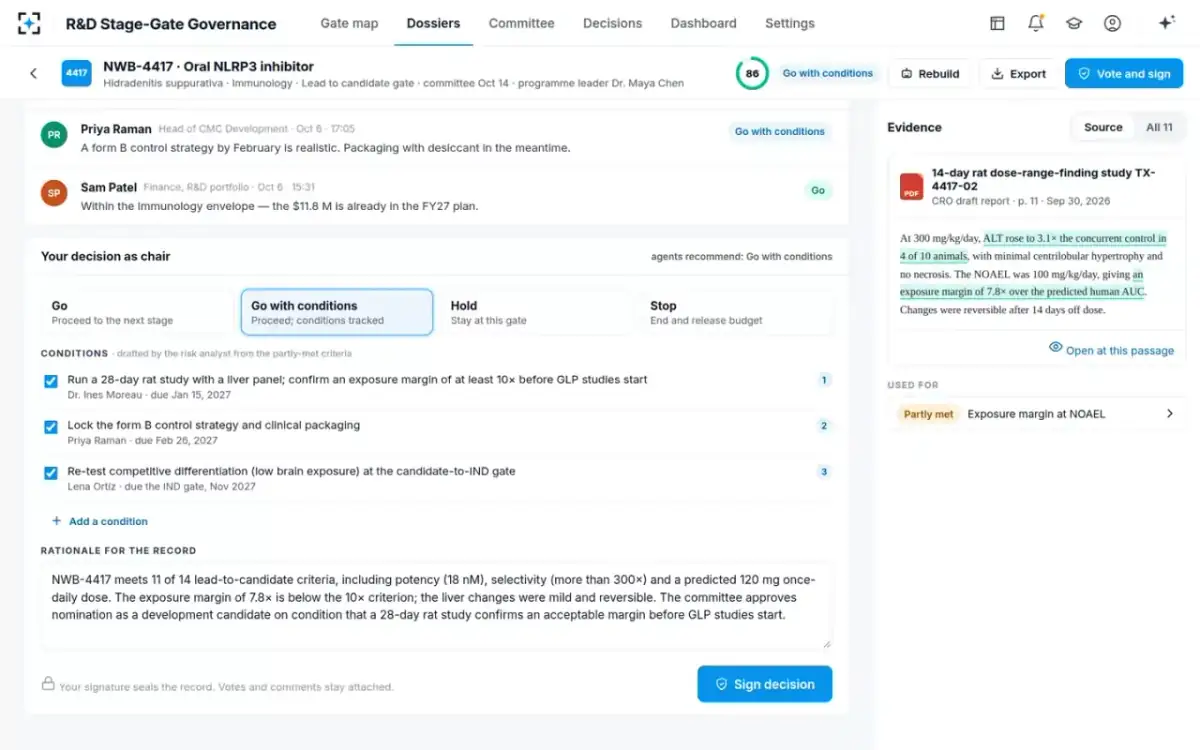
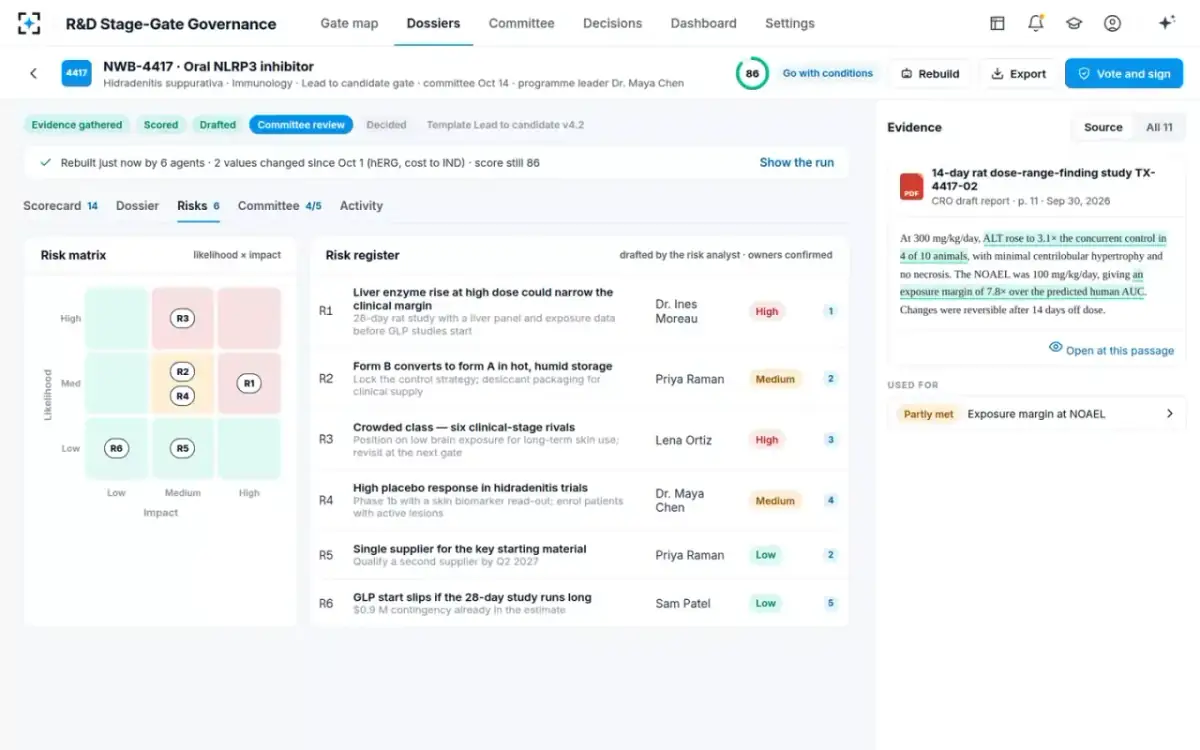
That line is about clinical protocols, but it names exactly what a research committee's conditions need and usually lack: a decision point, and a criterion that says what happens when it arrives. In the sample case the committee reaches go with conditions on an oral NLRP3 inhibitor for hidradenitis suppurativa. Eleven of fourteen lead-to-candidate criteria are met; the gap is a safety margin of 7.8× against a 10× criterion, from a mild, reversible rise in liver enzymes at the top dose of a 14-day rat study. The template calls a margin between five- and ten-fold partly met, needing a mitigation plan. That is the sentence that generates the condition, and it was written before anyone saw the study.
A condition that can be closed: measurable, owned, dated
Three properties, and a fourth that is usually forgotten. A condition has to name a measurement, so that closing it is an observation rather than an opinion. It has to name one person, not a function. It has to carry a date, and the date has to be before the work it protects begins. And it has to say what counts as closed, because "the study was done" and "the study showed reversibility" are different outcomes of the same study.
Seven tests a condition should pass before the chair signs it
- It names a measurement, not an intention
"A 28-day rat study with a liver panel" can be closed. "Further work on safety" cannot.
- One named owner, a person
A function cannot be chased. In the sample decision the three conditions belong to the head of nonclinical safety, the head of CMC development and the head of immunology.
- A date, not a milestone
"Before the next review" moves when the review moves. 15 January 2027 does not.
- It says what closes it
The report exists, or the report shows the change reverses. Decide which, in the room.
- It fits before the work it protects
A condition due after the spending it was meant to protect is a note, not a condition.
- It rests on a cited passage
The condition on the sample programme points at the study, the page and the passage that produced it.
- Failing it would change the decision
If the programme would proceed anyway, it is a preference. Say so, and do not call it a condition.
The sample decision carries three conditions that pass those tests. Run a 28-day rat study with a liver panel and confirm an exposure margin of at least 10× before the good-laboratory-practice studies start — owned by the head of nonclinical safety, due 15 January 2027. Lock the control strategy for a solid form that converts at 60 °C and 75% relative humidity, with the clinical packaging — owned by the head of CMC development, due 26 February 2027. Re-test competitive differentiation at the candidate-to-IND review — owned by the head of immunology, due November 2027. Read the first one again: it does not say "run a study", it says what the study has to show, and it says what the finding protects.
One condition, from a partly-met criterion to a closed obligation
Agent
Criteria scorerMarks the exposure-margin criterion partly met: 7.8× measured against a 10× threshold, under lead-to-candidate criteria v4.2, with the study and page recorded.
Never: change a threshold, or let its recommendation stand as a decision
Agent
Risk analystTurns the partly-met criterion and the source caveats into a risk with likelihood, impact, owner and mitigation, and drafts a condition that is measurable, dated and owned.
Never: decide the outcome, or draft a condition without an owner and a date
A person decides
Programme leaderChecks the drafted dossier against the evidence and releases it to the committee, so members read the data rather than the formatting.
A person decides
Committee membersRead the cited passage, vote, and comment. In the sample decision three vote go with conditions and one votes go.
A person decides
Committee chairKeeps, edits or deletes each drafted condition, records the rationale, and signs with the meaning of the signature. The record is sealed at the signature.
A person decides
Condition ownerRuns the study, files the report, and closes the condition against what the committee said would close it. Open and overdue conditions show on the portfolio screens.
What happens to conditions after the meeting
This is where many governance systems end and many conditions die. The minutes are written, circulated and filed. Nothing watches the dates. At the next committee someone asks whether the 28-day study was done, and the answer is a search through email.
The alternative is unglamorous: every condition the chair signs carries its owner and its due date into a register that the portfolio screens read, so an overdue obligation appears beside the programme it belongs to rather than in last month's minutes. In the sample portfolio one condition is overdue on the morning of the committee — a 28-day monkey study report on a different programme, due 3 October — and it is visible on the same screen as the four decisions being asked for that day. That is the whole mechanism. It is not sophisticated, and it is the difference between a condition and a wish.
The same obligation, owned and dated, or recorded in the minutes
- Drafted and signed2 d
- Open, owned, visible on the portfolio screens91 d
- Report filed, condition closed2 d
- Written up2 d
- Nobody owns it; no date is watched91 d
- Re-discovered when the next dossier is built70 d
The chair's screen: four outcomes, the votes and the drafted conditions
Progression bias, and the three habits that keep a dead programme alive
Programmes often survive not because someone argued successfully that they should, but because of three habits that each look reasonable.
The next experiment. Every unmet criterion suggests a study that might close it, and every such study is cheap relative to the programme's sunk cost. The habit is to authorise it without asking what happens if it reads out badly — which is the question that turns a study into a kill criterion rather than a delay.
The moving threshold. A margin of ten-fold was the criterion; the programme delivers 7.8; the discussion becomes whether ten was ever the right number. Sometimes it was not. But the conversation has to be a template change, owned by the template owner, applied to the next dossier — not an adjustment made in the room by the people reading the result.
The absent counterfactual. The question in the room is "should this programme proceed?", which is usually answerable with yes. The question that produces portfolio discipline is "should this programme proceed instead of the next one in the queue, at this cost?" The sample committee makes that visible by putting the money on the agenda: four decisions, $73.5 M asked if all four proceed.
None of those is cured by better intentions, and all three are harder to sustain when the criterion was written in advance, the threshold is versioned, and the cost of the next stage sits beside the recommendation. What the next stage actually costs is the number that makes the counterfactual real.
What stopping rules in the clinic teach a research stage-gate
Clinical trials have had to solve this problem under supervision, and three of their habits transfer directly.
First, the rule names its own kind. A clinical stopping rule has to say whether it ends dosing or pauses it, because the two have different consequences and different routes back. A research committee that says "hold" without saying which kind has not finished the sentence.
Second, the route back is defined in advance. Restarting after a clinical stopping rule fires does not require a new negotiation if the review lands inside conditions that were written down beforehand. The research equivalent is the restart test on a hold — written at the moment of the hold, not improvised when the programme asks to come back.
Third, the rules are separated by situation rather than bundled. A rule for an individual subject, a rule for a cohort, a rule for progression to the next part: each is a distinct decision point with its own criteria. A research committee that writes one list of kill criteria for a whole programme, rather than a list per milestone, is bundling in the same way — and the result is criteria vague enough to survive every milestone, which is to say criteria that never fire.
The risk register the conditions are drafted from
What a stop should leave behind for the next programme
A stop is the only outcome that produces no further work, which is why its by-product is usually lost. The team disperses, the data goes into a share drive, and three years later another programme hits the same solubility wall in the same chemical series and starts from nothing.
Four things are worth capturing at a stop, and all of them are cheap on the day and impossible later. The criterion that failed, with the measured value against the threshold, so the next programme knows the bar. The evidence behind it, cited to the study and the passage, so a later reader can judge it rather than inherit a conclusion. The alternatives considered and rejected, including the conditions the committee discussed and chose not to set. And the decision itself, sealed with its rationale, its votes and the dossier it rested on, so that the organisation can later ask whether it was right.
That last one is what makes a scoring model testable at all. A registry of sealed decisions, each with the evidence it was taken on, is the only dataset an R&D organisation has about its own judgement. Keeping it is a small discipline; the alternative is to run the same argument again in three years with no record of how the last one came out. To see the four outcomes, the drafted conditions and the sealed records on one portfolio, start from R&D Stage-Gate Governance.
What a stopped programme should leave behind
- The criterion that failedThe measured value against the threshold, and the template version it was tested under. "Exposure margin 3.1× against a 10× criterion, candidate-to-IND v2.8."
- The evidence, citedStudy, page and passage for each value, so a later reader can form their own view instead of inheriting a conclusion.
- What was considered and not doneThe conditions the committee discussed and chose not to set, and why. This is the part that saves the next team six months.
- The sealed decisionRationale, votes, signer, the meaning of the signature and the dossier it rested on — so the organisation can ask, later, whether the call was right.
Questions people ask
What are kill criteria?
Thresholds agreed before the data exists, under which a programme stops rather than continues. They are written per milestone, tied to a measurement, and applied by the committee without a negotiation. The test of a real one is that someone who had never met the team could apply it. "If the exposure margin at the no-observed-adverse-effect level is below five-fold, the programme stops" is a kill criterion; "we will look hard at safety" is not.
Who decides to stop a research project?
The portfolio committee, by vote, with the chair signing the decision and its meaning. In the sample portfolio the chair signs lead-to-candidate decisions and finance co-signs the budget at the candidate-to-IND milestone. Agents and software never decide: they read the evidence, score it against the written criteria and draft the conditions, and the recommendation they produce is advisory. Who sits on the committee sets out the roles.
What does go with conditions mean?
The programme proceeds, carrying obligations that must be closed by a date. It is a common outcome at a research milestone and often the least well specified. It is only different from a plain go if each condition names a measurement, one owner and a date, says what counts as closed, and falls due before the spending it was meant to protect.
How do you track conditions set by a committee?
By sealing them into the decision record with an owner and a due date, and putting open and overdue conditions on the same screens as the programmes they belong to. In the sample portfolio an overdue 28-day study report is visible beside the four decisions on the day's agenda, rather than in the previous month's minutes. The mechanism is unremarkable; it is the absence of it that lets conditions lapse.
Why do companies keep failing projects alive?
Three habits, not one bad decision. Each unmet criterion suggests a cheap next experiment, which is authorised without asking what a bad read-out would mean. The threshold moves in the room when a programme lands just under it. And the question asked is "should this proceed?" rather than "should this proceed instead of the next programme in the queue, at this cost?" Writing criteria in advance, versioning the thresholds and putting the cost of the next stage beside the recommendation make all three harder.
What happens to a programme after it is stopped?
The team is released and the asset is shelved or out-licensed — and four things should be captured before the team disperses: the criterion that failed with its measured value, the evidence cited to its passage, the conditions the committee considered and rejected, and the sealed decision with its rationale and votes. That record is also the only dataset an organisation has for testing whether its own criteria predict anything.