Credit analyst job description listings tend to describe the role in terms of tasks — spread financials, test covenants, flag exceptions — without saying where that work sits relative to the four other seats that touch the same loan before a decision reaches a committee. On a private credit loan book, a concession works its way from a document to a vote through five distinct roles: the analyst who first reads the file, the portfolio manager who signs what gets proposed, the valuation lead who keeps the mark separate from the score, the chief investment officer who approves a rating change, and the head of portfolio management who answers for the whole book to investors and the board. Reading the agents into this picture does not remove a seat. It changes what sits in each one's week. The worked example is a fictional sample fund in Botminds' Private Credit Portfolio Monitoring, whose agents rebuild each loan's amendment, interest and covenant history before anyone opens the file; its people and figures are invented.
The five seats, and what each one decides
Five people carry one loan's history to a committee table, and each holds a different kind of authority over it. The analyst reads and checks; the portfolio manager signs what gets proposed; the valuation lead owns the mark, kept apart from the stress score on purpose; the chief investment officer approves rating changes, the watchlist and non-accrual; and the head of portfolio management watches the whole book's accumulated stress and answers for it upward. None of the five can do another's job — a portfolio manager cannot set a mark, and a valuation lead does not vote on a rating — and that separation is itself a form of control, not an accident of org-chart history.
Five seats, what their week held, and what it holds now
Today
Spreads certificates by hand across 19 borrowers and chases late reporting, one loan at a time.
With agents
Reads each covenant on the reset test and on the original definition and cap, with the quarters it has failed, before deciding what to chase first.
Today
Signs off each amendment as it arrives, seeing one document at a time.
With agents
Answers a request with the loan's whole concession history, a pro forma and counter-terms drawn from the fund's own precedents.
Still theirs: the decision to sign, and what the signature means
Today
Prepares quarterly marks with a third-party valuation firm while concessions sit in other files.
With agents
Receives the evidence — mark against peers, liquidity, sponsor support — kept separate from the stress score.
Still theirs: the mark itself; the agents never set or change it
Today
Hears about the latest amendment request, not the pattern of concessions behind it.
With agents
Reviews signed proposals and a cited stress note before approving a rating change, a watchlist addition or non-accrual.
Still theirs: every rating change and non-accrual decision
Today
Answers to investors and the board for non-accruals and rising PIK income, often after the fact.
With agents
Sees the fund ranked by accumulated stress every morning, each score explained driver by driver with its source.
What does a credit analyst actually do all week?
O*NET's own description of the role is to "analyze credit data and financial statements of individuals or firms to determine the degree of risk involved in extending credit or lending money" and to "prepare reports with credit information for use in decisionmaking" (O*NET, Credit Analysts, 13-2041.00). In practice, on a private credit book, that description covers a wide range of actual hours: re-spreading a compliance certificate by hand against a covenant definition, chasing a borrower whose reporting is late, tracking which interest payments were made in kind, and writing up what a new amendment actually changes. An analyst carrying nineteen borrowers, as in the sample fund behind this guide, spends much of that time on work that is mechanical rather than judgment-based — the certificate has to be re-spread correctly before anyone can say whether a covenant was really met.
The portfolio manager: signing one amendment at a time, or seeing the pattern
A portfolio manager's hardest problem is rarely any single amendment request; it is that requests arrive one at a time, and a fourth concession in nine months looks almost identical, read in isolation, to the first. "Every amendment looked reasonable on the day. It's the fourth one that tells you," is how the fund's own portfolio manager describes the gap in the sample case behind this guide — a line that captures the actual risk in the seat: not bad judgment on any one request, but no visible pattern across several. The seat's authority does not change when a loan's full concession history is laid out — the portfolio manager still signs or does not — but what the manager is looking at when deciding does.
One loan's history, moving through five seats to a decision
Agent
History rebuiltAmendments, interest notices, certificates and marks for one loan are read and tied together across eight quarters.
A person decides
Analyst checks the driversReviews what moved the score and what has not yet been reconciled, rather than re-spreading figures from scratch.
A person decides
Portfolio manager signsReviews a drafted proposal against its cited evidence and signs, with the meaning of the signature recorded.
Agent
Committee note draftedA cited note is assembled for the watchlist and valuation committee, five sections, every figure sourced.
A person decides
CIO decidesApproves or declines a rating change, a watchlist addition or non-accrual status.
What does a chief investment officer approve, and what doesn't reach them?
A chief investment officer's seat is defined as much by what is kept off their desk as by what reaches it. Rating changes, watchlist additions and non-accrual status are decisions the CIO or an equivalent committee chair approves — nothing moves without that approval. Day-to-day covenant re-tests, interest tracking, and routine reporting do not need to reach that level; they are the analyst's and portfolio manager's work, surfaced to the CIO only when a loan actually crosses a watch or escalation line. That filtering is deliberate: a CIO who has to review every covenant certificate personally has no time left to weigh the decisions that are actually theirs to make.
Why the valuation seat is a rule, not a preference, at a BDC
For a business development company or a registered fund, the separation of the mark is written into the Securities and Exchange Commission's fair value rule, Rule 2a-5. Determining fair value in good faith requires four functions: "periodically assessing any material risks associated with the determination of the fair value of fund investments ('valuation risks'), including material conflicts of interest"; selecting, applying and periodically reviewing fair value methodologies; "testing the appropriateness and accuracy of the fair value methodologies that have been selected"; and overseeing any pricing services (17 CFR 270.2a-5). The board may hand the work to a valuation designee, usually the adviser, which must report to the board at least quarterly and, within five business days, on any matter that materially affects the fair value of the portfolio.
Two parts of the rule explain the design of the seats. The conflicts clause is the reason a portfolio manager who argues for a borrower's amendment is not the person who marks that borrower's loan. And the rule requires the designee to specify "the titles of the persons responsible for determining the fair value of the designated investments," function by function. A stress score can inform a mark, by sending the evidence; it cannot be the mark, because the rule puts that determination with named people under board oversight.
The valuation team's seat: kept apart from the score on purpose
A valuation lead's job — setting the mark on a loan, typically with a third-party valuation firm — is kept structurally separate from the stress score a portfolio manager and CIO use to judge credit risk, and that separation is a design choice, not an oversight. The mark and signal watcher agent "never changes a mark — the valuation team does," and sends evidence instead: the mark against peers, liquidity trends, sponsor support signals. A valuation lead who receives that evidence can weigh it against information the credit side does not have — market comparables, bid activity, third-party opinions — without the credit team's own score quietly pre-deciding the number.
What a credit analyst earns, by the numbers
Credit analysts earned a median of $83,510 a year ($40.15 an hour) in 2025, across 64,700 jobs, in Bureau of Labor Statistics wage data as O*NET reports it (O*NET, Credit Analysts 13-2041.00). Financial and investment analysts, the broader occupation that includes most portfolio analysts, earned a median of $102,740 across 377,200 jobs (O*NET 13-2051.00), and financial examiners $94,160 (O*NET 13-2061.00). The gap between credit analysts and investment analysts is roughly the path a credit analyst's career takes — from re-spreading certificates toward the judgment-heavy work a portfolio manager or senior analyst does once the mechanical load is smaller.
Median annual pay for the occupations behind the seats, 2025
What changes in the week when agents read the documents first
The clearest way to see what changes is to look at where an analyst's hours actually go. In the sample fund behind this guide, pulling every amendment and consent by hand took an estimated three working days per quarterly review before agents read first, down to about a quarter of a day once they do; re-spreading certificates and re-testing covenants fell from roughly three days to half a day. The hours that shrink are the mechanical ones — pulling documents, re-spreading figures, tying interest notices. The hours that do not shrink, and arguably grow as a share of the week, are the ones spent deciding what a pattern of concessions actually means for a borrower.
Where a credit analyst's week goes, before and after agents read first
A credit analyst's week, before
- Re-spreading certificates · 35%
- Chasing late reporting · 25%
- Pulling amendments and notices · 20%
- Writing notes, judging what matters · 20%
The same week, with agents reading first
- Re-spreading certificates · 8%
- Chasing late reporting · 12%
- Checking what the agents found · 25%
- Writing notes, judging what matters · 55%
What a credit analyst opens first each morning
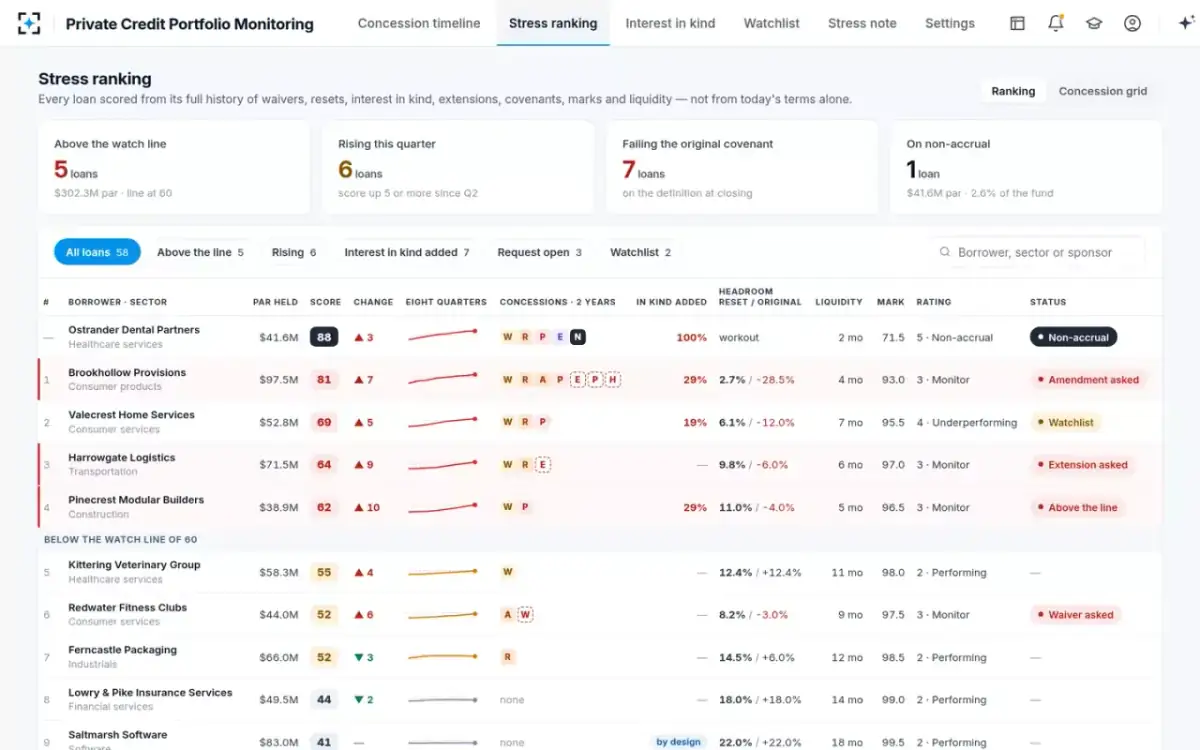
Where the handoffs sit, and which ones agents remove
Five seats mean four handoffs, and not all of them change the same way. The handoff from analyst to portfolio manager — raising a loan's pattern for a decision — stays, because it is a judgment call only a person makes. The handoff from portfolio manager to CIO for a rating change stays for the same reason. What changes is the handoff that used to sit between "pulling the documents" and "having something to decide on": an analyst no longer waits on their own manual re-spreading before a portfolio manager can see a loan's pattern, because the agents have already rebuilt it. The seat survives; the wait inside it shrinks.
A loan's score, with every driver linking back to the document behind it
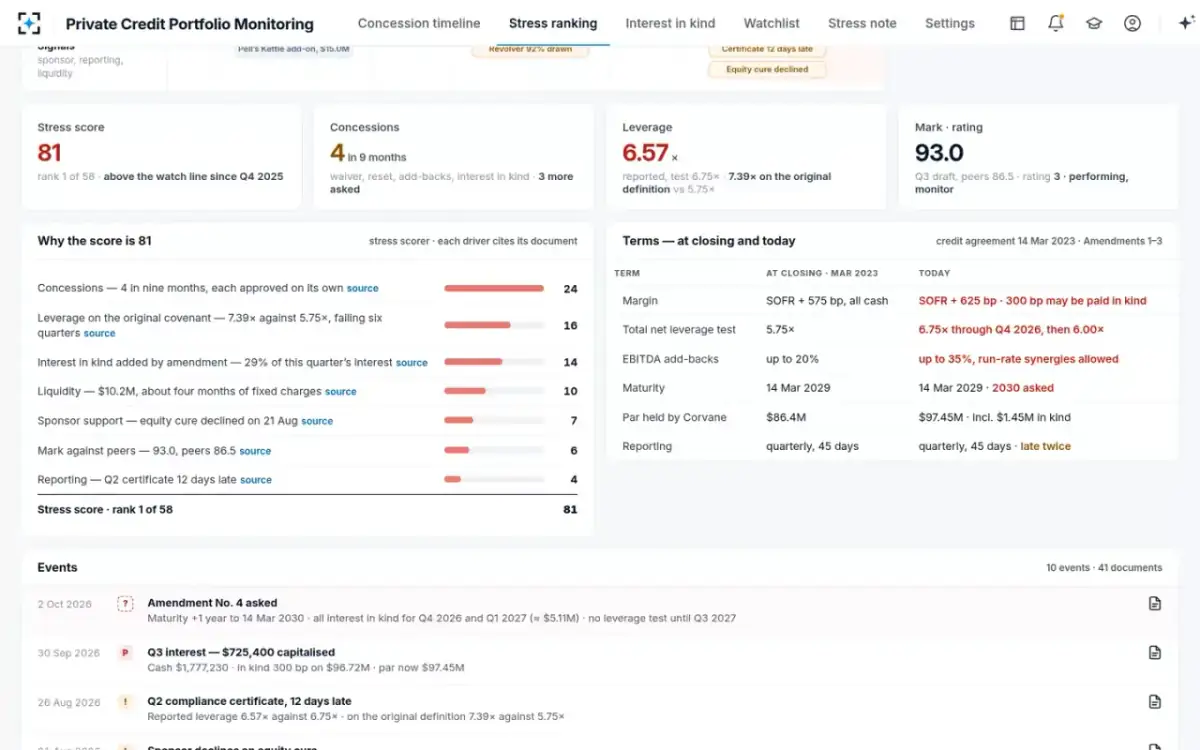
Is credit analyst still a good way into the work?
As a way into credit and portfolio work, the seat still functions the way it always has — a place to learn how a loan's documents translate into a judgment about risk — but the share of the week spent on that judgment, rather than on re-spreading a certificate, is larger than it used to be. Financial examiners, a related oversight occupation, carry a similar description of the underlying skill: O*NET lists their core task as working to "resolve problems concerning the overall financial integrity of banking institutions including loan investment portfolios, capital, earnings, and specific or large troubled accounts" (O*NET, Financial Examiners, 13-2061.00) — the same kind of judgment a credit analyst builds toward, whether the mechanical reading in front of them is done by hand or by an agent first.
To see how the five seats and the agents that feed them work through one loan's amendment request end to end, start from Private Credit Portfolio Monitoring; what each agent does, and never does, covers the other side of the same desk.
Questions people ask
What does a credit analyst do?
Analyzes credit data and financial statements to assess lending risk and prepares reports to support decisions, per O*NET's own description. On a private credit loan book, that covers re-spreading compliance certificates, testing covenants, tying interest payments, and chasing late reporting across a portfolio of borrowers.
What does a portfolio manager do at a credit fund?
Reviews each loan's performance and any requests — a waiver, a reset, an extension — and signs off on what gets proposed to the committee, carrying responsibility for seeing whether a pattern of requests from one borrower adds up to more than any single request suggests on its own.
Credit analyst job description: what should it actually include?
Beyond spreading financials and testing covenants, an accurate description should note the seat's place relative to the portfolio manager who signs proposals and the committee that decides — a credit analyst surfaces what a loan's documents show; deciding what to do about it sits elsewhere.
How much does a credit analyst make?
A median of $83,510 a year nationally in 2025, across 64,700 jobs, in Bureau of Labor Statistics data as O*NET reports it. The broader financial and investment analyst occupation, which includes most portfolio analysts, has a median of $102,740.
What changes for a credit analyst when AI reads the documents first?
The mechanical share of the week — re-spreading certificates, pulling amendments, chasing late reporting — shrinks, while the time spent reading what a pattern of findings actually means for a borrower grows as a share of the week. The seat and its judgment stay; the wait before there is something to judge gets shorter.