The cost of a quarterly portfolio review is not mysterious: it is hours spent, multiplied by what those hours cost, multiplied by how many loans the fund carries. Every input in that formula is either published or measurable from a fund's own calendar — nothing about it requires taking a vendor's return-on-investment slide at face value. This page builds the formula from federal wage data and shows where the hours actually go, so a head of portfolio management or a CFO can fill in their own fund's numbers rather than someone else's.
The time and document figures on this page come from a fictional sample fund as it runs through Botminds' Private Credit Portfolio Monitoring: Corvane Senior Lending Fund II. The wage data comes from the Bureau of Labor Statistics, via O*NET, linked where it appears.
What one credit analyst's quarter is built from
19
borrowers carried by one credit analyst in the fictional sample fund
13days
estimated for one analyst’s full quarterly review, by hand
41
documents behind one loan’s history: the agreement, 4 amendments, a waiver, 8 interest notices, 7 certificates, 7 marks and call notes
Building the cost of one quarterly review from hours and rates
The formula has three inputs, and all three are things a fund already knows or can look up: hours spent per review, a fully loaded hourly cost for the people spending them, and how many loans or borrowers go through a review each quarter. Multiply the three together and the "cost of a quarterly review" stops being a vague sense that it takes "a couple of weeks" and becomes a number a CFO can put next to the cost of any alternative, including doing nothing differently.
What the formula does not resolve on its own is whether the time is well spent. A fund that takes thirteen days to produce a review that still misses a pattern sitting in plain sight across four separate amendments has not bought itself safety with those thirteen days — it has bought a long way of arriving at the same blind spot a faster review might also have missed, or might have caught. Cost and value are two different questions, and the rest of this page treats them that way.
What does a credit analyst actually cost per hour?
Credit analysts earned a median of $83,510 a year, or $40.15 an hour, in the Bureau of Labor Statistics' 2025 wage data as O*NET reports it (O*NET, Credit Analysts 13-2041.00). Financial and investment analysts, the occupation that covers much of the more senior work in a portfolio review, earned a median of $102,740, or $49.40 an hour (O*NET, Financial and Investment Analysts 13-2051.00). These are national medians across all employers; a private credit fund in a major financial centre will often pay more, and should use its own figure.
Wages are not what a fund pays to put an analyst in a seat for an hour. The BLS's Employer Costs for Employee Compensation gives the size of the gap for benefits: in June 2026, wages and salaries were 70.0% of private-industry compensation, $32.82 of $46.89 an hour (BLS, Employer Costs for Employee Compensation). Total compensation therefore runs about 1.43 times the wage, which puts a credit analyst at the median near $57 an hour. That is our arithmetic from two published figures, before office and systems overhead, and a fund should replace it with its own loaded cost.
Where the days go: pulling documents, re-spreading, writing the note
A quarterly review is not one task; it is five, and they do not take equal time. In the fictional sample fund, one analyst's full quarterly review, estimated across a book of 19 borrowers, breaks down as pulling every amendment, waiver and consent per loan (an estimated 3 days by hand), tying interest notices for cash, in-kind and toggled payments (2 days), re-spreading compliance certificates and re-testing covenants (3 days), comparing marks, liquidity and sponsor news (2 days), and writing the stress note and watchlist proposals (3 days) — 13 days in total. These are our estimates for the sample fund; a fund should time its own review stage by stage before relying on them.
Where the days go, before and after
Pulling documents
- Before: 3 days · 55%
- After: 0.25 days · 5%
Tying interest
- Before: 2 days · 36%
- After: 0.25 days · 5%
Re-spreading and re-testing
- Before: 3 days · 55%
- After: 0.5 days · 9%
Comparing marks and signals
- Before: 2 days · 36%
- After: 0.5 days · 9%
Writing the note
- Before: 3 days · 55%
- After: 1 day · 18%
Totalled, the estimate moves from 13 days by hand to about 2.5 days with the agents doing the reading and the re-computation first: 0.25 days each for pulling documents and tying interest, 0.5 days each for re-spreading covenants and comparing marks, and 1 day for writing the note, which stays the stage where a person does the most work because judgment, not transcription, is what a stress note actually requires.
What 41 documents and one loan's history actually take to rebuild by hand
The five-stage breakdown above describes a whole book; one loan inside it shows what "pulling documents" actually means in practice. Brookhollow Provisions Holdings' file alone runs to 41 documents: the credit agreement, four amendments, a waiver letter, eight interest notices, seven compliance certificates, seven quarterly marks, lender call notes and the current amendment request. Rebuilding that one loan's concession history by hand — reading each document, noting what changed and when, and checking it against what the loan's terms were at closing — is most of where a single loan's share of the "pulling documents" and "re-spreading" days actually goes, multiplied by however many loans in the book have a similarly deep file.
The return that matters: a quarter of earlier warning, not a faster PDF
A faster review is worth something, but it is not the number that should decide whether a fund invests in better monitoring. The number that should is how much earlier a fund sees a loan heading for trouble. Back-tested against a fund's own non-accrual history, the solution's own estimate is a median of three quarters of earlier warning on loans that eventually went on non-accrual — found by re-running the stress score against history the fund had already lived through, not a figure available from any outside published source. Three quarters is the difference between negotiating from a position where a fund still has leverage — more collateral, a fresh covenant, new sponsor equity — and discovering the same problem only once a borrower has already stopped paying.
The regulatory lens on private credit points the same direction. The National Association of Insurance Commissioners, describing how state regulators look at insurers' private credit holdings, puts it in one line: "regulators focus on whether these investments are transparent, properly valued, and supported by appropriate capital" (National Association of Insurance Commissioners) — a focus on seeing clearly and early, not on processing paperwork quickly. A review that takes two and a half days instead of thirteen but still only looks at a loan's current terms has not actually answered that regulatory concern; one that also tests a loan's original covenant and its full concession history has.
A return formula you can fill in with your own numbers
The honest ROI calculation has two separate terms: the hours a fund actually saves, priced at its own loaded rate, and the value of earlier warning, which a fund has to price for itself based on what a late catch typically costs it — in principal at risk, in a worse recovery, or in the cost of negotiating from a weaker position.
Two terms, not one
Hours saved
(hours before − hours after) × loaded hourly rate × analysts in the fund
Build this from your own staffing and your own loaded rate; BLS wage data is a starting point, not a loaded cost.
Value of earlier warning
quarters of earlier warning × your fund’s own estimate of what a late catch costs on an average stressed loan
No public benchmark prices this term; a fund has to estimate it from its own workout history.
Priced by the fund, not by a vendor
What has no public benchmark, and why that's said plainly
Two figures on this page cannot be checked against an outside source, and it would be dishonest to present them as if they could. The three-quarters-of-earlier-warning figure is our estimate from a back-test of the stress score against a fund's own non-accrual history — useful as an illustration of the kind of return earlier warning can produce, not a number every fund should expect to replicate. The 13-day and 2.5-day review times are our estimates for the fictional sample fund. No government or academic source publishes how long a private credit portfolio review takes, so a fund building its own business case should time its own and treat ours as a hypothesis to test, not a result to cite.
Sensitivity: which input moves the answer the most
Of the three inputs in the cost formula — hours, loaded rate, and loans in the book — hours moves the answer the most, because it is the input with the widest range between funds: a fund with clean, well-organized loan files and few amendments spends far fewer hours per loan than one with Brookhollow Provisions Holdings' 41-document file. Loaded rate moves the answer next, since what a fund adds for benefits and overhead, and whether it pays near the national median at all, can shift the per-hour cost by 10% or more. The number of loans in the book scales the total cost linearly but does not change the per-loan economics at all — a larger book costs proportionally more to review, but a review that is inefficient per loan stays inefficient at any size.
Which input moves the total cost the most, holding the other two fixed
What the solution's own sample fund shows, and what it doesn't prove
In the fictional sample fund, six agents rebuild one loan's full history — all 41 documents for Brookhollow Provisions Holdings — in 69 seconds. That figure is a measurement of how long the software takes to run, not a measurement of analyst hours saved, and the two should never be substituted for each other: 69 seconds of agent run time replacing 13 days of analyst work does not mean an analyst's week shrinks to 69 seconds, because reading the agents' output, deciding what to counter-offer on an amendment, and signing a watchlist proposal all still take a person's time and judgment. What the 69-second figure actually demonstrates is that the mechanical, repetitive part of a review — reading documents and tying numbers together — can run far faster than the part that requires a decision, which is exactly the part the hours-saved calculation above already assumes stays with a person.
One loan's file, before the review starts
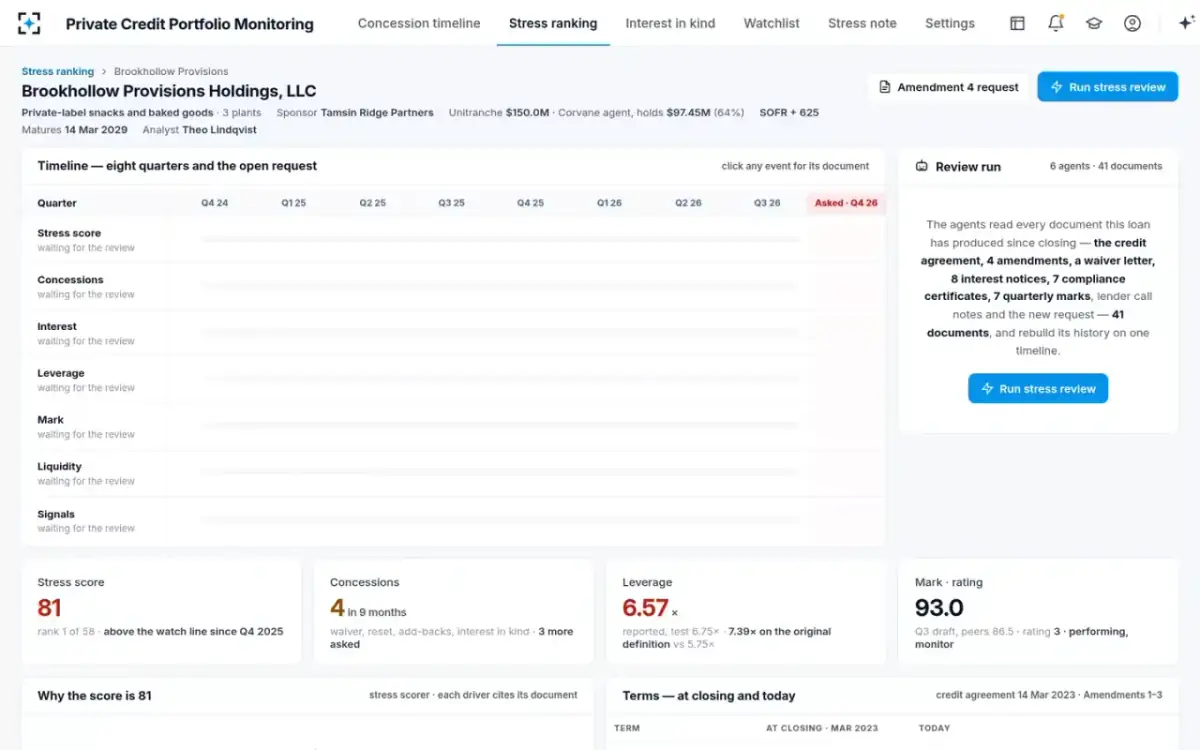
Reading the output still requires the same judgment a loan's rating and watchlist status always have — why a covenant reset can leave a rating untouched for quarters and what an amendment request actually trades away are both decisions the hours saved on document-pulling were never going to make by themselves.
Private credit as an asset class has grown large enough that the hours question is no longer a rounding error for most funds: the asset class "totaled $1.34 trillion in the U.S. ... and nearly $2 trillion globally" as of the second quarter of 2024 (Federal Reserve, FEDS Notes), and every dollar of it sits inside a loan that someone, somewhere, has to review every quarter. To see what a quarterly review looks like with the agents' reading already done, start from Private Credit Portfolio Monitoring.
Questions people ask
How much does a quarterly portfolio review cost?
Build it from hours, loaded hourly rate, and loans or borrowers reviewed. By our estimate for the fictional sample fund, one analyst's review of 19 borrowers runs to about 13 days by hand; at roughly $57 an hour, the median credit analyst wage loaded for benefits, that is about $6,000 per analyst per quarter, before overhead and more senior review time.
How many hours does a credit analyst spend per loan review?
It varies enormously with how complex a loan's file is. A clean, unamended loan takes far less time than one like the fictional sample fund's Brookhollow Provisions Holdings, whose 41-document file includes four amendments and eight interest notices. Averaged across a book, our estimate for the fictional sample fund is roughly 13 analyst-days per quarter across 19 borrowers, or well under a full day per loan on average — concentrated heavily in the loans with the most amendment activity.
What is the ROI of portfolio monitoring software?
It has two components: hours saved, which can be priced against published wage data and a fund's own staffing, and the value of earlier warning on stressed loans, which has no public benchmark and has to be estimated from a fund's own workout history. A credible ROI case shows both, rather than only the easier-to-price hours figure.
How long does a private credit quarterly review take?
There is no published government or academic figure. Our estimate for the fictional sample fund is about 13 analyst-days by hand for 19 borrowers, falling to about 2.5 days when software does the document-reading and recomputation first; a fund should time its own review before relying on either number.
What does a credit analyst cost per hour?
The median credit analyst wage was $40.15 an hour in 2025, in BLS data as O*NET reports it. Benefits add about 43% on top, on the BLS's June 2026 employer-cost figures, which puts the loaded cost near $57 an hour before office and systems overhead — our arithmetic, to be replaced with a fund's own employment cost.
Is portfolio monitoring software worth the cost?
That depends on a fund's own numbers on both sides of the formula: what its reviews currently cost in analyst hours, and what it estimates a late catch on a stressed loan actually costs it. A fund that cannot yet estimate the second number honestly should say so, rather than lean entirely on the hours-saved figure to justify the decision.