Amend and extend is the market's own name for a specific trade: a borrower that cannot or does not want to refinance or repay a loan at maturity asks its existing lender to push the maturity date out, and in exchange the lender rewrites other terms in its own favor — a wider spread, a tighter covenant, more reporting, sometimes a fee. It is one of the most common requests a private credit portfolio manager receives, and almost never the borrower's first request. Botminds' Private Credit Portfolio Monitoring reads every amendment, waiver and consent letter against a loan's full history, so a fifth or seventh request is seen as part of a pattern rather than as one more reasonable-sounding ask.
The examples on this page come from a fictional sample fund as it runs through the solution: Corvane Senior Lending Fund II, and one loan in particular — Brookhollow Provisions Holdings, a $150 million unitranche to a private-label snacks and baked-goods maker. The external research comes from FASB, the Federal Reserve, the FDIC and the National Bureau of Economic Research, linked where it appears.
One loan's amendment request, read against its history
4
concessions already granted to this borrower in nine months
7
concessions in sixteen months, if the current request is agreed
81 → 88
where the fund’s own stress score moves if the request is granted as asked
What amend and extend actually means
At its simplest, amend and extend is two things happening together: an amendment to a credit agreement's terms, and an extension of its maturity date. The amendment is rarely limited to the date alone — a lender asked to carry a loan longer than it originally agreed to almost always wants something back for the additional time and additional risk. What makes the term a recognizable pattern, rather than just "a loan got amended," is that it names a specific motive: the borrower cannot repay or refinance on the original schedule, and both sides know it.
Direct lenders are, in a sense, built for exactly this kind of negotiation. Research on direct lending finds that "direct lenders have a relative advantage in lending to higher risk borrowers where there is a large gap between continuation value and liquidation value in the event of default" (Jang, Kim, Sufi & Chen, NBER Working Paper 34500) — in plain terms, when a struggling borrower is worth more kept alive and operating than sold off in pieces, a private credit lender that already knows the business is often better placed to negotiate a path through than a bank would be. Amend and extend is one of the main tools of that negotiation.
How is amend and extend different from a refinance?
A refinance replaces an existing loan with a new one, often from a different lender, at whatever terms the market will currently bear for that borrower. Amend and extend keeps the existing lender and the existing loan in place, modifying its terms rather than replacing it. The practical difference matters most to the borrower: a refinance requires finding a new lender willing to underwrite the credit today, which a borrower already showing signs of stress may not be able to do on acceptable terms, or at all. Amend and extend only requires persuading the lender who is already in the deal, who already has due diligence on file, and who may prefer a renegotiated performing loan to a messy workout or a sale at a discount.
What lenders usually take in exchange for an extension
An extension is not granted for nothing. The specific terms vary by deal, but the categories of what a lender typically asks for repeat across the market: a wider interest margin to compensate for the added risk and duration; a tighter or reset financial covenant, since the original covenant was set against projections the extra time has now outrun; more frequent or more detailed reporting, so the lender can see trouble sooner next time; sometimes a fee, paid either in cash or added to the loan; and sometimes new sponsor equity as a condition of the lender's agreement at all, so the borrower's owners are sharing in the cost of the extension rather than the lender bearing it alone.
What a lender typically asks for, by category
| What the borrower wants | What the lender typically takes |
|---|---|
| More time to maturity | A wider spread, often with part of it payable in kind rather than cash |
| Relief from a covenant it would otherwise breach | A reset covenant tested against new projections, sometimes with a stricter level than the reset alone would suggest |
| Flexibility now, with less scrutiny | Monthly rather than quarterly financials, and sometimes a short-term cash-flow forecast |
| The lender to agree at all, where risk has clearly risen | New equity from the sponsor, so the owners share the cost of the extension |
Why would a lender agree to this at all?
Because the alternative is usually worse. A lender that refuses an extension and instead calls a loan it believes is at risk of default may force a borrower into bankruptcy or a fire sale, crystallising a loss that a negotiated extension might have avoided entirely. If the business is fundamentally sound and the problem is timing — a slow quarter, a one-off working-capital gap, a maturity that happens to fall at an inconvenient moment — an extension on the lender's own terms can be the better economic outcome for everyone, including the lender. The risk is that the same reasoning, applied uncritically to a borrower whose problems are not timing but solvency, simply defers an inevitable loss while making it larger.
The line between a reasonable reset and "extend and pretend"
"Extend and pretend" is the market's own derisive name for what happens when that second case is mistaken for the first: a lender keeps extending and amending a loan that is not actually improving, each time treating the request as an isolated, reasonable ask, because in isolation it usually is. The loan never formally defaults. It also never gets better. The distinguishing fact is rarely visible in any single amendment — it only becomes visible when someone lines up every amendment a loan has received and asks whether the pattern looks like a business working through a rough patch or a business that has been in trouble for a long time and is simply not being called on it.
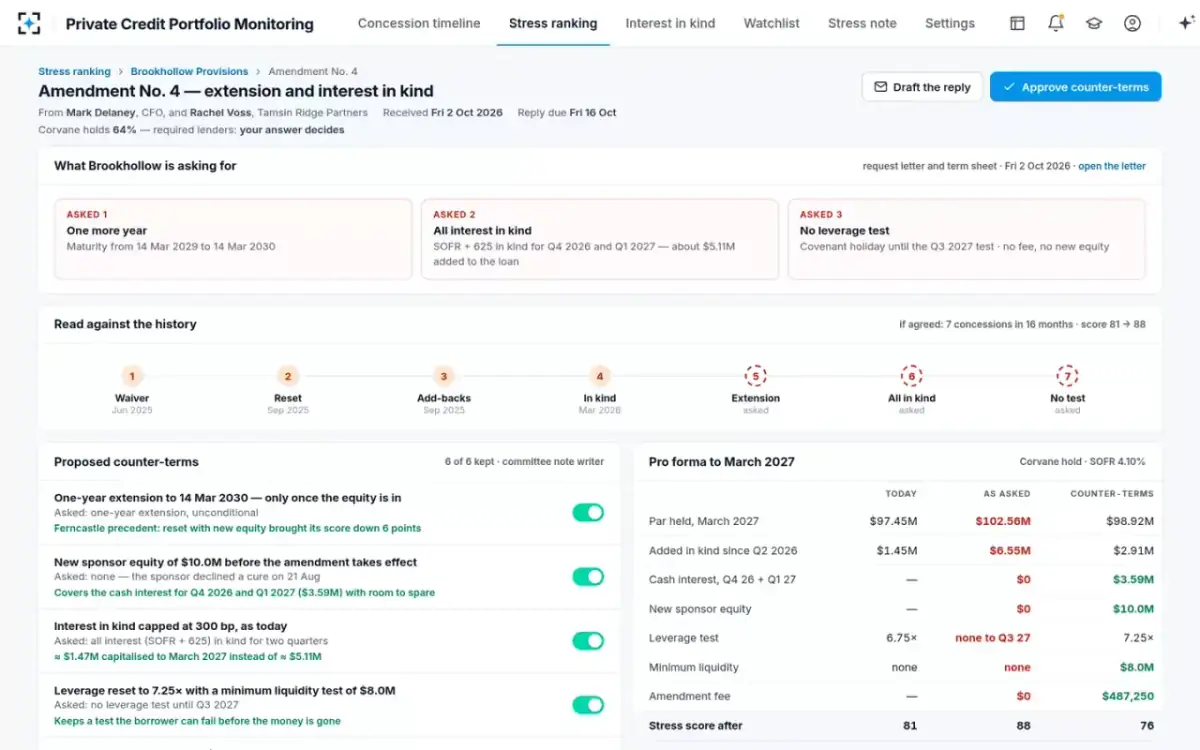
Brookhollow Provisions Holdings is the fictional sample fund's own worked example of exactly this question. Four concessions in nine months — a covenant waiver, a reset of the leverage test from 5.75× to 6.75×, wider EBITDA add-backs (from 20% to 35%), and a switch to interest in kind — each one, read on its own the day it arrived, looked like a reasonable ask from a borrower managing a temporary problem. Now a new request has arrived. Read together, on one timeline, they describe a borrower that has not had a temporary problem for nine months.
What FASB's own modification-disclosure rule is looking for
Accounting standard-setters track the same pattern. Accounting Standards Update 2022-02, issued in March 2022, eliminated the old troubled debt restructuring accounting for lenders under the current credit-loss standard and replaced it with disclosure: lenders must report modifications to borrowers experiencing financial difficulty that take the form of "principal forgiveness, an interest rate reduction, an other-than-insignificant payment delay, or a term extension (or a combination thereof)" (FASB, ASU 2022-02). For lenders that had already adopted the credit-loss standard, it took effect for fiscal years beginning after December 15, 2022.
Two things follow for a private credit fund. First, the categories are the right ones: a term extension to a struggling borrower is a modification the accounting rules want counted, not an administrative date change. Second, the rule is written for loans held at amortized cost, as banks hold them; a fund that carries its loans at fair value reports under investment-company rules instead, so nothing in its financial statements will add up a borrower's modifications for it. The disclosure rule does not tell anyone when to stop granting extensions, but it confirms that amend-and-extend sits inside a category worth tracking loan by loan.
Reading one request against a loan's full concession history
A single amendment request arrives as a document: a letter, a redline, a term sheet. What it means depends entirely on what came before it, which is why Private Credit Portfolio Monitoring's amendment reader agent is built to classify every change against the full agreement rather than reading each request in isolation — waiver, covenant reset, add-back change, interest in kind added, maturity extension, covenant holiday, margin change, or consent — and never counts a change toward a loan's concession history unless it can cite the section of the document that makes it one. A lender-favourable change, or a plain consent that does not loosen anything for the borrower, is explicitly not counted as a concession, so the history is not inflated by routine administrative items.
Brookhollow Provisions: four concessions in nine months, three more requested
- Covenant waiver1
- Leverage test reset, 5.75× to 6.75×2
- Wider add-backs, 20% to 35%3
- Switch to interest in kind4
- Amendment No. 4, requested5–7 asked
By the solution's default settings, three or more concessions within twelve months is enough to flag a loan for bunching — a configurable line, not a regulatory one. Brookhollow passed that line months before the current request arrived.
What a pro forma on the request should show before you sign
Granting or countering a request without first modelling its effect is the single easiest way to lose track of how much a loan has actually moved. Amendment No. 4, granted exactly as the borrower's CFO and sponsor asked — one more year to 14 March 2030, all interest paid in kind for two quarters (about $5.11 million added to the loan), and no leverage test until the third quarter of 2027 — would move Brookhollow's stress score from 81 to 88 in the fictional sample fund's own scoring. The fund's counter-terms tell a different story: the extension conditioned on $10 million of new sponsor equity, PIK capped at 300 basis points rather than the full interest bill, a reset leverage test at 7.25× alongside an $8 million minimum liquidity requirement, a 50 basis point fee of $487,250, and monthly financials with a 13-week cash flow forecast. Modelled forward, the counter-terms put the loan's par value at $98.92 million in March 2027, against $102.56 million under the original ask, and the pro forma score at 76 rather than 88.
What was asked, against the counter-terms offered
Amendment No. 4, as requested: One more year, to 14 March 2030
The fund's counter-terms: Same extension, conditioned on new equity
Amendment No. 4, as requested: All interest in kind for two quarters (≈$5.11M added)
The fund's counter-terms: Interest in kind capped at 300 basis points
Amendment No. 4, as requested: No test until Q3 2027
The fund's counter-terms: 7.25× reset, with an $8.0M minimum liquidity test
Amendment No. 4, as requested: None required
The fund's counter-terms: $10.0M of new sponsor equity required before the extension takes effect
Amendment No. 4, as requested: Unchanged
The fund's counter-terms: Monthly financials plus a 13-week cash flow forecast
Amendment No. 4, as requested: None
The fund's counter-terms: 50 basis points, $487,250
Precedents: what the fund did the last time this pattern showed up
A fund's own history with similar requests is itself evidence worth reading before deciding this one. In the fictional sample fund, Ostrander Dental took an extension without new sponsor equity and all interest in kind — the same shape as what Brookhollow is currently asking for — and went on non-accrual the following quarter. Ferncastle, facing a similar request, was granted a reset only alongside $6.0 million of new equity, and its own stress score fell from 58 to 52 afterward rather than rising. Those two outcomes are not a guarantee of what happens to Brookhollow; they are the fund's own closest evidence for which kind of counter-terms have actually worked before, which is exactly what a committee note writer agent is built to draft into a proposal rather than leaving a portfolio manager to recall from memory.
From a request to a signed proposal
Agent
Amendment readerClassifies the request and lays it on the loan’s full concession history.
Never: counts a change it cannot cite to a section
Agent
Committee note writerDrafts counter-terms and a pro forma, using the fund’s own precedents on similar past requests.
Never: sends anything without the portfolio manager’s signature
A person decides
Portfolio managerKeeps or drops each counter-term and signs the reply.
A person decides
Chief Investment OfficerApproves any resulting rating change or watchlist addition.
Across the broader leveraged-loan market, the regulators who examine shared national credits report that "nearly half of total SNC commitments are leveraged, and leveraged loans comprise 81 percent of non-pass loans" (FDIC, 2025 Shared National Credit Program Report) — a reminder that the borrowers most likely to need an amend-and-extend conversation are concentrated exactly where private credit funds do most of their lending. The Federal Reserve's broader observation about the asset class, that "the elevated usage of payment-in-kind (PIK) provisions indicates some borrowers may face repayment difficulties" (Federal Reserve, May 2026 Financial Stability Report), describes the same population of borrowers from the interest-payment side of the same problem.
One request, read against the loan's history
To see an amendment request read against a loan's full history, with counter-terms and a pro forma drafted from a fund's own precedents, start from Private Credit Portfolio Monitoring.
Questions people ask
What does amend and extend mean?
It is a negotiated trade in which a borrower's loan maturity is pushed out in exchange for other terms moving in the lender's favor — typically a wider spread, a tighter or reset covenant, more reporting, or new sponsor equity. It is distinct from a refinance, which replaces the loan with new financing, usually from a different lender.
Is amend and extend a sign of credit trouble?
Not on its own — borrowers and lenders renegotiate maturities for ordinary business reasons too. It becomes a stronger signal when it is one of several concessions granted to the same borrower in a short period, or when the borrower is asking for terms it could not plausibly get from a new lender today.
What is "extend and pretend"?
It is the market's term for a lender repeatedly amending and extending a loan to a borrower that is not actually recovering, treating each request as reasonable in isolation rather than reading the pattern across requests. The loan avoids a formal default while the underlying problem persists.
How many times can a loan be amended?
There is no fixed limit in most credit agreements; each amendment requires the lender's consent, which it can withhold. No regulation sets a threshold for when a pattern of amendments should trigger closer review; a lender sets its own. Private Credit Portfolio Monitoring's default flags three or more concessions in twelve months, with two in six or four in eighteen as alternatives.
Does FASB require disclosure of loan modifications?
Yes, for modifications to borrowers experiencing financial difficulty. Since Accounting Standards Update 2022-02, lenders must separately disclose modifications involving principal forgiveness, an interest rate reduction, an other-than-insignificant payment delay, or a term extension, so these changes are visible as a distinct category rather than blended into ordinary loan activity.
What should a lender ask for before agreeing to an extension?
At minimum, a current view of why the borrower cannot meet its existing maturity, what has changed since the loan was underwritten, and whether the borrower's owners are willing to share the cost of the extension through new equity. A pro forma showing what the loan's value and risk score look like under the request as asked, and under any counter-terms, turns that judgment into a comparison rather than a guess.