AI model validation for credit risk is not a one-time certificate a vendor hands over before a sale closes. It is a discipline that supervisory guidance has asked of banking models for well over a decade, and a stress score produced by AI agents reading a loan file is not exempt from it just because the output looks like a well-formatted number with a source link attached. The useful question is not "has this been validated" — almost any vendor will say yes. It is which of the three specific things validation actually requires has been done, on this fund's own loans, and whether it gets redone when anything about the model changes. The worked example is the stress score in Botminds' Private Credit Portfolio Monitoring, which ranks every loan in a private credit book on seven drivers, each traced to the document behind it; the fund, loans and figures shown from it are fictional sample data.
The three-part test: soundness, outcomes, ongoing monitoring
The banking agencies' current statement of the discipline is the Revised Guidance on Model Risk Management that the Federal Reserve, the OCC and the FDIC issued on April 17, 2026, which supersedes the 2011 guidance known as SR 11-7. It keeps the same three components of validation: conceptual soundness, which "involves assessing and documenting model design (including key modeling choices, assumptions, qualitative judgments, and data selection), construction, and developmental testing"; outcomes analysis, which "compares model outputs to corresponding real-world outcomes"; and ongoing monitoring (SR 26-2). A review of banking validation practice by Sudjianto and Zhang (a preprint, not peer reviewed) sums up the purpose: "to ensure that the models are not only designed correctly but also perform reliably and consistently in real-world environments" (arXiv 2410.13877). Applied to a stress score, each part answers a different question: does the model's design make sense, does its output agree with what actually happened, and does it keep agreeing after something about it changes.
The three-part test, applied to a loan stress score
A person decides
Conceptual soundnessThe seven drivers — concessions, original-covenant test, interest in kind added, liquidity, sponsor support, mark vs peers, reporting — and their weights are reviewed by the people who will rely on the score, and make sense as a model of what stress looks like.
Agent
Outcomes analysisThe model is replayed on quarters the fund has already closed, and every score is compared with what the committee actually decided at the time.
A person decides
Reading the disagreementsEach loan where the replay and the committee's past decision diverge is reviewed: sometimes the model missed a fact outside its documents; sometimes the old file missed a pattern.
Agent
Ongoing monitoringScores are watched over time, and any change to a weight or the look-back window triggers a fresh outcomes-analysis pass rather than being trusted on faith.
What is conceptual soundness, for a score built from seven drivers?
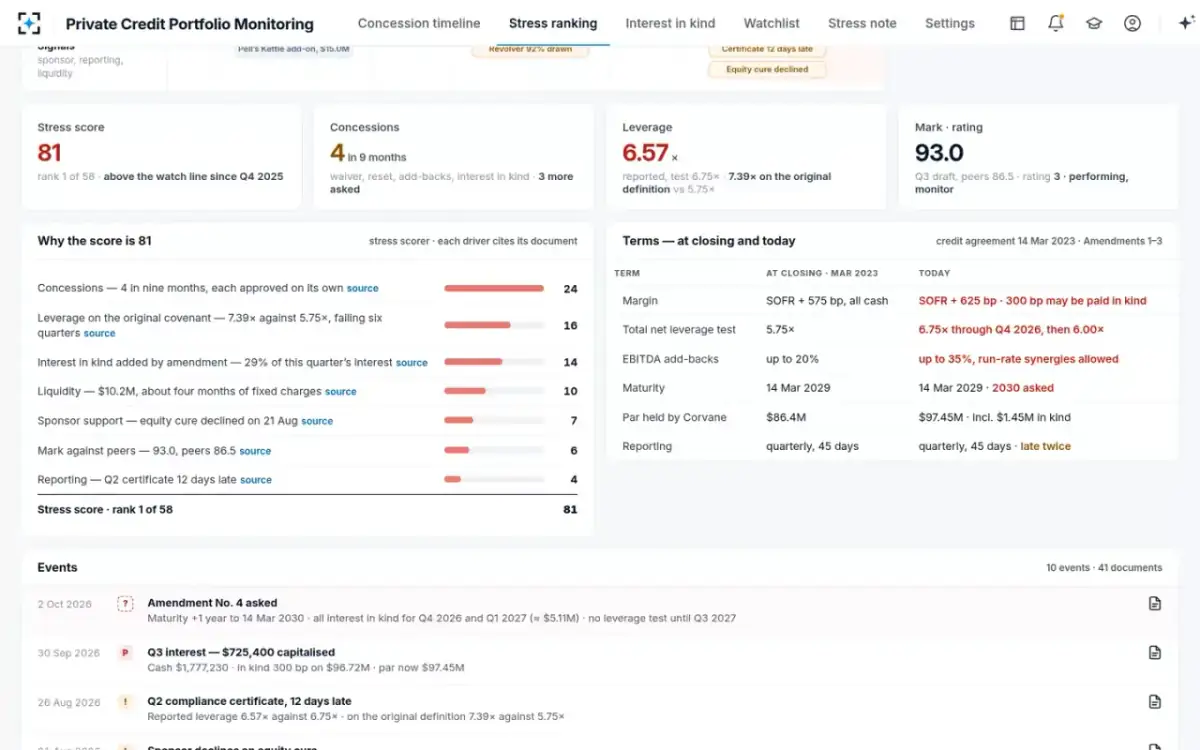
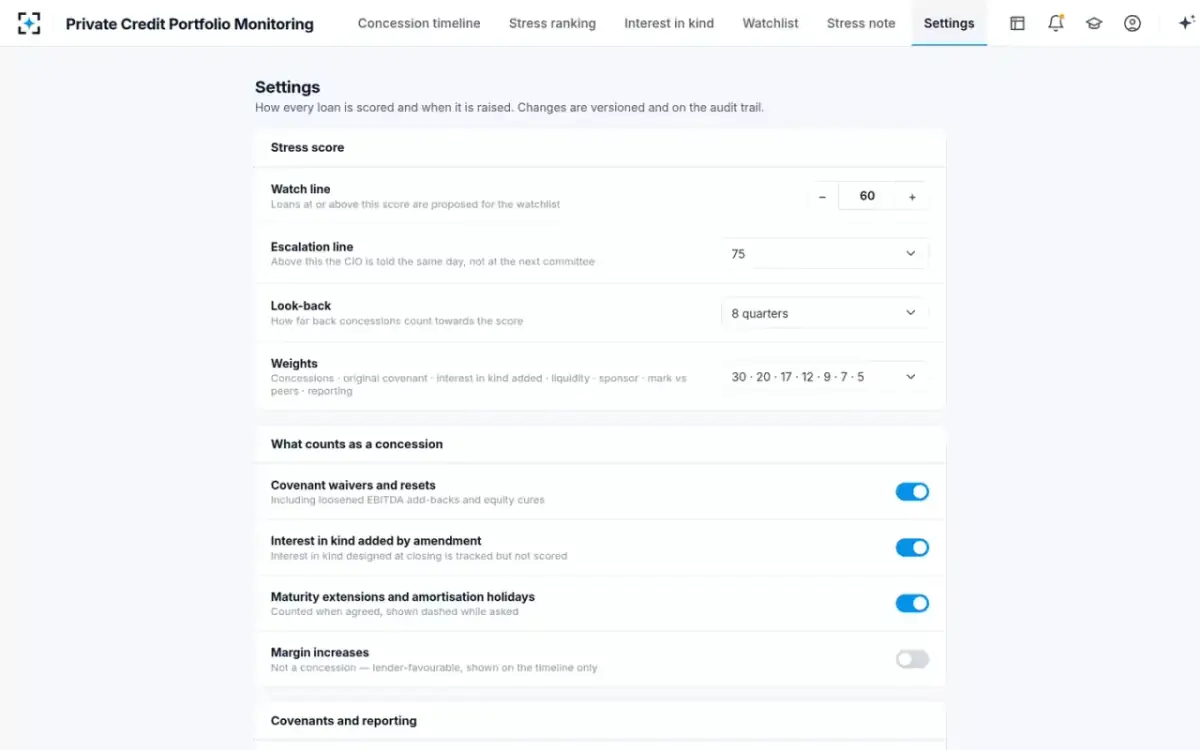
Conceptual soundness asks whether a model's design reflects real, defensible judgment about what it is measuring — not whether its code runs correctly. For a stress score built from seven drivers — concessions, the original-covenant test, interest in kind added by amendment, liquidity, sponsor support, the mark against peers, and reporting, weighted 30, 20, 17, 12, 9, 7 and 5 in one fund's own settings — soundness means the people who rely on the score can explain why concessions carry nearly twice the weight of interest in kind, and agree that the ranking reflects how stress actually shows up in a loan book they know. A weighting scheme nobody on the committee can defend is not conceptually sound just because it produces plausible-looking numbers.
Outcomes analysis: replaying the model on quarters you've already closed
Outcomes analysis is where validation stops being a design review and becomes a measurement. Take every loan from a quarter the fund has already closed, score it with the model exactly as it would have run at the time, and compare the result with what the committee actually decided — the rating it assigned, whether the loan went on the watchlist, whether non-accrual was ever declared. This is not a hypothetical exercise; it is the same replay a fund should run before going live in the first place, repeated periodically rather than done once and filed away.
What is a gold set, and how do you build one from your own files?
A gold set is the fund's own answer key: a sample of closed loan files paired with the decisions the committee actually made on them, used to measure a model rather than take its output on faith. Building one from scratch means pulling several years of closed quarters, the full amendment and certificate history for each loan in the sample, and — the part most funds skip — a few loans the committee got wrong in hindsight, not only the clean, correctly-called ones. A gold set with no hard cases in it cannot show whether a model would have caught what a fund's own process once missed.
What a gold set needs before you trust a replay
- At least four to eight closed quarters per loan
Enough history for the concessions and look-back drivers to be tested meaningfully, not just a single snapshot.
- The committee's actual past decision on each loan
A rating, a watchlist status, and whether non-accrual was ever declared — the thing the replay is measured against.
- Every amendment, waiver and consent from the period, not a summary
The amendment reader needs the section language itself to classify changes the same way it would on a live file.
- At least a few loans the committee got wrong in hindsight
A gold set that only contains clean, correctly-called loans cannot show whether the model would have caught the ones the fund missed.
- A record of which weights and look-back window were used for the replay
So a later re-validation after a settings change can be compared against this one on the same terms.
Reading a disagreement: when the model is wrong, and when the old file was
A disagreement between a replayed score and the committee's past decision is not automatically a model failure. Sometimes the model is missing a fact that never made it into a document — a lender call note that was never filed, a side letter the committee knew about informally. Sometimes the opposite is true: the replay surfaces a pattern, such as four concessions inside nine months, that the committee's own file-by-file review genuinely missed because no single document showed the whole sequence at once. Reading a disagreement means pulling both the model's cited sources and the committee's original note, side by side, and deciding — case by case — which one had the fuller picture, rather than assuming either one is right by default.
A driver with its points and its source, the unit a disagreement review checks
Agreement rate by driver, on one fund's own closed-quarter replay
Ongoing monitoring: what changes when the weights or the look-back change
Validation is not a single pass. Every time a fund changes a driver's weight or extends the look-back window for concessions, the outcomes-analysis step should run again, because a model validated under one set of weights has not been tested under a different one. The pattern below shows why: raising the sponsor-support weight dropped agreement from 88% to 81% against the fund's own past decisions, which is exactly the kind of change ongoing monitoring is supposed to catch before a committee relies on scores that have quietly drifted away from what was validated.
Agreement rate across two settings changes, each triggering a fresh validation pass
- Validated88%
- Gap
- Validated81%
- Gap
- Validated90%
- Gap
Is a stress score a "model" under the 2026 guidance?
It depends on how the score is built. The 2026 guidance defines a model as "a complex quantitative method, system, or approach that applies statistical, economic, or financial theories to process input data into quantitative estimates," and it excludes "simple arithmetic calculations, such as those found within spreadsheets, as well as deterministic rule-based processes and software where there are no statistical, economic, or financial theories underpinning their design or use" (SR 26-2). A score that adds seven extracted facts with fixed weights a committee chose sits close to that exclusion. A score whose weights or watch line were fitted to the fund's own history of non-accruals is estimating something, and looks much more like a model.
Two more lines in the guidance matter for an AI-built score. The agents that read amendments and certificates are generative or agentic AI, and the guidance says such models "are not within the scope of this guidance" — while adding that "a banking organization's risk management and governance practices should guide the determination of appropriate governance and controls" for them. And for anything bought rather than built, "sound practice includes developing an understanding of the vendor model, including its conceptual soundness, design, development data, and performance." The practical reading for a fund is the same either way: validate the score, test the extraction against the documents, and keep a record of both.
Does bank model risk guidance apply to a private credit fund?
Not directly. The 2026 guidance is addressed to banking organizations, and its cover letter says it is "expected to be most relevant to banking organizations with over $30 billion in total assets regulated by the Federal Reserve." A private credit fund or a business development company answers to its own investors, auditors and, for registered funds, the securities regulator. The guidance is still the most complete public statement of what a credible validation looks like, which is why fund risk teams, and the banks that lend to funds, use it as the reference point. Its definition of independent review is a useful test for any fund: "effective challenge is performed by individuals with the appropriate expertise to conduct a critical and objective challenge, sufficient independence to maintain objectivity, as well as the organizational standing and influence to effect any change."
For a fund that means the person who signs off a stress score's validation should not be the deal partner whose loans it ranks, and should have the standing to stop the score being used if the replay fails. A validation run by the team that chose the weights, on loans that team originated, is a self-review, however careful it is.
Why every driver needs a source, not just a probability
A probability or a confidence percentage attached to a score tells a committee how sure the model is, not why. Applied machine-learning work on credit scoring has run into this directly: a 2025 study building a credit-risk system on ensemble models described "addressing the challenges of model interpretability using SHAP and LIME" as a necessary part of making the system usable, not an optional extra (not peer reviewed; arXiv 2506.19383). A validated model that produces an unexplained probability is still not something a credit committee can act on with confidence — what makes a score checkable is the same thing that makes it validate-able in the first place: a document behind every driver, not just a number attached to the total. How each of six agents traces a driver back to its source works through this at the agent level.
The weights a validation pass is run against
What validation cannot do: replace the committee's own judgment
Validation establishes that a model's scores agree with a committee's past decisions often enough, and for understood reasons, to be worth relying on — it does not establish that the model should make the decisions itself. Even a stress score validated to a high agreement rate still produces a proposal, not a rating change; the committee chair's approval is a separate act from the model's output agreeing with what the chair would likely have decided anyway. The National Institute of Standards and Technology's framework is explicit that trustworthiness considerations run through design, development, use and evaluation together (NIST AI RMF) — validation is the evaluation step, not a replacement for the use step, where a person still has to act.
To see a validated score's drivers, sources and the committee's own decision sit side by side on one loan, start from Private Credit Portfolio Monitoring.
Questions people ask
How do you validate an AI model used for credit risk?
Through three steps: review whether the model's design and weights make sense to the people relying on it (conceptual soundness), replay it on quarters already closed and compare its output with what was actually decided (outcomes analysis), and re-run that comparison whenever the model's weights or settings change (ongoing monitoring).
What is outcomes analysis in model risk management?
Comparing a model's output against real, known outcomes rather than against its own internal logic. For a loan stress score, that means replaying closed quarters and checking the score against what the committee actually decided at the time, loan by loan.
How often should an AI scoring model be re-validated?
At minimum, every time its weights, watch line, escalation line or look-back window change — a model validated under one configuration has not been tested under a different one. Beyond that, a periodic re-run of the outcomes-analysis step, even with no settings change, catches drift that a static validation would miss.
What should change when the scoring weights change?
The validation, not just the score. A new set of weights is, in the sense that matters for model risk, a new model, and its agreement with the committee's past decisions should be re-measured rather than assumed to carry over from the prior weights' validation.
What is a gold set for testing a stress score?
A sample of closed loan files paired with the decisions a fund's own committee actually made on them, including some loans the committee got wrong in hindsight, used as the answer key a replayed model's scores are checked against.