Private credit monitoring software implementation does not begin with switching the current quarter's review over to a new tool. It begins earlier and more conservatively than that: on loan files the fund has already closed, so the first thing anyone sees is not a live score but a comparison between what the tool would have said and what the committee actually decided. A go-live plan built this way answers the only question that actually matters before a fund trusts a stress score in a live committee meeting — does this tool's read of a file agree with ours, and where it does not, why. The plan below is written around Botminds' Private Credit Portfolio Monitoring, whose agents rebuild each loan's amendment, interest and covenant history and rank the book by a stress score; the screens shown are fictional sample data.
The sequence below is a target shape, not a commitment to a fixed number of weeks; how long each stage takes depends on how many loans, how complete the documents are, and how much of the fund's own review history is available to replay against.
Week by week: from signed contract to the first live review
Four stages sit between a signed contract and a live committee review: get the documents and policy in, replay closed quarters against decisions already made, tune the settings on what the replay shows, and run one live quarter in shadow beside the team's existing process before switching over for real. Nothing about this sequence is specific to one vendor; it is the order any fund should insist on, because each stage exists to catch a different kind of mistake before it reaches a committee table.
A target sequence from signed contract to the first live review
- Documents and data inearly weeks
- Closed-file replaytarget
- Validation pass, weights tunedtarget
- Shadow run beside the teamtarget
- First live reviewgo-live
What you need to provide to start: documents, not just data
The most common go-live delay is not a technical one; it is a fund assuming it can hand over a loan tape and a few PDFs and call that a document set. What the replay and the later live run actually need is closer to what a new analyst would need on their first day: the full, executed credit agreements and amendments, the administrative agent's interest and PIK notices, compliance certificates with the financial statements behind them, the fund's own watchlist and rating policy, a committee note template, and — critically — a record of what the committee actually decided on a sample of files, so there is something to measure the replay against.
Documents and data needed before week one
- Every credit agreement and its amendments, waivers and consents
The full, executed set per loan, not a summary — the amendment reader needs the actual section language to classify each change.
- The administrative agent's interest and PIK notices
For as many trailing quarters as you want in the replay, so interest in kind designed at closing can be told apart from interest in kind added later.
- Compliance certificates and the financial statements behind them
As reported, so the covenant recomputer can test both the certificate's numbers and the original definition.
- Your current watchlist and risk-rating policy
The grade definitions and who approves a change — this becomes the settings the tool is configured to, not a generic default.
- Your committee note template
So the draft the tool produces matches what your committee already expects to read, not a new format to get used to.
- A sample of loan files spanning at least a few closed quarters
This is what the closed-file replay runs against — the more history, the more the replay can show about pattern detection, not just single-period accuracy.
- The actual decisions your committee made on those files
Without this, a replay can show what the tool would have said; it cannot show whether that agrees with what happened.
Why the first run should be on closed files, not live ones
A tool run for the first time on an open, live loan has no way to prove itself before its output matters. Run on a closed quarter instead, it can be checked against a known answer: what the committee actually decided, with the documents that were available at the time. This is the same logic as the banking agencies' April 2026 model risk guidance, which describes outcomes analysis as comparing "model outputs to corresponding real-world outcomes," and names "back-testing" as one of its forms (SR 26-2). A closed-file replay is back-testing on the fund's own decisions, and it is the cheapest way to find out whether a score is wrong before anyone relies on it.
What a model-validation pass looks like before go-live
Validation here means something specific and checkable, not a vendor's claim of accuracy. It means every covenant in the replay set recomputed as reported and again at its original definition and add-back cap, every interest-in-kind amount split between designed-at-closing and added-by-amendment, and every resulting score compared, loan by loan, against what the committee actually did. Where the two agree, that is evidence the settings are reasonable. Where they disagree, the disagreement is the thing worth reading closely — sometimes the model missed something the committee knew from a phone call that never made it into a document; sometimes the committee's own file missed a pattern across quarters that the replay surfaces for the first time.
Four checks before a live committee relies on the output
| Check | What has to be true | Who signs off |
|---|---|---|
| Document coverage | ≥ 95% of amendments, notices and certificates in the replay set read and classified without a gap flagged | a named operations lead |
| Replay agreement rate | scores and flags on closed quarters reviewed loan by loan against what the committee actually decided; every disagreement explained, not hidden in an average | the head of portfolio management |
| Weights and lines set | watch line, escalation line, look-back and the seven driver weights chosen and recorded as the fund's own settings | the chief investment officer |
| Shadow run | at least one live quarter scored in parallel with the team's own manual review, with differences reconciled before switching over | the portfolio manager |
Setting your fund's own weights, watch line and escalation line
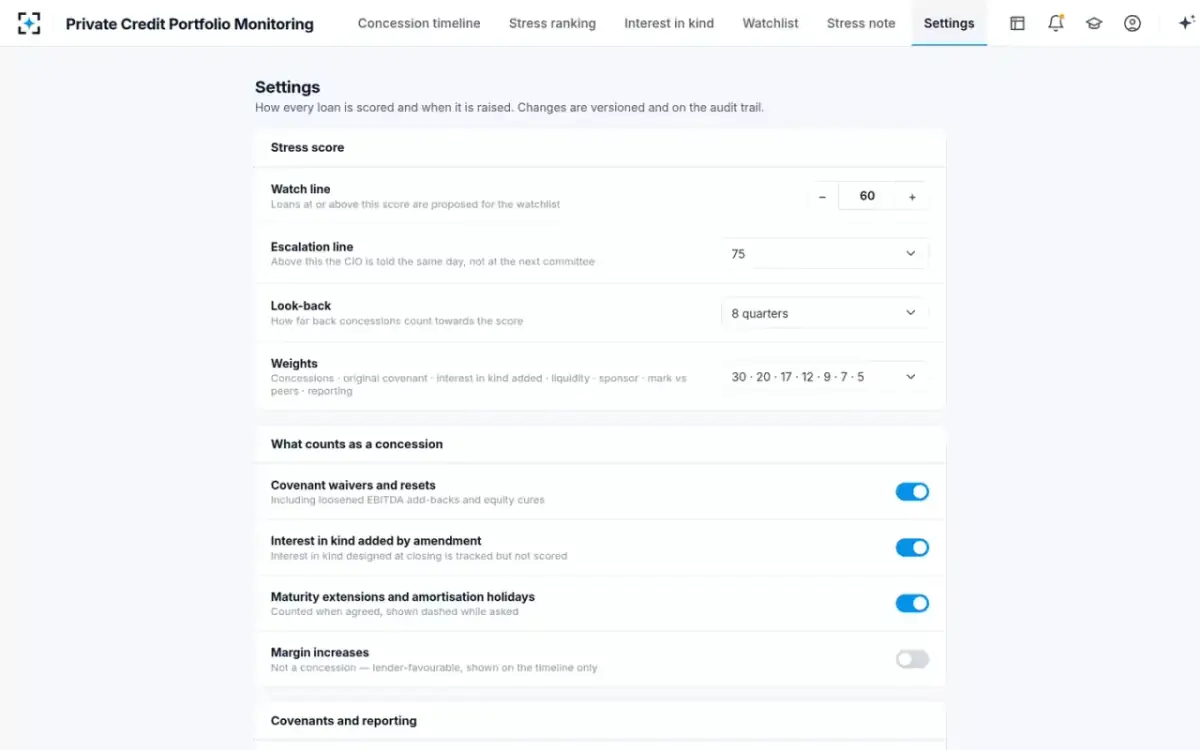
Nothing about how a loan is scored should arrive as a vendor default a fund never looks at again. The watch line — the score at or above which a loan is proposed for the watchlist — the escalation line that tells the chief investment officer the same day rather than at the next committee, the look-back window for how far concessions count, and the weights across the seven drivers are all settings, not fixed rules, and the replay stage is exactly when a fund should decide them. A fund whose closed-quarter replay shows concessions mattering more than the default weight assumes can move that weight before go-live, not after a loan it already knew about slips through.
What the go-live file should record: the limits, not just the score
The record a fund keeps from go-live matters as much as the replay result. The 2026 guidance puts limitations at the centre: "effective model use depends on a clear understanding of a model's limitations," and "sound validation identifies model limitations and errors and clarifies appropriate use." It also says why the paperwork is worth the effort: documentation "can help maximize the likelihood of continuity of operations, including supporting the tracking of recommendations, responses, and exceptions" (SR 26-2). For a stress score built from documents, the limits are specific and can be written down before the first live meeting.
Limits of a document-built stress score, and what the go-live file should say about each
| Limit | Why it exists | What to record before go-live |
|---|---|---|
| Facts that never reach a document | A sponsor call or an informal side understanding is invisible to an agent that reads only executed documents | Which drivers lean on such facts (sponsor support, usually), and how the team adds them |
| Gaps in the document set | A missing amendment or late certificate leaves a driver short of evidence | The replay’s coverage figure, and the rule that a gap is flagged rather than filled |
| Peer marks depend on who else holds the loan | A loan with no other holders has no peer median to compare | How the mark driver behaves when there is no peer, and who reviews those loans by hand |
| Weights chosen, not estimated | A committee’s judgment sets the seven weights; they are not fitted to defaults | Who chose them, the replay that supported them, and when they will be re-tested |
| The look-back window | Concessions older than the window stop counting | The window chosen and the loans whose history runs longer than it |
Who signs off at each step, and what each signature means
Four roles carry distinct responsibility through the sequence above, and conflating them is how a go-live plan quietly loses its own audit trail. A named operations lead confirms document coverage. The head of portfolio management reviews the replay's agreement rate against the committee's own past decisions. The chief investment officer sets and owns the scoring weights and lines. The portfolio manager runs the shadow quarter and decides when the team is ready to rely on the tool's output as the review of record. None of this is a formality — each signature is what a fund would want on file if an examiner later asked how the scoring model came to be trusted.
From a closed-file replay to the first live run
Agent
Closed-file replayLast quarter's amendments, interest notices and compliance certificates are read and scored as if live, against documents the team has already decided on.
A person decides
Settings tunedThe fund reviews where its own replay scores agreed and disagreed with its past decisions, and sets the watch line, escalation line and driver weights accordingly.
Agent
Shadow run beside the teamA live quarter is scored by the tool while the team still produces its own review by the existing process, side by side.
A person decides
First live runThe committee reviews the tool's output as the review of record for the first time, with the team's prior process available as a backstop.
Never: the switch happens for one committee meeting, not mid-quarter
What happens to the current quarter's review while you switch over
The current quarter's review does not stop while go-live is underway; it runs on the existing process, in parallel, until the shadow-run stage shows the tool's output and the team's manual review landing on the same conclusions for a live quarter. Only after that does the committee treat the tool's note as the review of record, and the switch happens at a single committee meeting rather than partway through a quarter already in progress — a loan under review should not change review methods mid-cycle.
A fund's own settings, not a vendor default, going into the shadow run
How is the scoring model validated before go-live?
The same way any model used in a financial decision should be, under the three-part discipline the banking agencies restated in their April 2026 model risk guidance, which replaced SR 11-7: conceptual soundness, outcomes analysis, and ongoing monitoring (SR 26-2). The guidance is written for banks, not funds, but it is the most complete public description of the discipline. Conceptual soundness means the seven drivers and their weights are reviewed and make sense to the fund that owns them. Outcomes analysis is the closed-file replay itself — scores compared against decisions already made. Ongoing monitoring means the model is re-checked whenever the weights or the look-back window change, not validated once and left alone. The three-part test, worked through in full, is the detail behind this stage.
What 'live' actually means: the first committee meeting it feeds
Go-live is not a date on a deployment calendar; it is the first committee meeting where the tool's stress note, not a person's manual spreadsheet, is the document the watchlist and valuation committee reads from. Everything before that — document ingestion, the closed-file replay, the settings review, the shadow quarter — exists to make that one meeting safe to rely on. The National Institute of Standards and Technology's framework for trustworthy AI use exists for exactly this kind of moment: a system whose output is about to carry real weight in a real decision, checked before it does (NIST AI RMF). A go-live plan that skips the replay and the shadow run is asking the first live committee meeting to be the validation.
Once live, the work does not disappear from the roles that used to do it by hand; it changes shape. Who monitors a private credit loan book, seat by seat, follows the analyst, portfolio manager, valuation lead, chief investment officer and head of portfolio management through what each one's week looks like once the agents are reading the documents first. To see the pilot stage itself, start from Private Credit Portfolio Monitoring.
Questions people ask
How long does it take to implement portfolio monitoring software?
It depends on document completeness and how many closed quarters are available to replay, more than on the software itself. A fund that can hand over complete credit files and a clear record of its own past committee decisions moves through the replay and validation stages faster than one still assembling its document set.
What documents do I need to start using monitoring software?
Full, executed credit agreements and amendments; the administrative agent's interest and PIK notices; compliance certificates and the financials behind them; your current watchlist and rating policy; a committee note template; and a sample of closed loan files along with the decisions your committee actually made on them.
What is a pilot on your own closed loan files?
A replay of a quarter the fund has already closed — the same amendments, notices and certificates the team worked from at the time — scored by the tool and compared loan by loan with what the committee actually decided, so disagreements can be found and explained before anything runs live.
Can you test the software on last quarter's loans first?
Yes, and this guide's whole sequence depends on it. A closed quarter is the only data a fund has that comes with a known answer attached — what the committee already decided — which is what makes it possible to check a scoring model before trusting it on an open file.
Who needs to be involved in a monitoring software rollout?
At minimum: a named operations lead for document coverage, the head of portfolio management for the replay's agreement rate, the chief investment officer for the scoring weights and watch lines, and the portfolio manager for the shadow run and the decision to go live.