PIK interest — payment-in-kind interest — is interest a borrower is allowed to pay by adding it to the loan's principal instead of handing over cash. A $100 million loan with a quarter's $2 million interest payment switched to PIK does not shrink; it grows to $102 million, and next quarter's interest is calculated on the larger number. The borrower's cash problem does not go away. It is deferred, compounding, onto a balance sheet that someone will eventually have to repay. The Federal Reserve's own Financial Stability Report puts it plainly: "In private credit markets, loan defaults remained at relatively low levels, but the elevated usage of payment-in-kind (PIK) provisions indicates some borrowers may face repayment difficulties" (Federal Reserve, May 2026 Financial Stability Report). Botminds' Private Credit Portfolio Monitoring reads every interest notice for every loan in a fund's book and keeps PIK that was built into a loan at closing apart from PIK added later by amendment, because the second kind is the one that predicts trouble.
The examples on this page come from a fictional sample fund as it runs through the solution: Corvane Senior Lending Fund II, 58 loans and $1.62 billion of par value. The external research comes from the Federal Reserve and the National Bureau of Economic Research, linked where it appears.
What one borrower's PIK switch actually added
$725K
capitalised to Brookhollow Provisions’ loan in one quarter, added by amendment
8.6%
of the fund’s $41.3M quarterly interest income was paid in kind
5.1%
of income was PIK added by amendment — against 0.8% two years earlier
What PIK interest actually is
A conventional loan pays interest in cash on a schedule: quarterly, say, at a rate tied to a reference rate plus a spread. A PIK provision lets some or all of that interest instead be "paid" by adding it to the loan's outstanding principal. The lender books the income — it has still been earned — but receives no cash for it this period, and the next period's interest is calculated on the now-larger balance. The Federal Reserve describes the mechanics the same way: "PIK provisions allow borrowers to defer interest payments by adding them to the loan principal, which preserves liquidity but could indicate credit quality deterioration" (Federal Reserve, May 2026 Financial Stability Report).
"Preserves liquidity" is the borrower's side of the trade. A company that cannot generate enough cash to cover its interest bill this quarter, for whatever reason — a soft quarter, a working-capital squeeze, a sponsor unwilling to inject more equity — gets to keep that cash rather than hand it to the lender. The lender's side is less comfortable: it has agreed to lend the deferred interest back to the same borrower, at the same time it already has doubts about the borrower's ability to pay. Private credit as an asset class exists because non-bank lenders extend "debt-like, non-publicly traded instruments" directly to private businesses that banks increasingly do not serve (Federal Reserve, FEDS Notes), and PIK is one of the terms those loans are negotiated with from the start — not always a sign of distress, but always a term worth tracking.
Is PIK interest good or bad for a lender?
Neither, by itself. A loan can carry a PIK option on day one, priced into the spread the lender charges precisely because it expects to use it occasionally — a cushion built for a cyclical business, not a warning sign. The same mechanism, invoked for the first time eighteen months after closing because the borrower cannot otherwise make its interest payment, is a different fact entirely, even though the accounting entry looks identical. The question a lender should ask is not "does this loan have PIK" but "why is PIK being used, and who decided it would be."
That is the distinction the Fed's own language gestures at without resolving: elevated PIK usage "indicates some borrowers may face repayment difficulties," which is a statement about the market in aggregate, not a rule for any one loan. A fund with a handful of cyclical, intentionally-PIK-toggle loans and a fund with a growing list of loans where PIK was never designed but was granted under pressure can show the same aggregate PIK percentage and mean very different things.
The three kinds of PIK: designed, toggle, and added by amendment
Private credit agreements use PIK in three distinct ways, and conflating them is the most common way a portfolio report understates risk.
Three kinds of PIK interest, and what each one means
| Kind | How it arises | What it signals |
|---|---|---|
| Designed at closing | A fixed PIK component is written into the agreement from day one — part of the pricing, not a response to stress. | Priced risk. Track it; do not score it as a concession. |
| Toggle | The borrower may elect cash or PIK each period, usually at a worse rate if it elects PIK, under a term set at closing. | An option the borrower is using more, which is itself information — worth flagging if a toggle election is about to recur. |
| Added by amendment | The original agreement had no PIK, or less of it, and a later amendment adds or increases it — usually alongside other concessions. | A borrower leaning on the fund. This is the kind that correlates with repayment difficulty. |
In the fictional sample fund's third quarter, $1,450,000 of PIK interest across three loans was designed at closing and is tracked but not scored — it is simply how those loans were built. $2,110,400 across six loans was added by amendment: Brookhollow Provisions Holdings alone accounts for $725,400 of it, Pinecrest Modular $316,000, Tidewell Marine $300,000, Quarrytown Building $295,000, Valecrest Home $264,000 and Calderwood Pet Nutrition $210,000. Only the second category — PIK added by amendment — counts toward the fund's own stress score, weighted at 17 of 100 points in its default settings.
PIK added by amendment this quarter, loan by loan: one borrower carries a third of it
Why PIK is rising across private credit and BDCs
The pattern in the fictional sample fund matches what regulators are measuring at the market level. Economists at the Federal Reserve Bank of Boston read the schedules of investments of 168 business development companies — nearly 890,000 company-quarter loan observations — and found that "the share of BDC loans with PIK usage rose from approximately 6 percent to roughly 10 percent by early 2026—a 67 percent increase over three years" (Wang, Fillat and Shen, Boston Fed Current Policy Perspectives, August 5, 2026). They read it as "consistent with higher interest rates since 2022 having mechanically increased debt service burdens for floating-rate borrowers, which constitute the majority of BDC portfolios." The rise has come over the same years that private credit itself has grown rapidly, as non-bank lenders that are "highly capitalized, with equity typically accounting for 65–80 percent of total assets, compared with about 10 percent for U.S. banks," have taken on a larger share of lending to borrowers that banks used to serve (Matvos, Piskorski & Seru, NBER Working Paper 34991).
A larger, younger market lending to riskier, smaller borrowers will naturally see more requests for payment flexibility, PIK among them. That alone does not make rising PIK a crisis signal. What makes it worth a portfolio manager's attention is not the market-wide trend but what is happening inside any one fund's own book, loan by loan.
What does a growing share of PIK income tell a portfolio manager?
Inside one fund, PIK added by amendment as a share of total interest income is a trend line worth watching on its own, separate from any single loan's rating. In the fictional sample fund, PIK added by amendment grew from 0.8% of interest income two years ago to 5.1% today — a more than six-fold increase, while the loans involved mostly kept their original credit ratings. A portfolio manager who only reads today's rating sees six loans paying PIK by amendment, most still at the internal rating they carried before it. A portfolio manager who reads the trend sees a book that is quietly extending more credit, in the form of unpaid interest, to a growing slice of its borrowers — exactly the pattern a single quarter's snapshot hides.
Two years of PIK added by amendment, as a share of interest income
- Two years ago0.8%
- One year ago2.4%
- Two quarters ago3.6%
- This quarter5.1%
Why PIK still counts as income, for the books and for tax
Interest income is recognized when it is earned, not when cash changes hands — a lender that has agreed to let a borrower add $725,400 to a loan's principal instead of paying it still records $725,400 of interest income for the period, under ordinary accrual accounting. That is precisely why PIK matters to a fund's own reported earnings and to the investors who are paid from them: income can be rising on paper while the cash a fund actually collects from its loans is falling. Tax follows the same logic. Interest that is not "unconditionally payable in cash or in property (other than debt instruments of the issuer)" is not qualified stated interest under the Treasury regulations (26 CFR 1.1273-1), so interest that may be paid in kind generally makes the loan an original issue discount instrument, and the holder must include "the sum of the daily portions of the original issue discount" in gross income as it accrues (26 U.S.C. 1272). A lender can owe tax, or a fund can owe distributions, on income it has not received in cash. A fund with a large and growing share of PIK income needs to be able to show, separately, the cash it has actually received, the PIK that was designed into its loans from the start, and the PIK added later under pressure — because an investor asking "is this fund's income real" is really asking which of those three categories it is looking at.
Reading a loan's PIK history instead of its PIK balance
A single number — "this loan has $2.1 million of accrued PIK" — says almost nothing on its own. The history behind that number says a great deal. Brookhollow Provisions Holdings, the fictional sample fund's most-watched loan this quarter, did not arrive at PIK in one step. Its interest terms moved from SOFR plus 575 basis points, all paid in cash, to SOFR plus 625 with 300 basis points payable in kind — a change made alongside three other concessions over nine months, not on its own. Reading that one loan's full concession history, rather than its current terms, is what let the fund's portfolio manager see the pattern rather than four isolated, each-looked-reasonable decisions; what an amendment request trades away, and why the fourth one tells you something the first one didn't, follows that history in full.
Interest in kind, kept apart by how it arose
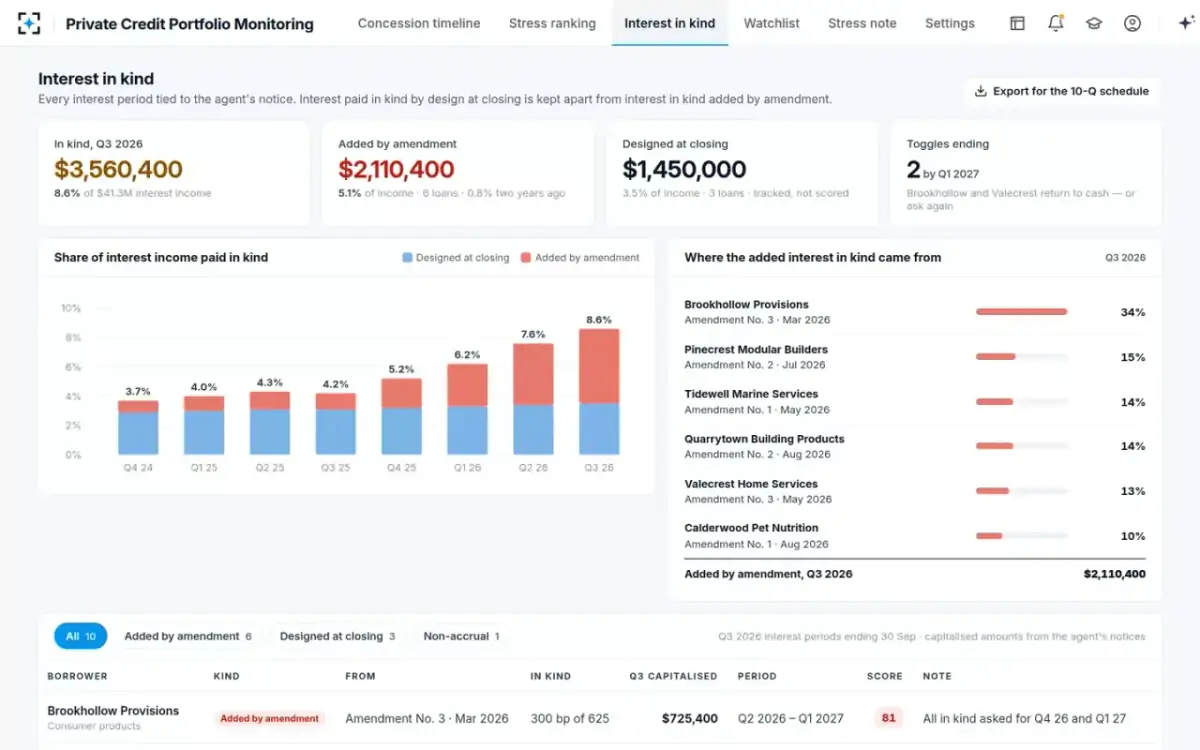
What a PIK switch does to the fund's own distributions
PIK income is real income under accrual accounting, but it is not cash a fund can distribute to its own investors without selling something or drawing a credit line. A fund whose interest income looks healthy while its PIK share quietly climbs from 0.8% to 5.1% is a fund whose cash distributions are increasingly backed by promises rather than payments. That gap does not show up in a headline yield number; it shows up only when someone lines up reported interest income against cash actually collected, loan by loan and quarter by quarter — which is the same work, done at the loan level, that separating designed PIK from added PIK requires in the first place.
The line between a liquidity bridge and a workout
Every PIK election sits somewhere on a spectrum between two very different stories. At one end, PIK is a liquidity bridge: a fundamentally sound borrower smooths one difficult quarter and resumes cash payments afterward, exactly as the option was designed to let it do. At the other end, PIK is the first visible step of a workout: a borrower that cannot service its debt in cash now, and may not be able to later either, buying time while its lenders decide what to do. The Fed's own framing — PIK "preserves liquidity but could indicate credit quality deterioration" — sits deliberately between those two stories, because from the outside, in any single quarter, the two can look identical.
What separates them is what happens next: does the PIK toggle reverse to cash within a quarter or two, or does it compound alongside a second concession, then a third? That is the question Private Credit Portfolio Monitoring's six agents are built to keep visible — the interest and PIK tracker flags "toggles ending in the next two quarters" so a portfolio manager is watching for the reversal, and the amendment reader never counts a concession it cannot cite to a section of the agreement, so a PIK election that was always part of the deal is never mistaken for one added under duress. Brookhollow's path, from a single switch to PIK to seven concessions in sixteen months if its open request is agreed, is the workout story playing out in real time; what the Fed, BIS and NBER actually measure before an individual fund's loans fail puts that one loan's pattern against what regulators watch at the level of the whole market.
To see a fund's own PIK, designed and added, kept apart on one screen, start from Private Credit Portfolio Monitoring.
Questions people ask
What is a PIK toggle?
A PIK toggle is a term, set at closing, that lets a borrower choose each interest period whether to pay in cash or add the interest to principal — usually at a higher rate if it chooses PIK. The option itself is not a warning sign; a rising rate of elections, especially late in a loan's life, is worth watching.
Does PIK interest count as income for the lender?
Yes. Interest accrues and is recognized as income when it is earned, whether it is paid in cash or added to the loan's principal. A fund with rising PIK income needs to track, separately, how much of its reported interest income it has actually collected in cash.
What percentage of loans carry PIK interest?
There is no single figure for all of private credit. For business development companies, Boston Fed economists found the share of loans with PIK usage rose from about 6% to roughly 10% by early 2026; the Federal Reserve's Financial Stability Report describes usage as "elevated" without giving a number. A fund's own PIK share, measured loan by loan and separated into designed and added, is the figure that actually describes its own book.
What happens to PIK interest if a loan goes on non-accrual?
Once a loan is placed on non-accrual, interest — cash or PIK — generally stops being recognized as income at all; amounts already capitalised into the loan balance typically stay on the books as principal, but future PIK is no longer booked as earnings. A loan with a large accrued-but-unrecognised PIK balance at the point it goes on non-accrual, as in the fictional sample fund's Ostrander Dental loan, shows the gap between income a fund once reported and cash it will ever collect.
Why do private credit borrowers use PIK instead of just refinancing?
Refinancing requires a new lender willing to extend fresh credit, usually at a market rate that reflects the borrower's current condition — which may be worse, and more expensive, than its existing terms. A PIK election keeps the existing lender in place and the existing rate largely intact, deferring the cash cost rather than resetting it, which is why it is often the first request a borrower under pressure makes rather than the last.
Is a rising PIK share always bad news for a private credit fund?
No — some PIK is designed into loans intentionally, particularly for cyclical borrowers, and using it as intended is not a credit event. What separates a manageable PIK share from a warning sign is whether the increase is concentrated in PIK added by amendment, under pressure, after the loan was already structured without it — and whether it arrives alongside other concessions on the same loans.