Does private credit pose a systemic risk? The honest answer from the regulators and academics who study it closely is: not in the way banks do, not yet, but the links between private credit and the banking system are growing and worth watching. That is a more careful answer than either side of the public debate usually gives, and it is worth reading in the original sources' own words rather than in a headline. Botminds' Private Credit Portfolio Monitoring does not answer the market-wide question — no fund-level tool can — but the loan-by-loan risk the regulators say is harder to see from outside is exactly what it is built to make visible inside one fund's own book.
The research on this page comes from the Federal Reserve, the Bank for International Settlements, the U.S. Treasury's Office of Financial Research, and the National Bureau of Economic Research, linked where it appears. The portfolio example is a fictional sample fund, Corvane Senior Lending Fund II, as it runs through the solution.
How big private credit has gotten
$2.5T+
global private credit fund assets under management, by the BIS’s March 2025 count
$1.34T
U.S. private credit market size by 2024-Q2
$95B
bank lending commitments to private credit vehicles by 2024-Q4, up from about $8B in 2013
How big is the private credit market, really?
The scale of private credit's growth is not in dispute among the institutions that track it. The Bank for International Settlements puts private credit funds' assets under management at "over $2,500 billion today," up from a negligible base in the early 2000s (BIS Quarterly Review, March 2025) — an asset class that barely existed at the turn of the century. The U.S. share alone "totaled $1.34 trillion ... and nearly $2 trillion globally by 2024-Q2" according to separate Federal Reserve research (Federal Reserve, FEDS Notes, May 2025). Growth of that speed is itself a reason regulators pay closer attention than they might to a more mature, slower-growing market — not because fast growth is automatically dangerous, but because fast growth makes yesterday's assumptions about a market's behavior under stress less reliable.
Do private credit funds use leverage like banks?
No, and this is the structural fact that most separates private credit from the banking system it is sometimes compared to. Banks fund themselves mostly with deposits and other short-term, withdrawable liabilities, against a small sliver of equity — commonly cited at around 10% of assets. Research comparing the two finds "private credit funds are highly capitalized, with equity typically accounting for 65–80 percent of total assets, compared with about 10 percent for U.S. banks" (Matvos, Piskorski & Seru, NBER Working Paper 34991). A private credit fund that loses money on its loans burns through its own investors' capital, which has typically committed to stay locked up for years; a bank that loses an equivalent share of its asset value can face depositors who want their money back the same day. The leverage and the funding mismatch that make a banking crisis spread fast are largely absent from the private credit fund structure itself.
Two very different balance sheets
A typical U.S. bank: About 10%
A private credit fund: Typically 65–80%
A typical U.S. bank: Deposits and other short-term, withdrawable liabilities
A private credit fund: Committed capital from investors, typically locked up for years
A typical U.S. bank: Funding can run, forcing fire sales
A private credit fund: Losses are absorbed by investors’ committed capital, without a funding run
What regulators are actually watching: the counterparty channel
If private credit funds themselves are not structured like banks, the channel regulators watch most closely is the connection between the two: how much banks lend to private credit funds and vehicles, directly. The U.S. Treasury's Office of Financial Research states plainly that "counterparty exposures between banks and private credit funds are the main channel for risk transmission" between the two systems (U.S. Department of the Treasury, Office of Financial Research, Brief 26-02), and its brief estimates that "total bank and nonbank lending to private credit entities, including BDCs, ranges from $410 to 540 billion and capital call obligations total approximately $300 billion as of year-end 2024," with U.S. financial institutions providing about 80% of that lending (OFR Brief 26-02). The Office of Financial Research adds that "this channel merits close monitoring given the industry's rapid growth" (OFR Brief 26-02) — not a conclusion that the channel is already dangerous, but a statement that it is growing fast enough to deserve a closer look than it may have received when it was smaller.
Separately, the Federal Reserve's own research tracks the growth of this specific lending relationship over time: banks' committed lending to private credit vehicles grew from around $8 billion in the first quarter of 2013 to around $95 billion by the fourth quarter of 2024 (Federal Reserve, FEDS Notes, May 2025) — more than a tenfold increase, concentrated mostly in the years after private credit's own assets under management began accelerating.
The counterparty channel's growth, two measures
- 2013-Q1 · $8B$8B
- 2024-Q4 · $95B$95B
Is private credit the next subprime?
The comparison people reach for is almost always subprime mortgages and the 2008 financial crisis, and the comparison mostly does not hold up under the data above. What made the subprime crisis systemic was not that risky loans existed — risky loans always exist — but that those loans were funded through short-term, highly leveraged structures, widely held by banks and shadow banks whose own funding could run at the first sign of trouble, with losses that propagated through a dense web of interconnected counterparties faster than anyone could trace them in real time. Private credit funds, capitalized at 65–80% equity with investor capital locked up for years, lack the funding-run mechanism that turned mortgage losses into a banking panic. The Federal Reserve's own research concludes, carefully, that "the financial stability implications of banks' lending to private credit seem limited so far" (Federal Reserve, FEDS Notes, May 2025) — a measured statement about the present, not a permanent verdict, and one that applies specifically to the bank-lending channel rather than to every conceivable way private credit could eventually cause trouble.
What PIK and amend-and-extend have to do with the systemic-risk debate
The market-wide debate and the loan-by-loan reality connect through exactly the mechanisms this solution tracks. Rising use of interest paid in kind and repeated amend-and-extend requests are, in aggregate, among the signals regulators point to when they describe private credit's risks as worth monitoring — the Fed's own Financial Stability Report language about "elevated usage of payment-in-kind (PIK) provisions" indicating borrowers "may face repayment difficulties" is a market-level observation built from the same kind of loan-level facts a single fund's own portfolio review is trying to catch. The connection runs in both directions: a market-wide trend toward more PIK and more amendments is itself made up of individual loans like Brookhollow Provisions Holdings, each one a data point regulators can see only in aggregate and far later than the fund holding the loan can see it directly.
Where the risk is real today: inside one fund's own book
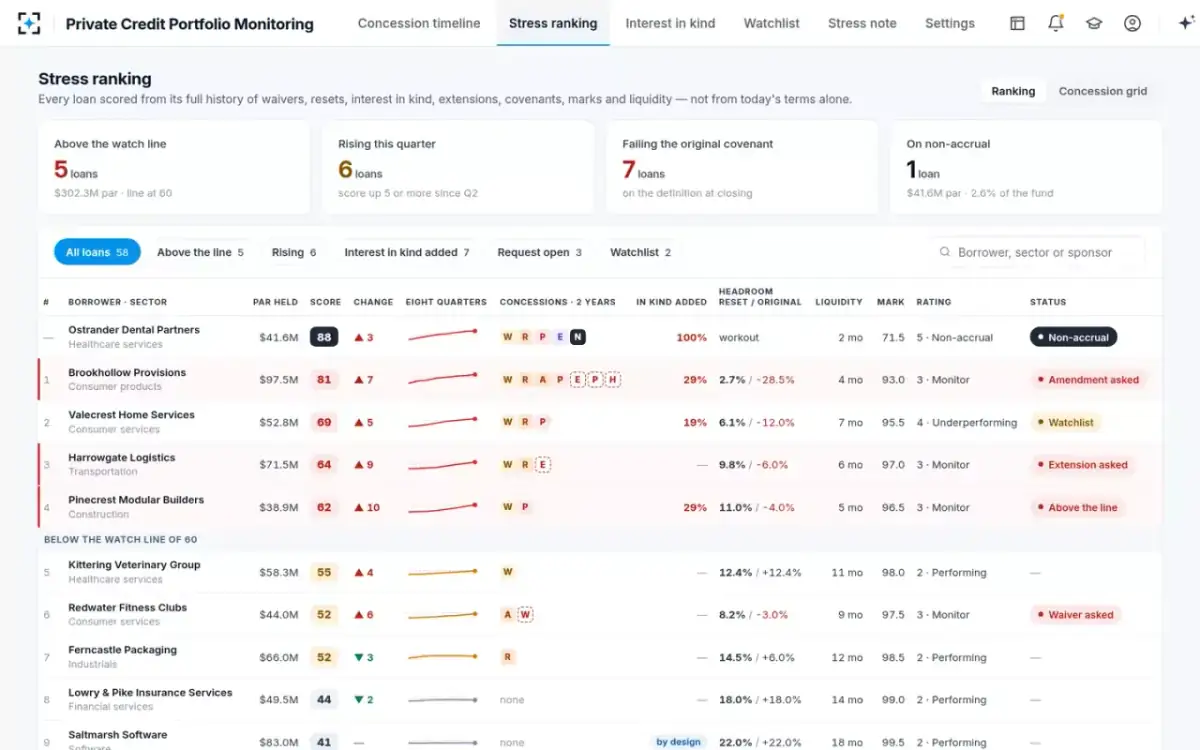
This is the asymmetry worth sitting with. Regulators and academics can measure the private credit market's aggregate size, its aggregate capitalization, and the aggregate exposure running through the banking system — all useful for judging whether the system as a whole is at risk. None of that aggregate data tells a single fund's portfolio manager whether the particular loan in front of them, this quarter, is the one quietly deteriorating behind a string of individually reasonable amendments. The risk that is concrete and actionable today is not "is private credit systemic" — it is "which of my 58 loans is Brookhollow Provisions Holdings," a borrower with four concessions in nine months, interest increasingly paid in kind, and a widening gap between its reset covenant and the covenant it was originally underwritten to.
One fund's own stress, ranked
What the Fed's own stress tests found, and what they didn't test
The Federal Reserve's research goes a step further than description: it models a stress scenario in which private credit vehicles draw down all their remaining undrawn bank credit lines simultaneously — a liquidity shock, rather than a credit-loss shock. The finding was that "such an increase in drawdowns would have a minimal impact on both aggregate CET1 capital ratio (about 2 basis points) and aggregate Liquidity Coverage Ratio ... about 1 percentage point," leading the authors to conclude that "the largest U.S. banks are well capitalized and highly liquid, allowing them to absorb a significant drawdown risk from private credit vehicles, thus financial stability concerns from the direct credit channel seem limited" (Federal Reserve, FEDS Notes, May 2025). That is a real, specific, favorable finding — and it tests one scenario: a simultaneous liquidity draw on existing credit lines. It does not test, and does not claim to test, a scenario in which private credit's own underlying loans experience a wave of credit losses at once, which is a different kind of shock than the one modeled. A finding that the banking system can absorb a liquidity shock from private credit is not the same claim as a finding that private credit's own loan losses, however they arise, would stay contained.
Reading "warrants monitoring" without reading "systemic threat" into it
Regulatory language is written carefully, and "warrants monitoring" or "merits close monitoring" is a specific, modest claim — it means a trend is moving fast enough, or a channel is large enough, that the people whose job is to watch for systemic risk want better visibility into it going forward. It does not mean the thing being monitored has already been found dangerous, and treating every monitoring statement as a near-miss headline misreads exactly the kind of careful, bounded language regulators use on purpose. The Office of Financial Research's own framing — a channel that "merits close monitoring given the industry's rapid growth" — is language about growth and visibility, not language about a crisis already underway. Reading it as "the Fed says private credit could cause the next crisis" overstates what the sentence actually says; reading it as "regulators want to see more clearly into a growing part of the financial system" is the accurate version.
What a fund can measure about its own book that a regulator can't
A regulator studying private credit works from aggregated, often lagged data across thousands of funds and loans — enough to see market-wide trends, not enough to see one borrower's fourth concession the week it is requested. A fund's own data is the opposite: narrow, but immediate and complete. The solution's own frame for this is a line from its FAQ: the point of tracking a loan's full history of concessions is "so a borrower leaning on the fund shows up before the loan goes on non-accrual" — a fund-level answer to an individual-loan problem, not an attempt to resolve the market-level systemic-risk debate the Fed, BIS and Office of Financial Research are having.
The banking regulators' own loan reviews show where the weak loans in syndicated lending sit. In the 2025 Shared National Credit review of $6.9 trillion of large shared commitments, U.S. banks held 45% of all commitments but only 22% of the non-pass loans, while "nearly half of total SNC commitments are leveraged, and leveraged loans comprise 81 percent of non-pass loans" (FDIC, 2025 Shared National Credit Program Report). The weaker credits have migrated away from banks and toward the leveraged, nonbank-held part of the market, which is where much of private credit's lending sits.
Where the weak large loans sit: banks hold less of the risk than of the book
To see a fund's own loans ranked by accumulated stress — the question a market-wide statistic cannot answer for any one portfolio manager — start from Private Credit Portfolio Monitoring.
Questions people ask
Does private credit pose systemic risk?
Not in the way banks do, based on current research: private credit funds are far more heavily capitalized than banks and do not rely on the short-term, runnable funding that makes banking crises spread quickly. Regulators do flag the growing lending relationship between banks and private credit funds as a channel worth close monitoring, which is a narrower and more specific concern than systemic risk from the asset class as a whole.
Is private credit the next subprime?
The comparison mostly does not hold up. The 2008 crisis spread through highly leveraged, short-funded institutions; private credit funds are capitalized at roughly 65–80% equity with investor capital typically locked up for years, which removes the funding-run mechanism that made subprime losses systemic.
How big is the private credit market?
Private credit funds' global assets under management exceed $2,500 billion, according to the Bank for International Settlements' March 2025 Quarterly Review. The U.S. market alone was estimated at $1.34 trillion by the second quarter of 2024.
How exposed are banks to private credit funds?
Growing, but modest relative to bank balance sheets so far. Federal Reserve data shows bank committed lending to private credit vehicles rising from about $8 billion in 2013 to about $95 billion by the end of 2024; the Treasury's Office of Financial Research estimates total bank and nonbank lending to private credit entities, including BDCs, at $410–540 billion as of year-end 2024.
Why are regulators watching private credit?
Mainly because of its rapid growth and its deepening financial links to banks through lending and counterparty relationships, not because current data shows an active crisis. The Office of Financial Research describes the bank-to-private-credit lending channel as one that "merits close monitoring given the industry's rapid growth."
How is PIK interest connected to the systemic-risk debate?
Rising PIK usage across the market is one of the loan-level signals regulators cite when describing private credit risk as worth watching in aggregate. At the level of one fund, the same signal — interest increasingly paid in kind rather than cash, especially when added by amendment rather than designed into a loan — is a warning sign about a specific borrower, well before it shows up in any market-wide statistic.