Loan risk ratings are a five-grade scale that bank examiners and, by extension, most lenders use to describe how much concern a loan deserves: Pass, Special Mention, Substandard, Doubtful and Loss, each running from "no identified weakness" to "not worth carrying as an asset at all." The grades are not a private credit fund's own invention — they come from decades of bank-examination practice, with wording published by federal regulators, and most funds adopt the same scale or a close variant of it for their own watchlists. Botminds' Private Credit Portfolio Monitoring assigns every loan a rating on this scale and, separately, a 0–100 stress score built from a loan's full concession history — because the two numbers can disagree, and when they do, the disagreement is the thing worth reading.
The examples on this page come from a fictional sample fund as it runs through the solution: Corvane Senior Lending Fund II. The grade definitions are quoted directly from the FDIC's own examination manual.
One loan, still rated 3, after four concessions
3
Brookhollow Provisions’ rating after four concessions in nine months
7.39×
leverage on the loan’s original covenant definition, against 6.57× as reported
6qtrs
the original covenant has now failed, even while the reset test still passes
The five grades, in the regulators' own words
The FDIC's Risk Management Manual of Examination Policies sets out the scale examiners use to classify bank assets, and the same five grades — in substance, if not always in a fund's own internal names for them — show up across most institutional credit books, including private credit funds and business development companies that answer to their own investors rather than to a banking regulator.
The five grades, quoted from the FDIC's own manual
Pass
No identified weakness that would cause an examiner to classify the loan. The large majority of a healthy book sits here.
Special Mention
"A Special Mention asset has potential weaknesses that deserve management’s close attention. If left uncorrected, these potential weaknesses may result in deterioration of the repayment prospects for the asset or in the institution’s credit position at some future date."
Substandard
"Substandard loans are inadequately protected by the current sound worth and paying capacity of the obligor or of the collateral pledged, if any."
Doubtful
"Loans classified Doubtful have all the weaknesses inherent in those classified Substandard with the added characteristic that the weaknesses make collection or liquidation in full ... highly questionable and improbable."
Loss
"Loans classified Loss are considered uncollectible and of such little value that their continuance as bankable assets is not warranted."
The manual defines the four grades below Pass; Pass is, in effect, every loan an examiner finds no reason to criticize. The four are not equal in kind. Special Mention is a warning, and the manual is explicit that "Special Mention assets are not adversely classified and do not expose an institution to sufficient risk to warrant adverse classification." Substandard, Doubtful and Loss are the three adverse classifications, and each is defined by what makes collection doubtful, not simply by how a borrower's numbers look this quarter.
What is a special mention loan?
Special Mention is the first rung below Pass, and it is deliberately a soft one: "potential weaknesses that deserve management's close attention," not weaknesses that have yet caused a loss or even a missed payment. A borrower can be rated Special Mention while current on every payment and in compliance with every covenant, if something about its trend — a weakening industry, a management change, rising leverage even within covenant limits — gives a lender reason to watch more closely than usual. It is the grade built for "nothing has gone wrong yet, but something could," which is also why it is the easiest grade for a rating file to under-use: there is no trigger event that forces the question the way a missed payment or a covenant breach does.
Substandard vs doubtful: where the line actually sits
Substandard and Doubtful both describe a loan already in trouble, and the FDIC's own language draws the line between them around how confidently a loss can be sized. A Substandard loan is one "inadequately protected by the current sound worth and paying capacity of the obligor or of the collateral pledged, if any"; it "must have a well-defined weakness or weaknesses that jeopardize the liquidation of the debt," and such loans "are characterized by the distinct possibility that the institution will sustain some loss if the deficiencies are not corrected" (FDIC, Risk Management Manual, Section 3.2). Doubtful goes a step further: loans so classified carry "all the weaknesses inherent in those classified Substandard with the added characteristic that the weaknesses make collection or liquidation in full, on the basis of currently known facts, conditions, and values, highly questionable and improbable" (FDIC, Risk Management Manual, Section 3.2). The practical distinction a committee has to make is whether full collection is still a realistic outcome if the weaknesses are corrected. If it is, Substandard is defensible. If the honest answer is "we don't see how this gets repaid in full," the loan has moved to Doubtful whether or not anyone wants to say so out loud.
Loss doesn't mean worthless — it means stop carrying it as if it were
Loss is the most misread of the five grades, because it sounds final in a way the actual definition is more precise about. The manual's own words: "Loans classified Loss are considered uncollectible and of such little value that their continuance as bankable assets is not warranted" (FDIC, Risk Management Manual, Section 3.2). The manual adds that the classification "does not mean that the loan has absolutely no recovery or salvage value but rather it is not practical or desirable to defer writing off this basically worthless asset even though partial recovery may be effected in the future." A Loss classification is an instruction about accounting treatment, not a prediction that recovery is impossible. What the grade forces is an end to carrying the loan on the books at a value the evidence no longer supports, which is a different question from whether every last dollar is gone for good.
Who assigns the rating, and how often it is reviewed
In a bank, ratings are assigned by the institution's own credit function and tested independently by examiners on a cycle set by the regulator. In a private credit fund, there is no outside examiner assigning the grade — the rating is the fund's own judgment, usually proposed by a credit analyst or portfolio manager and approved by a credit committee or a chief investment officer, reviewed on whatever cadence the fund sets for itself. In the fictional sample fund, that cadence is quarterly: Q3's results close, the watchlist and valuation committee meets the following week, and every loan's rating is revisited alongside its stress score at that meeting — more often if a specific event, such as a new amendment request, calls for it sooner.
Why a covenant reset can leave the rating untouched for quarters
A rating review usually asks "does this loan still pass its covenants, on the terms currently in force?" — and a covenant reset, by definition, changes what "currently in force" means. Brookhollow Provisions Holdings' leverage covenant was reset from 5.75× to 6.75× as part of an earlier concession. Tested against the new 6.75× limit, the borrower's reported 6.57× passes. Tested against the original 5.75× limit the loan was actually underwritten to, the same borrower's leverage, calculated the same way, is 7.39× — a clear breach, and one that has now persisted for six quarters. A rating review that only re-tests the current covenant never sees the second number, because the reset, not the rating, is what normally gets re-checked each quarter.
The same borrower, two covenant tests
Reset covenant (6.75×): 6.57× — passes
Original covenant (5.75×): 7.39× — fails
Reset covenant (6.75×): A borrower in compliance
Original covenant (5.75×): Not tested unless the original definition is kept alongside the reset
Reset covenant (6.75×): Zero, on the reset test
Original covenant (5.75×): Six, on the original test
Testing the original covenant as well as the reset one
The fix is not complicated in principle: keep testing the covenant a loan was originally underwritten to, alongside whatever reset has since been granted, for as long as the loan is outstanding. In practice it is tedious enough by hand — recomputing an add-back-adjusted leverage ratio twice, on two different definitions, every quarter, for every loan in a book — that it is exactly the kind of check that quietly stops happening once a reset is granted and a file moves on. Private Credit Portfolio Monitoring's covenant recomputer agent is built never to retire the original definition: it recomputes each covenant "as reported, then on the definition, level and add-back cap at closing," reports headroom on both, and counts the quarters a loan has been failing the original test even while passing the current one. It never resets a covenant on its own or accepts an add-back above the cap it is testing — that decision stays with the people who negotiate the amendment.
From rating to watchlist: what moves a loan onto the committee's table
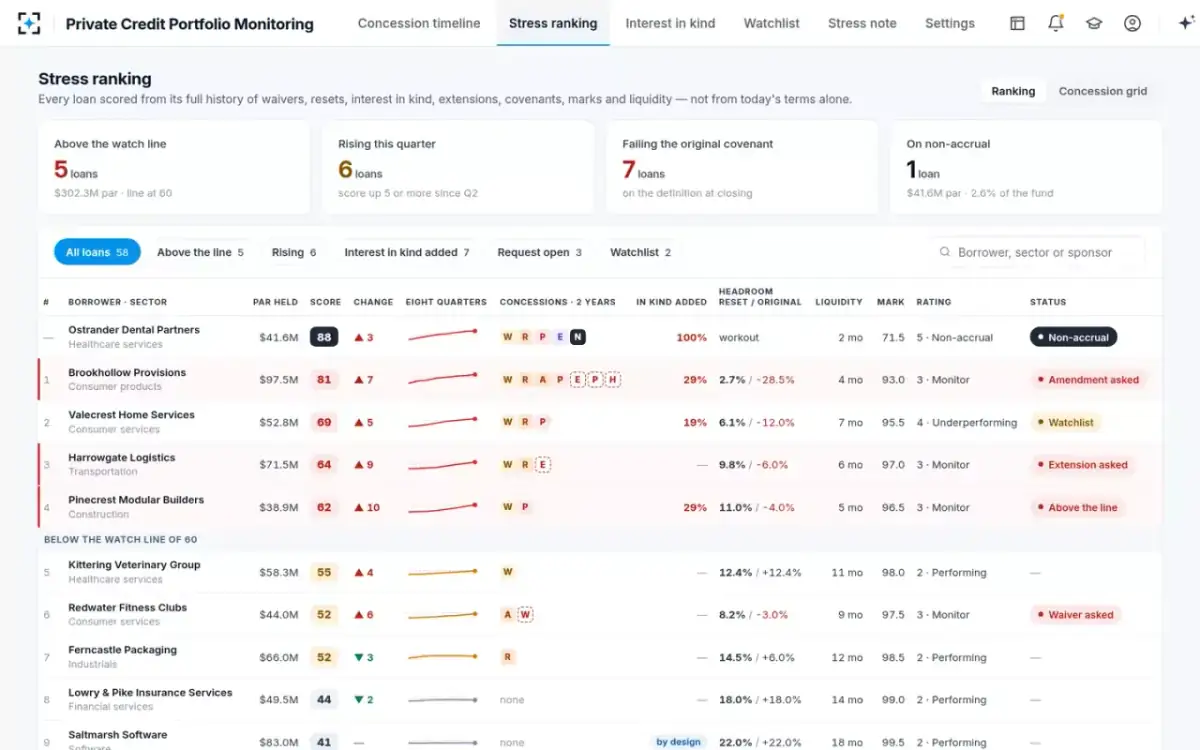
A rating and a watchlist are related but distinct decisions. The rating describes where a loan sits on the five-grade scale; the watchlist is the shorter, more urgent list of loans a committee wants to look at closely regardless of their formal grade, often because something — an accumulating pattern of concessions, a widening gap between a reset and an original covenant, a declining mark — has changed faster than the rating has caught up. Brookhollow Provisions Holdings is the clean illustration: still formally rated 3 because each of its four concessions was reviewed and approved one at a time, it ranks first in the fictional sample fund's own stress scoring at 81 out of 100, built from seven weighted drivers — concessions, the original-covenant test, interest in kind added by amendment, liquidity, sponsor support, the mark against peers, and reporting timeliness. At the fund's committee meeting, the proposal on the table is to move the loan from 3 to 4 and add it to the watchlist in the same decision — treating the stress score, not the untouched rating, as the signal that forced the committee's hand.
From a stress score to a rating decision
Agent
Stress scorerScores every loan 0–100 from seven drivers and ranks the fund against the watch line.
Never: puts a loan on the watchlist or non-accrual
A person decides
Portfolio managerSigns the watchlist proposal and the rating-change recommendation.
A person decides
Chief Investment OfficerApproves the rating change and the watchlist addition.
A fund ranked by accumulated stress, not by rating alone
What examiners look for in a private fund's own rating file
Across the leveraged-loan market broadly, the regulators who jointly examine shared national credits report that "the percentage of loans that deserve management's close attention ('non-pass' loans rated 'special mention' and 'classified') decreased to 8.6 percent of total commitments from 9.1 percent in 2024" (FDIC, 2025 Shared National Credit Program Report) — a useful outside reference point for what share of a leveraged book typically sits below Pass in a given year, even though no single fund should expect its own book to track the market average exactly. What a rating file needs to show, whether or not an outside examiner ever reviews it, is the reasoning behind each grade: which covenant was tested, on which definition, what the result was, and who approved the rating — the same evidence trail that lets a portfolio manager answer, months later, why a loan was rated the way it was and what would have to change to move it. What an amend-and-extend request trades away and how PIK interest predicts trouble before a rating does both feed directly into that reasoning for Brookhollow's own file.
To see a fund's own ratings, stress scores and covenant headroom — on both definitions — on one screen, start from Private Credit Portfolio Monitoring.
Questions people ask
What are the FDIC loan risk rating definitions?
Pass (no identified weakness), Special Mention (potential weaknesses deserving close attention, but not adversely classified), Substandard (inadequately protected by the borrower's or collateral's current worth), Doubtful (collection in full is highly questionable and improbable), and Loss (uncollectible and not worth carrying as a bankable asset). The definitions are in the FDIC's Risk Management Manual of Examination Policies, Section 3.2; Substandard, Doubtful and Loss are the three adverse classifications.
What is a special mention loan?
A loan with potential weaknesses that deserve closer management attention, even though nothing has yet caused a missed payment or a covenant breach. It is the earliest warning grade on the five-grade scale, used when a trend — rather than a confirmed problem — is the concern.
What is the difference between substandard and doubtful?
Both describe a loan with real, identified weaknesses. Substandard means a well-defined weakness and a distinct possibility of some loss if it is not corrected. Doubtful means the same weaknesses have progressed to the point that collection or liquidation in full is highly questionable and improbable given what is currently known.
Who assigns a loan's risk rating?
In a bank, the institution's credit function assigns it and examiners test it independently. In a private credit fund, the rating is the fund's own judgment — typically proposed by a credit analyst or portfolio manager and approved by a credit committee or chief investment officer — reviewed on whatever cycle the fund sets, commonly quarterly.
Can a covenant reset hide a ratings downgrade?
Yes, if a rating review only re-tests the covenant on its current, reset terms. A loan can pass a reset covenant comfortably while failing the original covenant it was underwritten to by a wide margin, and that gap stays invisible unless both definitions are tested every period.
What is a watchlist loan?
A loan a credit committee has flagged for closer attention regardless of its formal rating grade — often because a pattern across several data points, such as accumulating concessions or a widening gap between a reset and an original covenant, has moved faster than the rating has been updated to reflect.