A VA partial entitlement calculator works in four steps: take 25% of the 2026 conforming loan limit for the county where the home is, subtract the entitlement still charged on the veteran's earlier VA loan, multiply what is left by four to find the largest loan most lenders will make with no down payment, and ask for 25% of any price above that line as the down payment. A veteran who still has $78,000 of entitlement tied up in a first home and wants a $900,000 house needs $94,812.50 down in a county at the $832,750 baseline and $37,062.50 in King County, Washington, where the limit is $1,063,750. Loan officers meet this when a veteran keeps a VA-financed home and buys another, and it is easy to get wrong because the county limit is buried in a spreadsheet. Botminds' Mortgage Loan Scenario Search runs the calculation inside every VA cell of its program matrix, with the circular and the county limit cited, so the answer arrives with its working.
VA itself describes the method. "The amount of remaining entitlement is calculated by taking 25% of the CLL and subtracting the previously used entitlement that was not restored," and "for Veterans without full entitlement who do not make a down payment, lenders often limit the total loan amount to four times the amount of the remaining entitlement" (VA Circular 26-25-10, December 1, 2025). The circular applies to loans closed from January 1, 2026 and is rescinded on January 1, 2027, when the 2027 limits take over.
The VA partial entitlement calculation, worked twice for the same veteran and the same $900,000 price
1. County one-unit limit, 2026
Maricopa, AZ$832,750
King, WA$1,063,750
2. Guaranty limit: 25% of step 1
Maricopa, AZ$208,187.50
King, WA$265,937.50
3. Less entitlement still charged on the first VA loan
Maricopa, AZ− $78,000
King, WA− $78,000
4. Remaining entitlement
Maricopa, AZ$130,187.50
King, WA$187,937.50
5. Largest loan with no down payment: 4 × step 4
Maricopa, AZ$520,750
King, WA$751,750
6. Price above that line
Maricopa, AZ$379,250
King, WA$148,250
7. Down payment: 25% of step 6
Maricopa, AZ$94,812.50
King, WA$37,062.50
How do you calculate VA partial entitlement?
Use the method in the frame above, in this order, and keep the county limit and the entitlement charged as separate inputs, because each comes from a different document. VA's own page sets out the first four steps: check the "Entitlement Charged" column on the Certificate of Eligibility, find the county's one-unit limit on FHFA's list, multiply it by .25 and subtract the entitlement already used. "This is your remaining bonus entitlement" (VA, entitlement and loan limits).
The last two steps are lender practice, not statute. VA guarantees a loan, it does not set a down payment, but most lenders sell VA loans into securities that need a 25% guaranty. The circular says so plainly: "VA-guaranteed loans are often securitized in pools that require the loan to have a 25% guaranty." So the lender needs remaining entitlement, a down payment or both to cover a quarter of the loan, and the 4× multiplier is the loan size at which entitlement alone does that.
One detail changes the answer. VA's page phrases the lender condition as entitlement plus down payment covering "at least 25% of your total loan amount." Most calculators, including the frame above, measure that 25% against the price, which gives a down payment of 25% of the price above the 4× line. A lender that measures it against the loan after the down payment asks for less: for the Maricopa case, $75,850 rather than $94,812.50, because each dollar down also shrinks the loan it has to cover. A calculator should say which convention it uses, and a loan officer should know which one the investor buying the loan applies.
What is VA remaining entitlement?
Remaining entitlement is the guaranty VA can still give a veteran who has used part of it: 25% of the county's one-unit conforming limit, less the entitlement charged to earlier loans and not restored. The Certificate of Eligibility shows basic entitlement, $36,000, which covers loans of $144,000 or less; above that, "bonus" or second-tier entitlement applies, and VA notes it "isn't listed on your COE because you'll need to calculate it."
With full entitlement there is no county limit at all. VA says a veteran with full entitlement does not "have a loan limit (as long as you can afford the loan amount and the property appraisal supports the purchase price of the home)", and for a loan above $144,000 VA guarantees up to 25% of the loan amount. Partial entitlement is what brings the county limit back into the calculation, which is why the same veteran's answer depends on where the second home is.
The four numbers in every partial entitlement calculation
$144K
loan size above which the county limit enters the entitlement formula
25%
of the county one-unit conforming limit is the guaranty ceiling
4×
remaining entitlement: the loan most lenders make with no money down
3,075
of 3,235 county lines sit at the $832,750 baseline in 2026
Which county limit does VA use? The input most calculators hide
VA uses the FHFA conforming loan limit for the county where the property is, and always the one-unit figure. FHFA set the 2026 baseline at $832,750 and the high-cost ceiling at $1,249,125 (FHFA, November 25, 2025), and the circular adds that even for a two- to four-unit purchase "the entitlement statute requires the use of the CLL applicable to a single-family residence." A veteran buying a duplex in a baseline county is calculated on $832,750, not the two-unit limit of $1,066,250.
Most counties sit at the baseline, which is why a calculator with a single default limit looks right most of the time. In our count of FHFA's 2026 list, 3,075 of 3,235 county lines are at $832,750; the other 160 are higher. Those 160 include the metropolitan areas where a veteran is most likely to need a second VA loan large enough for the limit to matter: Denver's Jefferson and Arapahoe counties at $862,500, King County at $1,063,750, New York and Nassau at $1,209,750, and Los Angeles and Santa Clara at the ceiling.
The same veteran, the same $900,000 home: the down payment moves with the county
The difference between the first and fourth bars is $57,750 of cash the veteran does or does not need, and nothing about the veteran changed. A calculator that defaults every county to $832,750 overstates the down payment in the high-cost counties; one that uses the wrong county overstates or understates it at random. The county limit belongs in the calculation as a looked-up input with its source, not a default. The wider effect of the county line on every program, not only VA, is the subject of conforming loan limits by county.
What is the VA 4x rule?
It is the lender convention that a veteran without full entitlement can borrow up to four times remaining entitlement with no down payment. It follows from the 25% guaranty that most VA pools require: if VA's remaining guaranty is $130,187.50, a loan of four times that, $520,750, is exactly 25% covered. VA's circular describes it as what lenders "often" do, and VA's entitlement page calls the result "the maximum amount most lenders would be willing to loan you without your needing to make a down payment."
Three things follow for a loan officer. The 4× line is not a VA limit, so a lender with portfolio appetite can go further. A down payment above the line does not have to be 25% of the whole price, only of the part above the line. And a veteran can borrow above the county conforming limit with a VA loan; VA's page says so directly: "If you're able and willing to make a down payment, you may be able to borrow more than the county loan limit with a VA-backed loan."
Can a veteran have two VA loans at once?
Yes, if the veteran has remaining entitlement and qualifies for both payments. The partial entitlement calculation exists precisely for the veteran who keeps the first home, still financed with a VA loan, and buys a second; the circular's formula subtracts the entitlement that "was not restored" because the first loan is still outstanding. Each VA loan must still be for a home the veteran occupies when it closes, so the usual case is a move: the first home becomes a rental and the second is the new residence.
That move brings in a second set of rules: whether rent from the home being left can count as income. VA's regulation lets the proposed rent offset that home's payment when the home will not be hard to rent, and treats a rental agreement as something to obtain where one exists (38 CFR 36.4340(f)(12)(ii)). Fannie Mae, since September 2026, does not accept a lease for a departing residence at all; the contrast is worked through in departing residence rental income.
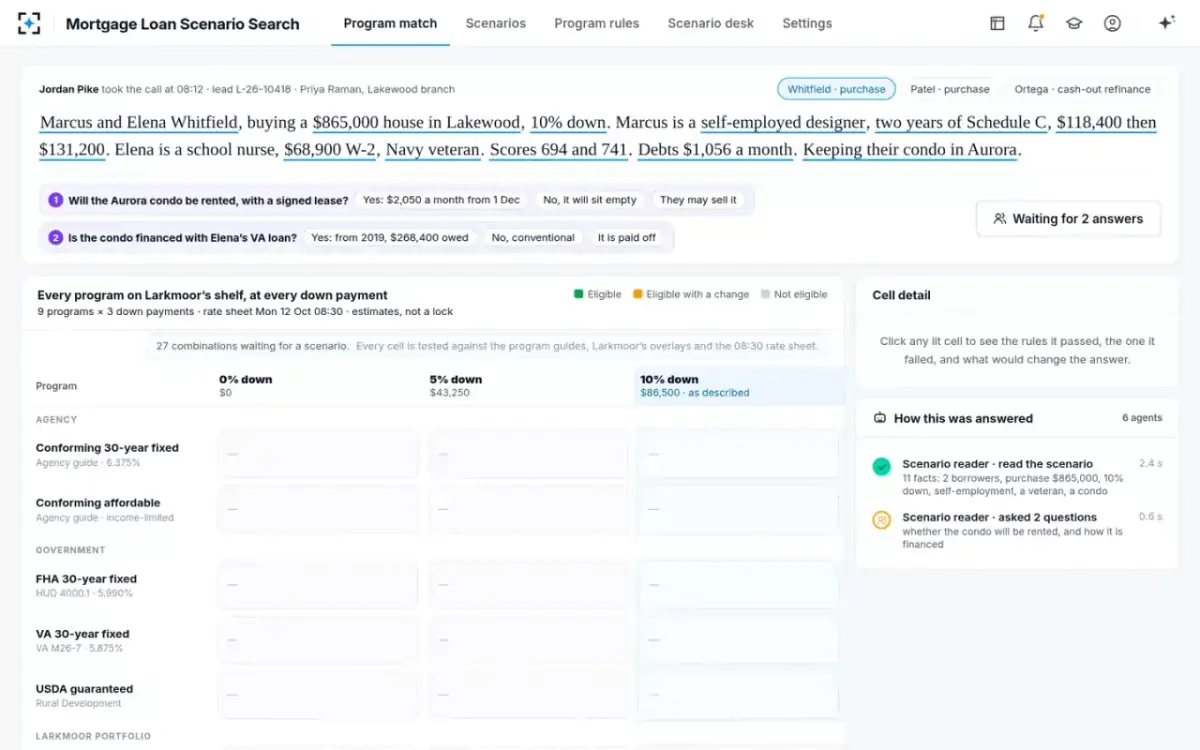
Mortgage Loan Scenario Search asks the entitlement question rather than assuming the answer
How much is the VA funding fee after first use?
For a purchase after first use it is 3.3% of the loan with less than 5% down, 1.5% with 5% or more and 1.25% with 10% or more; first-time users pay 2.15% under 5% down and the same 1.5% and 1.25% above (VA funding fee charts, effective April 7, 2023). A veteran with partial entitlement is by definition a subsequent user, so the 3.3% rate is the one in play whenever the down payment is small. Veterans receiving compensation for a service-connected disability, and some others, are exempt.
The 2026 VA funding fee on a purchase, and what it does to the King County case
| Down payment | First use | After first use | King County case at $900,000 |
|---|---|---|---|
| Less than 5% | 2.15% | 3.3% | $37,062.50 down (4.1%): fee 3.3% of $862,937.50 = $28,476.94 |
| 5% or more | 1.5% | 1.5% | $45,000 down: fee 1.5% of $855,000 = $12,825 |
| 10% or more | 1.25% | 1.25% | $90,000 down: fee 1.25% of $810,000 = $10,125 |
The table shows why a calculator that stops at entitlement leaves money on the table. In King County the entitlement formula asks for $37,062.50, which is 4.1% of the price, so the fee is charged at 3.3%. Bringing $7,937.50 more, to reach 5%, cuts the fee by $15,651.94. That is the kind of near-miss a loan officer would want shown beside the minimum, with the cost and the saving both stated, before the borrower decides.
Residual income and the 41 percent ratio: the checks after entitlement
Entitlement answers how much VA will guarantee; it says nothing about whether the veteran can carry two payments. VA underwrites with two standards, "debt-to-income ratio and residual income analysis", and a ratio above 41% needs a supervisor's written justification unless residual income "exceeds the guidelines by at least 20 percent" (38 CFR 36.4340(c)). Residual income is the money left each month after the housing payment, debts and taxes, measured against a table by family size and region.
VA residual income guidelines for loans of $80,000 and above, by region
| Family size | Northeast | Midwest | South | West |
|---|---|---|---|---|
| 1 | $450 | $441 | $441 | $491 |
| 2 | $755 | $738 | $738 | $823 |
| 3 | $909 | $889 | $889 | $990 |
| 4 | $1,025 | $1,003 | $1,003 | $1,117 |
| 5 | $1,062 | $1,039 | $1,039 | $1,158 |
For a veteran keeping a first home, the residual income test is where the rent decision bites. If the departing home's rent cannot be counted, its full payment comes out of residual income; if it can, only the shortfall does. Take a sample family of four in Colorado as it runs through the solution: with the rent counted, the cell detail shows residual income of $5,760 against the $1,117 the table asks for, and a ratio of 39.8% against 41%.
A VA entitlement calculator for 2026, as a worksheet
A worksheet that a loan officer can defend has eight lines, and each one names where its number came from. That is the difference between a calculator and an answer: the arithmetic is simple; the inputs are where the errors live.
The eight inputs, and the document each comes from
| Line | Where it comes from | What goes wrong |
|---|---|---|
| Entitlement charged | Certificate of Eligibility, "Prior Loans charged to entitlement" | Using the old loan’s balance instead of the entitlement charged. |
| Restoration | COE; whether the first loan is paid off and the home sold | Assuming a refinanced or rented home has freed its entitlement. |
| County | The property address, not the borrower’s current address | Using the branch’s county or a metro default. |
| County one-unit limit | FHFA conforming loan limit list for the closing year | Using the two-unit limit for a duplex, or last year’s list. |
| Price and value | Contract and appraisal; VA lends on the lower | Calculating on price when the appraisal comes in lower. |
| Down payment convention | The investor’s rule: 25% of price or of the loan | Mixing conventions between the quote and the approval. |
| Funding fee | VA chart: use, down payment band, exemption | Charging first-use rates to a subsequent user. |
| Residual income and ratio | 38 CFR 36.4340(c) and (e): region, family size | Leaving the departing home’s payment out of the test. |
What Mortgage Loan Scenario Search does with VA entitlement
It treats entitlement as one rule among the dozens each VA cell is tested against, with the working shown. The scenario reader asks whether the home being kept carries a VA loan instead of assuming; the program matcher computes remaining entitlement against the county limit, the zero-down line and the down payment at each of the three down payments it tests; the payment and cash estimator adds the funding fee for the right use and band and finances it if the borrower chooses; and the near-miss finder names the smallest honest change, such as selling the first home to restore full entitlement, or crossing a fee band, with its cost.
The VA column side by side with conventional and FHA, funding fee financed
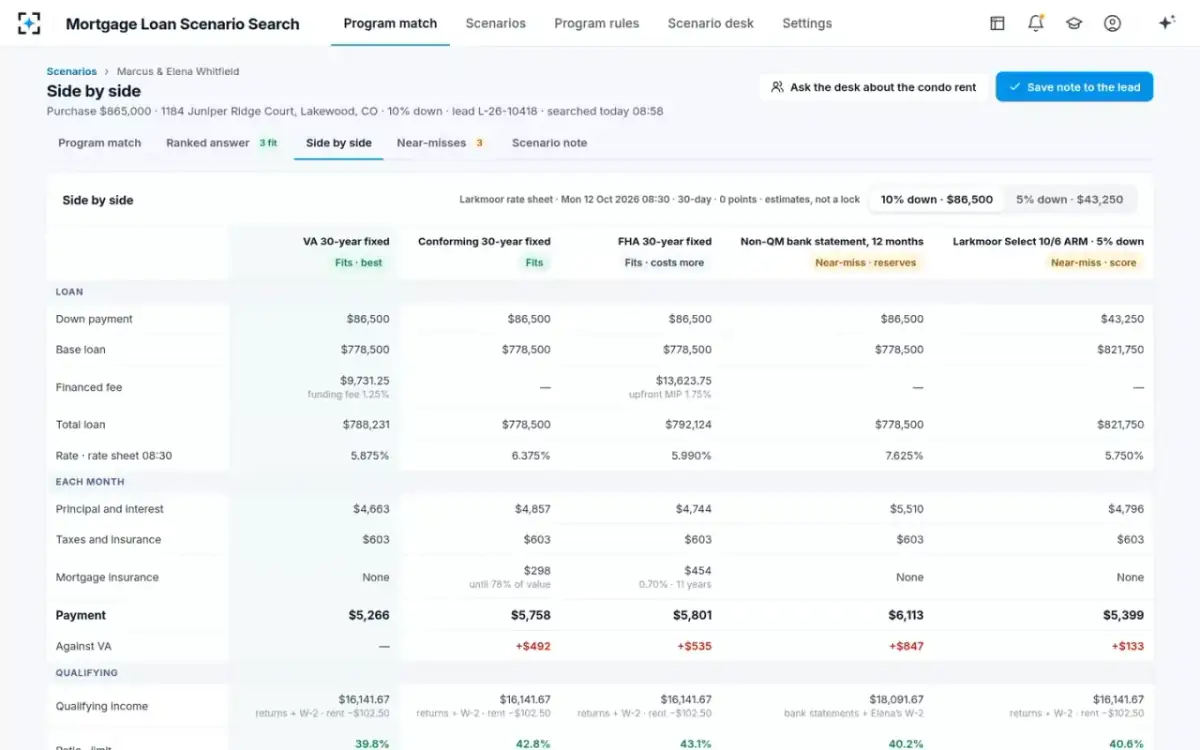
Two settings matter for a lender adopting it. The county limit is a looked-up input, so it has to be the limit for the property's county in the closing year, and it should be checked against FHFA's list when the year turns; the 2026 circular is rescinded on January 1, 2027. And the down payment convention, price or loan, is the investor's, so it belongs in the lender's settings rather than in anyone's head. The solution itself, and the other eight programs it tests at the same time, are described at Mortgage Loan Scenario Search.
Questions people ask
Does the VA county loan limit still exist in 2026?
Only for veterans without full entitlement. With full entitlement VA says there is no loan limit, provided the veteran qualifies and the appraisal supports the price. With partial entitlement the county's 2026 one-unit conforming limit is part of the formula, under VA Circular 26-25-10.
What is the difference between basic and bonus entitlement?
Basic, or first-tier, entitlement is $36,000 and is what VA guarantees on loans of $144,000 or less; it is printed on the Certificate of Eligibility. Bonus, or second-tier, entitlement covers larger loans and has to be calculated from the county limit, which is why it is not on the certificate.
Can a VA loan with partial entitlement be above the conforming limit?
Yes. The county limit sets how much VA will guarantee, not how much the veteran may borrow. A veteran who brings a down payment covering the part above four times remaining entitlement can borrow above the county limit, if the lender approves the loan.
Does a refinance use the county limit too?
Not an interest rate reduction refinance. The circular states that the conforming limit does not apply to IRRRLs and that VA guarantees 25% of an IRRRL above $144,000 regardless of the veteran's entitlement. Cash-out refinances follow the normal entitlement rules.
Which year's limit applies to a loan that closes in January?
The limit in force when the loan closes. Circular 26-25-10 made the 2026 limits effective for loans closed on or after January 1, 2026, so a scenario quoted in December for a January closing should be recalculated on the new year's county limit.