The best AI tools for mortgage loan officers are the ones that refuse to guess. A borrower's description almost always leaves out something that decides which programs fit: whether the home will be occupied, whether a co-borrower's VA entitlement is already in use, what happens to the home being left. An assistant that fills those gaps with a plausible default gives a confident, wrong answer; one that asks gives a slower first reply and a right one. Most AI products sold to loan officers write marketing copy, summarise calls or answer guideline questions. Botminds' Mortgage Loan Scenario Search does a narrower job, program matching: six agents read the loan officer's plain-words scenario, ask at most three questions that change an answer, and test every program on the lender's shelf with the rule behind each result, so the loan officer can see why before choosing what to present.
The pressure behind the category is volume. The Bureau of Labor Statistics counted 274,330 loan officers in May 2025, 222,090 of them in credit intermediation, at a mean wage of $87,790 (BLS Occupational Employment and Wage Statistics); those figures cover all loan officers, not only mortgage. Each fields scenarios that do not fit one product, and each has the same three ways to check them: memory, the pricing engine and the underwriting desk.
Mortgage Loan Scenario Search: six agents, and the two places a person decides
Agent
Scenario readerTurns the loan officer’s words into the inputs each program needs, and asks for the ones the words leave out.
Never: assumes a detail that was not stated; asks more than three questions
Agent
Income calculatorWorks out qualifying income the way each program counts it: self-employment averages, W-2, rent from a home being left, bank statements, VA residual income.
Never: counts income a program would not count
Agent
Program matcherTests every program at every down payment: eligibility, loan limits, entitlement, mortgage insurance, ratios, reserves, overlays.
Never: marks a fit without citing every rule it passed
Agent
Payment and cash estimatorPrices each fit and near-fit from the day’s rate sheet, with the sheet’s time on every figure.
Never: quotes a locked rate or a Loan Estimate
Agent
Near-miss finderFinds the smallest honest change that would pass each failed rule, with its cost and time.
Never: suggests anything that misstates income or occupancy
A person decides
Scenario desk underwriterConfirms or corrects the rules the lender marks as judgement, from the agents’ draft.
Agent
Scenario note writerWrites the note to the lead and drafts a plain-language summary for the borrower.
Never: sends anything to the borrower
A person decides
Loan officerChooses what to present, and sends it.
What are the best AI tools for mortgage loan officers?
The best are the ones that change a decision, not a sentence. AI products aimed at loan officers fall into roughly five groups: marketing and CRM writers, call and meeting summarisers, document readers that pull figures from pay stubs and returns, guideline assistants that answer "what does the guide say about X", and scenario or program matchers that answer "what does this borrower fit". The first two save time on communication. The last three touch eligibility, which is where an error costs a deal, a borrower or a buyback.
For the eligibility tools, three properties separate the useful from the risky. The tool must know when it does not know, and ask. It must cite the rule behind each answer, so the loan officer and the underwriter can check it in seconds. And it must keep a person on every decision that reaches the borrower. A tool with the first two and not the third is a fast way to send a borrower an unchecked answer; a tool with the third and not the first two hands the person a guess to rubber-stamp.
Why an AI that guesses is worse than no AI
Because its errors are fluent. A loan officer who does not know an answer says so; a model that does not know an answer writes one. The danger is concentrated in a few details that a borrower's story often omits and that each reverse the result, and a tool tuned to be helpful will fill them with whatever is most common, which for a buyer who owns a home is usually wrong in one direction or another.
An assistant that guesses, and one that asks, on the same borrower
Guesses the missing detail: Assumes it will be sold, frees the payment, and qualifies the borrower on one housing payment.
Asks before answering: Asks whether it will be kept, rented or sold, and with what financing; each answer moves the ratio and the reserves.
Guesses the missing detail: Assumes full entitlement and quotes VA with no money down.
Asks before answering: Asks whether an earlier VA loan is still outstanding, which turns on the county limit and may require a down payment.
Guesses the missing detail: Assumes a primary residence because most purchases are.
Asks before answering: Asks; owner-occupied, second-home and investor programs are different shelves with different rules.
Guesses the missing detail: Uses the latest year’s income.
Asks before answering: Asks for both years, because a declining second year changes which figure the guides allow.
Guesses the missing detail: A ranked answer that looks final.
Asks before answering: A ranked answer with each assumption shown, sent only when the loan officer chooses.
What questions should a loan officer ask? The three that flip a program
Three questions settle more programs than any others: what happens to the home the borrower is leaving, whether any VA entitlement is in use, and how the new home will be occupied. They matter because the guides answer them very differently, and a scenario that has not asked them has not been tested.
Three questions, and what each answer does to the shelf
| Question | Why it flips the answer | Rule it turns on |
|---|---|---|
| Will the home being left be kept, rented or sold? | Kept and rented: Fannie Mae counts 75% of market rent less the payment, with no lease accepted and six months of extra reserves for a new landlord. FHA counts rent only if the borrower moves more than 100 miles and has at least 25% equity. | Fannie Mae B3-3.8-05 (09/02/2026); HUD 4000.1 |
| Is a VA loan still outstanding on it? | With full entitlement VA has no loan limit; with part of it in use, the county limit sets the guaranty and a down payment may be needed above four times what remains. | VA entitlement page; Circular 26-25-10 |
| How will the new home be occupied? | Owner-occupied, second-home and investor loans are priced and limited differently, and some programs exist only for one of them. | Each program’s eligibility section |
The departing-home question alone splits programs four ways. Since September 2, 2026, Fannie Mae's Guide has refused leases as evidence for a departing residence altogether, asking instead for market rent from an appraisal, a rent schedule or market tools, plus six months of the home's payment in extra reserves when the borrower has less than a year of landlord experience (Selling Guide B3-3.8-05). FHA wants the opposite document, a lease of at least a year, and a move of more than 100 miles (HUD Handbook 4000.1). An assistant that does not ask cannot know which world it is in. The full comparison is in departing residence rental income at Fannie Mae.
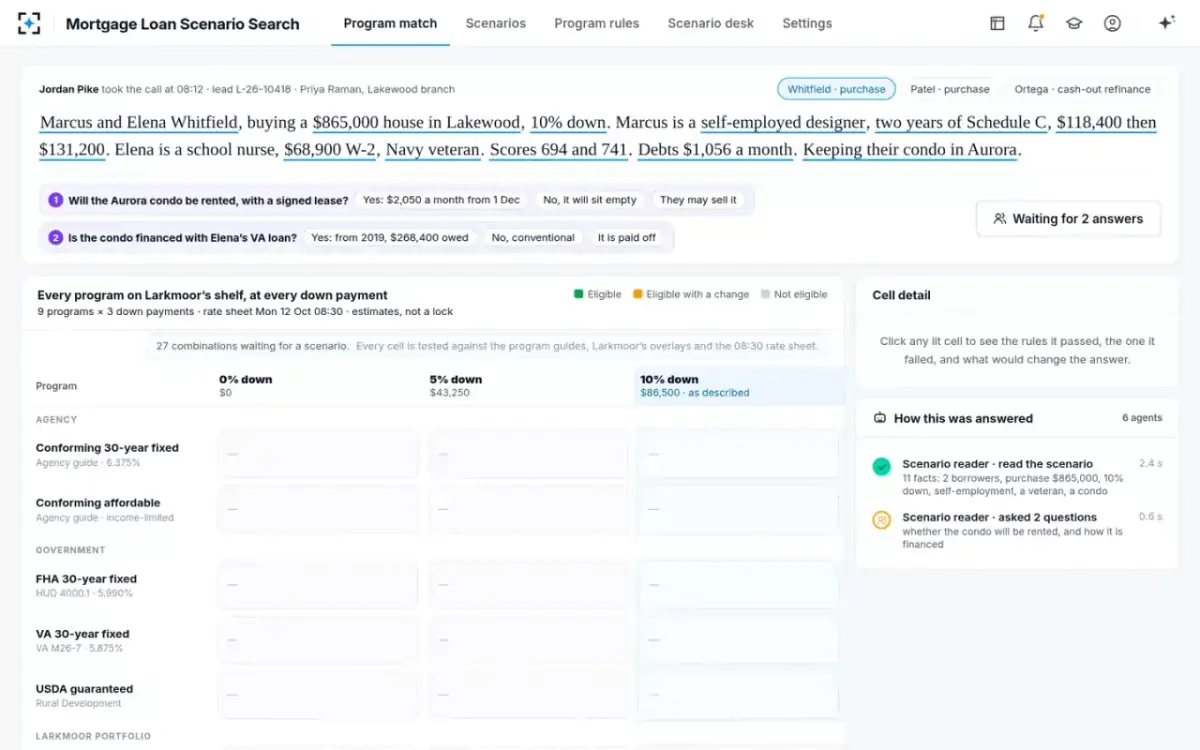
The scenario reader underlines what it used, then asks two questions with answers to tap
Can AI tell which loan a borrower qualifies for?
It can tell which program rules the described borrower passes and fails, which is most of the question, but it cannot approve a loan. Eligibility under a guide is a set of written tests: score, ratio, loan-to-value, loan amount against the county limit, reserves, income type, occupancy. A system that holds the guide sections, the lender's overlays and the day's rate sheet can apply all of them to a scenario faster and more consistently than a person reading matrices. What it tests is a description. The application, the credit report, the documents and the appraisal will each test it again, through the lender's automated underwriting and its underwriters.
The answer also has to survive being explained. If a lender relies on a tool's "not eligible" to turn a borrower down after an application, Regulation B requires a statement of reasons that is "specific and indicate[s] the principal reason(s)", and says that a statement that the applicant failed "to achieve a qualifying score on the creditor's credit scoring system" is insufficient (12 CFR 1002.9(b)(2)). A tool that cites the failed rule per program gives the loan officer a reason that can be stated; a score from a black box does not.
Will AI replace mortgage loan officers?
Nothing in the rules points that way, and the work an AI can take is the part loan officers least value. No regulator has said AI will or should replace loan originators. The Government Accountability Office found that the financial regulators using AI on the data institutions file "were not using AI to make decisions autonomously or relying on it as a sole source of input" (GAO-25-107197, May 2025). The 2026 interagency model risk guidance says "Generative AI and agentic AI models are novel and rapidly evolving" and leaves them outside its scope for now (Federal Reserve SR 26-2). FHFA's bulletin to Fannie Mae and Freddie Mac treats AI as useful and risky at once, able to "improve efficiencies and operations with reduced error and cost" while exposing the companies to "financial, compliance, reputational, model, and other risks" (FHFA AB 2022-02).
The people the tools serve, and what earlier automation did
274,330
loan officers employed in the US, May 2025, all lending
20%
less processing time at technology-led lenders, with no higher defaults
222,090
of those loan officers work in credit intermediation
The research on earlier automation points to faster work, not fewer decisions. Technology-led lenders cut processing time "by about 10 days, or 20% of the average processing time", and their loans did not default more (NBER 24500). The time saved came out of waiting and re-keying. In scenario work the same is true: what an agent takes is the matrix reading and the pricing runs; what stays is the judgement about what to present, the conversation and the licence. Under Regulation Z the loan originator is a person or organisation with qualification duties of its own, and the safe harbor for steering, covered in three loans, three lenders, one file, is an obligation of that originator, not of its software.
How do loan officers use AI safely?
By keeping three habits. Treat every AI output that will reach a borrower as a draft until a person has read it. Prefer answers with a cited rule over answers without one, and check the citation when it matters. And never let a tool propose a change that misstates the borrower: a near-miss that "works" by calling a rental a second home, or by counting income the borrower does not have, is not a near-miss but a misrepresentation.
Two practical rules follow from the regulations. Payment figures given to a borrower before a Loan Estimate are estimates and must be labelled as such; the exact wording a written pre-application estimate must carry is set out in the scenario worksheet guide. And the lender, not the vendor, answers for the tool: a model a lender uses in origination is the lender's, whether built in-house or bought.
What should you ask an AI vendor before a pilot?
Ask what the tool does when it does not know, and test it. Give it a scenario with a missing detail that flips eligibility and see whether it asks or assumes. Then ask the rest of the list below. The same questions apply to Mortgage Loan Scenario Search; we would rather be tested than believed.
Questions for an AI vendor serving mortgage loan officers
- What does it do with a missing detail?
Plant one, such as an outstanding VA loan, and see whether it asks or assumes.
- Can every answer show its rule?
The guide section, overlay or rate sheet line, opened in place.
- Which guide versions does it use, and how fast do they update?
Fannie Mae changed departing-residence rent on September 2, 2026; a tool still on the old text quotes leases.
- Where do our overlays live?
As settings with history, applied the same way for every loan officer.
- What is labelled an estimate?
Payments and cash to close should carry the rate sheet’s time and never look like a lock.
- Who confirms the judgement calls?
A named underwriter, with the confirmation kept.
- What reaches the borrower without a person?
The right answer is nothing.
- Can we replay our own closed files?
A pilot on last quarter’s scenarios shows what the tool would have found.
Mortgage Loan Scenario Search: six agents and two questions
Take a sample scenario as it runs through the solution. A loan officer assistant types what the borrowers said on the phone, with no form and no product codes. The scenario reader underlines eleven inputs it read and asks two questions: will the condo they are keeping be rented with a signed lease, and is it financed with the veteran co-borrower's VA loan. With the answers tapped, the other agents test nine programs at three down payments, 27 combinations, in 38 seconds: five eligible, seven eligible with a stated change, fifteen not. The VA loan fits at their 10% down at $5,266 a month, $492 below conforming; the one rule the lender leaves to judgement, counting the condo's rent on VA, goes to the scenario desk with the agents' draft.
The assistant's note as typed, before any program is tested
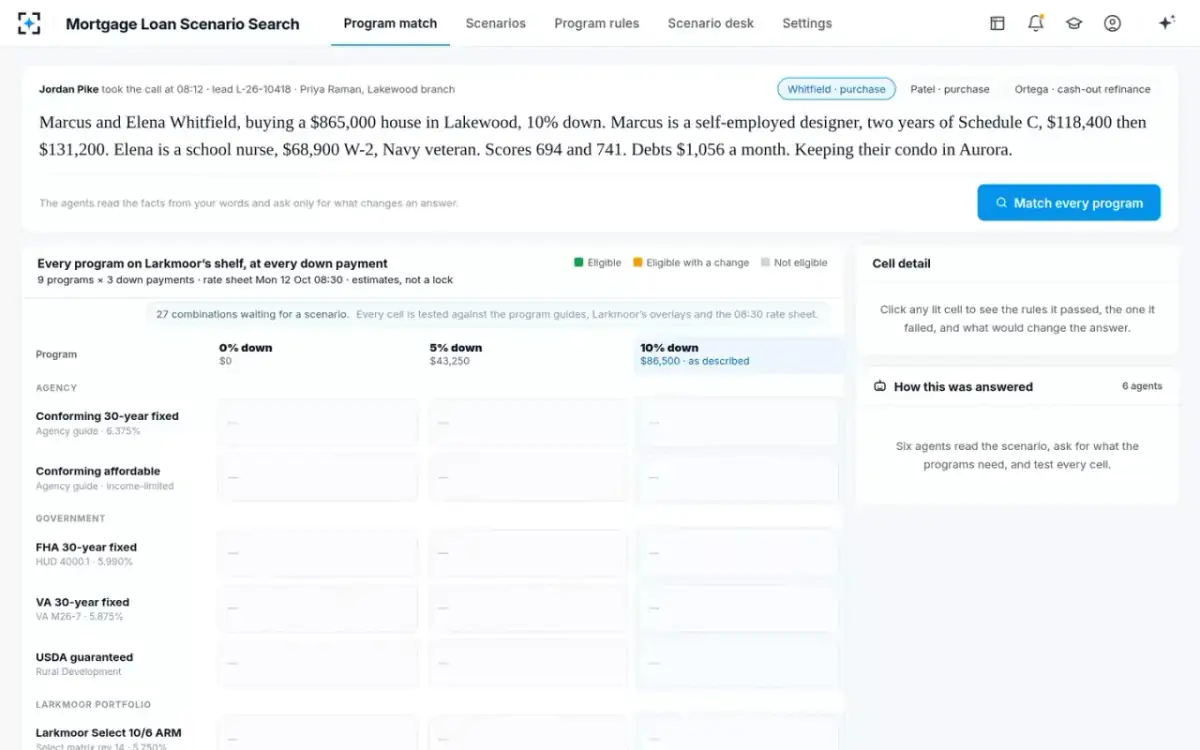
What the solution does not do matters as much. It does not pull credit, issue a Loan Estimate, lock a rate or talk to the borrower. Every payment carries the rate sheet's time and the word estimate. The scenario note writer drafts a summary for the borrower, and the loan officer decides whether to send it. The rest of the solution, including how the desk sees its share of questions, is described at Mortgage Loan Scenario Search.
Questions people ask
Is ChatGPT safe for mortgage loan officers to use?
For drafting emails and marketing that a compliance team reviews, general assistants can save time. For eligibility answers they are risky, because they may not hold the current guide text, cite nothing checkable and will fill a missing detail with a plausible assumption. Anything with borrower data also raises privacy and vendor-management questions the lender owns.
Do lenders have to disclose that they use AI?
We know of no federal rule that requires a general disclosure of AI use in mortgage origination. Existing rules still apply to what the AI produces: Regulation B's specific reasons for adverse action, Regulation Z's rules on estimates before a Loan Estimate, and fair lending laws on the outcome.
Can an AI quote mortgage rates to borrowers?
It can compute payments from a rate sheet, but a rate sheet figure is not a lock or a Loan Estimate. A written estimate specific to a consumer given before the Loan Estimate must carry Regulation Z's prescribed warning, and a lender should treat any AI-produced quote to a borrower as the lender's own statement.
What is the difference between an AI scenario tool and a pricing engine?
A pricing engine prices the product the loan officer enters; a scenario tool tests the borrower against every product on the shelf and explains each result. Lenders often run both, and the way to compare them on your own files is a replay of last quarter's applications.
How long does it take a loan officer to learn an AI scenario tool?
If the input is the loan officer's own description in plain words, there is little to learn beyond reading the cited rules. The longer work is the lender's: loading its program shelf, overlays and rate sheet, and deciding which rules go to the desk.