Departing residence rental income at Fannie Mae is, since the Selling Guide update of September 2, 2026, calculated as 75% of the home's monthly market rent minus its full payment of principal, interest, taxes, insurance and association dues (PITIA). A positive result may only offset that home's own payment; a negative one is added to the borrower's debts. The market rent must come from an appraisal, a comparable rent schedule or market tools with three comparables, because "lease agreements are not permitted for any departing residence", and a borrower with less than a year of landlord experience needs six months of that payment in extra reserves. The same home is treated very differently by FHA, which wants a lease and a move of more than 100 miles, and by VA, which may allow an offset without a lease. Buyers who keep their current home are a common and difficult scenario, and Botminds' Mortgage Loan Scenario Search tests it program by program, with the guide section behind each answer and the judgement calls sent to an underwriter.
Take a sample couple as it runs through the solution: they are buying in Lakewood and keeping a condo in Aurora that will rent for $2,050 a month, with a payment of $1,640. The frame below runs that one condo through all three sets of rules.
One departing residence, three rulebooks: the sample condo at $2,050 rent and a $1,640 payment
Fannie Mae, since 09/02/2026
Rent used75% of market rent: $1,537.50
Less the home’s PITIA− $1,640
Result−$102.50 a month, added to debts
Extra reserves6 × $1,640 = $9,840 if under 12 months as a landlord
LeaseNot permitted; rent from an appraisal, Form 1007 or three comparables
FHA, HUD 4000.1
Rent usedNone unless the move is more than 100 miles
A move across one metro areaFull $1,640 payment in debts
If over 100 miles75% of the lesser of appraised market rent or the lease, less PITI
Also neededA lease of at least one year and 25% equity
LeaseRequired
VA, 38 CFR 36.4340
Rent usedMay offset the home’s payment if it will not be hard to rent
LeaseObtained if available; in a strong rental market its absence need not bar the offset
Underwriter’s dutyKnow the local rental market
Lender’s rulesThe Lender’s Handbook and overlays can add documentation and reserves
ResultUp to the full $1,640 offset, subject to those rules
Can rental income from a departing residence be used?
At Fannie Mae, yes, as an offset to that home's payment, but not as income toward the new loan. The Guide's rule is that the lender multiplies "the monthly gross rent(s) by 75% for the net rental income amount, then subtract[s] the PITIA for the departing residence. If ANRI is positive, the lender may use rental income to offset the departing residence PITIA only. If ANRI is negative, the lender must include the amount in the DTI ratio" (Selling Guide B3-3.8-05). ANRI is adjusted monthly net rental income.
The practical effect is a floor and a ceiling. At best, a well-rented home costs the borrower nothing in the ratio; it never adds income. At worst, a home that rents for less than 133% of its payment adds the shortfall to the borrower's debts. The sample condo rents for $2,050 against a payment of $1,640, which is 125% of it: 75% of the rent is $1,537.50, so $102.50 a month lands in the ratio.
The 25% that disappears is a vacancy and maintenance factor, and it is applied to the borrower-occupied unit only. For a two- to four-unit departing residence, the units already rented are handled under the general non-subject rental rules, and the Guide asks for the most recent year's federal tax return to support them.
What changed at Fannie Mae on September 2, 2026
The departing-residence topic, B3-3.8-05, was reissued on September 2, 2026 with Announcement SEL-2026-08, and its documentation rule now rests on market evidence rather than an agreement between the borrower and a tenant. The lender "must document a current housing payment to use any rental income from the departing residence" and "must include all documentation used to determine monthly market rents in the loan file." The acceptable sources are "a complete appraisal report that includes market rents, or a Single-Family Comparable Rent Schedule (Form 1007) for the occupied unit, or market analysis tools to determine the gross rental income amount", and with market tools "the lender must obtain at least three comparable rental properties", from the same market area, subdivision or project where possible.
Departing residence rental income at Fannie Mae, in five numbers
75%
of monthly market rent counts, before the home’s PITIA is subtracted
0
leases accepted as evidence for any departing residence
3
comparable rentals at least, when market tools set the rent
6months
of the home’s PITIA in extra reserves for a borrower under 12 months as a landlord
50%
maximum DTI through DU, the ratio a negative result lands in
Do I need a lease for my departing residence?
Not for Fannie Mae, and a lease will not help: the Guide says "lease agreements are not permitted for any departing residence." The rent figure must come from the appraiser's market rent, a Form 1007 rent schedule, or market tools with at least three comparables. A borrower who has already signed a tenant at a rent above the market will see the market figure used, not the lease.
For FHA the answer is the opposite: a lease is required. HUD's handbook says that where rental income comes from a property being vacated, "the Mortgagee must obtain a lease agreement of at least one year's duration after the Mortgage is closed and evidence of the payment of the security deposit or first month's rent" (HUD Handbook 4000.1). For VA, the regulation asks for a rental agreement "if available" and adds that "in areas where the rental market is very strong the absence of a lease should not automatically prohibit the offset" (38 CFR 36.4340(f)(12)(ii)). One document, three answers: required, optional, not permitted.
How is departing residence rent calculated?
In three steps for a Fannie Mae loan: establish market rent from one of the sources Fannie Mae accepts, take 75% of it, subtract the home's full PITIA. The remainder offsets the payment if positive and is a debt if negative. Every figure must be in the file: the current housing payment, the appraisal or rent schedule or the comparables, and the PITIA components.
The calculation on three rent levels for the same $1,640 payment
| Market rent | 75% of rent | Less PITIA | Effect on the ratio |
|---|---|---|---|
| $1,900 | $1,425 | −$215 | $215 a month added to debts |
| $2,050 (sample) | $1,537.50 | −$102.50 | $102.50 a month added to debts |
| $2,200 | $1,650 | +$10 | Payment fully offset; nothing added, no income counted |
| $2,600 | $1,950 | +$310 | Payment fully offset; the $310 is not income |
The break-even rent is the payment divided by 0.75: $2,186.67 for a $1,640 payment. Above it, the home disappears from the ratio; below it, each $100 of rent shortfall costs $75 of debt. For a borrower near Fannie Mae's DU limit of 50% (Selling Guide B3-6-02), that line can decide the loan.
How much reserves for a departing residence?
Six months of the departing home's PITIA, if the borrower has less than twelve months of property management experience, on top of everything else. The Guide states that "the lender must verify the borrower has six months of reserves to cover the PITIA obligation for the vacated property when the borrower has less than 12 months of property management experience", and that this "is in addition to any reserves required for multiple-financed properties."
For the sample couple, first-time landlords, that is 6 × $1,640 = $9,840 of extra reserves after closing. It is the requirement most often missed in a scenario, because it appears nowhere in the ratio and nowhere in the cash to close. A borrower who qualifies on income and has exactly enough cash to close can fail on this line alone.
FHA guidelines on rental income from a departing residence
FHA lets rent from a home being vacated count only when the borrower is moving a long way and has real equity. The handbook: "If Rental Income is being derived from a Property being vacated by the Borrower, the Borrower must be relocating to an area more than 100 miles from the Borrower's current Principal Residence." Where the borrower has no rental history on the property, the lender "must obtain an appraisal evidencing market rent and that the Borrower has at least 25 percent equity in the Property." The rent counted is 75% of the lesser of the appraiser's market rent or the lease, less PITI.
For most move-up buyers, that rule means FHA counts no rent at all. A family moving across one metro area, like the sample couple, is far inside 100 miles, so FHA carries the condo's full payment in the ratio. The same household can fit a conventional or VA loan and fail FHA on the same home, for a reason that has nothing to do with income or credit, which is why a scenario assistant has to ask what happens to the home being left before it answers. The handbook text quoted here is the November 2025 revision; HUD issued Update 18 in August 2026, so confirm the current wording before relying on it for a file.
VA rules on rental income from a departing residence
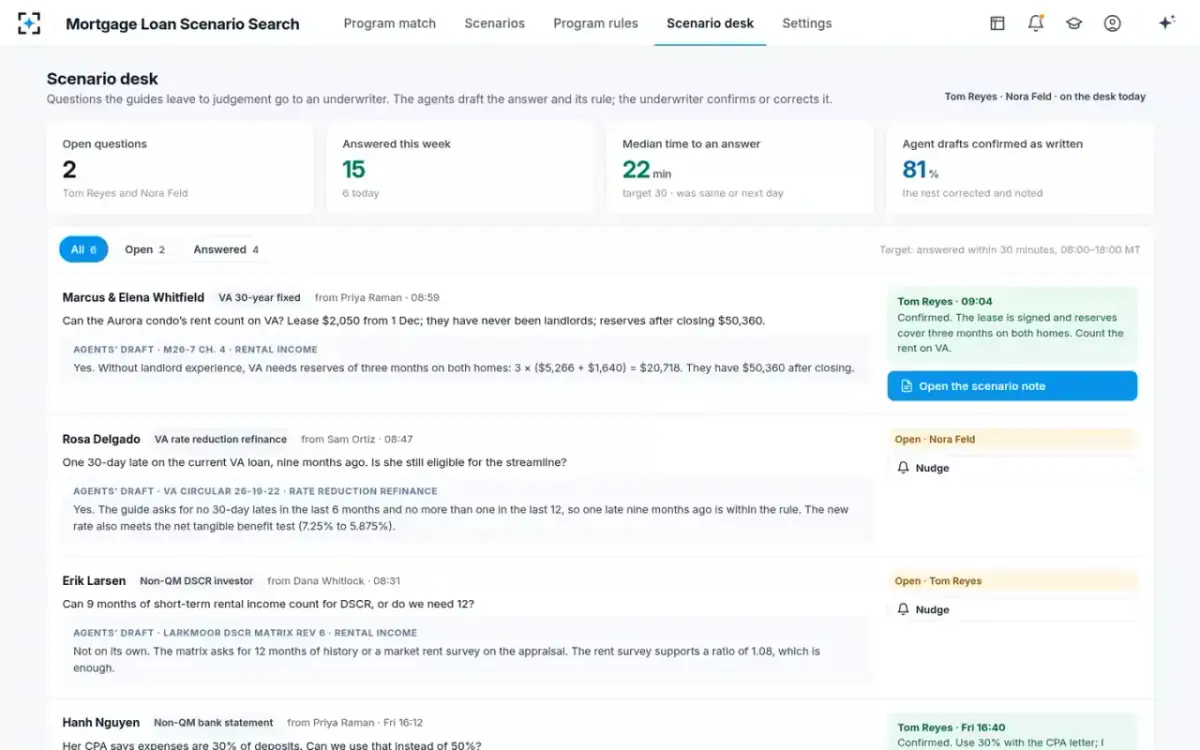
VA's regulation is the most permissive of the three and the most dependent on judgement. "Proposed rental of a veteran's existing property may be used to offset the mortgage payment on that property, provided there is no indication that the property will be difficult to rent," and "it is the responsibility of the loan underwriter to be aware of the condition of the local rental market" (38 CFR 36.4340(f)(12)(ii)). For other rental property, the same section asks for "cash reserves equaling 3 months PITI on the rental property" and says a veteran with no landlord experience is unlikely to have such income counted.
The VA Lender's Handbook and lenders' own overlays can add documentation and reserve requirements on top of the regulation, and they vary by lender. That is why the sample lender treats rent from a home being left on VA or FHA as a judgement rule: the agents draft the answer with the rule, and a scenario desk underwriter confirms or corrects it. If the departing home also carries a VA loan, the veteran's entitlement is partly in use, which changes the down payment on the new home; that calculation is in the VA partial entitlement calculator.
Mortgage Loan Scenario Search sends the VA rent question to the scenario desk with a drafted answer
Scenarios quoted before September may now fail
Any Fannie Mae scenario built on a signed lease for the home being left needs to be rebuilt on market rent. If the lease was above the market, the counted rent falls; if the borrower is a new landlord and the old answer did not hold six months of the departing home's PITIA in reserve, the loan may now fail on reserves; and if the file has no appraisal market rent, Form 1007 or three comparables, it has no rent at all until one is obtained.
Re-checking an open scenario with a departing residence after September 2, 2026
- Is a lease the only evidence of rent?
Replace it with appraisal market rent, a Form 1007 or three comparables from the same market area.
- Is the market rent lower than the lease?
Recompute: 75% of market rent less PITIA.
- Is the result negative?
Add it to the debts and re-test the ratio against 50% (DU) or the manual limit.
- Has the borrower managed property for 12 months?
If not, add six months of the home’s PITIA to required reserves.
- Is the current housing payment documented?
Without it, no rental income from the departing home can be used.
- Is the loan FHA or VA instead?
Apply that program’s rule: FHA’s 100 miles, lease and 25% equity; VA’s rental market test and the lender’s rules.
Mortgage Loan Scenario Search and the home they are keeping
It asks before it assumes, then applies each program's rule to the same home. When a loan officer's note mentions a home being kept, the scenario reader asks whether it will be rented and how it is financed; the income calculator then counts the rent the way each program counts it, the program matcher adds the reserves each requires, and rules the lender marks as judgement go to the desk with a draft. A rule change like Fannie Mae's of September 2 is a dated change to the rules the search reads, and open scenarios are re-checked overnight against it; how a lender keeps those rules current is part of what the lender brings.
The scenario note shows how the rent was counted, and who confirmed it
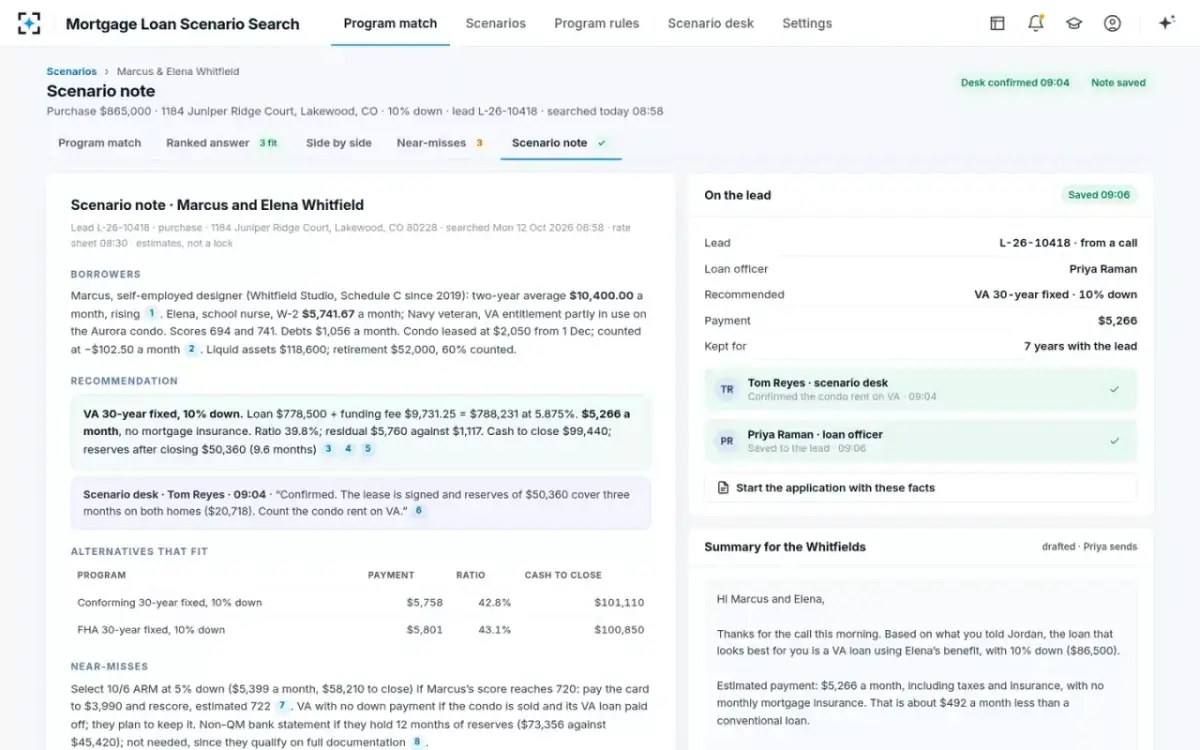
The solution does not order the appraisal or the rent schedule, and it does not decide the judgement calls; it tells the loan officer, before the borrower is quoted, which program counts the rent, how much, and what reserves that program will want. Freddie Mac's rule for a departing residence is not covered on this page. The solution, and the other programs it tests alongside, is at Mortgage Loan Scenario Search.
Questions people ask
Does Fannie Mae allow rental income from a departing residence to qualify for the new loan?
Only to offset the departing home's own payment. A positive adjusted net rental income cannot be added to the borrower's income; it can only cancel the PITIA of the home being left. A negative result is added to monthly debts.
What counts as property management experience?
The Guide ties the six-month reserve to borrowers with less than twelve months of property management experience. Lenders document it from the borrower's history, such as tax returns showing rental income; a borrower renting a home for the first time usually does not have it.
Can a Zillow or Redfin estimate set the market rent?
Fannie Mae's Guide names market analysis tools "such as Zillow, Redfin, MLS, etc." as acceptable, provided the lender obtains at least three comparable rental properties, ideally in the same market area, subdivision or project, and keeps the documentation in the file.
Does the departing residence rule apply to a second home being converted?
B3-3.8-05 covers "a primary residence that will be vacated and converted to an investment property when the borrower purchases a new primary residence." Other properties the borrower owns fall under the general rules for rental income from non-subject property.
What if the borrower plans to sell the departing residence instead?
Then the question is whether the sale closes before or with the new loan. If it does, the payment drops out and the proceeds may become assets; if not, the payment stays in the ratio until it does. A scenario tool should treat a planned sale as a what-if, not as something already settled in the file.