A mortgage product and pricing engine (PPE) is the system that holds a lender's or broker's loan products, their eligibility rules and the day's rate sheets, and returns which products a loan qualifies for and at what price once a loan officer enters the loan's parameters: amount, value, score, occupancy, property type, lock period. It answers "what does this loan cost?" very well. It does not answer "what should this borrower have been offered?", because it only sees the loan as entered, one set of parameters at a time. Botminds' Mortgage Loan Scenario Search works one step earlier: it reads the borrower's situation, works out qualifying income program by program and tests every program on the shelf at three down payments, naming the change that would rescue each near-miss. The fair way to compare the two on your own business is a replay: run last quarter's applications back through both and count what the engine's first answer missed.
The comparison matters because the engine's input is a guess. A loan officer who types "conventional, 10% down, 694" has already chosen the program, the down payment and the score that counts. Every other combination the borrower could have used is outside the run, and nothing in the engine's log shows that it was never tried.
One sample scenario run through Mortgage Loan Scenario Search: where its combinations land
All 27 combinations: 9 programs × 3 down payments
- Eligible · 5 · 18.5%
- Eligible with a change · 7 · 25.9%
- Not eligible · 15 · 55.6%
The ten options at the borrowers’ own plan, 10% down
- Fit · 3 · 30%
- Nearly fit · 3 · 30%
- Do not fit · 4 · 40%
What is a mortgage product and pricing engine?
A PPE is the lender's or broker's catalogue of loan products joined to their prices. Behind the screen it holds three things: product eligibility rules (score, loan-to-value, loan amount, property and occupancy limits), loan-level price adjustments by those same factors, and the rate sheets the secondary marketing desk posts each morning and whenever the market moves. A loan officer enters a loan, and the engine returns the eligible products with rate, points and lender credit at each lock period.
For a broker the engine also spans creditors, which makes it the natural tool for the lowest-rate and lowest-points comparisons that Regulation Z's anti-steering safe harbor asks for. For a retail lender it is the system of record for what was quoted at what price. Either way, it is designed around a loan, not around a borrower.
How does a pricing engine work?
It filters, then prices. The loan's parameters are tested against each product's eligibility grid; products that fail drop out, usually silently; products that pass are priced from the base rate sheet with each adjustment the loan triggers added or subtracted. The result is a table of rates and points per product, often with a best-execution view that sorts by price.
Three features of that design shape what it can tell a loan officer. The test is pass or fail on parameters, so a product that fails by one point of score or one dollar of loan amount looks the same as one that fails by a mile. Qualifying income is usually an input, not a calculation, so the engine trusts whatever income figure the loan officer typed, even though programs count income differently. And eligibility rules that are not parameters, such as whether rent from a departing home can count or whether two years of self-employment is stable, are outside its reach.
What is the difference between a PPE and a scenario search?
A PPE takes a loan and returns prices; a scenario search takes a borrower and returns programs, with reasons. The first is a pricing tool with eligibility filters; the second is an eligibility tool with pricing attached. Most lenders need both, and the useful question is which one the loan officer opens first.
A mortgage product and pricing engine, and a scenario search, on the same borrower
Product and pricing engine: Loan parameters, typed in: program, amount, LTV, score, occupancy.
Scenario search: The borrower’s situation in plain words; missing details asked.
Product and pricing engine: One qualifying income, entered by the loan officer.
Scenario search: Qualifying income computed the way each program counts it.
Product and pricing engine: The parameters entered, one run at a time.
Scenario search: Every program on the shelf at several down payments, in one run.
Product and pricing engine: Usually drops out, or shows an ineligibility code.
Scenario search: Shows the rule it failed and the smallest honest change that would pass it.
Product and pricing engine: Outside the engine: rent from a departing home, income stability, judgement calls.
Scenario search: Tested where written, sent to an underwriter where the guide leaves judgement.
Product and pricing engine: Precise: rate, points, credits, lock periods, best execution.
Scenario search: An estimate from the day’s rate sheet, labelled with its time.
Product and pricing engine: The quote and its price.
Scenario search: Every combination tested, the rules passed and failed, and the note to the lead.
The difference in income is the one most often missed. The sample self-employed borrower on this page has two years of Schedule C income, $118,400 then $131,200. A program that averages two rising years counts $124,800 a year, $10,400 a month; a bank-statement program counts deposits instead; VA tests residual income as well as a ratio. Typing one income into an engine forces a choice that only the program's rule should make. The engine cannot see that the choice was made, or that another program would have counted the income differently.
The question a pricing engine cannot answer: what else would have fit?
The engine answers the question it was asked, and the loan officer asked about one program. "What else would this borrower have fit?" needs the opposite loop: hold the borrower fixed and vary the program, the down payment and the honest changes. That is not a feature a pricing engine lacks by accident; it is a different starting point.
The missed answers come in three kinds, and they cost differently. A better fit the borrower was never shown, such as a VA loan for a household with a veteran co-borrower, costs the borrower money every month; in the sample, $492 a month against the conventional loan the loan officer might have priced first. A near-miss nobody mentioned, such as a score twenty-six points short of a cheaper program, costs a choice the borrower could have made. And a fit the engine showed but the borrower would not have kept, because a rule outside the engine's parameters fails at underwriting, costs the lender a file: one of the 2,115,090 denied and 1,710,723 withdrawn applications in 2025 HMDA data (FFIEC HMDA Data Browser).
How do you test a pricing engine? Replay last quarter's closed files
Take a quarter's applications, every outcome, and re-run each borrower's first-contact situation through both the engine and a scenario search, on the rate sheet and guide versions in force that day. Then sort each file by what the search found that the first answer did not. It is a test on your own data, it needs no new borrowers, and it produces a number the sales and secondary teams will both recognise.
A replay test for a pricing engine and a scenario search, step by step
- Choose the quarter and keep every outcome
Originated, denied, withdrawn and incomplete files. Survivors alone hide the expensive misses.
- Rebuild the first-contact scenario
From the lead or the first application screen: what the loan officer knew, not what the file proved later.
- Freeze the rules to that date
Rate sheet, overlays, guide versions and county limits as they stood, or the test measures this month, not last quarter.
- Run both tools blind
Nobody sees the outcome until both answers are recorded.
- Sort each file into four groups
Offered the best fit; a better fit existed; a near-miss with an honest change existed; nothing fit.
- Price the gaps
Monthly payment difference for better fits; cost and time of the change for near-misses.
- Check the denials and withdrawals
How many failed on a rule outside the engine’s parameters that a search would have caught at first contact.
- Have an underwriter review a sample
Twenty files from each group, read by someone who did not build either tool.
Two cautions keep the test honest. A scenario search sees honest changes the borrower might not accept: selling a home they want to keep, or paying down a card they need. Count near-misses separately from better fits, and never as lost revenue. And a replay with today's rate sheet flatters whichever tool is faster to update; freezing rules to the application date is the single most important design choice.
What programs did a borrower nearly qualify for?
The near-miss list is the part of a replay sales leaders find most useful, because it turns "no" into a plan. For each program a borrower failed, the scenario search names the rule and the smallest honest change: a higher down payment, a credit card paydown and rapid rescore, more months of bank statements, selling a property before closing. A pricing engine reports the same program as ineligible, with no distance and no route.
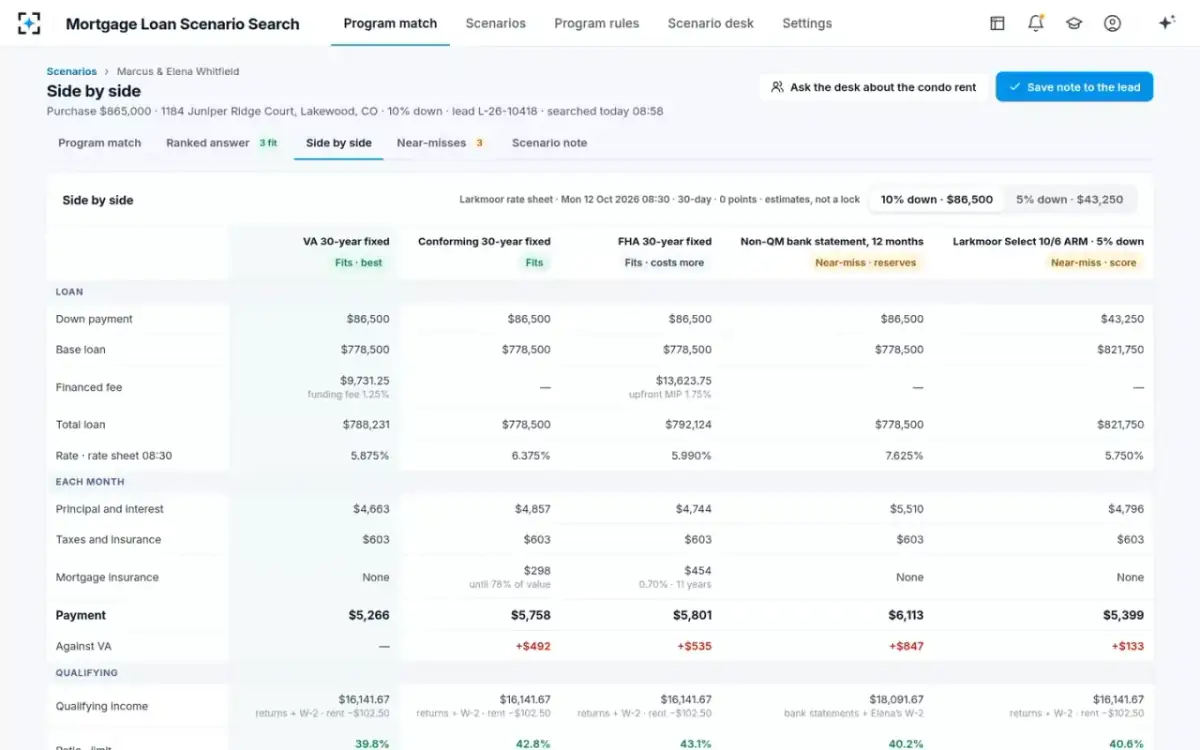
In the sample run, three near-misses sat beside three fits at 10% down. A portfolio ARM needed a 720 score against the borrower's 694; paying a card from $9,850 to $3,990 for $5,860, with a rapid rescore in three to five business days, gave an estimated 722. VA with no money down needed the condo the borrowers were keeping to be sold. A non-QM bank-statement loan needed twelve months of reserves, $73,356 against $45,420, and was not needed anyway. Each came with its cost and time; none was written into the file as if it had happened.
Mortgage Loan Scenario Search side by side: fits and near-misses priced from one rate sheet
Pricing still decides qualified mortgage status
A scenario search does not make pricing less important, because price now defines the General QM. In 2020 the CFPB "removes the General QM loan definition's 43 percent DTI limit and replaces it with price-based thresholds" (FR Doc 2020-27567). A first-lien loan of $137,958 or more is a General QM in 2026 only if its APR is less than 2.25 percentage points above the average prime offer rate (FR Doc 2025-22773).
2026 General QM price limits for first-lien loans, and the points and fees cap
| Loan amount | APR over APOR that ends General QM status | Points and fees cap |
|---|---|---|
| $137,958 or more | 2.25 percentage points or more | 3% of the total loan amount |
| $82,775 to $137,957 | 3.5 percentage points or more | $4,139 |
| Under $82,775 | 6.5 percentage points or more | Set by smaller loan tiers in the same rule |
| Manufactured home under $137,958 | 6.5 percentage points or more | As for its loan amount |
The ratio did not disappear with the cap. A General QM creditor still "considers the consumer's current or reasonably expected income or assets … debt obligations … and monthly debt-to-income ratio or residual income" (12 CFR 1026.43(e)(2)(v)), and the agencies keep their own ratio limits: Fannie Mae's DU allows 50%, manual underwriting 36% to 45% (Selling Guide B3-6-02). So a full answer needs both halves: the search to say which programs the borrower fits and why, and the engine to price the chosen one precisely enough to know whether it stays inside the QM line. A non-QM option, such as a bank-statement loan, is non-QM by design and should be labelled so wherever it appears.
Where Mortgage Loan Scenario Search sits beside your pricing engine
Before it, not instead of it. The search is the loan officer's first look at a borrower: every program at three down payments, each cell with its rules and a payment estimate from the morning's rate sheet, the near-misses with their changes, and the judgement calls routed to the scenario desk. When the loan officer has chosen what to present, the engine prices it to the basis point and the lock desk locks it. The search never shows a locked rate or a Loan Estimate, and every figure it shows carries the rate sheet's time.
The branch's scenarios: best program, near-misses and the overnight re-check
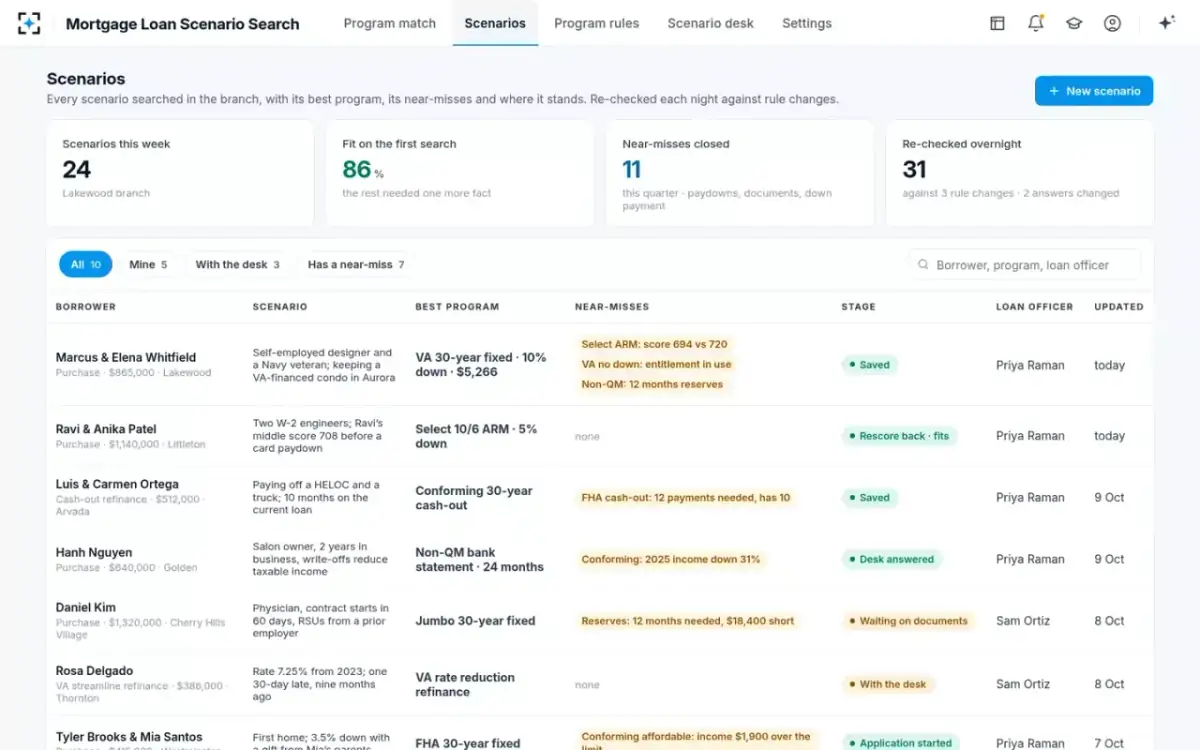
A lender adopting it should expect the integration questions to be about the shelf, not the engine: which programs and overlays are loaded, which rate sheet feeds the estimates, and which rules go to the desk. Those inputs, and who supplies each, are in the scenario worksheet and what your lender brings. A replay is also the right first test of the solution itself; how its questions work is shown in AI tools that ask before they answer, and the solution at Mortgage Loan Scenario Search.
Questions people ask
Does a pricing engine check eligibility?
Yes, for the rules it holds as parameters, such as score, loan-to-value, loan amount, property and occupancy. It usually does not compute qualifying income or test rules that need judgement, such as income stability or rent from a home being left, and it tests only the loan as entered.
What is best execution in a pricing engine?
A view that sorts eligible products, often across investors, by price for the same loan, so the lender or broker can pick the cheapest delivery. It optimises the price of one loan definition; it does not ask whether a different program or down payment would serve the borrower better.
Can a scenario search replace a product and pricing engine?
Not for pricing. A scenario search estimates payments from the rate sheet to compare programs, but locks, lender credits, investor-specific adjustments and best execution belong to the engine. The two answer different questions, in sequence.
How many files does a replay test need?
A few hundred first-contact scenarios across all outcomes is usually enough to see the pattern of better fits and near-misses, provided denials and withdrawals are included. The larger cost is rebuilding each scenario as the loan officer knew it, not running the tools.
Is a non-QM loan ever the right first answer?
Sometimes, when an agency or government program genuinely does not fit, as with income that cannot be documented the way those programs require. In a replay, a non-QM loan offered to a borrower who also fit an agency program at a lower rate is the clearest example of a better fit missed.