A mortgage loan scenario worksheet is the short list of details a loan officer gathers before asking whether a borrower will fit a program: who is borrowing, how each earns, the scores, the price and down payment, where the property is and how it will be occupied, the debts, the assets, and any home the borrower already owns. It is half of a contract. The other half is the lender's: the program shelf, the overlays, the morning's rate sheet, the county loan limits and the rules that go to an underwriter. A scenario tool is only as good as both halves, which is why going live with Botminds' Mortgage Loan Scenario Search starts not with software but with this list: the six agents read the loan officer's plain words against the shelf, overlays and rate sheet the lender supplies, and cite which of them decided each answer.
The worksheet also sits on a regulatory line. Collect one particular combination of six details and the scenario becomes an application under Regulation Z, with a Loan Estimate due within three business days. A worksheet designed for scenarios should know where that line is.
Who supplies what to a mortgage loan scenario search
Today
Hold the borrower’s story in notes, emails and memory, in whatever order the call went.
With agents
Supply the scenario in plain words: borrowers, income types, scores, price, down payment, place, occupancy, debts, assets, other homes.
Still theirs: Answering the agents’ questions, and choosing what to present.
Today
Posts rate sheets each morning and on market moves; prices exceptions.
With agents
Supplies the rate sheet feed and its posting time, so every estimate carries it.
Still theirs: Locks, pricing exceptions and investor delivery.
Today
Writes overlays into memos and matrices; updates them when investors or losses change.
With agents
Supplies the shelf and overlays as settings with effective dates, and the list of rules that need an underwriter.
Still theirs: Every policy decision, and the history of each change.
Today
Answer every question that reaches them, by email and chat.
With agents
Review the drafted answers to judgement rules and confirm or correct them.
Still theirs: Every judgement call, under their name.
Today
See scenarios only when they become applications, or walk.
With agents
Set which programs each branch shows, and read near-misses and stages across the branch.
Still theirs: Coaching and staffing.
Today
Own the lead system, the loan origination system and the retention rules.
With agents
Connect leads in and notes out; set retention and labelling of estimates.
Still theirs: Access, retention and vendor oversight.
What is a mortgage loan scenario worksheet?
It is the structured version of "here's my borrower", used before an application to ask an underwriter, a scenario desk, a wholesale lender or a tool which programs fit. Lenders and brokers keep their own versions, often a one-page form or a web form on a wholesale portal, and the fields vary less than the formats. Every version is trying to capture the details that change program eligibility, and nothing that would start an application by accident.
A good worksheet is short and ordered by consequence. The details that flip whole programs (occupancy, VA entitlement, the home being left, self-employment history) come first, because a worksheet that captures fifteen fields but not those four produces a confident wrong answer. The fields that refine a price (lock period, points preference) come last, because they matter only once the program is chosen.
What information do you need for a loan scenario?
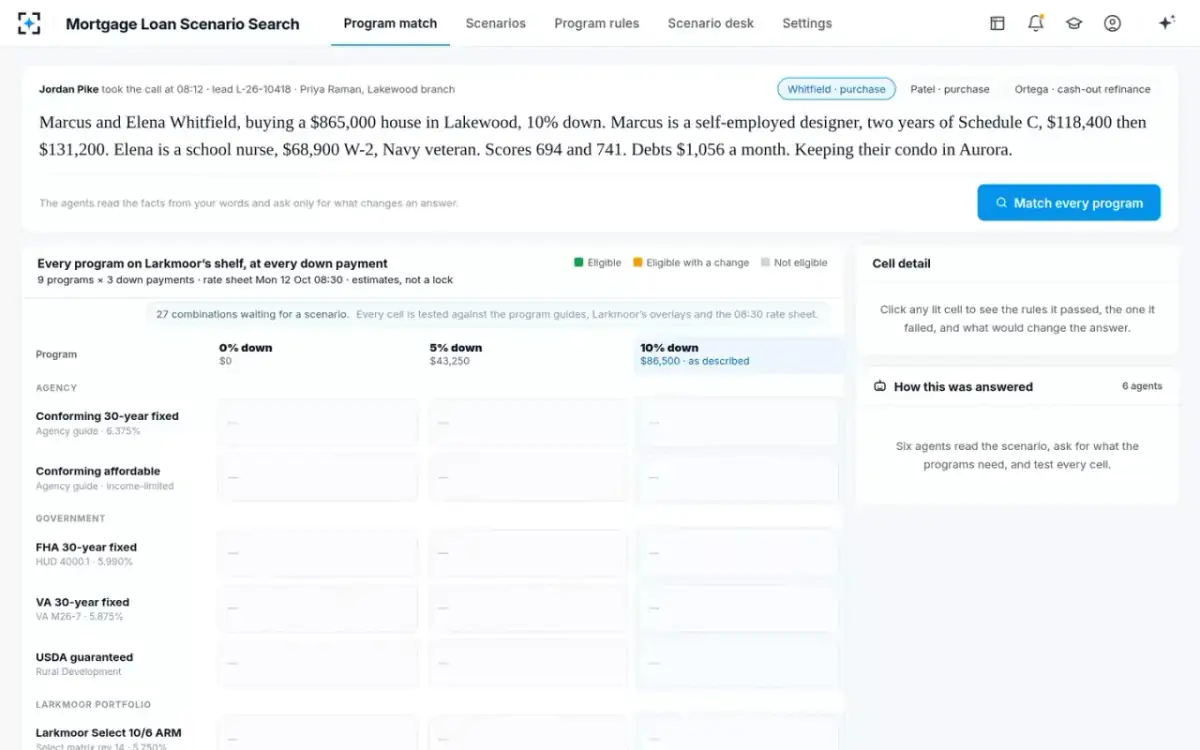
About a dozen details, each because a program's rule reads it. The table below is the worksheet we would build, with the rule each field feeds; the sample entries are the ones a loan officer assistant typed into the solution in one paragraph.
The mortgage loan scenario worksheet: each field, and why the programs need it
| Field | Why the programs care | Sample, as typed |
|---|---|---|
| Borrowers and relationship | Which incomes and scores count; FHA uses the lowest borrower’s score, Fannie Mae manual loans the average of medians. | Marcus and Elena, married |
| Income type and history, each borrower | Self-employment needs two years in most programs; W-2, bank-statement and rental income are each counted differently. | Schedule C $118,400 then $131,200; W-2 $68,900 |
| Credit scores | Program floors and overlays; price adjustments by score. | 694 and 741 |
| Price and down payment | Loan-to-value, mortgage insurance, loan amount against limits. | $865,000, 10% down |
| County of the property | Conforming, FHA and VA partial entitlement limits are set by county. | Lakewood |
| Occupancy and property type | Owner-occupied, second home and investor programs differ; units change limits. | Primary, single-family |
| Monthly debts | Debt-to-income: 50% through DU, 36% to 45% manual, 41% as VA’s line. | $1,056 a month |
| Assets after closing | Reserves, and cash to close. | Not in the typed note |
| Other real estate | Whether a home is kept, rented or sold; rent rules and reserves differ by agency. | Keeping their condo in Aurora |
| Military service and entitlement | VA eligibility; full or partial entitlement. | Navy veteran |
Notice what the sample does not contain: a street address, a Social Security number, an exact income figure for every source, the condo's financing or whether it will be rented. The first two are deliberate (see the next section). The last two are exactly what the scenario reader asked before testing anything, with answers to tap, because each changes the result. How an assistant should behave when a worksheet is incomplete is the subject of AI tools that ask before they answer.
When does a loan scenario become an application? The six details
When the lender has six specific pieces of information. Regulation Z says that for loans covered by the integrated disclosures "an application consists of the submission of the consumer's name, the consumer's income, the consumer's social security number to obtain a credit report, the property address, an estimate of the value of the property, and the mortgage loan amount sought" (12 CFR 1026.2(a)(3)(ii)). Once those six arrive, the creditor must deliver or mail the Loan Estimate "not later than the third business day after the creditor receives the consumer's application" (12 CFR 1026.19(e)(1)(iii)).
The official commentary closes the obvious workaround: the lender may collect more information, "however, once a creditor has received these six pieces of information, it has an application for purposes of the requirements of Regulation Z", and "a written record of an oral application" counts (comment 2(a)(3)-1). A scenario worksheet that captures name, income, Social Security number, address, value and loan amount is an application worksheet, whatever its title. A scenario worksheet built for the purpose leaves out at least one of them, usually the Social Security number and often the street address, and says so.
A scenario worksheet and an application, side by side
Loan scenario: Any description of a borrower, as complete or partial as the loan officer has.
Application under Regulation Z: All six: name, income, SSN for a credit report, property address, value, loan amount.
Loan scenario: None set by regulation.
Application under Regulation Z: Loan Estimate delivered or mailed by the third business day.
Loan scenario: None required.
Application under Regulation Z: None may be required before the Loan Estimate is given.
Loan scenario: Scores as the borrower or loan officer reports them.
Application under Regulation Z: A credit report may be pulled, with only a bona fide fee for it before the Loan Estimate.
Loan scenario: Allowed, with the prescribed statement at the top and not formatted like a Loan Estimate.
Application under Regulation Z: The Loan Estimate itself.
What a written scenario must say at the top
If anything written goes to the borrower before the Loan Estimate, it carries a warning in the regulation's words. A creditor or other person that gives "a written estimate of terms or costs specific to that consumer" before the Loan Estimate must state at the top of the first page, in at least 12-point type, a prescribed sentence, and the estimate "may not be made with headings, content, and format substantially similar to" the Loan Estimate form (12 CFR 1026.19(e)(2)(ii)). The creditor also "shall not require a consumer to submit documents verifying information" before the Loan Estimate.
Your actual rate, payment, and costs could be higher. Get an official Loan Estimate before choosing a loan.
12 CFR 1026.19(e)(2)(ii), the statement required on a written estimate before the Loan Estimate
That is why a scenario tool should label every payment as an estimate with the rate sheet's time, never format a comparison like a Loan Estimate, and never send a summary to the borrower without a person choosing to. In the solution, payments are shown as estimates by a required setting, and the plain-language summary for the borrower is drafted, not sent; the lender's compliance team decides the wording and the statement that goes on it.
The scenario as the assistant typed it: no form, no product codes, no Social Security number
What is a lender's program shelf?
The program shelf is the list of loan programs a lender or broker will actually originate, by branch and channel, with the guide or matrix version each follows. It is narrower than "every program that exists" and broader than "what this loan officer usually sells". In the sample settings the shelf has ten options at one branch: conforming fixed, an income-limited conforming program, FHA, VA with and without a down payment, USDA guaranteed, jumbo, a portfolio 10/6 ARM, and two non-QM loans, bank statement and investor DSCR, each tied to a named source such as HUD Handbook 4000.1, the VA Lender's Handbook or the lender's own matrix revision.
Three details make a shelf usable by a search. Each program needs its own source and version, so a cell can cite it. Each needs to be switchable by branch, because a program a branch cannot close should not be offered there. And each needs the program's limits as data: the conforming and high-balance limits by county from FHFA's list, FHA's floor and ceiling from the annual Mortgagee Letter, which for 2026 set the one-unit floor at $541,287 (HUD Mortgagee Letter 2025-23), and VA's entitlement rule.
How are overlays configured?
As settings, beside the agency line they tighten, with an effective date. An overlay is a lender's rule stricter than the agency's: a higher minimum score, a lower maximum ratio, a smaller maximum loan, a requirement the guide does not have. Fannie Mae accepts them as long as its minimums are met and the lender applies them consistently to similar loans (Selling Guide B3-6-02). That consistency requirement is the strongest argument for keeping overlays as configuration that every search reads, rather than in a policy memo each loan officer interprets.
Mortgage Loan Scenario Search settings: the shelf by branch, overlays beside the guide, and the desk's rules
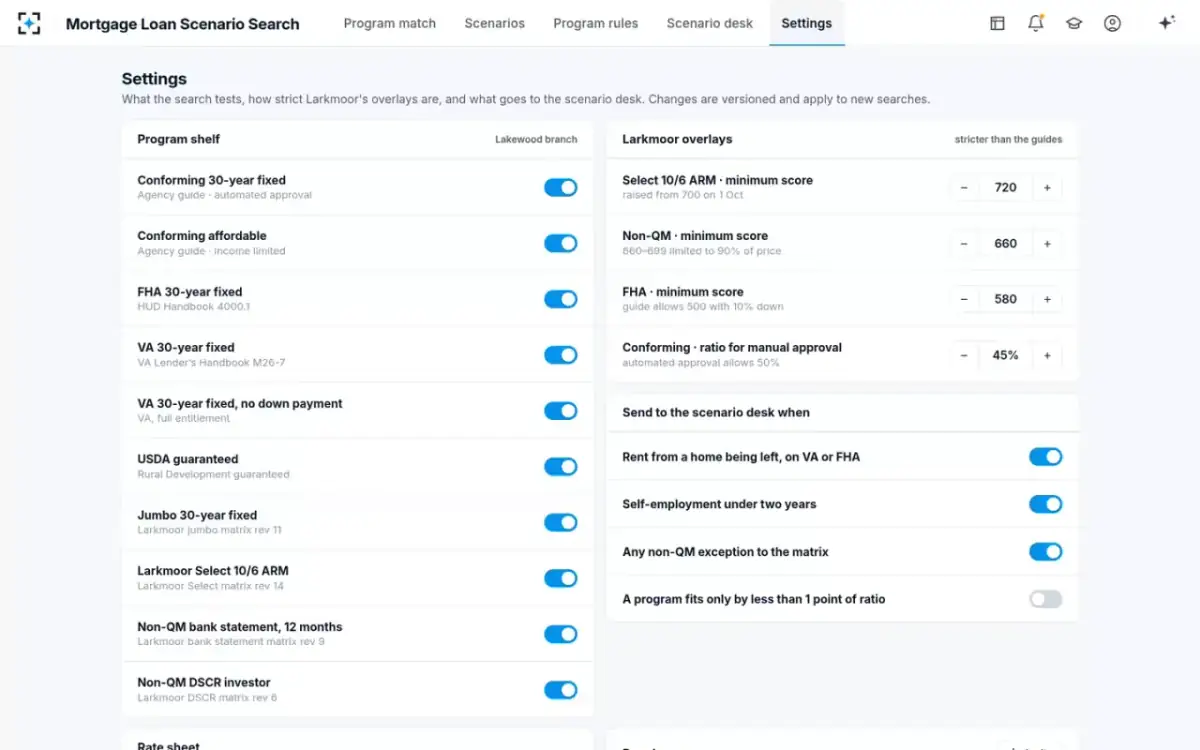
Two practical rules help. Write the agency line next to each overlay, as the sample does ("guide allows 500 with 10% down" beside an FHA minimum of 580), so a loan officer can tell a borrower who is outside the program from one who is outside the lender's appetite. And give each overlay change a date and a reason: the sample portfolio ARM's minimum moved from 700 to 720 on October 1, and every scenario quoted on the old line needs a re-check. The overlay's effect on credit scores is worked through in the 620 myth.
What does a scenario tool need from secondary marketing?
A rate sheet it can read, with a time on it, every time it changes. Payments, mortgage insurance and cash to close are estimates computed from the rate sheet, so the tool needs the base rates by program and lock period, the price adjustments the sheet applies, and the posting time. In the sample, the rate sheet refreshes at 08:30 every business day "and whenever secondary posts a change", and every figure on every screen carries its time.
Secondary also decides how near the estimates come to a quote. A scenario search that prices at one point setting is comparing programs; one that loads the full points grid can also show the lowest-points option the anti-steering safe harbor asks for. Either is defensible if it is stated. What is not defensible is an estimate without a time, because it cannot be checked against the sheet that produced it.
Going live with Mortgage Loan Scenario Search: who brings what
The lender brings the shelf, the overlays, the rate sheet, the desk rules and the people; the solution brings the agents and the screens. The checklist below is the order we would load them in, and the first test is always a replay: a sample of the lender's own recent scenarios, run through the configured shelf and read by an underwriter.
Go-live list for a mortgage loan scenario search
- The program shelf, by branch and channel
Every program the branch can close, with its guide or matrix version.
- Overlays with their agency lines and dates
Minimum scores, maximum ratios and loan amounts, extra requirements.
- County loan limits for the closing year
FHFA’s conforming list and FHA’s limits; refreshed when the year turns.
- The rate sheet feed and its posting time
Including how points are priced, if the lowest-points option is wanted.
- The desk rules
Which rules are judgement and go to an underwriter, and who is on the desk.
- Lead system connection
Scenarios in from the lead, the cited note back to it.
- Estimate labelling and retention
Compliance sets the wording on anything the borrower may see, and how long notes are kept.
- A replay on recent scenarios
A sample of the lender’s own, with outcomes, read by an underwriter before loan officers rely on it.
The replay is where the configuration earns trust, and its method is set out in the pricing engine replay test. The solution, and what each of its six agents may and may not do, is described at Mortgage Loan Scenario Search.
Questions people ask
Is there a standard mortgage scenario worksheet form?
We know of no agency scenario form; lenders and wholesale channels build their own. The standard form is the Uniform Residential Loan Application, which belongs to the application stage, after the six details that make an application have been collected.
Can a loan officer pull credit for a scenario?
A credit pull needs the consumer's Social Security number, which is one of the six details that make an application under Regulation Z. Once the lender has all six, it has an application and the Loan Estimate clock runs; before that, scenarios usually work from scores the borrower reports.
Does a scenario need the property address?
It needs the county, because conforming, FHA and VA limits are set by county, and sometimes the property type. It does not need the street address, which is one of the six details that make an application; a worksheet can stop at the city or county.
How often do overlays and guides change?
Agency guides change several times a year; Fannie Mae, for example, rewrote its departing-residence rent rule on September 2, 2026. Lender overlays change whenever credit policy decides. A scenario tool should show each rule's version and re-check open scenarios when one changes.
Who should own the scenario worksheet?
Usually sales support or credit policy, with compliance reviewing what borrowers may see. The worksheet's fields follow the shelf, so whoever owns the shelf should own the list of details it needs.