A mortgage pull through rate is the share of a lender's applications, or of its rate locks, that close as loans: closed loans divided by the applications or locks in the same cohort. Every loan that falls out costs the work already done on it, and on locked loans it also costs the hedge. Most of the fallout a lender can influence is decided early. The CFPB's national survey found that "for most borrowers, the mortgage shopping process stops after their first application" and that "about 77 percent of borrowers applied to only one lender" (CFPB, 2015), so the borrower who stays is usually the one whose first loan officer showed the program that fit. Finding that program is hard: a loan officer working from memory tests the products they sell most, at one down payment, while the cheapest fit for a household may be VA, a portfolio ARM or a change the borrower could make. Botminds' Mortgage Loan Scenario Search tests every program on the lender's shelf at several down payments against the borrower's own story, with each rule cited, while the borrower is still on the phone.
The borrowers, branch, loan officers and rate sheet in the examples are fictional sample data from the solution. Research figures are linked where they appear.
What the research says about the borrowers a lender can lose
77%
of borrowers applied to only one lender
54bp
gap between the 10th and 90th percentile rate for identical borrowers and loans, same day
$6,500
almost: average upfront costs on a purchase mortgage in 2023, up nearly 33% from 2021
How do you calculate a mortgage pull through rate?
Divide the loans that closed by the applications or locks that entered the cohort, and say which. Application pull-through answers a production question: of the borrowers who applied, how many did we fund? Lock pull-through answers a secondary-marketing question: of the loans we hedged, how many delivered? The two move differently, and a lender that reports one number without its denominator cannot tell a sales problem from a pricing problem.
Where applications go that do not close, and who can move each
| Outcome | What it is | Who can move it |
|---|---|---|
| Closed | The numerator | Everyone |
| Withdrawn by the applicant | The borrower went elsewhere, changed plans, or never answered | Loan officer: fit, price and speed at the first conversation |
| Closed for incompleteness | The borrower did not finish the file | Processing: clear requests, early |
| Denied | The loan did not meet a program's rules | Loan officer and underwriting: matching the right program before application |
| Approved but not accepted | The borrower declined the terms offered | Pricing and the loan officer |
Two of those rows are largely decided before a borrower formally applies. A denial on the program the loan officer quoted first, when another program fit, is a borrower lost to the lender's own shelf. And a withdrawal after a second lender quotes a cheaper program is a borrower lost to a search the first loan officer could have done.
Why do borrowers fall out to another lender?
Because the price of the same loan differs widely, and a minority of borrowers go looking. Federal Reserve economists estimated "a gap between the 10th and 90th percentile mortgage rate that borrowers with the same characteristics obtain for identical loans, in the same market, on the same day, of 54 basis points", about $6,500 in points on the average loan; "time-invariant lender attributes explain little of this rate dispersion, and considerable dispersion remains even within loan officer" (FEDS 2020-062). A study of broker-arranged loans found "borrowers sacrifice at least $1,000 by shopping from too few brokers" (Woodward and Hall, NBER 16007).
The same Federal Reserve paper found that "the average overpayment decreases when overall market interest rates rise, suggesting that a rising level of borrowing costs encourages more search and negotiation". For a production leader that is a pull-through forecast: in a high-rate market more borrowers call a second lender, and the first loan officer's answer has to survive the comparison. The CFPB survey adds who borrowers rely on: "the primary source of information relied on by mortgage borrowers is their lender or broker, followed by a real estate agent". The loan officer is the borrower's main adviser on whether to keep looking.
Program fit is a pull-through lever, not only a rate
For many borrowers the program, not the lender's margin, decides the payment. Take a sample household as it runs through the solution: a self-employed designer and a school nurse who is a Navy veteran, buying at $865,000 with 10% down and keeping a condo. Across the programs they fit or nearly fit on one lender's morning rate sheet, the monthly payment spans $847.
One sample household, one lender, one morning: each program's payment above the cheapest
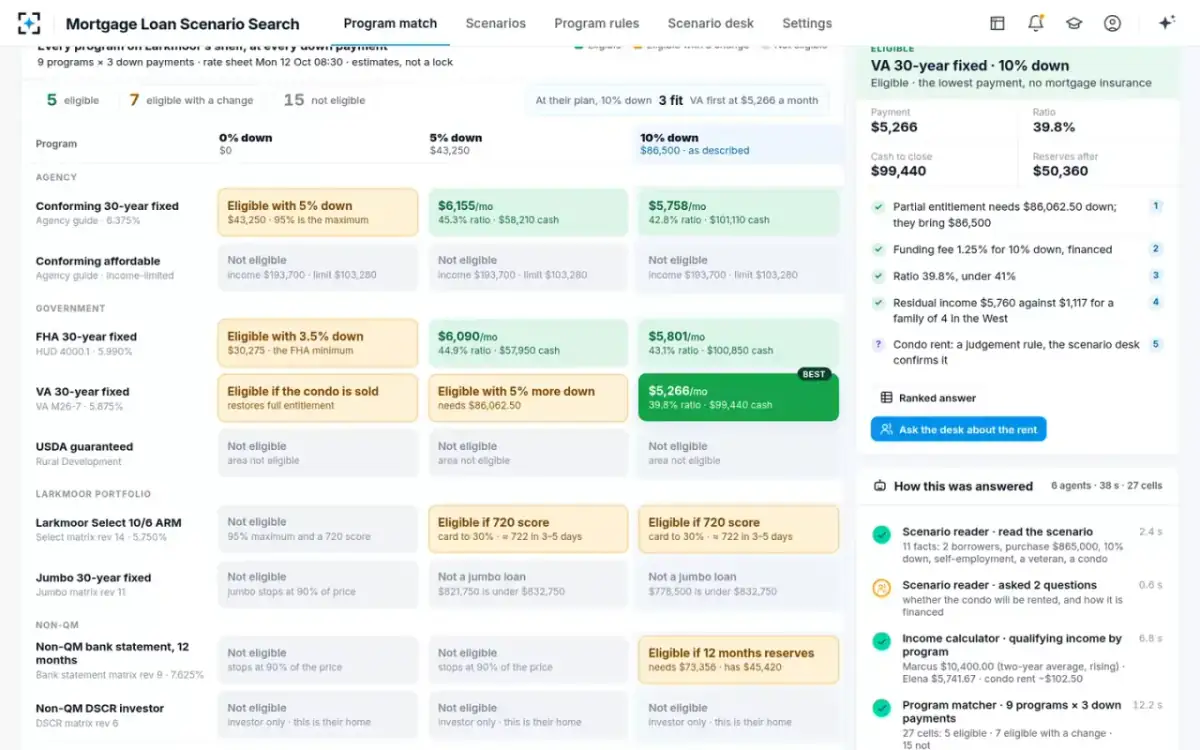
The VA loan is $492 a month below the conforming loan a loan officer might quote first. That gap comes from a question, is anyone in the household a veteran, not from a negotiation, and it is larger than the market's rate dispersion is worth on the same loan. A loan officer who quotes conforming has given this household a reason to keep shopping; the next lender who asks about service, or the borrower's own search, finds the VA loan, and the application is withdrawn. The cell detail for VA showed why it fit, rule by rule: partial entitlement needed $86,062.50 down and the household brings $86,500, the funding fee is 1.25% financed, and the ratio is 39.8% against 41%. How partial entitlement is worked is in the VA partial entitlement calculator.
Every program at every down payment, lit, in Mortgage Loan Scenario Search
Near-misses: the borrowers a lender keeps by naming the change
A near-miss is a program the borrower does not fit today but would with an honest change, and naming it keeps the borrower at the lender that named it. In the sample scenario the Select 10/6 ARM at 5% down needed a 720 score against the lower score of 694 on file. Paying one card from $9,850 to $3,990, $5,860, and ordering a rapid rescore of three to five business days produced a bureau-simulator estimate of 722. The ARM would then leave the household $35,370 more in the bank than VA, at $133 a month more.
Other near-misses are not worth taking, and the scenario says so. Non-QM bank statement at 10% down needed 12 months of reserves above $750,000, 12 × $6,113 = $73,356, against $45,420 after closing, $27,936 short. VA with no money down needed the condo sold, which the borrowers did not want. A loan officer who explains all three, and why VA at 10% down is the answer, has given the borrower nothing to discover elsewhere.
Two first conversations with the same household
Quote the program the loan officer knows best: A conforming loan at 10% down, $5,758 a month with mortgage insurance.
Test every program at every down payment: VA at $5,266 with no mortgage insurance, two alternatives, and three near-misses with their changes.
Quote the program the loan officer knows best: Score, income, down payment.
Test every program at every down payment: Eleven facts read from the story, and two missing ones asked: the condo lease and the existing VA loan.
Quote the program the loan officer knows best: A self-employed borrower's income discovered in underwriting.
Test every program at every down payment: Each program's rules applied to the stated income before application.
Quote the program the loan officer knows best: A lower payment exists and nobody mentioned it.
Test every program at every down payment: The borrower has seen the field at this lender.
Quote the program the loan officer knows best: A likely withdrawal or a denial.
Test every program at every down payment: A borrower who stays, or an honest change they can make here.
Why the judgement call has to come back the same morning
Because the borrower who is still deciding hears from another lender while the first one waits on an answer. Some questions in a scenario cannot be answered by a rule lookup alone: whether a departing residence's rent can count, whether a gap in self-employment breaks the two-year history, whether an overlay applies to a condo project. If those go into an email queue for an underwriter, the answer moves from the morning to the next day, and a borrower comparing lenders, as about half of purchase borrowers do before they apply, may have already heard a yes elsewhere.
In the sample scenario the loan officer asked whether the condo rent could count toward the VA loan. The question reached the scenario desk with the agents' draft and the rule: without landlord experience, VA needs three months of reserves on both homes, 3 × ($5,266 + $1,640) = $20,718, and the household would have $50,360 after closing. The desk underwriter confirmed five minutes later, and the answer went into the scenario note before the call ended. How a desk is staffed and what it should decide is in the mortgage scenario desk.
The speed matters for lock pull-through too. A borrower who locks on a program that later fails underwriting on a question nobody asked at the start falls out after the hedge is placed, which costs secondary marketing as well as production. Answering the judgement calls before the lock moves that fallout to a point where it costs nothing but a conversation.
What should a lender measure besides pull-through?
The leading indicators that explain it, by branch and loan officer. Pull-through is a lagging number: by the time a cohort's closings are counted, the conversations that decided it are weeks old. The measures that move first are the ones a scenario tool records at the first conversation.
Six pull-through measures a production leader can act on
- Pull-through with its denominator
Application and lock cohorts separately, so a sales problem is not mistaken for a pricing one.
- Fit on the first search
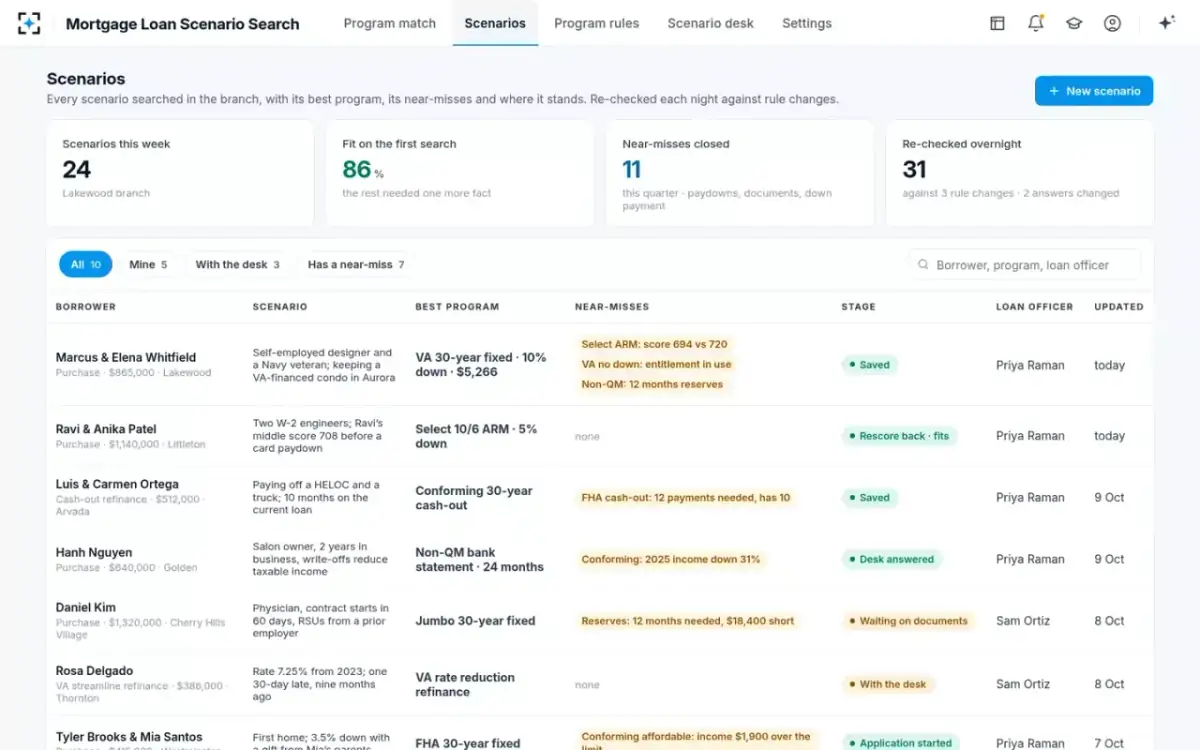
The share of scenarios where an eligible program was found at the borrower's own plan: 86% at the sample branch this week.
- Near-misses named and closed
Borrowers shown an honest change who made it and stayed: 11 this quarter at the sample branch.
- Withdrawals by stage and loan officer
A withdrawal before disclosure is a lost conversation; after disclosure it is often a lost price.
- Denials on a program another program would have passed
The fallout a lender causes with its own shelf.
- Scenarios re-checked when rules change
At the sample branch 31 scenarios were re-checked overnight against 3 rule changes, so no borrower is told a program fits that no longer does.
Near-misses closed are borrowers who stayed: the branch view
Pull-through, pricing and the rules on steering
A lender raising pull-through by matching programs must do it inside the rules that govern how originators present options. Regulation Z bars paying an originator on a loan's terms and bars steering a borrower to a loan because it pays the originator more; for brokers, its anti-steering safe harbor turns on presenting specific options from a sufficient number of creditors. Showing every program a household fits, with the rules that decide each, is consistent with that design, and the record of what was shown is the evidence. The safe harbor itself is set out in the anti-steering safe harbor.
The Federal Reserve's finding that "considerable dispersion remains even within loan officer" is a pricing control question as much as a sales one. If the same loan officer prices identical borrowers differently, some of those borrowers are paying more than they had to, and those who notice leave. Upfront costs make it harder to see: Philadelphia Fed researchers estimate purchase borrowers' out-of-pocket upfront costs rose "nearly 33 percent from 2021 to 2023, to almost $6,500", driven mainly by discount points. A comparison that shows the lowest-rate and the lowest-points option side by side keeps a borrower from leaving over a quote they misread.
Where Mortgage Loan Scenario Search fits
The solution reads the borrower's story as the loan officer types it, underlines each fact, asks for what is missing, and tests every program on the lender's shelf at several down payments against the lender's guides, overlays and that morning's rate sheet, with each finding cited. It ranks what fits, names each near-miss with its change, cost and time, sends judgement calls to the scenario desk with a draft and the rule, and saves a scenario note to the lead with a plain-language summary the loan officer may send.
It does not lock, price exceptions or decide credit; underwriting decides, and the desk confirms judgement calls. What it changes is the first conversation, which is where most of the pull-through a lender can influence is won or lost. To see your own shelf tested against a borrower's story, start from Mortgage Loan Scenario Search.
Questions people ask
What is a good mortgage pull through rate?
No public benchmark is published by a regulator or research body, and the figure depends on channel, product mix and whether the denominator is applications or locks. The useful comparison is a lender's own cohorts over time, by branch and loan officer, with the reason for each fallout.
What is the difference between application and lock pull-through?
Application pull-through divides closings by applications and measures production; lock pull-through divides closings by locked loans and drives hedge ratios in secondary marketing. Rate moves change lock fallout more than application fallout.
Why does pull-through fall when rates rise?
Federal Reserve research found average overpayment falls when market rates rise, consistent with more search and negotiation. More borrowers compare quotes, so a first answer that missed a cheaper program is more likely to be found out.
How many borrowers shop more than one lender?
In the CFPB's national survey about 77% applied to only one lender, and almost half of purchase borrowers seriously considered only one lender or broker before applying. Those who did not shop relied mainly on their lender or broker for information.
Does matching more programs raise denial risk?
It should lower it, if each program's rules are applied to the borrower's actual income and assets before application. In the sample scenario a self-employed borrower's two years of Schedule C income were tested against each program, so none was quoted that underwriting would reject.
Can a loan officer show a near-miss without steering?
Yes, if the change is honest and the options are presented on the borrower's terms, not the originator's pay. The sample tool names each change with its cost and time, and the loan officer decides what to send; nothing reaches the borrower automatically.