The minimum credit score for a conventional loan sold to Fannie Mae is, since April 22, 2026, no score at all for a loan underwritten through Desktop Underwriter (DU), and 620 for a fixed-rate loan or 640 for an adjustable-rate loan that is underwritten manually. The Selling Guide is explicit: "A minimum credit score is not required for DU loan casefiles." The 620 that most rate pages still quote is now the manual-underwriting floor, and the number many borrowers hear from their lender is that lender's own overlay. For a loan officer the practical question is not one minimum but which rule applies to which program on the shelf, and Botminds' Mortgage Loan Scenario Search exists to answer that across every program at once, citing the guide section or lender setting behind each answer.
The change sits in topic B3-5.1-01 of the Selling Guide, dated 04/22/2026, which also brings VantageScore 4.0 into use for approved lenders and lists FICO Score 10T as approved for future deliveries (Fannie Mae Selling Guide B3-5.1-01). It does not make credit irrelevant. DU "will assess a borrower's creditworthiness in accordance with the risk factors outlined in B3-2-03", and the lender still has to pull scores from all three repositories.
The 620 myth, line by line against the Selling Guide's April 2026 text
What people repeat: "You need a 620 for a conventional loan."
What B3-5.1-01 says now: "A minimum credit score is not required for DU loan casefiles."
What people repeat: Same 620 for everything.
What B3-5.1-01 says now: 620 for fixed-rate loans and 640 for ARMs, with the Eligibility Matrix setting higher floors by LTV, units, purpose and DTI.
What people repeat: The borrower’s score.
What B3-5.1-01 says now: One borrower: the representative score. More than one: the average of the borrowers’ median scores, for manual loans.
What people repeat: No score, no conventional loan.
What B3-5.1-01 says now: Loans where no borrower has a score are an exception, under nontraditional credit (Section B3-5.4).
What people repeat: Classic FICO only.
What B3-5.1-01 says now: Classic FICO still required for DU and manual loans; VantageScore 4.0 eligible for approved lenders; FICO 10T approved for future loans.
What people repeat: FHA rules apply.
What B3-5.1-01 says now: Minimum representative score of 620 for HUD, FHA, VA and RD loans Fannie buys.
What is the minimum credit score for a conventional loan in 2026?
For a Fannie Mae loan run through DU there is none; for a manually underwritten Fannie Mae loan it is 620 fixed and 640 adjustable, and higher where the Eligibility Matrix says so. The two paths are not interchangeable. A manual loan has a stricter ratio as well: "Fannie Mae's maximum total DTI ratio is 36% of the borrower's stable monthly income", up to 45% with the matrix's score and reserves, while "for loan casefiles underwritten through DU, the maximum allowable DTI ratio is 50%" (Selling Guide B3-6-02).
So the answer to a borrower with a 605 score is "it depends on DU", and the answer to one with a 625 score and a 44% ratio is "probably DU or nothing", because a manual loan at that ratio needs the matrix's higher score and reserves. A loan officer who quotes 620 as a pass mark gets both of those borrowers wrong, in opposite directions.
Does Fannie Mae still require 620?
Only for manually underwritten fixed-rate loans, and for the government loans it buys. The Guide's minimum-score table now has three rows that matter: manual loans (620 fixed, 640 ARM, "or the minimum representative credit score required by the variance" if the lender has one), DU casefiles (no minimum), and "mortgage loans insured or guaranteed by a federal government agency (HUD, FHA, VA, and RD)", where "the minimum representative credit score is 620."
That last row explains part of the confusion. A lender that sells its FHA and VA loans to Fannie Mae may hold every program to 620 because one investor requires it for the government loans it buys, and the borrower never learns that the agency itself would go lower. The program's own rule and the investor's rule are two different lines; a scenario search has to know both.
Credit score lines by program, as the 2026 rules state them
| Program | Minimum score | Score used | Source |
|---|---|---|---|
| Conventional, DU | None | DU reads the credit report itself; scores still pulled from three repositories | Fannie B3-5.1-01 |
| Conventional, manual | 620 fixed · 640 ARM, higher by the Eligibility Matrix | Representative score, or the average of median scores for two or more borrowers | Fannie B3-5.1-01 |
| FHA, maximum financing | 580 | Minimum decision score: median of three, lower of two, lowest across borrowers | HUD 4000.1 |
| FHA, 90% LTV | 500 to 579 | Same | HUD 4000.1 |
| FHA | Below 500 not eligible | Same | HUD 4000.1 |
| VA | No VA minimum | Lender sets any minimum | VA |
| Government loans sold to Fannie | 620 | Representative score | Fannie B3-5.1-01 |
Can a lender make a conventional loan with no credit score?
Yes, as an exception the Guide names. Among the transactions "not subject to the minimum credit score requirement" are "loans where no borrower has a credit score (see Section B3–5.4, Nontraditional Credit History)", manually underwritten HomeReady loans that include a borrower with a low score, and high-LTV refinances. The credit report must still be kept in the file "whether the report includes traditional credit and a credit score or indicates that a credit score could not be produced due to insufficient or frozen credit."
The path is narrow and documentation-heavy, and it is exactly the kind of program a loan officer does not reach for unprompted. A borrower who was told "no score, no loan" by one lender and found the nontraditional-credit route at another is a borrower the first lender lost to a rule it did not read.
Why do lender overlays still require 640, or 680?
Because a lender may be stricter than the agency, and many are. Fannie Mae's own Guide accepts this: "lenders may sometimes apply a more conservative approach when qualifying borrowers. This is acceptable as long as Fannie Mae's minimum requirements are met, and lenders consistently apply the same approach to similar loans." The stricter rule is an overlay, and it usually exists because the lender, not the agency, carries the cost if a loan has to be bought back or performs badly.
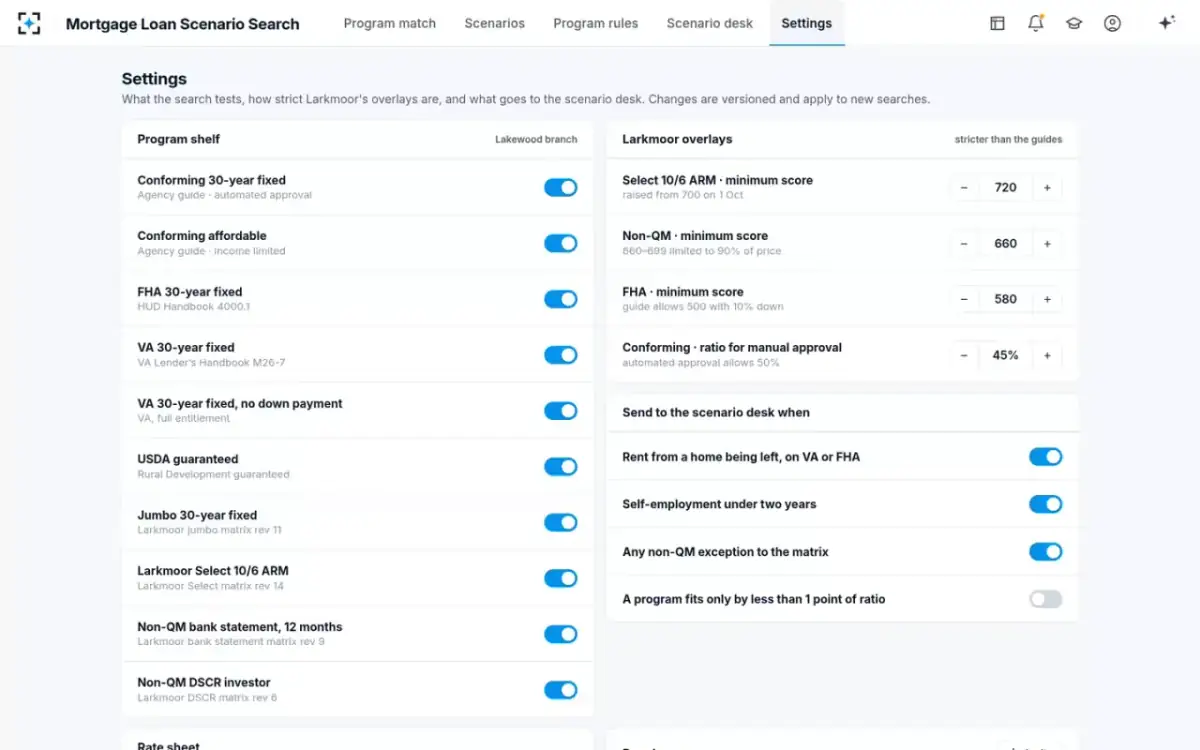
Two things follow. An overlay is a business choice, so it can differ by branch, by channel and by month; in the sample settings below a portfolio ARM's minimum was raised from 700 to 720 on October 1, and every scenario quoted before that date was quoted on the old line. And because the Guide asks lenders to apply their approach consistently, the overlay belongs in a setting that every loan officer's search reads, not in a memo some have seen. Where an overlay sits in the stack of rules, and how a lender configures one, is covered in the scenario worksheet and what the lender brings.
Mortgage Loan Scenario Search keeps overlays as settings, each beside the guide's own line
What score does DU need for approval?
No set number. "Credit scores are not an integral part of DU's risk assessment because DU performs its own analysis of the credit report data," the Guide says; DU weighs the report's contents with the loan's other risk factors and returns a recommendation. A low score makes an approve recommendation less likely, alongside the ratio, the loan-to-value, reserves and the rest, but there is no cliff at 620 or anywhere else.
What does not change is the paperwork. The lender must request scores from each of the three repositories when it orders the merged credit report, and the report is acceptable if one repository has data for borrowers with traditional credit, or two if a file is frozen at one. A score that cannot be produced is a different case from a low score, and goes to the nontraditional-credit route above.
What is the minimum score for FHA?
500, with a 90% loan-to-value limit between 500 and 579, and maximum financing at 580 and above. HUD's handbook is direct: a borrower "is not eligible for FHA-insured financing if the MDCS is less than 500", and a score "between 500 and 579" is "limited to a maximum LTV of 90%" (HUD Handbook 4000.1). For a purchase, maximum financing means 96.5% of the adjusted value.
FHA's score is computed differently from Fannie Mae's, and the difference matters for couples. HUD's minimum decision credit score is the median of three scores or the lower of two for each borrower, and then "the lowest MDCS for all Borrowers." Fannie Mae's manual rule uses the average of the borrowers' median scores. The same two people therefore carry different scores into different programs.
One couple, three credit scores, depending on the program's rule
VA has no score floor of its own. VA's entitlement page says: "We don't require a minimum credit score, but some lenders do have a requirement, so be sure to contact more than one lender to compare." The 620 a veteran meets at the lender is therefore an overlay or an investor's line, not VA's.
A score still prices the loan, even where it no longer decides eligibility
Removing the minimum for DU casefiles did not remove the score from pricing. B3-5.1-01 keeps its section on "Loan-Level Price Adjustments Based on Credit Score", and a lender's rate sheet still steps by score band. A borrower at 690 and one at 760 can both be eligible and pay quite different rates, which is why the choice of score model and the merged report's middle score still decide money even when they no longer decide eligibility.
That is where small changes pay. Take a sample case as it runs through the solution: a portfolio ARM needs 720 and the self-employed borrower's median score is 694 with a card at 74% of its limit. The near-miss finder works out that paying the card from $9,850 to $3,990 costs $5,860, a rapid rescore takes three to five business days, and the bureau simulator estimates about 722, an estimate, not a promise. Against the VA loan the couple also fits, that ARM would cost $133 a month more and leave $35,370 more cash in the bank; it is a choice to present, not an answer to impose.
What the April 2026 change did, and did not, change
None
minimum credit score for a Fannie Mae DU casefile
620/ 640
manual underwriting floor for fixed-rate and adjustable loans
50%
maximum DTI through DU, against 36% to 45% manual
580
FHA score for maximum financing; 500 to 579 capped at 90% LTV
How Mortgage Loan Scenario Search reads a credit score against the shelf
It applies each program's own score rule, then the lender's overlay, and says which one decided the answer. The income calculator and program matcher test every program on the shelf at three down payments; each cell lists the rules it passed and failed, so "not eligible: score 694 against a 720 overlay" reads differently from "not eligible: below the agency's floor". The first is a near-miss the loan officer can discuss; the second usually is not.
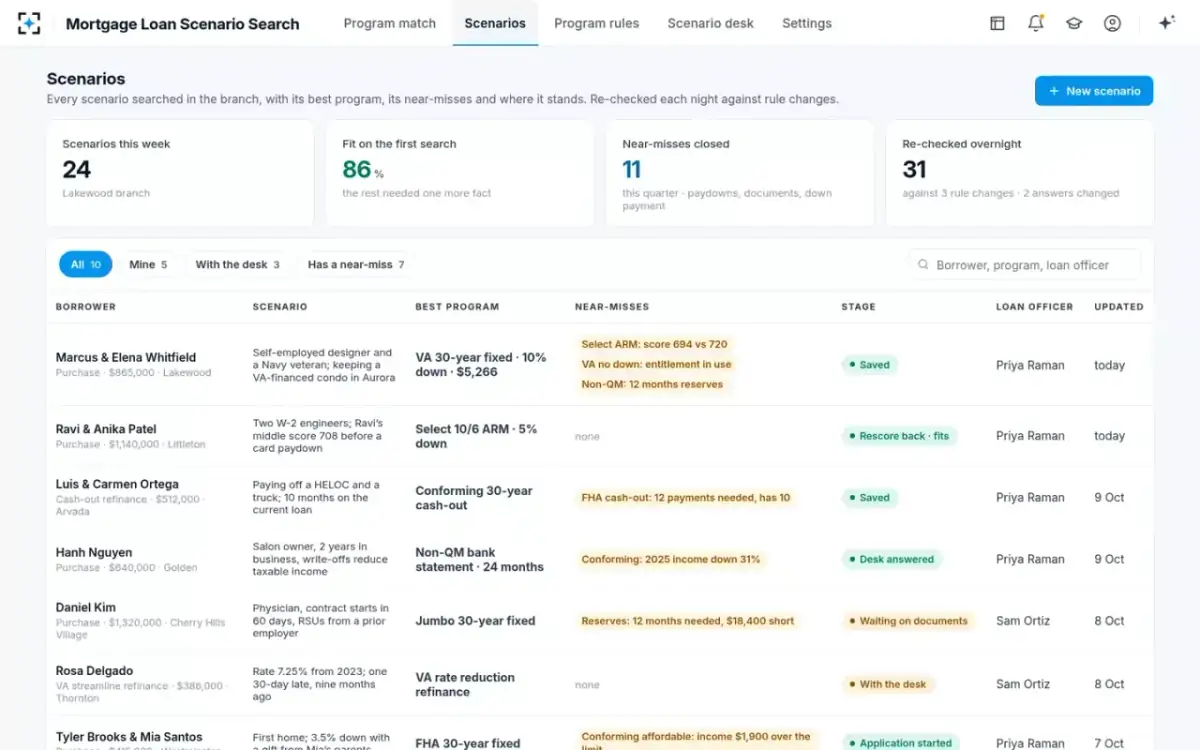
Overlays are settings with a history, so the solution can re-check open scenarios overnight when one changes. In the sample branch screen below, 31 open scenarios were re-checked against three rule changes and two answers changed. That is the practical cost of an overlay that moves: every quote made under the old line is now wrong until someone looks. The questions the agents ask before they answer are the other half of getting the score right, since a co-borrower the loan officer did not mention changes which score counts.
Every scenario in the branch, with its near-misses and the overnight re-check
What the solution does not do is pull credit or promise a score. The scores come from the loan officer's report, the simulator's figure is labelled an estimate, and the loan officer decides what to present. The full set of programs it tests, and the rules behind each, are on the Mortgage Loan Scenario Search page.
Questions people ask
Is 620 still the minimum for Freddie Mac?
Freddie Mac's Seller/Servicer Guide sets its own requirements, and this page does not cover them. The answer for a specific loan depends on whether it is assessed through Freddie Mac's automated system or manually, and on the lender's overlays, so check the current Guide section before quoting.
Does the 620 minimum apply to both borrowers?
For a manually underwritten Fannie Mae loan with more than one borrower, the score used for eligibility is the average of the borrowers' median scores, so one borrower can be below 620 if the average is not. FHA instead uses the lowest borrower's score, and a lender's overlay may use either.
Can a lender use VantageScore for a conventional loan?
Fannie Mae's Guide lists the Equifax, Experian and TransUnion versions of VantageScore 4.0 as eligible for approved lenders, who must contact Fannie Mae about program availability and delivery. Classic FICO remains required for DU and manual loans while the transition runs.
What is the minimum credit score for a jumbo loan?
There is no agency rule, because a jumbo loan sits above the conforming limit and is set by the investor or the lender's own portfolio matrix. Each matrix sets its own score floor, often by loan amount and loan-to-value, and it can change with the investor's next revision.
Does a higher score still lower the rate once a borrower qualifies?
Usually yes. Fannie Mae's loan-level price adjustments still vary by credit score, and lenders pass them into their rate sheets, so a borrower who qualifies at 690 can often get a better rate or fewer points at 740 on the same loan.