The anti-steering safe harbor is the part of Regulation Z, 12 CFR 1026.36(e)(2)–(4), that protects a mortgage loan originator from a steering claim if, for each type of loan the borrower showed interest in, the originator obtains options from at least three creditors it regularly works with and presents three loans: the one with the lowest interest rate, the one with the lowest rate without risky features, and the one with the lowest points and origination fees, all loans the borrower likely qualifies for. Read closely, that is a description of a scenario search: test the borrower against every program on the shelf, keep the ones that fit, and pick three by rule. Botminds' Mortgage Loan Scenario Search does the testing for loan officers, program by program and down payment by down payment, with the guide section behind each answer, which is why the safe harbor is a useful way to think about what such a search must keep.
The rule exists because pay can pull against the borrower. An originator may not steer a consumer to a loan "based on the fact that the originator will receive greater compensation from the creditor in that transaction than in other transactions the originator offered or could have offered to the consumer, unless the consummated transaction is in the consumer's interest" (12 CFR 1026.36(e)(1)). Proving a negative is hard. The safe harbor gives the originator a positive way to show the choice was fair.
The anti-steering safe harbor in six conditions
- Options from a significant number of creditors
Three or more of the creditors the originator regularly does business with, or all of them if there are fewer than three.
- For each type of transaction the consumer is interested in
Fixed-rate, adjustable-rate and reverse mortgages are separate types, each with its own set of options.
- The loan with the lowest interest rate
Whatever points or fees it takes to get that rate.
- The lowest rate without risky features
No negative amortization, prepayment penalty, interest-only payments, balloon in the first 7 years, demand feature, shared equity or shared appreciation.
- The lowest total points and origination fees
Ties go to the lower rate among the loans with the lowest dollar amount.
- A good-faith belief the borrower likely qualifies
Based on what the originator can reasonably know, including rate sheets and each creditor’s minimum score and other eligibility rules.
What is the anti-steering safe harbor?
It is a way to be deemed compliant with the steering ban without proving what was in the originator's head. The official interpretation is blunt: an originator that satisfies 1026.36(e)(2) "is deemed to comply" with the ban, and one that does not "is not subject to any presumption regarding the originator's compliance or noncompliance" (comment 36(e)(2)-1). Missing the safe harbor is not a violation. It simply leaves the originator to defend each loan on its own merits, transaction by transaction.
The ban itself turns on two comparisons. First, whether the loan paid the originator more than other loans it "offered or could have offered". Second, whether the loan was nonetheless in the consumer's interest. The commentary's own example: a borrower likely qualifies for a 7% fixed loan from Creditor A but is directed to a 7.5% loan from Creditor B that pays the originator more. That breaks the rule unless the higher rate is in the borrower's interest, for instance because the lower-rate loan carries a prepayment penalty or upfront charges the borrower cannot or will not pay.
The safe harbor turns both comparisons into a procedure. Gather options from enough creditors, show the borrower three defined loans per type of transaction, believe in good faith that the borrower qualifies for them, and the question of motive falls away.
Which loan options must be presented under anti-steering?
Three, per type of transaction the borrower expressed interest in: the lowest interest rate, the lowest rate without risky features, and the lowest total points and origination fees. One loan can satisfy more than one slot, so fewer than three can be enough, and the rule allows exactly that in 1026.36(e)(4). More than three is allowed too, but then the three that meet the criteria must be highlighted, and the commentary warns that more than four options per type "would not likely help the consumer make a meaningful choice."
"Type of transaction" is narrower than most people expect. Regulation Z defines only three: a loan whose APR cannot increase after consummation, one whose APR may increase, and a reverse mortgage. A borrower who asks about both a 30-year fixed and a 7/6 ARM has expressed interest in two types and is owed two sets of options. Program names do not matter to the rule; FHA, VA and conventional fixed-rate loans all sit in the same fixed-rate type.
Which rate counts as the lowest interest rate
| Loan | Rate the originator compares | Why it matters |
|---|---|---|
| Initial rate fixed for at least five years | The initial rate in effect at consummation | A 7/6 or 10/6 ARM is compared on its start rate, like a fixed loan. |
| Rate varies with an index, fixed under five years | The fully indexed rate at consummation, ignoring any initial discount or premium | A teaser rate cannot win the lowest-rate slot. |
| Step-rate loan | The highest rate that applies in the first five years | The step, not the opening rate, is compared. |
| Any loan for the lowest-rate slot | The lowest rate the borrower can likely obtain, however many points it costs | The points are judged separately, in the lowest-points slot. |
What is an anti-steering disclosure?
It is not a form the regulation prescribes. Regulation Z sets out which loans must be presented and that the qualifying ones be highlighted when more than three are shown; it does not supply a model disclosure, a signature line or a required format. The "anti-steering disclosure" or "loan options disclosure" that brokers hand borrowers is a document the industry built to show, after the fact, that the three options were presented.
That has two consequences. A signed sheet with three rates on it is only as good as the search behind it: if the lowest-rate loan on the sheet was not the lowest-rate loan the borrower likely qualified for among the creditors compared, the paper describes a safe harbor the originator never reached. And a sheet is not the only possible evidence. The comparison itself, which creditors were checked, at what time, against which rate sheet, and why each loan was or was not one the borrower likely qualified for, is what an examiner or a plaintiff would actually want to see.
How many lenders must a broker compare?
Three or more of the creditors the originator regularly does business with, or every such creditor if it regularly works with fewer than three. The commentary sets the number ("a significant number of the creditors with which a loan originator regularly does business is three or more of those creditors") and then defines "regularly", which is where brokers get caught.
The numbers the safe harbor turns on
3
creditors at least, or all of them if the originator regularly works with fewer
25
loans in the previous 12 months make a creditor one the originator regularly works with
3
options per type of transaction: lowest rate, lowest rate without risky features, lowest points
4
options per type, beyond which the commentary says choice is unlikely to be helped
A creditor counts if any of three tests is met: there is a written agreement governing the originator's submissions to it; it funded at least one of the originator's applications in the current or previous calendar month; or it funded twenty-five or more in the previous twelve calendar months. A broker with wholesale agreements at eight lenders therefore regularly does business with all eight, even if it sent most of last year's loans to two of them. Three is the floor for the comparison, not a choice of which three.
The originator need not present a loan from each creditor. The commentary's example: if three loans from one creditor meet the criteria, presenting those and nothing from anyone else satisfies the rule. What has to be broad is the search. What reaches the borrower can be narrow.
What is the lowest rate without risky features?
It is the cheapest loan by interest rate among those with none of the features the rule lists: negative amortization, a prepayment penalty, interest-only payments, a balloon payment in the first seven years, a demand feature, shared equity or shared appreciation. For most agency and government loans the slot is filled by the same loan as the lowest-rate slot, because those features are absent anyway. It bites where a shelf includes non-QM, investor or portfolio loans.
That is the slot most likely to be filled by habit. An interest-only jumbo or a bank-statement loan with a prepayment penalty can carry the lowest rate a borrower is offered, and a loan officer who knows that program well will quote it first. The rule asks the originator to show what the borrower would pay without those features, side by side, so the borrower sees the price of the feature rather than discovering it. The other two slots are covered in detail in the rule; the risky-features slot is where a program-by-program search earns its keep.
Does anti-steering apply to retail loan officers?
Largely no, as long as they stay retail. The commentary says that a loan originator who is an employee of the creditor cannot be paid on the transaction's terms under 1026.36(d)(1), "and compliance with that provision by such a loan originator also satisfies the requirements of § 1026.36(e)(1) for that transaction with the creditor." The steering rule is aimed at the originator who can choose between creditors, which in practice means brokers.
The exception is the retail loan officer who brokers a loan out. If a bank's employee forwards an application to another creditor, "such as when the employer does not offer any loan products for which the consumer would qualify," the commentary treats that employee as a broker for the transaction, subject to the steering ban if paid for arranging it. A retail lender that refers declined scenarios to a partner lender for a fee has, for those loans, become a broker.
The compensation half of the rule applies to everyone. No loan originator may be paid "based on a term of a transaction", or on a proxy for one (1026.36(d)(1)). The CFPB's 2015 order against Guarantee Mortgage shows what that looks like in practice: the company was found to be "paying loan originators in part based on the interest rates charged on loans they had originated", partly through payments to marketing companies owned by branch managers, and paid "$228,000 to the CFPB's Civil Penalty Fund" (CFPB, June 2015). Rate-based pay is exactly the incentive the steering ban guards against.
"Likely qualifies" is a search across programs
The safe harbor only protects options the borrower likely qualifies for, and the commentary says what that judgement rests on. It "should be based on information reasonably available to the loan originator at the time the loan options are presented", the originator "is not expected to know all aspects of each creditor's underwriting criteria", but pricing and eligibility information routinely sent to originators counts as reasonably available: "for example, rate sheets showing creditors' current pricing and the required minimum credit score or other eligibility criteria."
Put that next to a real shelf. A broker with four wholesale lenders may have twenty programs across them, each with a matrix of scores, loan-to-value limits, ratios, reserves and loan amounts, plus the lender's overlays, and each priced on that morning's rate sheet. The question "which is the lowest-rate loan this borrower likely qualifies for?" is answered by testing the borrower against all of them. A loan officer who checks the two programs they know best and stops has not formed a good-faith belief about the other eighteen; they simply have not looked.
What the anti-steering safe harbor asks, and what the search behind it has to hold
The rule says: Options from three or more creditors the originator regularly does business with.
So the scenario search must keep: Which creditors and programs were tested, so a missing lender is visible.
The rule says: Information reasonably available when the options are presented.
So the scenario search must keep: The rate sheet and guide versions in force at that moment, by time.
The rule says: A good-faith belief the consumer likely qualifies.
So the scenario search must keep: For each program, the rules passed and failed, with the reason.
The rule says: Lowest rate; lowest rate without risky features; lowest points and fees.
So the scenario search must keep: Each program’s rate, features and points, so the three can be picked by rule.
The rule says: A set for each type the consumer expressed interest in.
So the scenario search must keep: Fixed and adjustable results kept apart.
The rule says: Evidence of compliance kept two years.
So the scenario search must keep: The search saved with the lead, not rebuilt from memory.
The "likely qualifies" test also protects the originator from overreach in the other direction. An originator "need not inform the consumer about a potential transaction if the originator makes a good faith determination that the consumer is not likely to qualify for it." A search that sorts programs into fits and non-fits, with the failed rule stated, is the evidence for leaving a lower-rate program off the sheet. The same discipline applies to the borrower's credit score: the minimum credit score for a conventional loan is no longer the single line many loan officers remember, so a program dropped "because of the score" deserves a second look.
How do you document the safe harbor?
Keep the comparison, not only the result. Regulation Z's general retention rule requires a creditor to keep "evidence of compliance with this part" for two years after the date disclosures are required or action is taken, and separately requires three years of records on loan originator compensation and the agreements behind it (12 CFR 1026.25). Neither names a safe harbor file, so the content is the originator's choice.
A defensible file answers five questions without anyone's memory: which creditors the originator regularly worked with that month and which were searched; which type or types of transaction the borrower asked about; which loans were tested and why each did or did not likely qualify; which three were identified as the lowest rate, lowest rate without risky features and lowest points, from which rate sheet at what time; and what the borrower was shown. The fifth is the disclosure sheet most brokers already keep. The first four are what makes it mean something.
A scenario note keeps the alternatives, the near-misses and the reasons
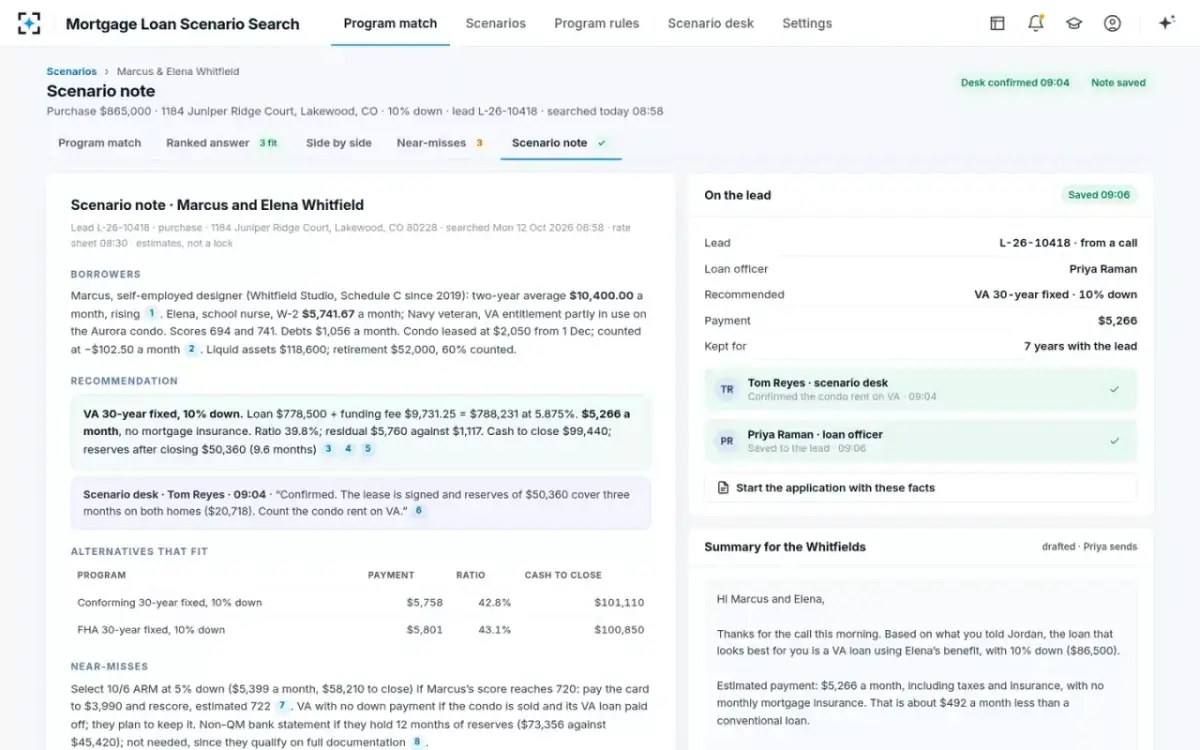
Where Mortgage Loan Scenario Search fits the safe harbor, and where it does not
It fits the hard part: forming the good-faith belief. A loan officer types the borrower's situation in plain words; six agents ask for the details that change an answer, work out qualifying income the way each program counts it and test every program on the shelf at three down payments, marking each cell eligible, eligible with a stated change, or not eligible, with the guide section, overlay or rate sheet line behind every finding. Take a sample scenario as it runs: nine programs across three down payments, 27 combinations, tested in 38 seconds, with three programs fitting at the borrowers' plan of 10% down.
Three limits matter for the safe harbor. First, the search tests the shelf it is given. A retail lender's shelf is one creditor; a broker who wants the search to support the safe harbor has to load the programs of at least three creditors it regularly works with. Second, the sample ranks fits by monthly cost, then cash to close, which is not the safe harbor's order; the three regulatory slots have to be picked from the results by rule. Third, in the sample every option is priced at one point setting from one rate sheet, so the lowest-points comparison depends on loading the rate sheet's full points grid. These are configuration questions to settle before relying on the output, not reasons to skip it.
Mortgage Loan Scenario Search side by side: rate, features and payment for every fit
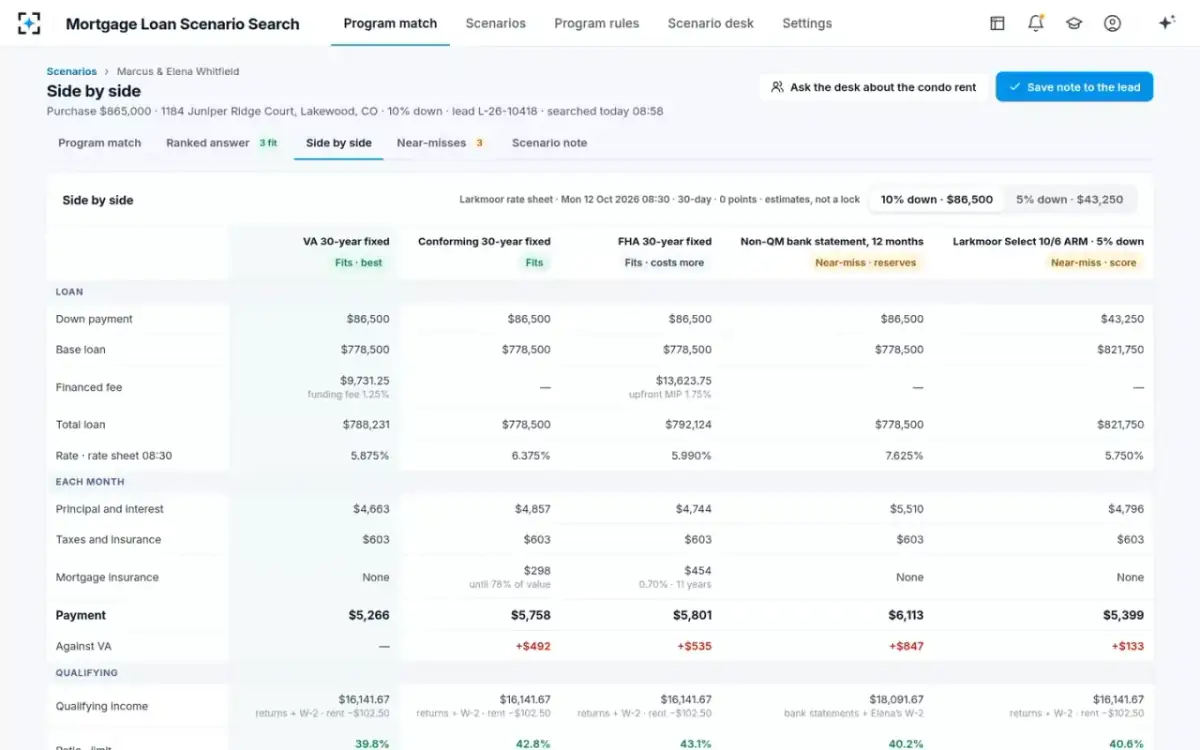
Two further pieces of the design line up with the rule's intent. The near-miss finder only proposes changes the borrower controls, such as paying down a card or bringing more down, and never anything that misstates income or occupancy, which keeps "likely qualifies" honest. And nothing reaches the borrower until the loan officer sends it. How a desk underwriter fits into that flow is covered in the mortgage scenario desk, and what a full first search does for pull-through in the mortgage pull through rate. The solution itself is described at Mortgage Loan Scenario Search.
Questions people ask
Is the anti-steering safe harbor mandatory?
No. The steering ban in 1026.36(e)(1) is mandatory; the safe harbor is an optional way to be deemed compliant with it. An originator that does not meet the safe harbor is not presumed to have violated the rule, but has to show from the circumstances that any loan paying it more was in the borrower's interest.
Does the safe harbor apply to reverse mortgages?
Yes, as its own type of transaction. For a reverse mortgage the second slot is the lowest-rate loan without a prepayment penalty, shared equity or shared appreciation, since negative amortization is inherent in the product.
Can a broker show options from only one lender?
Yes, if that lender's loans meet the three criteria after the broker compared at least three creditors it regularly does business with. The commentary's example accepts three loans from one creditor. The comparison has to be broad; the presentation does not.
What counts as a creditor the originator regularly does business with?
Any creditor with a written agreement governing the originator's submissions, or one that funded an application from the originator in the current or previous calendar month, or twenty-five or more in the previous twelve months. Most wholesale brokers meet the first test with every lender they are approved with.
Does presenting the three options protect a loan officer's pay plan?
No. The safe harbor answers the steering ban only. Pay based on a loan's terms, or on a proxy for them, is prohibited by 1026.36(d)(1) regardless of what was presented, and the CFPB's 2015 Guarantee Mortgage order was about exactly that kind of pay.