A mortgage scenario desk is the underwriter, or small team of underwriters, that loan officers ask whether a borrower's situation will work before anyone takes an application: will two years of Schedule C income count, can a co-borrower's VA entitlement be used, does a condo the borrower keeps sink the ratio. The desk's answer decides which program the borrower hears about first, often by the next morning, and almost nothing about it is kept or checked. Botminds' Mortgage Loan Scenario Search was built for that seat: six agents test the scenario against every program on the lender's shelf in under a minute, answer the questions the guides already answer, and send the desk only the ones the guides leave to judgement, each with a drafted answer and the rule behind it.
The desk exists because the alternative is worse. A loan officer who guesses either quotes a program the borrower will not get, which ends as a denial or a withdrawn file, or does not quote one the borrower would have got, which ends with the borrower at another lender. Both are expensive, and neither shows up in quality control, because quality control reviews loans that closed.
One tricky scenario, by hand and with drafted answers: most of the day is the desk queue
- Reading, income, matrices, pricing, write-up4.5
- Waiting on the desk6
- All1
What is a mortgage scenario desk?
It is a pre-application advice line inside a lender, staffed by underwriters, that answers loan officers' "can we do this?" questions. Names vary: scenario desk, underwriting help desk, credit desk, sales support. The function is the same: an experienced underwriter reads a description of a borrower that does not fit one program's matrix and says which programs it fits, which it might fit with a change, and which it cannot.
The questions are rarely about the easy cases. They are about self-employment under two years, rent from a home the borrower is leaving, a co-borrower with partial VA entitlement, a non-QM exception, a loan amount one step above a limit. Many have a written answer in a guide; some do not, because the guide leaves the call to the underwriter. The desk's value is knowing which is which, and the cost is that every question waits in the same queue whatever its kind.
What does a scenario desk underwriter do?
A scenario desk underwriter answers questions about loans that do not exist yet, without a file, from a loan officer's summary. That makes it different from file underwriting in three ways. The inputs are a paragraph, not documents, so the underwriter has to know which missing detail would change the answer. The answer is advice, not a decision, so it rarely carries the underwriter's name into a system. And the underwriter is usually answering for every program the lender offers, not the one the loan officer typed into the pricing engine.
Four seats around one scenario, and what each keeps when drafts arrive
Today
Reads matrices and runs the pricing engine one product at a time, emails the desk, and waits before calling the borrower back.
With agents
Sees every program at every down payment, with near-misses and their changes, before picking up the phone.
Still theirs: The choice of what to present, and the conversation with the borrower.
Today
Writes down what the borrower said without knowing which details the programs need, so the loan officer calls back for more.
With agents
Types the story as told; the agents underline what they used and ask only what changes an answer.
Still theirs: The first call and the relationship.
Today
Answers by email and chat all day, many questions the guide already answers.
With agents
Gets only the judgement calls, each with the agents’ draft and the guide section, and confirms or corrects.
Still theirs: Every judgement call, under their name and time.
Today
Finds out a borrower was quoted the wrong program when the deal walks.
With agents
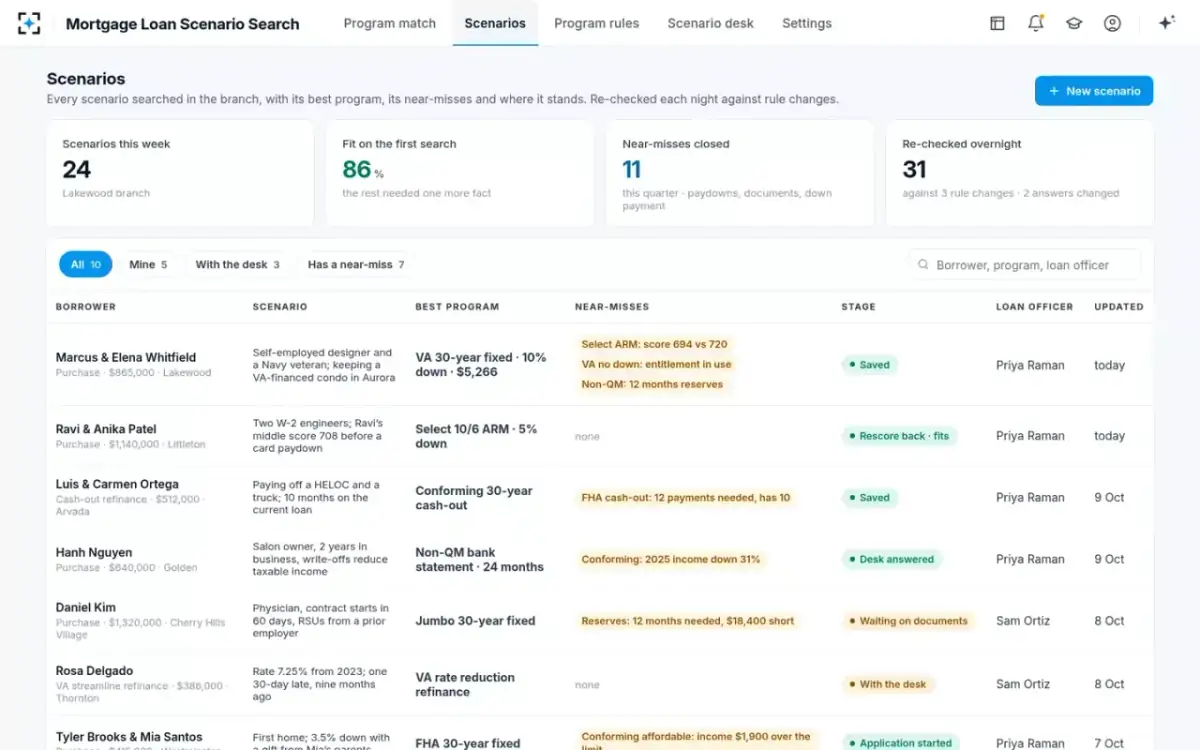
Sees each scenario’s best program, near-misses and stage, re-checked overnight when a rule changes.
Still theirs: Coaching, overlays and staffing.
How long does a scenario desk take to answer?
As long as its queue, which is set by volume, not by the difficulty of the question. No public study measures scenario desk turn times, but the wider evidence on mortgage capacity points the same way. Federal Reserve researchers find that lenders take "on average, 50.8 days to reach a decision" on an application (Horvath and Kay, FEDS 2026-017), and earlier work found that a doubling of application volume raised processing times by 13.5 days at traditional lenders against 7.5 at technology-led lenders, which cut processing time "by about 10 days, or 20% of the average processing time" without higher defaults (Fuster, Plosser, Schnabl and Vickery, NBER 24500).
A desk is the same queue earlier in the process. When rates fall and calls double, the desk's answer moves from the same afternoon to the next morning, and a borrower who is shopping, as about half of purchase borrowers do before they apply, has already heard from someone else. The economics of that lost morning are taken up in the mortgage pull through rate.
How do loan officers check if a borrower qualifies before applying?
Three ways, usually in this order: memory, the pricing engine, the desk. Memory covers the programs the loan officer sells most. The pricing engine covers whatever program is typed into it, one at a time, and returns a price, not a reason. The desk covers the rest. Each step narrows the search, and the narrowing is where borrowers are lost: the program not remembered is never priced, and the one not priced is never asked about.
The cost of a wrong pre-application answer shows up in the application data. In 2025 HMDA data, lenders reported 6,827,891 originated loans against 2,115,090 denied applications, 1,710,723 withdrawn by the applicant and 695,006 files closed for incompleteness (FFIEC HMDA Data Browser, 2025). Not every one is a scenario gone wrong, and many withdrawals are borrowers who changed their minds, but each was a file someone opened, priced and worked.
Applications that ended without a loan, 2025
2.1M
applications denied
1.7M
withdrawn by the applicant
695K
files closed for incompleteness
$11,094
production expense per loan at independent mortgage banks in 2025
That last figure is why pull-through matters to a sales leader. The MBA reports total production expense of $11,094 per loan in 2025 and lists "reduced application pull-through" with wages and third-party charges as what pushed it up (MBA, April 2026). Every application that ends without a loan spreads its cost over the ones that close. A desk that sends a borrower into the right program at the first conversation is one of the few levers on that number that sits before the application.
Who reviews loan scenarios before application, and who audits the answers?
Usually nobody after the fact. Lender quality control is built around closed loans: Fannie Mae requires loans to be "selected for post-closing QC reviews on at least a monthly basis", with the whole cycle finished "within 90 days from the month of the disbursement date" (Selling Guide D1-3-01). A scenario that was answered "no" and walked away never becomes a loan, so it never enters the sample. A scenario answered "yes" that should have been "no" enters it months later as an eligibility or income defect.
FHA's own review data shows where those defects sit. In HUD's reviews of fiscal year 2022 loans, 11.26% had material findings, and borrower income accounted for 22.17% of findings, credit for 19.12% and assets for 15.91% (FHA Quality Assurance Update, January 2023). Those are the same three questions a scenario desk answers first. The desk is, in effect, the earliest underwriting decision on the loan, and the only one with no file behind it.
There is a compliance reason to keep the answers too. A loan originator's protection under the anti-steering rule rests on a good-faith belief about which loans the borrower likely qualifies for, formed from what the originator could reasonably know when the options were presented (Reg Z official interpretations to 1026.36(e)(3)). A desk answer is that belief, written down. The rule's mechanics are covered in the anti-steering safe harbor.
Most desk questions already have a written answer
The desk's queue mixes two kinds of question, and treating them alike is the root of the wait. Some questions have a written answer: the VA residual income table, Fannie Mae's departing-residence rule, the FHA score tiers, the county loan limit. Others are left to judgement by the guide itself: whether self-employment under two years is stable enough, whether a borrower with no landlord history can rely on rent, whether a non-QM exception is acceptable. The first kind can be answered from the text, with the text cited. Only the second needs an underwriter.
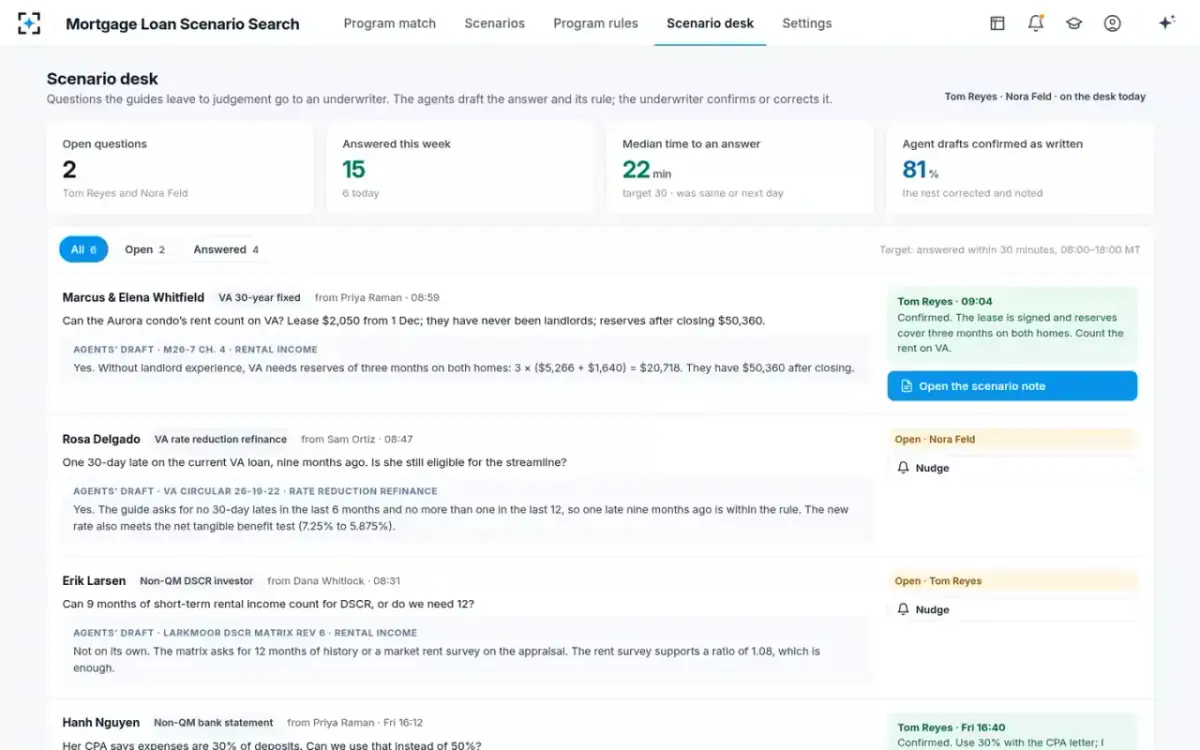
Separating them changes the desk's day more than speeding it up does. Take the sample desk as it runs in the solution: 15 questions answered in a week, a median of 22 minutes to an answer against a 30-minute target, and 81% of the agents' drafted answers confirmed as written, the rest corrected and noted. A desk that sees only judgement calls, each already argued from the rule, is a desk that can keep a 30-minute promise in a busy month.
Mortgage Loan Scenario Search's desk: each question arrives with a drafted answer and its rule
What should scenario desk software do? A buyer's checklist
It should shorten the queue by removing the questions that do not need an underwriter, and make the remaining answers last. A tool that only routes emails into a ticket queue changes where the wait happens, not how long it is. The checklist below is what we would ask of any product, including ours.
What to look for in mortgage scenario desk software
- It tests every program on your shelf, not the one typed in
The loan officer’s question is "what fits", so the answer should cover the whole shelf at more than one down payment.
- It reads your overlays, not only the agency guides
Most "no" answers at a desk are overlays. They should be settings with a history, not memory.
- It cites the rule behind every answer
A guide section, overlay or rate sheet line per finding, so the underwriter checks a citation instead of re-deriving it.
- It routes only judgement calls to an underwriter
With a drafted answer, so the underwriter confirms or corrects in minutes and the correction is kept.
- It asks for missing details instead of assuming them
Occupancy, entitlement and the home being left each flip eligibility; a tool that guesses them is wrong confidently.
- It keeps the answer with the lead
Who asked, what was answered, under which rule version, by whom and when, ready for the application and for any later question.
- It re-checks open scenarios when a rule changes
An overlay raised on the first of the month makes every earlier quote stale until it is re-tested.
- It shows near-misses with honest changes
A card paydown or more down, with cost and time, and never anything that misstates income or occupancy.
Mortgage Loan Scenario Search at the desk: drafts, routing and a kept answer
The solution puts the desk at the end of a search rather than at the start. A loan officer, or an assistant, types the borrower's situation in plain words. The scenario reader underlines what it used and asks at most three questions that change an answer. The income calculator, program matcher, payment and cash estimator and near-miss finder light every program on the shelf at three down payments, each cell green, amber or grey with its rules. Only the rules the lender has marked as judgement, in the sample "rent from a home being left on VA or FHA", "self-employment under two years" and "any non-QM exception", go to the desk, with the draft.
Every scenario in the branch, with what the desk has and where each stands
Two limits are worth stating. The solution does not underwrite the file; the desk's confirmation is advice on a scenario, and the application still goes through the lender's automated and human underwriting. And the routing is only as good as the lender's choice of what counts as judgement: a lender that marks too little sends the agents' drafts straight to borrowers' ears, and one that marks too much rebuilds the queue. The rules of thumb for that setting, and the rest of what a lender supplies, are in the scenario worksheet and what your lender brings. The solution is described at Mortgage Loan Scenario Search.
Questions people ask
Is a scenario desk the same as a pre-approval?
No. A pre-approval follows an application, a credit report and usually an automated underwriting run, and it is a conditional credit decision. A scenario desk answer comes before any of that, from a description, and commits nobody; it tells the loan officer which programs are worth an application.
Do wholesale lenders run scenario desks for brokers?
Some do, as an account-executive or underwriting service, because a broker's question about one borrower is also a question about which lender to send the file to. The answer then shapes not only the program but the creditor, which is where the anti-steering rules for brokers come in.
Should scenario desk answers be kept?
There is no rule naming them, but there are good reasons. Regulation Z asks creditors to keep evidence of compliance for two years, an originator relying on the anti-steering safe harbor needs to show what it believed the borrower qualified for, and a desk answer is the earliest underwriting judgement on the loan.
What questions should go to the scenario desk?
The ones the guide leaves to judgement: stability of short self-employment, rent from a home being left without landlord history, compensating factors, non-QM exceptions. Questions with a written answer, such as a residual income table or a county loan limit, can be answered from the text with the citation, and checked rather than re-derived.
Can a scenario desk answer change after application?
Yes, and it often should. The desk works from what the loan officer reported; the file brings documents, a credit report and an appraisal, any of which can change the answer. That is why a scenario note should say what it assumed, so the underwriter can see which assumption moved.