A lender overlay is a requirement that a mortgage lender, or the investor that buys its loans, adds on top of the agency guideline: a higher minimum credit score than FHA asks for, a lower maximum debt-to-income ratio than Fannie Mae allows, a payment calculation the Selling Guide permits but the investor does not. The agency rule is the floor; the overlay is the rule the loan must actually meet, so the stricter of the two governs. That is why "what's the guideline?" has two answers on most underwriting desks, and why Botminds' Mortgage Guideline Search exists: it answers from the agency guides, the investors' overlays and the lender's own overlays together, cites each sentence, and shows the stricter rule beside the agency rule it overrides.
This guide explains where overlays come from, how the three layers stack, what the agencies themselves say about them, and how one overlay changes one loan. The worked example uses fictional sample data from the solution: a lender called Halsted Ridge Mortgage and the investors it sells to.
One question, two rules: what a lender overlay looks like
The agency rule (the floor): Fannie Mae Selling Guide B3-6-05, Monthly Debt Obligations
The overlay (the rule that governs): An investor bulletin: Northcastle Capital NC-26-19 (fictional)
The agency rule (the floor): 1% of the outstanding balance, or a fully amortizing payment from the documented repayment terms
The overlay (the rule that governs): 1% of the outstanding balance only; the amortizing option is no longer accepted
The agency rule (the floor): Every loan sold to Fannie Mae, in the Guide edition in force
The overlay (the rule that governs): Loans Northcastle buys from 2 November 2026, whatever the lock date
The agency rule (the floor): $684, or $486 if the servicer documents an amortizing payment
The overlay (the rule that governs): $684
What is a lender overlay, exactly?
An overlay is any underwriting or eligibility requirement stricter than the program the loan is delivered under. The program is set by the agency: the Fannie Mae Selling Guide, the Freddie Mac Seller/Servicer Guide, HUD Handbook 4000.1 for FHA, the VA Lenders Handbook and 38 CFR Part 36 for VA, the USDA HB-1-3555 for guaranteed rural loans. Those books say what the agency will buy, insure or guarantee. They do not oblige any lender to lend to every borrower who meets them, and an overlay is the lender's or investor's decision not to.
Overlays come in a few recurring forms. A score floor above the agency's: FHA's Handbook allows maximum financing at a Minimum Decision Credit Score of 580 and 90% LTV between 500 and 579 (HUD Handbook 4000.1, Update 18), and many lenders simply decline below a higher number. A ratio cap below the agency's: Fannie Mae allows up to 50% DTI for loans underwritten in Desktop Underwriter (B3-6-02), and an investor may cap a program at 45%. Acalculation rule that removes an option the guide allows, as in the student loan example above. And documentation or property limits: more months of reserves, fewer financed properties, condominium or manufactured-home restrictions.
An overlay is not a waiver in the other direction. A lender cannot use an overlay to loosen an agency rule: a loan delivered to Fannie Mae must still meet the Selling Guide, and the Selling Guide defines a defect as a deficiency that "breaches a term contained in the Lender Contract in effect at the time of loan delivery" (A2-3.2-01). The overlay can only add.
Lender, investor and credit overlays: three layers on one loan
A single loan can sit under three layers of rules at once, and the words people use for them overlap. The "investor" is whoever buys the loan from the lender that closed it: Fannie Mae or Freddie Mac directly, or a correspondent aggregator that pools loans and delivers them on. A correspondent investor publishes a seller guide, an eligibility matrix and bulletins; its overlays apply to every loan it buys. The lender's own credit policy adds a third layer, approved by its credit committee, which applies to every loan it makes whoever buys it.
Three layers of overlay, and when each one applies
| Layer | Who sets it | Where it is written | What decides whether it applies |
|---|---|---|---|
| Agency guideline | Fannie Mae, Freddie Mac, FHA, VA, USDA | Selling Guide, Seller/Servicer Guide, Handbook 4000.1, VA Lenders Handbook, HB-1-3555 and their announcements, bulletins, mortgagee letters and circulars | The program; the edition in force on the date each change names |
| Investor overlay | The correspondent investor or aggregator buying the loan | The investor’s seller guide, eligibility matrix and bulletins | Which investor the loan is locked or committed to, and the investor’s own date basis: lock, registration, purchase |
| Lender credit overlay | The lender’s credit committee | The lender’s credit policy, version by version | Every loan the lender makes, from the date the committee sets, often the application date |
The date basis is the detail that makes overlays hard to answer from memory. In one sample week in Mortgage Guideline Search, five overlay changes arrived on four different bases: one investor's change applied to loans it purchases from a date, another to locks from a date, a third to registrations, and the lender's own changes to applications taken, or to every loan, from a date. The same rule text can govern one file and not the next because of a date that sits in a different system from the rule.
Why do lenders have overlays?
Lenders overlay because they, not the agency, carry the cost of a loan that turns out not to meet the agency's rules. A loan sold to Fannie Mae or Freddie Mac carries the lender's representations and warranties that it complies with the guide; when it does not, "the Enterprises may require remedies, including issuing a repurchase request" (FHFA, Representation and Warranty Framework). An FHA loan carries the lender's certification; a defect found later can mean an indemnification agreement or worse. A lender that is unsure how a defect will be judged protects itself by staying further from the line.
The regulators have said so directly. FHFA describes the years before its 2012 framework, when the Enterprises "had significant discretion to determine whether or not a loan had underwriting defects", as generating uncertainty that "can contribute to increased credit overlays that affect lending costs and may reduce access to credit" (FHFA). The Federal Reserve's April 2012 survey of senior loan officers asked banks why they were less willing than in 2006 to make a GSE-eligible loan to a borrower with a 620 score and 10% down; the higher risk of putbacks by the GSEs was "listed as the most important one by the largest number of banks" (Federal Reserve SLOOS, May 2012).
Why overlays exist, in the regulators' own words
#1
reason banks gave in 2012 for avoiding GSE-eligible loans at a 620 score: putback risk
Federal Reserve SLOOS
2012
FHFA and the GSEs began rebuilding the rep-and-warrant framework because uncertainty fed overlays
FHFA
36months
of on-time payments that can earn relief from underwriting reps, one of the framework’s first changes
FHFA, effective 1 January 2013
FHA had its own version of the problem. The Urban Institute's Laurie Goodman wrote in 2014 that "the FHA has been taking actions to reduce lender overlays", including supplemental performance metrics to accompany the "inflexible Lender Compare Ratios" by which FHA judged a lender's defaults against its peers (Urban Institute, June 2014). A lender measured on its default rate has a reason to turn away borrowers at the edge of the program, whatever the Handbook allows.
Overlays are also how an investor manages its own exit. An aggregator that will deliver the loan on to Fannie Mae or into a Ginnie Mae pool carries the repurchase risk twice, from its buyer and to its seller, and writes its matrix to keep its pipeline away from the edges that cost it most.
Does Fannie Mae allow lender overlays?
Yes, as long as the lender still meets Fannie Mae's minimums and applies its stricter rule consistently. The Selling Guide says so in its debt-to-income topic: "Fannie Mae acknowledges that lenders may sometimes apply a more conservative approach when qualifying borrowers. This is acceptable as long as Fannie Mae's minimum requirements are met, and lenders consistently apply the same approach to similar loans" (Selling Guide B3-6-02). Its example is a lender that calculates a higher minimum credit card payment than Fannie requires.
The word that matters is consistently. An overlay applied to some borrowers and waived for others is no longer a credit policy; it is a discretion that a fair lending review will ask about. That is one reason a lender should be able to say, for any loan, which overlay version applied and why, and why the exception path inside an overlay (a credit committee approval, for instance) should be written down as part of the overlay itself.
The agencies also move their own floors, which changes what counts as an overlay. Since April 2026 the Selling Guide has said that "a minimum credit score is not required for DU loan casefiles", while manually underwritten loans keep minimums of 620 for fixed-rate and 640 for ARMs (B3-5.1-01, 04/22/2026). A lender that kept its old 620 floor for DU loans now has an overlay it did not write.
How an overlay changes one loan
Take a sample file as it runs through Mortgage Guideline Search. Priya Calder's $68,400 of student loans are in forbearance and show $0 on the credit report. Her loan is conventional, locked with an investor called Northcastle Capital, and expected to be bought the week of 9 November. Her monthly income is $9,860, and her housing payment and other debts come to $3,888.
The Selling Guide gives the underwriter two ways to count the student loans when they are deferred or in forbearance: "a payment equal to 1% of the outstanding student loan balance (even if this amount is lower than the actual fully amortizing payment), or a fully amortizing payment using the documented loan repayment terms" (B3-6-05). Her servicer's letter gives an amortizing payment of $486, so under the agency rule her DTI is 44.4%. Northcastle's bulletin NC-26-19 accepts only the 1% figure for loans it buys from 2 November, which makes the payment $684 and the DTI 46.4%, over Northcastle's 45% cap.
Mortgage Guideline Search: the agency rule and the overlay, side by side
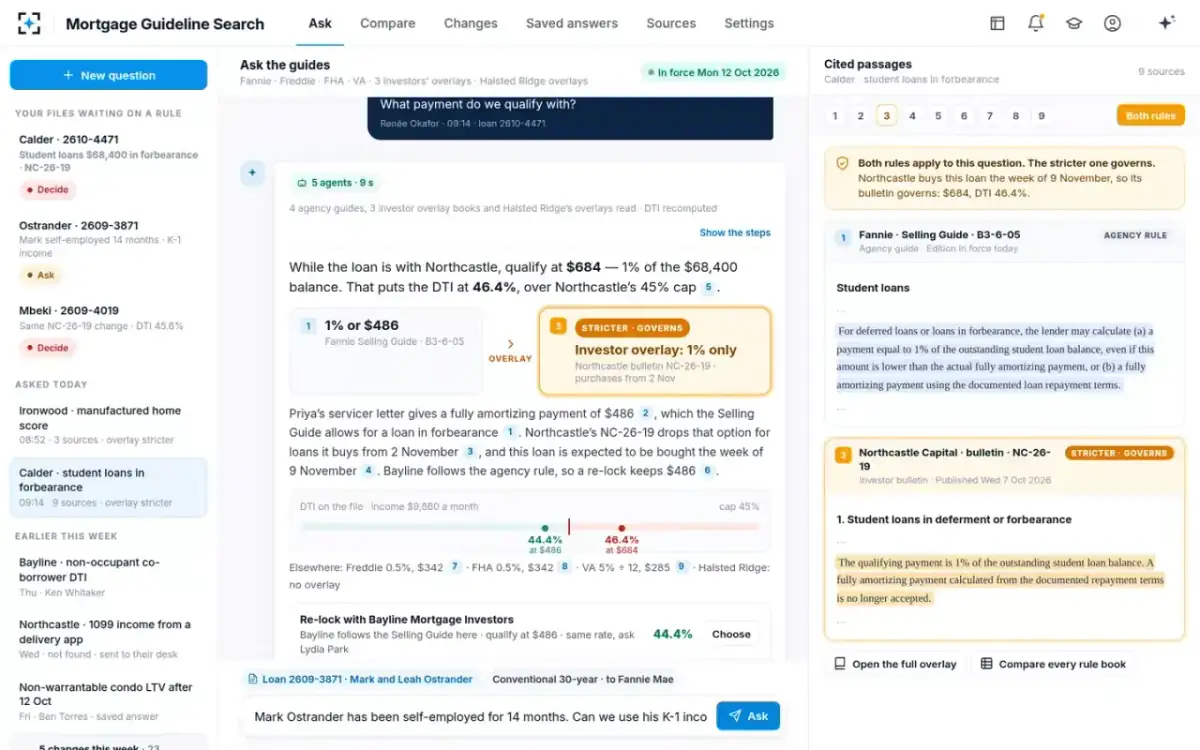
The answer also gives the other rule books on the same question, Freddie Mac 0.5%, FHA 0.5%, VA 5% ÷ 12, and the lender's own: no overlay.
Nothing about the borrower changed between the two answers; only the rule book did. Re-locking with an investor that follows the Selling Guide restores the $486 payment. Paying off a car loan at closing might bring the DTI under 45% at Northcastle. Moving to FHA changes the calculation again. Each of those options is a different set of rules, and an underwriter weighing them needs each rule's arithmetic, not a summary of the agency position.
Calder file: one borrower, four rule books, four DTI ratios
The student loan payment calculation guide works the same file through every agency's rule in detail, including the cases where a $0 income-driven payment can be used and where it cannot.
Are there FHA lenders with no overlays, or VA loans with no overlays?
Some lenders say they lend to the agency minimum with no overlays of their own, and for a borrower at the edge of the program that matters. But "no overlays" describes only the lender's own layer. A lender that sells its FHA or VA loans to an aggregator is still bound by that aggregator's matrix, and a lender that keeps no overlay today can add one by bulletin next month. The question to ask is narrower: which investor will buy this loan, and what does its current matrix say on this point?
It also helps to know where the agency floor actually is, because some "overlays" are folklore. VA's regulation does not stop at 41% DTI: above it a loan "may be approved with justification, by the underwriter's supervisor", and no second-level review is needed when residual income exceeds the guideline by at least 20% (38 CFR 36.4340(c)). FHA's floor is the 580 and 500 score tiers in the Handbook. A desk that refuses every VA loan at 42% DTI is applying its own overlay, whether it calls it one or not.
How do I find a lender's overlays?
Overlays are published to the lenders and brokers who sell to the investor, not to the public. A correspondent lender finds them in each investor's seller guide, its program matrices and the bulletins that amend them; a broker gets them from each wholesale lender's matrix; a lender's own overlays sit in its credit policy. Three practical points make the search manageable.
First, read the bulletins, not only the guide: overlays move by bulletin, and the guide may be updated weeks later. Second, note the date basis written into each bulletin, because "effective for loans purchased on or after" and "effective for locks on or after" put different files under the rule. Third, keep the superseded text: a quality control reviewer looking at a loan underwritten last month will want the overlay as it stood last month, not as it reads today.
That last point is where lookup tools usually stop. Mortgage Guideline Search reads each investor's seller guide, matrix and bulletins from the lender's overlay inbox and keeps every version, so an answer can be read as it stood on the day the file was underwritten. The guide to Selling Guide updates shows how the same version-keeping works for the agency announcements.
The agency rule is the floor. The overlay is the rule the loan must meet. An answer that quotes only the floor is a correct sentence about the wrong loan.
Where an overlay answer goes wrong
Most overlay mistakes are not about reading the rule. They are about matching the right rule to the file: the wrong investor (the loan was re-locked), the wrong date (the bulletin applies to purchases, and this one will be bought next week), the wrong version (the overlay changed after the training note was written), or a looser agency sentence quoted as if it decided the file. Each is the kind of error that surfaces late, as a suspense condition, a QC finding or a loan an investor will not buy.
A good overlay answer therefore states more than the rule. In Mortgage Guideline Search, the overlay checker finds every overlay on the question in the investor's guide, matrix and bulletins and in the lender's own policy, decides which applies from its date basis, and never lets a looser agency rule override a stricter overlay; when the overlay governs, both rules are shown. The guide to mortgage guidelines AI follows that one agent step by step.
What a complete overlay answer states
- The agency rule, with section and edition
For example Selling Guide B3-6-05 in the 08/05/2026 edition, and the announcement that set its effective date.
- Every overlay on the question
The investor’s guide, matrix or bulletin, and the lender’s own credit policy, each with its version.
- Which rule governs, and why
The stricter rule, and the date basis (lock, registration, application or purchase) that puts this file under it.
- What it does to this file
The qualifying payment, ratio or score under each rule, against the investor’s cap.
- The options, and who decides
Re-lock, restructure, change program or request an exception; the underwriter or credit committee chooses.
- "Not found" when nothing covers it
A search that finds no passage should say so and route the question to the investor’s scenario desk, not guess.
Questions people ask
What is an overlay in mortgage lending?
It is a requirement stricter than the agency program the loan is sold or insured under, set by the lender or by the investor buying the loan. Fannie Mae's Selling Guide accepts "a more conservative approach" as long as its minimums are met and the lender applies it consistently to similar loans.
What are investor overlays?
Investor overlays are the stricter rules a loan buyer, such as a correspondent aggregator, publishes in its seller guide, matrix and bulletins. They apply to every loan that investor buys, so re-locking a loan with a different investor can change which rules it must meet without changing anything about the borrower.
Is a lender overlay the same as a credit overlay?
The terms are used loosely. "Credit overlay" usually means a stricter credit requirement, such as a higher score floor or lower DTI cap; FHFA uses the phrase when it says uncertainty about repurchases "can contribute to increased credit overlays". A lender overlay is any such rule set by the lender itself rather than its investor.
Do overlays have effective dates?
Yes, and they differ in what they count from. An investor bulletin may apply to loans locked, registered or purchased from a date, and a lender's own overlay often to applications taken from a date. The date basis decides which files the new rule reaches, so it matters as much as the rule text.
Can an overlay make a loan ineligible that the agency would buy?
Yes. In the sample Calder file, the Selling Guide allows a $486 payment and a 44.4% DTI, but the investor's bulletin requires $684, which puts the DTI at 46.4% and over its 45% cap. The loan still meets Fannie Mae's rules; it no longer meets the investor's, so it needs a different investor or a different structure.
Why would a lender keep an overlay after the agency relaxes a rule?
Often it does not decide to: the overlay was the old agency rule, and nobody removed it. When the Selling Guide dropped the minimum credit score for DU loan casefiles in April 2026, any lender still applying 620 to DU loans acquired an overlay by standing still, which is why policy teams review their overlays against each agency change.