Mortgage guidelines AI is software that answers underwriting and eligibility questions in plain words from the rule books themselves: the Fannie Mae Selling Guide, the Freddie Mac Seller/Servicer Guide, HUD Handbook 4000.1, the VA Lenders Handbook, and, if it is any use to a lender, the investors' overlays and the lender's own credit policy. The hard part is not producing a fluent answer. It is choosing the right rule for this loan, from the version in force on the date that decides it, showing the passage behind every sentence, and saying "not found" when nothing covers the question. Botminds' Mortgage Guideline Search does that with six agents, each with one job and written limits; this guide follows the one that most often changes the answer, the overlay checker.
Mortgage Guideline Search: six agents, each with a limit
Agent
Question readerReads the question and the loan: program, occupancy, investor lock, expected purchase date, income and debts.
Never: Guesses the program or investor; it asks.
Agent
Guide searcherSearches the agency guides, mortgagee letters and circulars in the version in force on the deciding date.
Never: Answers from memory or the open web.
Agent
Overlay checkerFinds every overlay on the topic in the investor’s guide, matrix and bulletins and the lender’s policy, and decides which applies.
Never: Lets a looser agency rule override a stricter overlay.
Agent
File impact calculatorRecomputes the payment and the DTI, LTV or score test under each rule that applies, against the investor’s caps.
Never: Changes the loan file or the AUS submission.
Agent
Answer writerWrites the short answer, the reasoning with every sentence cited, and the options for the file.
Never: Writes a sentence without a passage behind it.
A person decides
UnderwriterChooses the option, edits and signs the note, asks secondary for a re-lock; exceptions go to the credit committee.
Is there AI for mortgage guidelines, and what kinds?
There are three kinds of tool a lender will meet, and they differ in what they read. The agencies' own assistants answer from their own books: Fannie Mae's Selling Guide pages invite readers to "get answers to your policy and guide questions, straight from the source" through its Ask Poli tool, and HUD answers FHA questions through the FHA Resource Center. General-purpose chat assistants answer from what their model learned in training, sometimes supplemented by a web search. And guideline search built for a lender reads the lender's own set of rule books, including the overlays nobody publishes.
The agency assistants are authoritative for their own guide and silent on everything else, and even the two enterprises' guides differ on details that decide loans, as the comparison of Fannie Mae and Freddie Mac guidelines shows. General chat is the riskiest for this work, for a reason specific to mortgage rules: they change faster than models are retrained. In 2026 Fannie Mae issued nine Selling Guide announcements by October, and 91 of the Guide's 410 topics carry a 2026 date (Selling Guide). A model that learned the Guide last year has learned a version that no loan delivered this month is judged by.
Two ways to put AI on a guideline question
A general chat assistant: What it learned in training, sometimes a web search
Guideline search over your rule books: The agency guides, announcements, bulletins and letters, your investors’ overlays and your own credit policy
A general chat assistant: Whatever it saw last; no notion of an effective date
Guideline search over your rule books: The version in force on the date that decides the loan: purchase, lock, registration or application
A general chat assistant: Cannot know them: investor overlays are not public
Guideline search over your rule books: Reads them from the investor’s seller guide, matrix and bulletins as they arrive
A general chat assistant: Only what is typed into the chat
Guideline search over your rule books: The file: program, investor, dates, income and debts, read but never changed
A general chat assistant: Usually still answers
Guideline search over your rule books: Says “not found” and drafts the question to the investor’s scenario desk
A general chat assistant: A transcript, if anyone kept it
Guideline search over your rule books: Each answer as it read on the day, with every passage it cited
Can AI answer Fannie Mae guideline questions correctly?
It can, if it reads the current Guide and understands how the Guide dates itself. Three features of the Selling Guide catch software that treats it as a flat document. The date beside each topic is the date of the last announcement that amended it, and the preface tells lenders to "refer to the individual Selling Guide announcement to determine the policy effective date" (preface). Lender letters and notices bind the lender too, though they sit outside the topics. And topic numbers move as the Guide is reorganised, so an answer that cites a number alone can end up citing a different rule.
A correct Fannie Mae answer can still be the wrong answer for the loan. The Selling Guide expressly accepts stricter lender practice, as long as Fannie Mae's minimums are met and "lenders consistently apply the same approach to similar loans" (B3-6-02). Every lender that sells through a correspondent investor lives under someone's stricter approach. That is the overlay checker's territory.
Does AI know lender overlays? Inside the overlay checker
Only if it is given them and taught what to do with them. Investor overlays live in each investor's seller guide, eligibility matrix and bulletins, sent to the lenders that sell to that investor; the lender's own overlays live in its credit policy. In Mortgage Guideline Search the overlay checker reads both, for every investor the lender holds a correspondent agreement with, from the overlay inbox where bulletins arrive.
Take a sample question as it runs through the solution. An underwriter asks which payment to use for Priya Calder's $68,400 of student loans, in forbearance and reported at $0. The guide searcher has already found the agency passages: Selling Guide B3-6-05 allows 1% of the balance or a fully amortizing payment from the documented terms (B3-6-05). The overlay checker now works through four tests.
The overlay checker's four tests, on the Calder question
| Test | What it asks | On the Calder file |
|---|---|---|
| 1. Which investor | Who will buy this loan? Read the lock, not the borrower’s preference. | Locked with Northcastle Capital; purchase expected the week of 9 November |
| 2. Which overlays touch the topic | Every passage on the topic in that investor’s guide, matrix and bulletins, and in the lender’s own policy. | Northcastle bulletin NC-26-19 on student loans; Northcastle matrix 4.02, 45% maximum DTI; the lender’s own policy has no overlay on this point |
| 3. Does the overlay reach this loan | What date does the overlay count from, and where does the loan’s own date fall? | NC-26-19 applies to loans Northcastle buys from 2 November; this one will be bought after that |
| 4. Which rule governs | Is the overlay stricter? If so it governs, and both rules are shown. | 1% only is stricter than “1% or amortizing”: the overlay governs, $684 instead of $486 |
The third test is the one people miss. An overlay's text says what the rule is; its date basis says which loans it reaches, and that basis varies by investor: purchases from a date, locks from a date, registrations, applications. A loan locked before an overlay was published can still fall under it if the overlay counts from purchase. Only an agent that reads the loan's dates alongside the bulletin can get that right without a phone call.
How the answer was found: each agent's step, timed
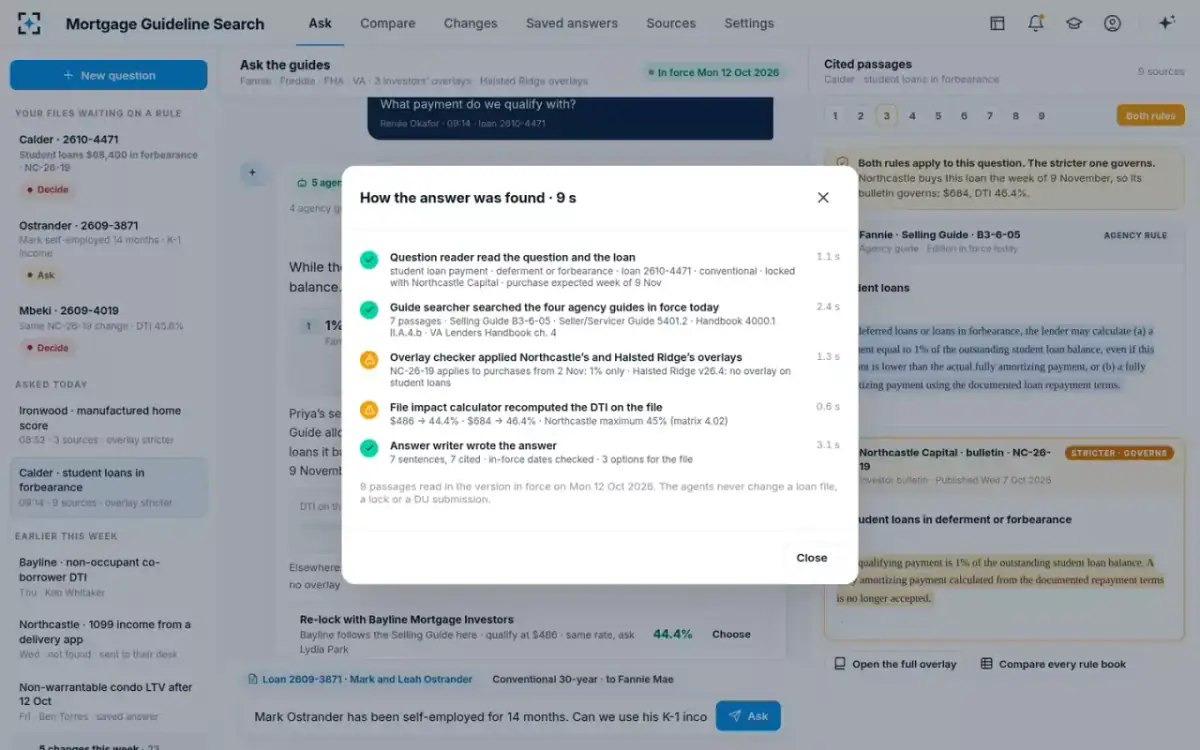
What is a cited answer, and how does AI cite mortgage guidelines?
A cited answer is one in which every sentence carries the passage it stands on: the rule book, the section, the version, and the date that version was in force. In Mortgage Guideline Search a sentence without a passage behind it is cut before the answer is shown, and both "cite every sentence" and "say 'not found'" are settings that cannot be turned off. Clicking a citation opens the section in that edition with the governing sentence highlighted.
The test of a citation is whether a reviewer who was not there can rebuild the answer from it. "Per Fannie Mae guidelines" fails. "Selling Guide B3-6-05, edition in force 12 October 2026, Student Loans, deferred loans or loans in forbearance" passes. In the sample Calder answer, seven sentences carry seven citations across nine sources, and the answer arrived in nine seconds. A nine-second median from question to cited answer is the design target, to be measured on the live solution, not a measured result.
One cited answer in Mortgage Guideline Search, by the numbers
7 of 7
sentences in the Calder answer cite the guide or overlay section they stand on
9
sources behind the answer: four agency rule books, the investor’s bulletin and matrix, the servicer letter and more
9s
from question to cited answer on the sample file; a 9-second median is the design target
How accurate is AI for underwriting guidelines?
No regulator or independent body has published an accuracy benchmark for AI guideline answers, so a lender has to measure it on its own questions. The useful measure is not "how often does it sound right" but how often each part of the answer survives a reviewer: the rule book chosen, the version, the overlay, the arithmetic, and the decision to answer at all. A tool that is right about Fannie Mae and wrong about the investor is wrong.
The best test set already exists inside the lender: questions underwriters have asked the policy desk, saved answers the training lead maintains, and QC findings that began with "underwriter applied the wrong guideline". Each has a known right answer for a known date. The four-week trial case study shows one way to run that evaluation, with the scoring a credit policy team can defend.
Measuring a guideline AI on your own questions
- Score each sentence, not the answer
Does the cited passage say what the sentence says, in the version in force on the loan’s date?
- Score the rule book chosen
Was the governing rule the investor’s or the lender’s overlay where one applies, and were both shown?
- Score the arithmetic on the file
Payment, ratio and cap, recomputed by the reviewer.
- Score the refusals
Questions no passage covers should produce “not found”; count the confident answers to them as errors.
- Re-run after an update
Ask the same questions after the next announcement or bulletin; answers citing replaced text should change.
What does Freddie Mac require for AI used in origination?
Freddie Mac has written AI governance into its Seller/Servicer Guide. Section 1302.8, effective 3 March 2026, applies to sellers that use "artificial intelligence and/or machine learning" in connection with the origination of loans sold to Freddie Mac (Freddie Mac Guide 1302.8). Use is conditioned on written policies approved by senior management, including the CIO, CTO, chief information security officer or chief risk officer, with an owner who reviews them "at least annually", and on prompt disclosure, on Freddie Mac's request, of the types of AI used, their purpose and the safeguards. The seller also agrees to indemnify Freddie Mac against losses "arising directly or indirectly out of or relating to its use of AI/ML".
The governance part asks for more than a policy document: assessing AI for threats "such as data poisoning and adversarial inputs", regular internal and external audits, monitoring AI systems "for performance, security breaches and biases", and segregation of duties with documented roles. The Enterprises' own regulator frames the stakes the same way: AI "can also expose the Enterprises to financial, compliance, reputational, model, and other risks" (FHFA Advisory Bulletin 2022-02, revised May 2025).
Freddie Mac 1302.8 duties, and what a guideline tool must give you to meet them
| What 1302.8 asks of the seller | What the guideline tool should provide |
|---|---|
| Disclose the types of AI used, purpose and safeguards, on request | A plain description of each agent, what it reads and what it may not do |
| Monitor AI systems for performance, security breaches and biases | Every question, answer and approval on an audit trail, with the passages cited, so performance can be sampled |
| Regular internal and external audits | Answers that can be read as they stood on the day, for any file, by an auditor who was not there |
| Segregation of duties; clear roles for managing AI risk | Agents that never change a loan, lock or AUS submission; people who decide, approve saved answers and own exceptions |
| Assess for threats such as data poisoning and adversarial inputs | Answers drawn only from named rule books in known versions, never from the open web |
What should I ask a mortgage guidelines AI vendor?
Ask for a demonstration on your rule books, not theirs: two of your investors' current matrices and last month's bulletins, your credit policy, and ten questions from your policy desk with known answers. Then ask the questions below. Mortgage Guideline Search is built to answer each of them on the screen; the guide to lender overlays explains why the overlay questions come first.
Questions for any mortgage guidelines AI
- Which rule books does it read, and how does a new bulletin get in?
Agency guides and letters, each investor’s guide, matrix and bulletins, your own overlays; and how fast after arrival.
- How does it decide which version applies to a loan?
Which date in the file it uses (purchase, lock, registration, application) and whether you can set it.
- What happens when an overlay is stricter?
Does it show both rules and say which governs, or quietly answer one?
- Can every sentence be traced to a passage?
Open a citation: is it the section in the edition that applied, with the sentence highlighted?
- What does it do when nothing covers the question?
A “not found” that routes the question to the investor’s scenario desk beats a fluent guess.
- What can it change?
It should read the loan file, never change it, the lock or the AUS submission.
- What will it show your auditors and Freddie Mac?
Agent descriptions, the audit trail, and answers as they read on the day.
Where Mortgage Guideline Search fits, and where it does not
It fits where a lender's guideline questions cross rule books: a correspondent or multi-channel lender that sells to both enterprises and to aggregators, makes FHA and VA loans, and keeps its own credit overlays. That is where an answer from one agency's tool is incomplete, where the date basis of an overlay changes the answer, and where a weekly change memo reaches every desk and changes nothing on most of them. The solution answers in the Ask screen, compares one topic across every rule book the lender delivers to, maps each week's changes to the files they touch, and keeps saved answers the policy lead approves.
Where it does not fit matters as much. It does not make the credit decision, run the automated underwriting system, price loans or shop a scenario across investors. It needs your investors' overlays delivered to it, and it is only as current as the bulletins it receives. A lender that sells only to Fannie Mae, with no overlays of its own, may find Fannie Mae's own tools answer most of its questions. The underwriter still decides, and exceptions still go to the credit committee.
The rules the agents work under, set by the desk
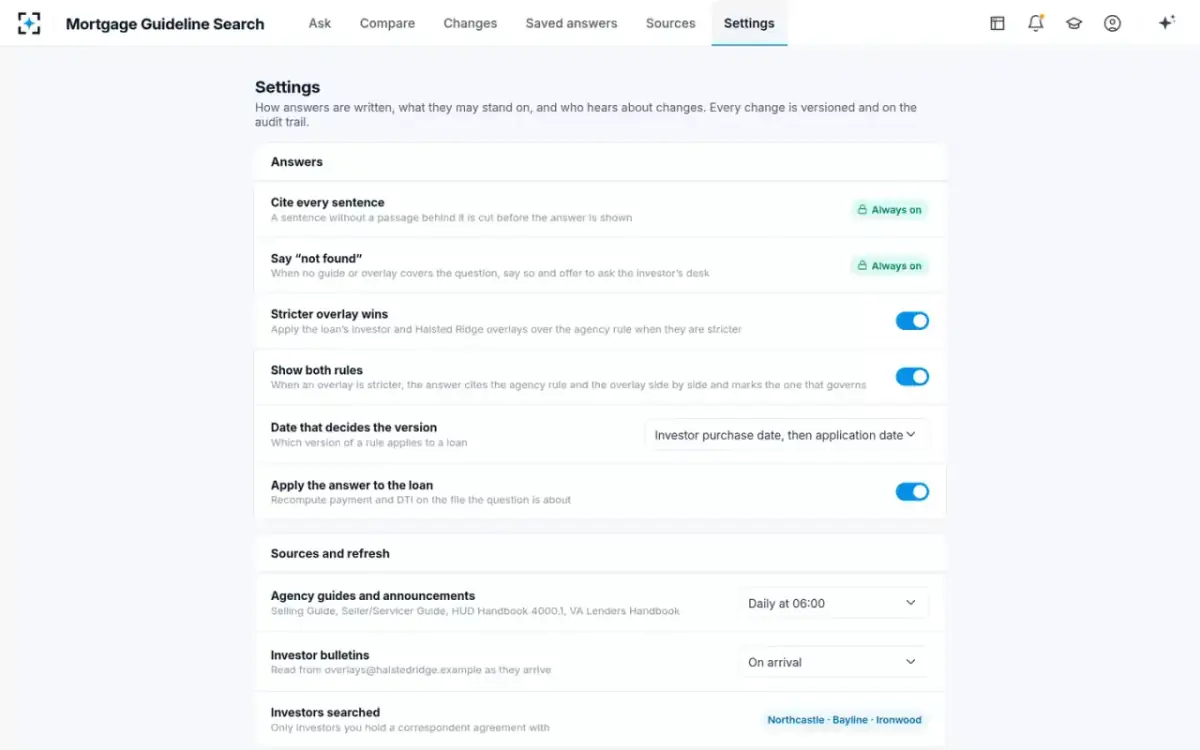
Questions people ask
Can ChatGPT answer mortgage guideline questions?
A general chat assistant can explain how a rule usually works, but it answers from what it learned in training, has no notion of which version is in force for a loan, and cannot know investor overlays, which are not public. For an answer an underwriter can rely on, the tool has to read the current rule books and cite them.
Will AI make the underwriting decision?
Not in Mortgage Guideline Search: the agents read the loan file but never change it, the lock or the AUS submission. They lay out the options with each one's arithmetic; the underwriter chooses, signs the note, and sends exceptions to the credit committee.
Does Freddie Mac allow AI in origination?
Yes, on conditions. Seller/Servicer Guide section 1302.8, effective 3 March 2026, requires approved AI policies with an owner who reviews them at least annually, disclosure of AI use on request, a governance framework with audits and monitoring, and an indemnity to Freddie Mac for losses arising from the seller's use of AI.
What should a guideline AI do when no rule covers the question?
Say so. In the sample, a question about 1099 income paid through a delivery app found no passage in the investor's seller guide, matrix or 41 bulletins, so the answer said "not found", gave the nearest section and drafted the question to the investor's scenario desk.
How quickly does an AI guideline answer arrive?
In the solution's sample, the Calder student loan answer took 9 seconds with five agents and nine sources, and a manufactured-home score question 6 seconds. A 9-second median is the design target, to be measured on the live solution rather than claimed from the sample.