A searchable FHA handbook exists: HUD publishes Handbook 4000.1 as a linked PDF that any reader can search, and previous versions in its archives. What a search box cannot do is decide which of the passages it finds governs a particular loan, on a particular date, under a particular investor's overlay. This case study follows a fictional policy and training lead through a four-week evaluation of the two approaches: searching the handbook, and asking Botminds' Mortgage Guideline Search, which answers in plain words with every sentence cited to the version in force and works the rule through to the file. The lender, the people and the loans are fictional sample data from the solution; the handbook, the rules and the dates are real.
What an FHA handbook search is up against
1,872pages
in Handbook 4000.1 as updated on 12 August 2026
3
separate Student Loans sections in it: TOTAL, manual underwriting and HECM
11
mortgagee letters numbered in 2026 by October, some not yet in the Handbook
Is there a searchable FHA handbook?
Yes. HUD offers Handbook 4000.1 as "a linear format similar to traditional FHA Handbooks, but with enhanced links, format, and structure", says "all previous versions are available on the HUD Archives website", and publishes a redline of each update (HUD, Handbook 4000.1 page). The Handbook's own quick guide helps a searcher: effective dates sit in parentheses at the fourth heading level, the latest changes are highlighted in yellow, and capitalised terms are defined in the glossary (Update 18, User Quick Guide). For questions the text does not settle, HUD's FHA Resource Center answers by email and phone.
So the question for a lender is not whether the Handbook can be searched. It is whether searching it, by an underwriter, mid-file, is the right way to get an answer that will stand up later. That is what the trial set out to test.
How do underwriters look up guidelines today?
Mostly from memory, then from a colleague, then from the book. An experienced underwriter knows the Selling Guide and the Handbook well enough to answer most questions without opening either; what she cannot know from memory is whether a rule changed last week, or whether the investor this loan is locked with publishes something stricter. So the hard questions travel: a loan officer waits on the underwriting desk, the desk asks the senior underwriter or the policy lead, and the policy lead searches the guide, the investor's matrix and the bulletins since.
The pace of change makes that harder each year. FHA alone has two Handbook editions in play in 2026, the August update optional until 10 November, and eleven numbered mortgagee letters by October; a lender that also sells conventional loans reads Fannie Mae's monthly announcements and Freddie Mac's bulletins on top. The policy lead's weekly update is the usual answer to that, and it shares the cheat sheet's problem: it says what changed, but not which files, and it keeps circulating after the next change.
The four-week trial at a fictional lender
- Week 1: the questions21–25 Sep
- Week 2: search the handbook28 Sep–2 Oct
- Week 3: cited answers5–9 Oct
- Week 4: live files, decision12–16 Oct
Week 1: how do you search HUD 4000.1 for a real question?
Hannah Lindqvist, Halsted Ridge's policy and training lead, starts with the questions rather than the tools. For a week she collects every guideline question that reaches her desk or the underwriting manager's, Doug Feldman's, and sorts them. A few are pure Handbook look-ups: what is the minimum decision credit score for 96.5% financing, how old can a pay stub be at disbursement. Most are not. They mix an FHA rule with a conventional one ("should this file go FHA instead?"), an investor's overlay ("does our FHA investor follow the Handbook on this?"), a date ("this was locked before the update"), or the file itself ("what does that do to her DTI?").
She tries the obvious method on one of them: open the PDF and search for "student loan". The phrase appears 44 times in the Update 18 text, and the hits lead to three separate Student Loans sections, one for loans scored through TOTAL, one for manual underwriting and one in the HECM financial assessment. The TOTAL section reads: use the reported or documented payment when it is above zero, or "0.5 percent of the outstanding loan balance, when the monthly payment reported on the Borrower's credit report is zero" (II.A.4.b.iv(H)). The search worked. It also left her to know which section applied, whether the text had changed since the file was started, and whether the investor buying the loan had a stricter rule.
Week 2: what a search box finds, and what it leaves to the underwriter
In the second week she runs the collected questions through the Handbook search and through the agencies' own answer channels, and scores each answer on five things a QC reviewer would later ask. The pattern is clear by Wednesday. Search is excellent at the first thing, finding the passage, provided the reader knows the Handbook's vocabulary. It does nothing for the other four. The Handbook does not know the loan's case number date, so it cannot say whether a September change applies; it does not contain investor overlays; and it cannot recompute a ratio.
Two of the week's questions show the gap. The first is the timing of Update 18 itself: most of its changes "may be implemented immediately, but must be implemented no later than November 10, 2026" (Update 18 transmittal), so for a file in process during the trial, either text could be right depending on when the lender adopted the update. The second is a mortgagee letter: ML 2026-11, on the methodology for the minimum decision credit score with alternative credit scores, was issued after the update and is not among the letters it superseded, so a search of the Handbook alone does not reach it (HUD Mortgagee Letters).
Week 2 and week 3 scorecard: what each approach delivered
| What QC will ask | Searching the Handbook PDF | Agency answer channels | Mortgage Guideline Search |
|---|---|---|---|
| Which passage? | Found, if the searcher knows the terms | Answered for that agency’s own book | Found, cited sentence by sentence |
| Which version, for this loan? | Left to the reader: section dates and redlines | Usually the current text | The version in force on the date the lender sets, with in-force dates shown |
| Any overlay? | Not in the Handbook | Not covered | Investor and lender overlays read; both rules shown when one is stricter |
| What does it do to the file? | Arithmetic by hand | Not covered | Payment and ratio recomputed under each rule, against the cap |
| When nothing covers it? | No result, or the wrong one | A human reply, in time | “Not found”, with the question drafted to the investor’s desk |
Week 3: the same questions as cited answers
In the third week the vendor loads the agency guides, the lender's three correspondent investors' seller guides and bulletins, and Halsted Ridge's own credit overlays, and Hannah asks the same questions again in Mortgage Guideline Search. She is not checking whether the answers sound right. She opens every citation, checks that it is the section the answer claims and in the edition that applied, and recomputes the arithmetic.
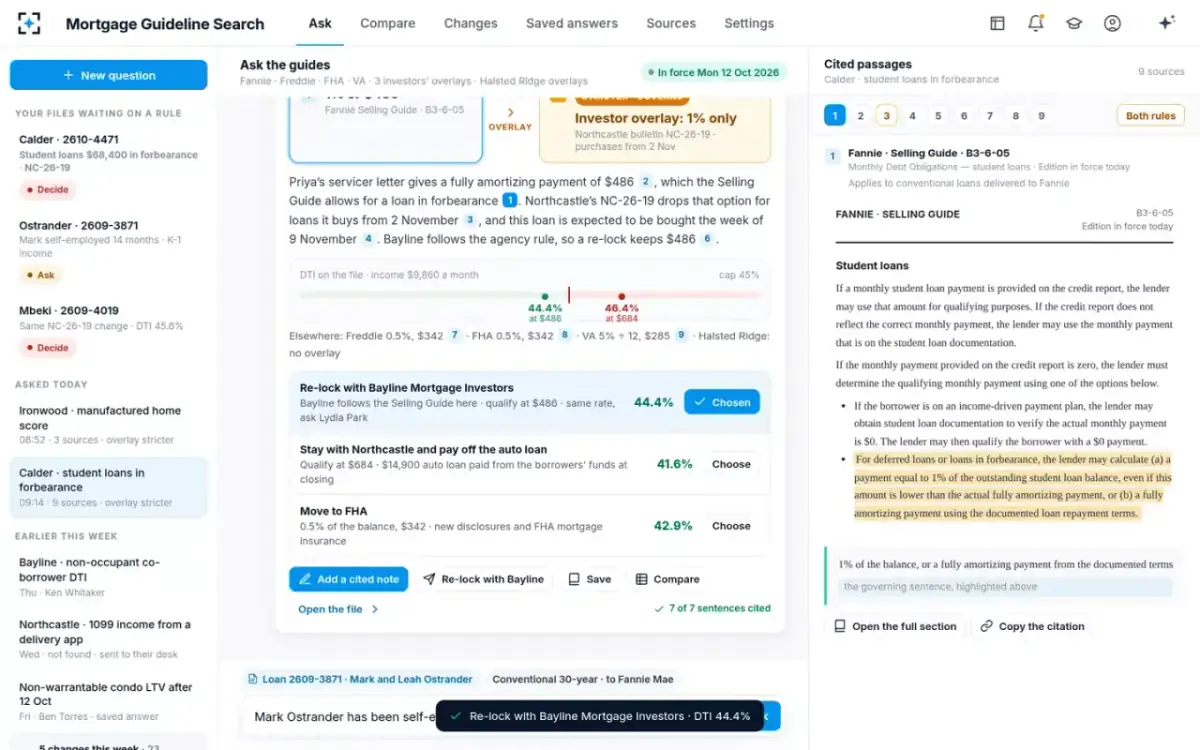
Mid-week the trial gets a live test it did not plan. On Wednesday 7 October one of the investors, Northcastle Capital, publishes bulletin NC-26-19: for loans it buys from 2 November, student loans in deferment or forbearance count at 1% of the balance only, removing the Selling Guide's option of a documented amortizing payment (B3-6-05). The solution's change watcher reads it on arrival, compares it with the text before, and lists the 14 files in the pipeline it touches, three of them now over Northcastle's 45% cap, along with two saved answers and a checklist line that cite the old text. Hannah's weekly update email, she notes, would have reached every desk and named none of the files.
One question is answered with nothing at all, which she counts as a pass: whether 1099 income paid through a delivery app counts for Northcastle. No passage in the investor's seller guide, matrix or 41 bulletins covers it, so the answer says "not found", gives the nearest section, and drafts the question to Northcastle's scenario desk.
Week 4: options for a real file, each with its rule and its DTI
Week 4: live files, and the decision
The last week runs on live questions. On Monday 12 October Renée Okafor, a senior underwriter, asks what payment to use for Priya Calder's $68,400 of student loans in forbearance on a loan locked with Northcastle. The answer comes back in nine seconds with seven sentences, all cited: $684 under Northcastle's bulletin, a 46.4% DTI over its 45% cap, against $486 and 44.4% under the Selling Guide. Below it, three options, one of them FHA at 0.5% of the balance, $342 and 42.9%, priced from the Handbook section Hannah had found by search two weeks earlier. Renée re-locks with an investor that follows the Selling Guide and adds the cited note to the file.
On Friday Hannah writes her recommendation for Doug and the credit committee. Keep the Handbook PDF and HUD's Resource Center: they are the authority, and the solution cites them rather than replacing them. Keep the agencies' own channels for interpretive questions. Add Mortgage Guideline Search for the questions that cross rule books, for change tracking to the file, and for saved answers, on three conditions: she approves every saved answer and every edit to one; the agents never change a loan file, a lock or an AUS submission; and the nine-second median, which the vendor calls a design target, is measured on Halsted Ridge's own questions in the first month.
Search answered "where does it say that?". The underwriters were asking "what do I do with this loan?". Only one of those questions ends up in a QC finding.
What the trial changed in the policy team's week
The biggest difference Hannah records is not in answering questions but in handling changes. For one investor bulletin like NC-26-19, the work runs from reading it against the old text to telling every affected desk. By hand, on Botminds' own estimate, that is about nine working days spread across the team; with the solution doing the reading, matching and recomputing, and people still reviewing every file and approving every saved answer, about a day and a half. The estimate is ours, not a measurement, and it covers one bulletin of the five changes in the sample week.
One investor bulletin, handled by hand and with Mortgage Guideline Search (estimate)
How should a policy team evaluate guideline tools?
Evaluate them on your questions and your rule books, scored the way a reviewer will later score the file. A vendor's demonstration on its own sample questions shows fluency; a trial on your last month's questions shows whether the tool handles your investors, your overlays and the dates that put your loans under one text or another. The guide to mortgage guidelines AI lists the questions to put to any vendor, and the guide to FHA guidelines in 2026 explains the Handbook's versions the trial had to handle.
Three design choices in a trial matter more than the tool. Use questions with known answers for known dates, from the policy desk's inbox, saved answers and past QC findings. Include questions that no passage covers, and count a confident answer to them as a failure. And run the trial across at least one update, an announcement, a bulletin or a mortgagee letter, because a tool that is right today and silent about what changed tomorrow fails the test that matters.
What should a guideline tool trial measure?
Measures for a guideline tool trial
- Citation accuracy, sentence by sentence
Does each cited passage say what the sentence says, in the edition that applied to the loan?
- Rule choice
On questions with an investor or lender overlay, was the governing rule chosen and were both shown?
- Arithmetic on the file
Payments and ratios recomputed by the reviewer, against the right cap.
- “Not found” rate on uncovered questions
Questions with no governing passage should be refused and routed, not answered.
- Change handling
After a real update in the trial window, were the right files and saved answers identified?
- Time to a usable answer
Measured on your questions; a vendor’s target is not a result.
- Control
Who approves saved answers, what the tool can change, and what the audit trail shows.
The same measures apply beyond FHA. A lender that also makes VA loans reads VA's circulars, three of them issued or changed in 2026 by September (VA), alongside the VA Lenders Handbook, and the trial should include their questions too.
Questions people ask
How long is the FHA handbook?
The Update 18 edition of HUD Handbook 4000.1, issued on 12 August 2026, runs to 1,872 pages. HUD describes it as a consolidation of hundreds of former handbooks, mortgagee letters and housing notices into one source.
Is there an online version of the FHA handbook?
HUD publishes the current Handbook 4000.1 as a linked PDF on its website, with a redline of the latest update, and keeps previous versions on its archives website. Policy questions go to the FHA Resource Center at answers@hud.gov or (800) CALL-FHA.
Can I search FHA and VA guidelines in one place?
Not on the agencies' own sites: HUD publishes Handbook 4000.1 and its mortgagee letters, and VA its Lenders Handbook and circulars, separately. Mortgage Guideline Search reads both, with the Fannie Mae and Freddie Mac guides, the USDA handbook and the lender's overlays, and answers across them with each source cited.
Does a guideline search tool replace the FHA handbook?
No. The Handbook and the mortgagee letters remain the authority, and a cited answer is only as good as the passage it cites. In the trial the lender kept the Handbook and HUD's Resource Center and added cited answers on top.
How long should a guideline tool trial run?
Long enough to include at least one real update. The fictional trial here ran four weeks and caught an investor bulletin in week three, which tested whether the tool found the affected files rather than only the new text.